Table of contents
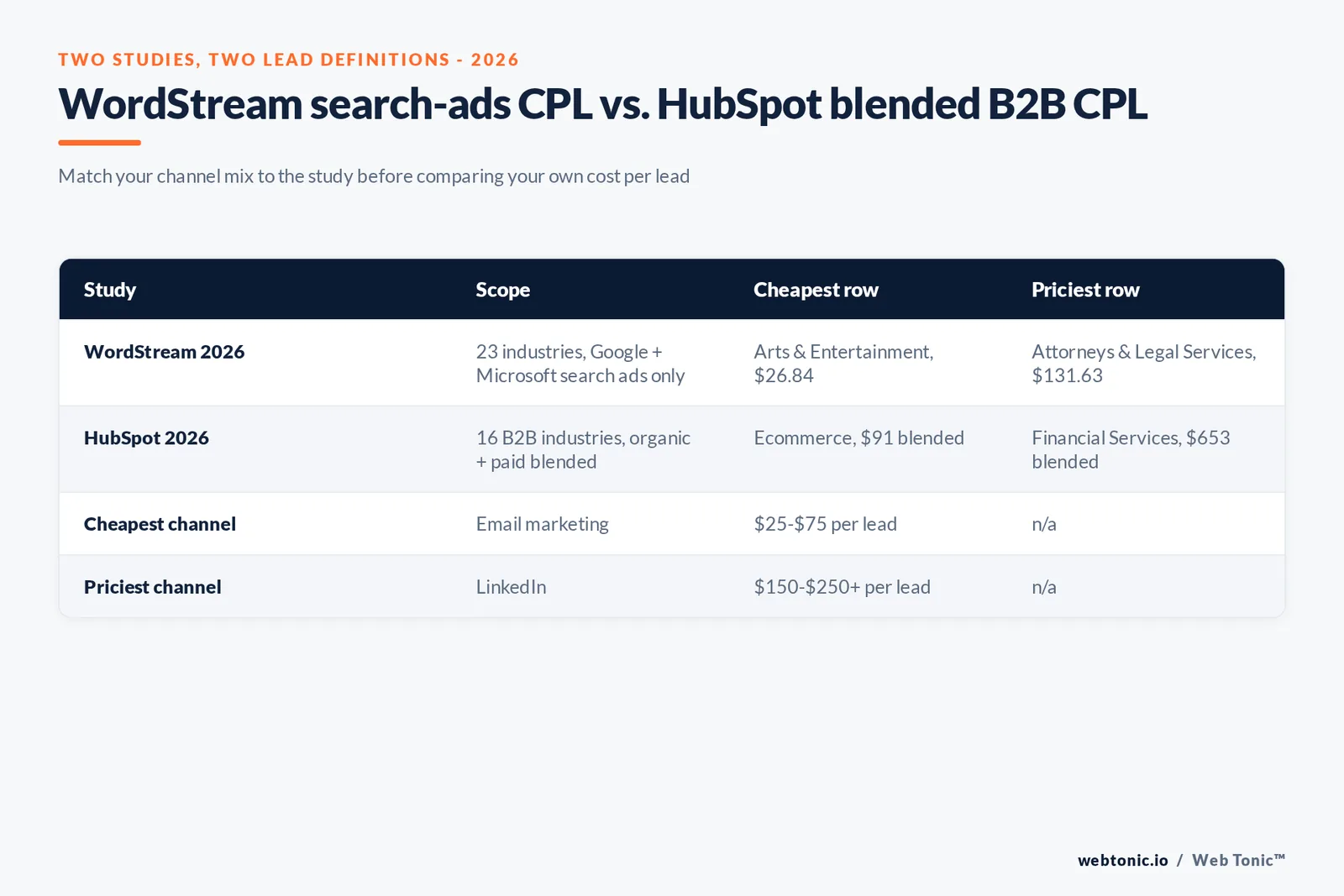
The average cost per lead depends entirely on which industry and which channel you measure. WordStream's 2026 Google Ads benchmarks put the all-industry search-ads average at $66.69, ranging from $26.84 to $131.63 across 23 categories. HubSpot's 2026-updated B2B benchmarks, blending every acquisition channel, put the all-channel average at $84 - and the two numbers are answering different questions.
Key Takeaways
- Average Google/Microsoft Ads cost per lead is $66.69 across 23 industries (2026).
- Arts and Entertainment has the cheapest search-ads lead at $26.84.
- Attorneys and Legal Services has the priciest search-ads lead at $131.63, a 5x spread.
- Overall cost per lead fell year over year for the first time since before 2020.
- Automotive-For Sale leads rose 13.90% year over year, the steepest increase measured.
- Travel leads fell 39.35% year over year, the steepest drop measured.
- Blended B2B cost per lead averages $84 across all channels (HubSpot, 2026).
- Ecommerce blended B2B leads cost $91, the cheapest B2B category tracked.
- Financial Services blended B2B leads cost $653, the priciest tracked.
- Legal Services paid B2B leads run $784 against $516 organic.
- Email leads cost $25 to $75, the cheapest channel in HubSpot's data.
- LinkedIn leads cost $150 to $250 or more, the priciest channel measured.
- SEO converts 51% of marketing-qualified leads to sales-qualified leads, the highest rate tracked.
- Paid search converts 26% of MQLs to SQLs, the lowest of the four channels measured.
- 87% of industries saw conversion rate increase year over year in the WordStream sample.
- Google Ads CPC hit $5.42 in 2026, more than double the $2.32 recorded a decade earlier.
- B2B SaaS blended leads cost $237, roughly 2.8x the all-channel B2B average.
- Construction blended leads cost $227, close behind SaaS in HubSpot's table.
Two studies, two definitions of a lead
Before any table below means anything, the definitions have to line up. WordStream's 2026 Google Ads Benchmarks report analyzed 13,474 LocaliQ customer search advertising campaigns running April 2025 through March 2026, across 23 industries, with roughly 80-85% of budget on Google and 15-20% on Microsoft Ads. A "lead" in that dataset is a tracked conversion action from a search ad click: a form fill, a call, a booking.
HubSpot's 2026-updated CPL and CAC benchmarks blend organic and paid activity - SEO, email, events, webinars, and paid search together - across 16 B2B industries, drawing on Market Research Future's 2025 report and First Page Sage's 2026 report. A "lead" there is any tracked contact across the entire acquisition mix, not one channel.
| Study | Scope | Sample | What counts as a lead |
|---|---|---|---|
| WordStream 2026 | Google + Microsoft search ads, 23 SMB-style industries | 13,474 campaigns, Apr 2025-Mar 2026 | One tracked search-ad conversion action |
| HubSpot 2026 | Blended organic + paid, 16 B2B industries | Aggregated from Market Research Future + First Page Sage | Any tracked contact across the funnel |
Cost per lead by industry: WordStream's 2026 search-ads table
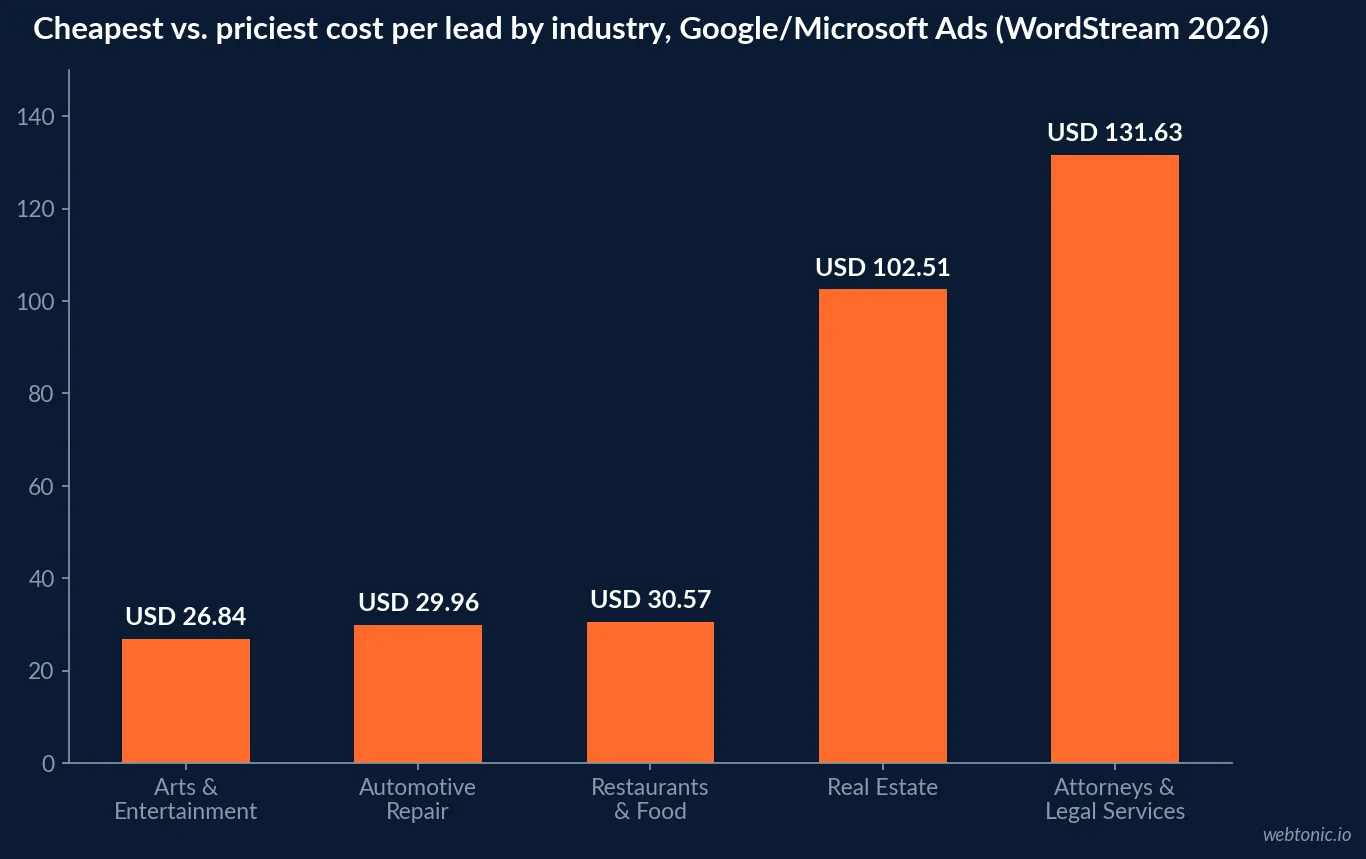
The average cost per lead in Google Ads in 2026 is $66.69. Here is the full 23-industry breakdown, ordered cheapest to most expensive.
| Industry | Avg. cost per lead (2026) | Source |
|---|---|---|
| Arts & Entertainment | $26.84 | WordStream |
| Automotive: Repair, Service & Parts | $29.96 | WordStream |
| Restaurants & Food | $30.57 | WordStream |
| Animals & Pets | $31.50 | WordStream |
| Beauty & Personal Care | $39.25 | WordStream |
| Physicians & Surgeons | $40.04 | WordStream |
| Automotive: For Sale | $44.26 | WordStream |
| Sports & Recreation | $44.26 | WordStream |
| Travel | $44.70 | WordStream |
| Shopping, Collectibles & Gifts | $49.40 | WordStream |
| Personal Services | $54.60 | WordStream |
| Career & Employment | $67.36 | WordStream |
| Health & Fitness | $67.36 | WordStream |
| Dentists & Dental Services | $72.97 | WordStream |
| Finance & Insurance | $74.44 | WordStream |
| Industrial & Commercial | $75.19 | WordStream |
| Education & Instruction | $77.48 | WordStream |
| Home & Home Improvement | $90.92 | WordStream |
| Business Services | $93.69 | WordStream |
| Apparel, Fashion & Jewelry | $97.51 | WordStream |
| Real Estate | $102.51 | WordStream |
| Furniture | $106.70 | WordStream |
| Attorneys & Legal Services | $131.63 | WordStream |
What moved year over year
For the first time in five years, the all-industry average cost per lead fell. But that headline hides a split: some industries got noticeably more expensive while others got sharply cheaper. Industries tied to tariff exposure - automotive and retail - saw the biggest increases.
| Direction | Industry | YoY change in cost per lead | Source |
|---|---|---|---|
| Up | Automotive - For Sale | +13.90% | WordStream 2026 |
| Up | Health & Fitness | +7.26% | WordStream 2026 |
| Up | Career & Employment | +7.26% | WordStream 2026 |
| Up | Automotive - Repair, Service & Parts | +5.12% | WordStream 2026 |
| Down | Travel | -39.35% | WordStream 2026 |
| Down | Beauty & Personal Care | -34.95% | WordStream 2026 |
| Down | Physicians & Surgeons | -29.64% | WordStream 2026 |
Cost per lead by industry: the blended B2B view
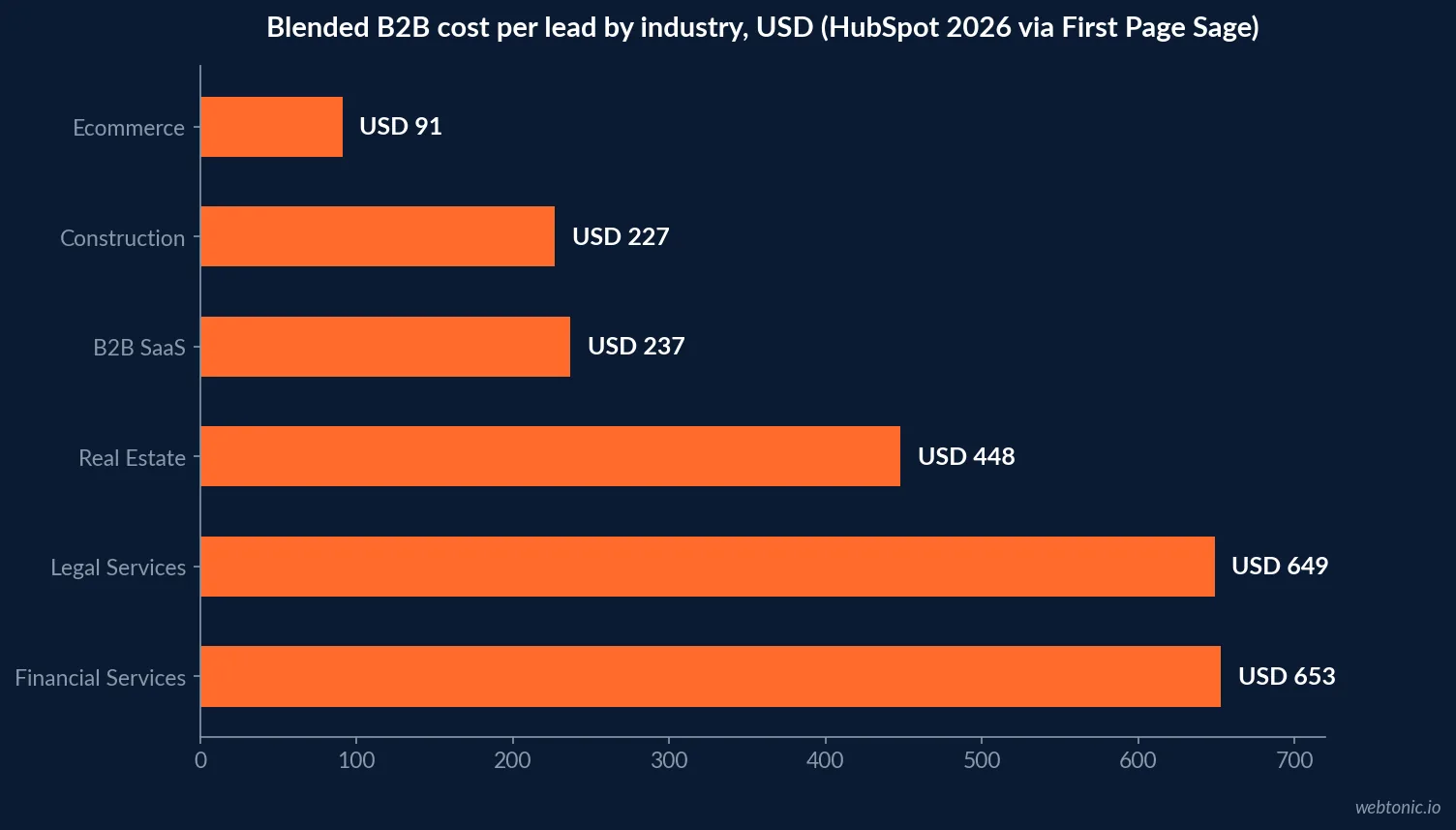
Widen the lens past search ads to every acquisition channel a B2B team runs, and the numbers change shape entirely. HubSpot's 2026-updated benchmarks - built on Market Research Future's 2025 report and First Page Sage's 2026 report - blend organic and paid cost per lead across 16 B2B industries.
| Industry | Organic CPL | Paid CPL | Blended CPL |
|---|---|---|---|
| Ecommerce | $83 | $98 | $91 |
| Construction | $280 | $174 | $227 |
| Hotels & Resorts | $224 | $308 | $266 |
| Engineering | $201 | $371 | $287 |
| B2B SaaS | $310 | $164 | $237 |
| Healthcare | $320 | $401 | $361 |
| Fintech | $413 | $490 | $452 |
| Real Estate | $416 | $480 | $448 |
| Cybersecurity | $404 | $411 | $406 |
| Staffing & Recruitment | $518 | $476 | $497 |
| Manufacturing | $415 | $691 | $553 |
| Software Development | $510 | $680 | $591 |
| Transportation & Logistics | $505 | $670 | $588 |
| Oil & Gas | $502 | $772 | $637 |
| Legal Services | $516 | $784 | $649 |
| Financial Services | $555 | $761 | $653 |
Read the organic-versus-paid columns closely and a pattern shows up: in Ecommerce, Construction and B2B SaaS, paid leads cost less than organic ones, because these categories have well-optimized paid funnels competing against slow, expensive content programs. In Manufacturing, Software Development, Oil & Gas and Legal Services, the reverse is true - paid leads cost far more than organic, because the paid auction for those keywords is brutally competitive and organic content still wins cheaper qualified traffic.
Which channel is actually cheapest
Industry explains part of the spread; channel explains the rest. HubSpot's 2026 benchmarks report email marketing as the cheapest channel for top-of-funnel leads at $25 to $75, with LinkedIn the most expensive at $150 to $250 or more. Market Research Future's underlying 2025 data puts average B2B Google Ads CPL at $70.11 and LinkedIn CPL at $110.
| Channel | Reported CPL range | MQL→SQL conversion | Source |
|---|---|---|---|
| Email marketing | $25-$75 | 46% | HubSpot 2026 |
| SEO / organic search | Lowest long-run cost, slower to build | 51% | HubSpot 2026 |
| Paid search (Google Ads) | $70.11 avg (B2B) | 26% | Market Research Future 2025 via HubSpot |
| Webinars | Mid-range, high production cost | 30% | HubSpot 2026 |
| Events | Highest effort per lead | 24% | HubSpot 2026 |
| $110-$250+ | Not separately reported | HubSpot 2026 / Market Research Future |
How to read your own cost per lead against these tables
Match your acquisition mix to the study before comparing your number. If every lead in your pipeline comes from a Google Ads search campaign, WordStream's 23-industry table is the closer comparison. If your pipeline blends SEO, email, events and paid search the way most B2B teams' does, HubSpot's blended table - and the specific industry row inside it - is the honest benchmark.
Neither table should be read as a target. A $131.63 legal-services lead and a $26.84 arts-and-entertainment lead can both be profitable, because the value of what a lead becomes differs by orders of magnitude between those two categories. Our growth marketing team builds that value comparison - lead cost against downstream revenue - before setting a target CPL for any account.
What tends to move a lead's price inside an industry
Three forces explain most of the spread inside any single row of these tables: how many competitors bid on the same terms, how long the buying decision takes, and how automated the advertiser's own account is. WordStream's report notes that the industries with the biggest CPL increases in 2026 - Automotive and Health & Fitness - are the ones most exposed to tariff-driven cost pressure and rising ad competition, while categories like Travel and Beauty saw double-digit declines as demand normalized.
Account structure matters almost as much as industry. WordStream's broader research found that adding a single well-chosen negative keyword can triple a campaign's conversion rate, which moves cost per lead more than almost any bid change. Before benchmarking against an industry row, confirm the account itself is not leaking spend on the wrong searches - see our guide to building a Google Ads strategy for the structural fixes that move CPL first.
Where this leaves a business setting a 2026 target
Pick the dataset that matches the channel mix, read the row for the closest matching industry - not the all-industry average - and treat the number as a ceiling to test against, not a floor to chase. Cost per lead by itself never tells you whether the lead converted to revenue; pair it with a real conversion-rate and close-rate benchmark before deciding a channel is too expensive to run. For search ads specifically, our breakdown of what Google Ads actually costs covers the account-level levers that move cost per lead beyond industry averages, and talking to our team is the fastest way to see where your own account sits against these benchmarks.
How "lead" gets defined and tracked
Every number on this page depends on a conversion action being tracked correctly in the first place. Google's own conversion tracking documentation treats a form fill, a phone call, or a booking as a distinct conversion event, separate from a completed sale - which is exactly why an ad account reports cost per lead, not cost per customer, unless it is wired up to track further down the funnel. Klipfolio's cost-per-lead KPI definition states the formula simply: total marketing spend divided by number of new leads generated in the same period.
Get that tracking wrong - counting a page view as a lead, or missing calls that never fill a form - and every benchmark on this page becomes uncomparable to your own number, regardless of which study you picked.
Frequently Asked Questions
What is the average cost per lead in 2026?
In Google and Microsoft search ads specifically, WordStream's 2026 benchmarks report puts the average cost per lead at $66.69 across 13,474 campaigns and 23 industries, the first year-over-year decline in five years. Widen the lens to every B2B acquisition channel - organic, paid, and blended - and HubSpot's 2026-updated benchmarks (built on Market Research Future and First Page Sage data) put average B2B cost per lead at $84. Neither number is wrong; they are measuring different things.
Which industry has the cheapest cost per lead?
Arts and Entertainment has the lowest cost per lead in Google and Microsoft Ads at $26.84, followed by Automotive Repair, Service and Parts at $29.96 and Restaurants and Food at $30.57, per WordStream's 2026 report. In HubSpot's blended B2B dataset, Ecommerce is the cheapest at $91 blended, since it has the shortest buying cycle and the highest inbound-traffic volume of any category tracked.
Which industry has the most expensive cost per lead?
Attorneys and Legal Services tops WordStream's 2026 search-ads table at $131.63 per lead, ahead of Furniture at $106.70 and Real Estate at $102.51. In HubSpot's blended B2B figures, Financial Services runs highest at $653 blended and Legal Services close behind at $649 - both categories close deals large enough to absorb a lead cost ten times a search-ads average.
Why do two reputable sources disagree on cost per lead by this much?
Because they define a lead, and the channel mix behind it, differently. WordStream measures only Google and Microsoft search ads across 23 general business categories from 13,474 real campaigns run April 2025 to March 2026. HubSpot's benchmarks blend organic and paid activity - SEO, email, events, search, and social - across 16 B2B verticals, sourced from First Page Sage's 2026 report. A blended multi-channel B2B number and a single-channel SMB search-ads number were never going to match.
Which channel produces the cheapest leads?
Email marketing, according to HubSpot's 2026 benchmarks: $25 to $75 per lead at the top of the funnel, the cheapest of any channel measured. LinkedIn is the most expensive at $150 to $250 or more per lead. The same research found SEO converts marketing-qualified leads to sales-qualified leads at 51%, the highest of any channel tracked, ahead of email at 46% and paid search at 26%.
Sources
WordStream - 2026 Google Ads Industry Benchmarks
WordStream - Search Advertising Benchmarks by Industry, 2026 PDF
WordStream - Digital Benchmarks by Industry: PPC
Do Good Design Co. - Average Cost Per Lead by Industry (WordStream 2026 data)
HubSpot - 2026 CPL and CAC Benchmarks
Klipfolio - Cost Per Lead KPI definition
Google Ads Help - About conversion tracking