Table of contents
Keyword density is the percentage of a page's total words that a given term accounts for: occurrences divided by total word count, multiplied by 100. It is a description of a page, not a ranking dial — Google has never published a target figure, and no percentage will lift a page that answers the query badly.
Key Takeaways
- The formula is fixed: 12 uses in a 1,200-word page = 1.0%. Nothing about it is subjective.
- The "ideal 1–2%" figure has no source at Google — it is a 2000s-era convention that survived because tools needed a number to show.
- Stuffing is a named policy violation, and the penalty risk sits with repetition that reads unnaturally, not with a specific figure.
- Modern retrieval weights rarity, not raw counts: TF-IDF and embedding models discount a term the more often it appears.
- A 2,000-word page using its term 40 times (2.0%) can read worse than one using it 14 times (0.7%) — placement beats volume.
- Use a checker as a diagnostic for the top 3 offenders, never as a target to hit.
How keyword density is calculated
Every checker on the market runs the same arithmetic. Count how many times the phrase appears in the body copy, divide by the total number of words, and express the result as a percentage. For multi-word phrases, some tools divide by the number of possible phrase positions instead of raw word count, which is why two tools can report 0.8% and 1.1% for the same page.
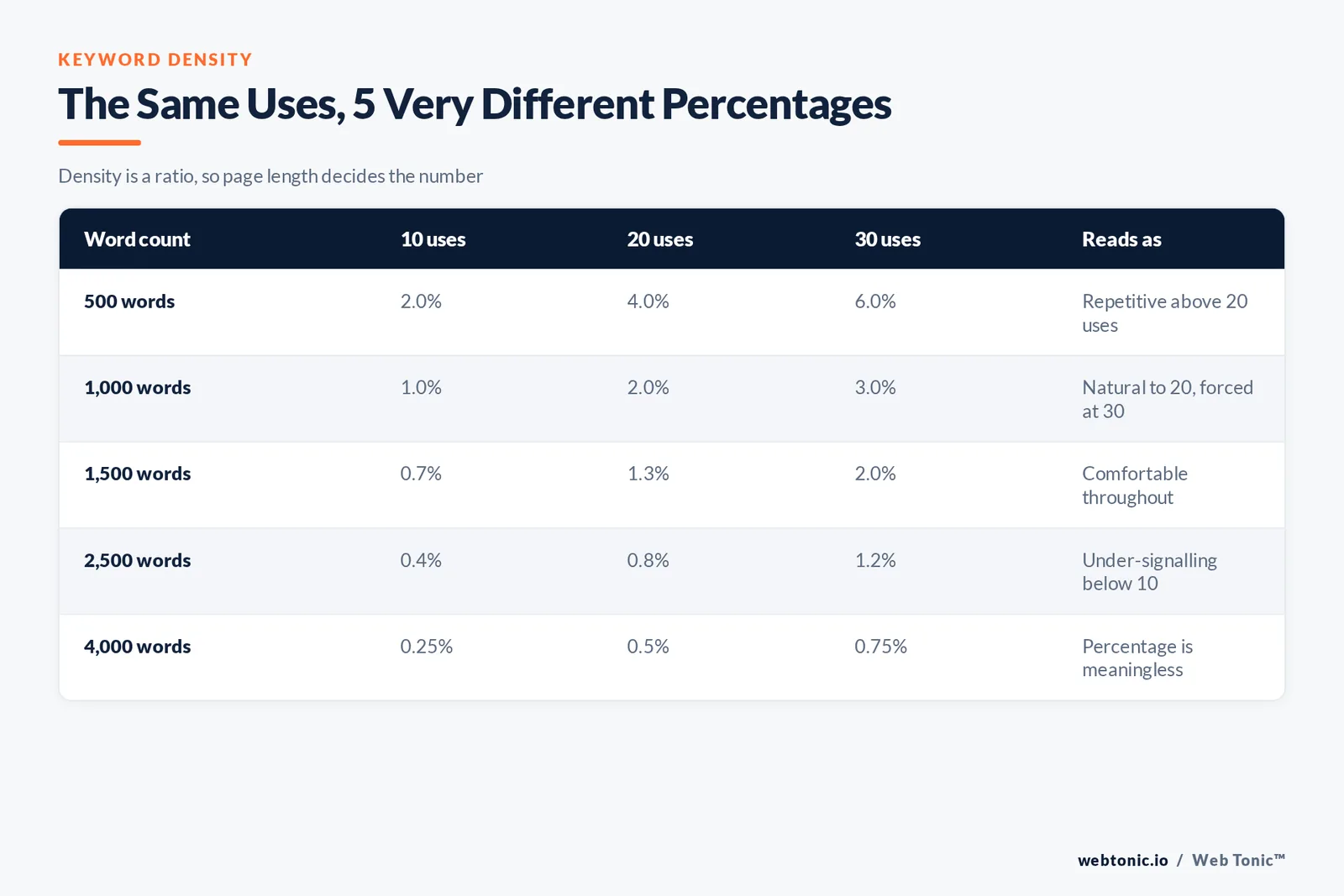
The practical consequence: the same number of uses produces wildly different percentages depending on length. A term used 10 times reads as 2.0% at 500 words and 0.4% at 2,500 words — the copy did not change, only the denominator.
| Word count | 10 uses | 20 uses | 30 uses | Reads as |
|---|---|---|---|---|
| 500 words | 2.0% | 4.0% | 6.0% | Repetitive above 20 uses |
| 1,000 words | 1.0% | 2.0% | 3.0% | Natural to 20, forced at 30 |
| 1,500 words | 0.7% | 1.3% | 2.0% | Comfortable throughout |
| 2,500 words | 0.4% | 0.8% | 1.2% | Risk of under-signalling below 10 |
| 4,000 words | 0.25% | 0.5% | 0.75% | Percentage becomes meaningless |
That table is the whole argument against percentage targets. Across the 5 lengths above, the same 20 uses swing from 4.0% down to 0.5%. A 4,000-word pillar page hitting a 2% target would need 80 uses of the same phrase, which no editor would sign off on. Chasing the ratio breaks longer pages first.
Why it matters less than it used to — and where it still matters
Early search engines ranked largely on term frequency, so counting was a reasonable proxy for relevance. Two shifts ended that. First, statistical weighting: TF-IDF deliberately dampens common terms so that a word repeated 30 times is not scored 30 times more relevant than a word used once. Second, quality filtering — Google's Panda update, launched in February 2011, targeted thin, repetitive pages at scale, and language models such as BERT, rolled into Google Search in 2019, read a query's structure rather than matching strings.
Two shifts across roughly 20 years moved the weight from counting to meaning. What survives is coverage, not counting. Google's own guidance on creating helpful, reliable content asks whether a page answers the question comprehensively — a page that never states its subject plainly fails that test just as a stuffed page does.
| Signal | Weight in 2005 | Weight now | What replaced it |
|---|---|---|---|
| Raw term frequency | High | Marginal | Dampened frequency, entity matching |
| Exact-phrase repetition | High | Near zero | Synonyms, paraphrase, embeddings |
| Term in title and H1 | High | Still meaningful | Unchanged as a labelling signal |
| Meta keywords tag | Moderate | Ignored since 2009 | Nothing — deprecated |
| Topic coverage breadth | Low | High | Subtopic and entity completeness |
| Search intent match | Low | Very high | Query understanding models |
The percentage myths, ranked by how much damage they do
Most on-page advice circulating today is a recycled version of a 2006 checklist. All 6 myths below share one flaw: they treat a ratio as an instruction. Moz's on-page reference and Semrush's own write-up both now frame the metric as descriptive rather than prescriptive, and WordStream's page reaches the same conclusion.
| Myth | What people do | Real cost | Better rule |
|---|---|---|---|
| Myth 1 — "Aim for exactly 2%" | Insert phrases to hit a number | Unreadable copy; 40 uses on a 2,000-word page | Write first, measure after |
| Myth 2 — "More uses = higher rank" | Repeat the head term in every paragraph | Stuffing risk, lower time on page | One clear mention per section |
| Myth 3 — "Exact match only" | Bans synonyms and plurals | Loses 30–60% of long-tail variants | Vary wording deliberately |
| Myth 4 — "Every H2 needs the term" | Six near-identical headings | Weak outline, poor snippets | Term in 2–3 headings maximum |
| Myth 5 — "Density is a ranking factor" | Reports it to clients monthly | Attention diverted from intent gaps | Report coverage and rankings instead |
| Myth 6 — "Footer links raise it safely" | Stacks phrases in the footer | Classic stuffing pattern, sitewide | Keep footers navigational |
Where stuffing actually gets a page punished
Google's spam policies name keyword stuffing explicitly and describe it as loading a page with terms to manipulate rankings — including lists of phone numbers or cities with no added value, and text repeated so it reads unnaturally. Nothing in the policy sets a threshold, because enforcement responds to the pattern, not to a percentage. Densities of 4% and above show up in almost every stuffing case we audit, but so do pages sitting at 1.5%. If a manual action lands, it appears in the Manual Actions report inside Search Console.
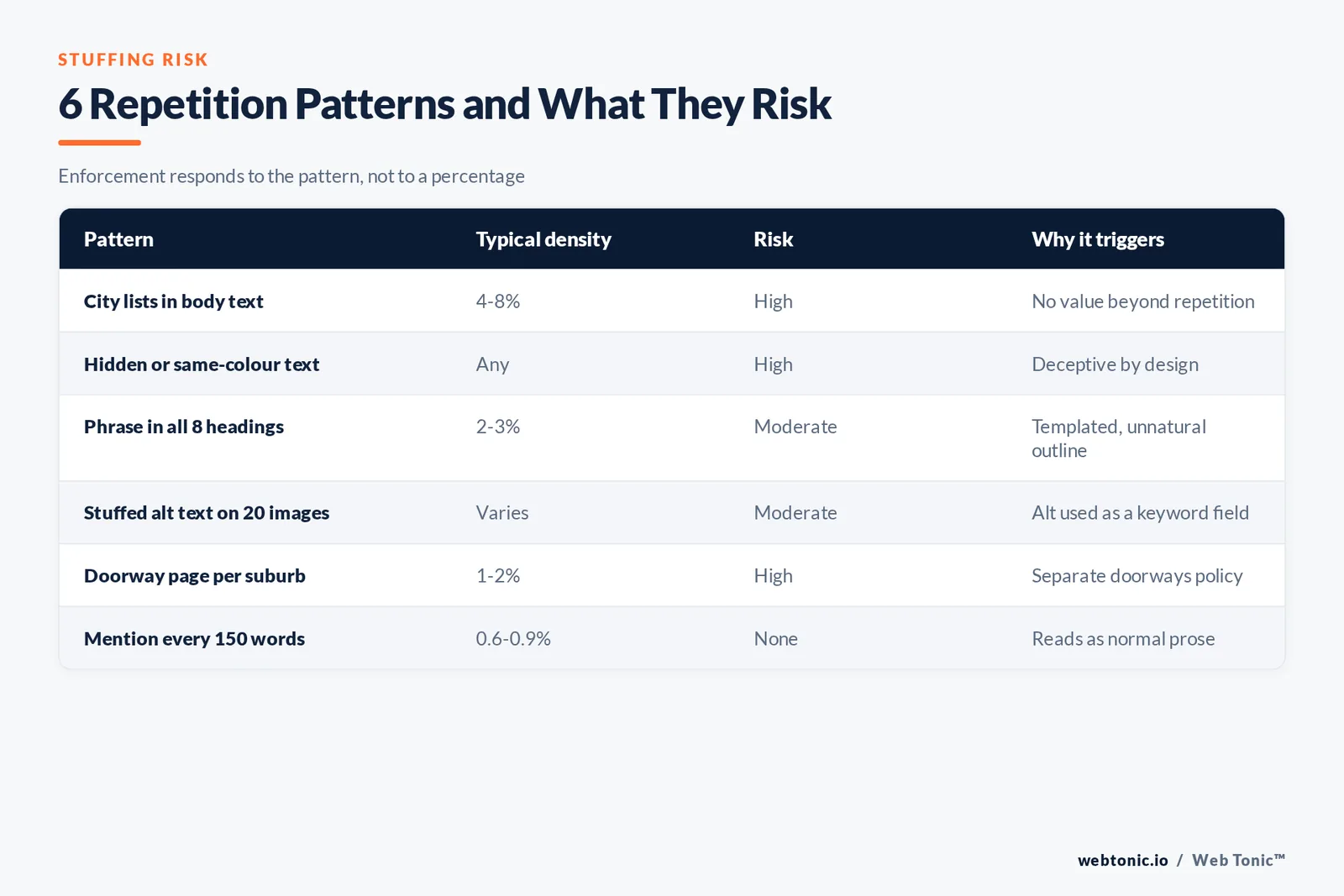
| Pattern | Typical density | Risk level | Why it triggers |
|---|---|---|---|
| City lists in body text | 4–8% | High | No value beyond the repetition |
| Hidden or same-colour text | Any | High | Deceptive by design |
| Phrase in all 8 headings | 2–3% | Moderate | Templated, unnatural outline |
| Alt text stuffed on 20 images | Varies | Moderate | Alt text used as a keyword field |
| Doorway pages per suburb | 1–2% | High | Separate policy: doorways |
| Natural mention every 150 words | 0.6–0.9% | None | Reads as normal prose |
Placement beats percentage: where the term should appear
If you only control one thing, control position. 7 positions carry almost all of the labelling value on a page. A term in the title, the opening sentence and one subheading does more labelling work than 20 extra mentions buried mid-page. That is partly a reading-behaviour fact: Nielsen Norman Group's research on web reading shows people scan headings and first lines rather than reading in full, and federal plain-language guidelines push the same front-loading discipline.
| Position | Target uses | Effect | Common error |
|---|---|---|---|
| Title tag | 1 | Strongest labelling signal | Two variants crammed in 60 characters |
| H1 | 1 | Confirms the topic | Different topic from the title |
| First 100 words | 1 | Answer-first clarity | Buried after 3 paragraphs of preamble |
| Subheadings | 2–3 of 8 | Outline scannability | All 8 headings identical |
| Body prose | 1 per 150–250 words | Consistent topical thread | Clustered in one section |
| Image alt text | 1–2 of 4 | Accessibility plus context | Same alt on every image |
| Meta description | 1 | Click-through relevance | Repeated three times |
Benchmarks by page type
Different page shapes tolerate very different ratios, which is another reason a single site-wide target fails. Comfortable ranges span 0.2% on a pillar guide to 3.0% on a glossary entry — a 15x spread across 6 page types. These are working ranges we use as a sanity check after drafting, not goals to write toward.
| Page type | Typical length | Comfortable range | Notes |
|---|---|---|---|
| Product page | 300–600 words | 1.0–2.0% | Short copy inflates the ratio naturally |
| Service page | 800–1,500 words | 0.8–1.5% | Service plus location both need a mention |
| Blog explainer | 1,500–2,500 words | 0.5–1.0% | Variants carry most of the load |
| Pillar guide | 3,000+ words | 0.2–0.6% | Subtopic coverage matters far more |
| Category page | 200–400 words | 1.5–2.5% | Product names lift it without stuffing |
| Glossary entry | 400–800 words | 1.5–3.0% | Definitions repeat the term by nature |
How to run a check that changes something
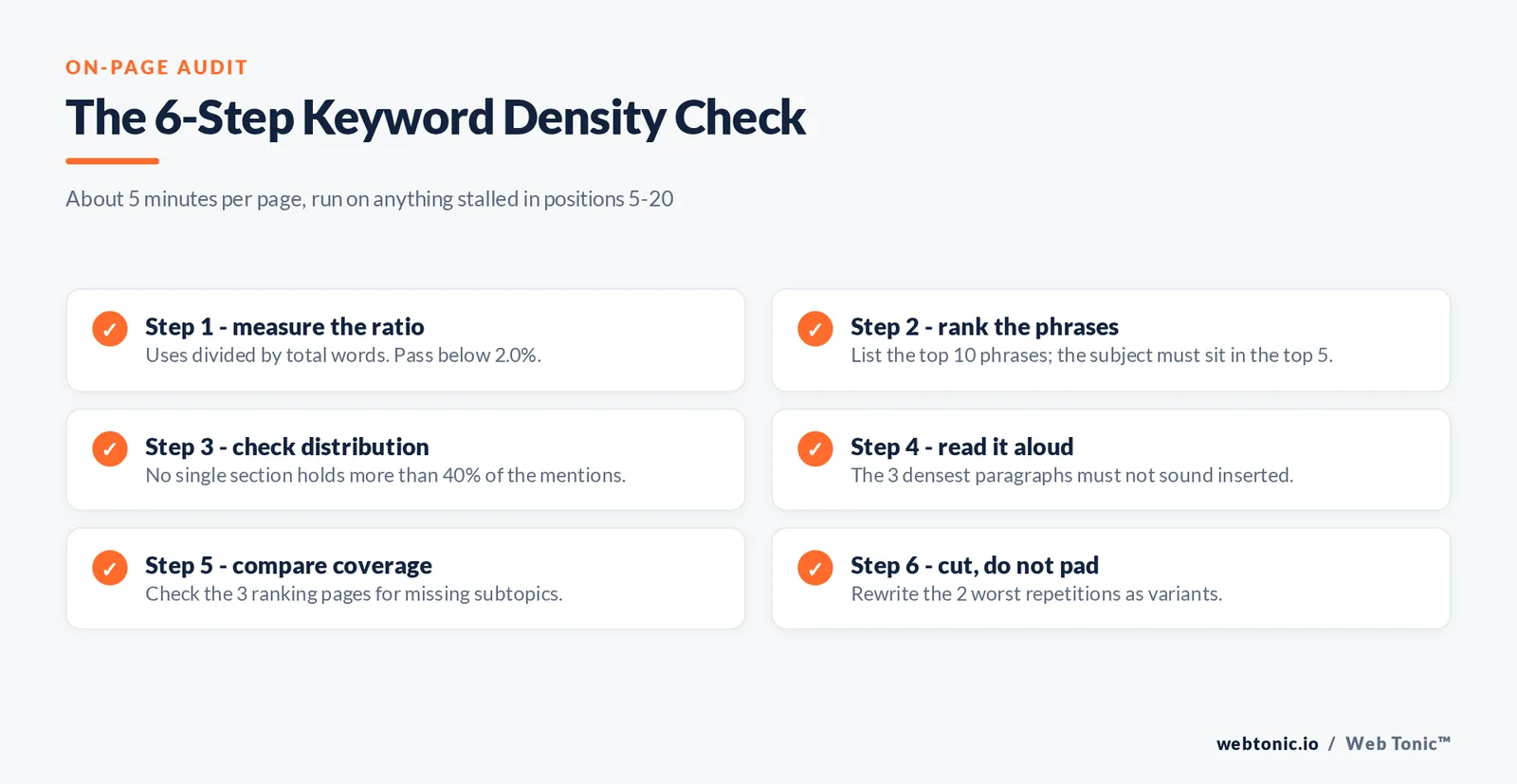
A checker is a text-analysis utility: it fetches the page, strips markup and counts. The value is in what you do with the top offenders, not the headline percentage. 6 checks, about 5 minutes per page. This is the five-minute pass our team runs on any page that stalls in positions 5–20.
| Step | Action | Pass condition |
|---|---|---|
| Step 1 | Count total words and uses of the head term | Ratio below 2.0% |
| Step 2 | List the top 10 one- and two-word phrases by frequency | The subject appears in the top 5 |
| Step 3 | Check the distribution across sections | No section holds over 40% of the mentions |
| Step 4 | Read the 3 densest paragraphs aloud | Nothing sounds inserted |
| Step 5 | Compare coverage with the 3 ranking pages | No missing subtopic |
| Step 6 | Rewrite the 2 worst repetitions as variants | Meaning unchanged, phrasing varied |
Checkers and what they actually measure
Tool outputs disagree because their denominators and stop-word handling differ. Stripping stop words alone raises a reported figure by 30–40%. Before you trust a figure, know which of these four calculations the tool used.
| Method | Denominator | Effect on the number | Best for |
|---|---|---|---|
| Simple word ratio | All words | Baseline | Single-word terms |
| Stop-words removed | Content words only | Raises it 30–40% | Comparing pages of different styles |
| Phrase-position ratio | Possible n-gram slots | Lowers multi-word figures | Three-word phrases |
| Weighted by position | Words, title weighted | Rewards front-loading | On-page audits |
| Rendered vs raw HTML | Visible text only | Excludes nav and footer | JavaScript-heavy templates |
Fixing an over-optimised page without losing the ranking
6 fixes, applied in order, typically remove 15–25 uses without touching the word count. Cutting repetition is the only real lever — adding words to dilute the ratio leaves the awkward sentences in place. Work down this list and re-measure after each pass. We apply the same discipline inside our data intelligence and growth marketing engagements, where on-page cleanups usually sit next to an intent-gap fix rather than replacing it.
| Fix | Where to apply it | Typical reduction |
|---|---|---|
| Fix 1 — pronoun swap | Second mention in a paragraph | 3–6 uses removed |
| Fix 2 — heading rewrite | Any heading beyond the third | 4–5 uses removed |
| Fix 3 — table headers | Column labels repeating the term | 5–10 uses removed |
| Fix 4 — alt-text cleanup | Images with duplicate alts | 2–4 uses removed |
| Fix 5 — footer and sidebar | Boilerplate blocks | Sitewide effect |
| Fix 6 — synonym pass | Body prose, 2 paragraphs at a time | Keeps meaning, cuts 20% |
Traps that survive a clean percentage
A page can measure a tidy 0.9% and still fail. These 5 traps account for most stalled pages we review. These are the five faults we see most often on pages that pass every tool check and still do not rank.
| Trap | Symptom | Fix |
|---|---|---|
| Trap 1 — intent mismatch | Guide ranking for a buying query | Rebuild as a comparison or product page |
| Trap 2 — cannibalisation | 3 pages on one term | Consolidate, redirect, pick a canonical |
| Trap 3 — thin coverage | 600 words against 2,400-word rivals | Add the 4 missing subtopics |
| Trap 4 — buried answer | Definition in paragraph 5 | Front-load a 40–60-word answer |
| Trap 5 — no unique data | Paraphrase of page 1 | Add original numbers, tables or examples |
Fact 1 — pages that win competitive terms usually differ on coverage and evidence, not on ratios. Fact 2 — the fastest on-page win is normally a title and opening rewrite, worth more than any 0.5% adjustment. Fact 3 — a tool that grades a page red at 1.4% is enforcing its own convention, not Google's.
Keyword density checker tools: what free and paid options include
A keyword density checker is a text tool: give it a URL or paste text, and it returns a frequency table for the webpage. Free checkers cover about 80% of what an on-page audit needs; paid SEO suites earn their place by adding crawl-wide reporting across a whole website and domain.
| Tool type | Free or paid | What it checks | Best use |
|---|---|---|---|
| Standalone density checker | Free | One URL, one- to three-word phrase counts | Quick check on a single webpage |
| Browser word-count extension | Free | Visible text only, live rendering | Checking a competitor's page in 30 seconds |
| SEO suite on-page report | Paid | Keyword usage, title, meta, internal links | Auditing 100+ URLs on one domain |
| Site crawler | Free tier to 500 URLs | Word counts and duplicate text sitewide | Finding thin and templated pages |
| Content editor with a term list | Paid | Term coverage against ranking pages | Writing to a brief, not a percentage |
| Manual spreadsheet count | Free | Anything you define | Settling a disagreement between two tools |
Rule 6 — never let a tool's green light decide whether a page ships. No checker on the market has access to Google's ranking algorithm, so its threshold is a house convention. What a good tool does give you is the frequency table, and that is where the useful signal lives: if your primary keyword is not in the top five phrases, the page has a focus problem no percentage will describe.
Density, user experience and quality signals
Search engines model reader behaviour, so keyword usage that damages the user experience tends to damage rankings by a longer route: fewer completed tasks, weaker engagement, fewer links. A search engine does not need a stuffing filter to demote a page that nobody finishes reading.
| Reader signal | What stuffing does to it | Quality effect |
|---|---|---|
| Scan-ability | 8 near-identical headings | Reader cannot find the relevant section |
| Time on page | Repetition in the first 100 words | Early exits before the answer |
| Trust | Robotic phrasing | Content reads machine-made |
| Accessibility | Keyword-stuffed alt text | Screen readers announce noise |
| Shareability | No original data | Nothing worth citing, so no links |
From a primary keyword to a topic cluster
The strategic answer to a density question is usually a structural one. Instead of pushing one webpage's ratio up or down, give each keyword its own page and let internal links build topical authority across the cluster. A 6-page cluster covering 6 distinct intents outranks one 6,000-word page in most competitive niches, because each URL can focus on a single query.
| Cluster role | Focus keyword type | Target length | Internal links |
|---|---|---|---|
| Pillar page | Broad head term | 2,500–3,500 words | Links out to all 6 children |
| Definition page | "What is" query | 800–1,500 words | Links up to the pillar |
| How-to page | Process query | 1,500–2,500 words | Links to tool and definition pages |
| Tool or checker page | Software query | 1,000–1,800 words | Links to the how-to |
| Comparison page | "X vs Y" query | 1,200–2,000 words | Links to both subject pages |
| Best-of list | Commercial query | 2,000–3,000 words | Links to the pillar and comparisons |
Build the cluster and the density question answers itself: each page states its subject where it counts, uses the phrase where a reader expects it, and never has to include a term 40 times to prove relevance. Google's SEO starter guide makes the same point in plainer language — describe the page accurately and let the structure do the rest.

A working policy you can hand to writers
Replace the target with rules. 5 rules replace every percentage target. Rule 1 — write the draft without counting. Rule 2 — state the subject in the first 2 sentences. Rule 3 — use the exact phrase in the title, the H1 and 2 subheadings. Rule 4 — vary wording after the third mention in any section. Rule 5 — measure once at the end and act only if the ratio exceeds 2.0% or the term never appears in the top 5 phrases. That is the standard our editors apply across every page we ship; if you want a second opinion on a page that has stalled, talk to us or browse more on-page teardowns on the Web Tonic blog.
FAQ
What is a good keyword density percentage?
There is no official figure. In practice, ratios between 0.5% and 2.0% occur naturally in well-written pages, and anything above 3% usually reads as repetitive. Treat those numbers as a post-draft sanity check rather than a writing target, and let page length decide what is normal.
How do I calculate it manually?
Count how many times the phrase appears in the visible body copy, divide by the page's total word count and multiply by 100. Twelve uses in a 1,200-word article is 1.0%. Exclude navigation, footer and boilerplate text, since those inflate the figure without contributing to the page's argument.
Is keyword stuffing still penalised in 2026?
Yes. Google's spam policies still list keyword stuffing as a violation, and manual actions for it appear in the Search Console Manual Actions report. The trigger is unnatural repetition — including city or phone-number lists added for search engines rather than readers — not a numeric threshold.
Are keyword density checkers reliable?
They are reliable at counting and unreliable as scoring systems. Two tools can report different figures for one page because they handle stop words, multi-word phrases and rendered versus raw HTML differently. Use one for the top-offender list, and ignore its pass or fail grade.
Does using synonyms hurt the ratio?
It lowers the number and usually improves the page. Search systems match paraphrase and related entities, so varied phrasing widens the range of queries a page can answer while keeping the prose readable. Reserve the exact phrase for the title, opening and a couple of headings.
Sources
Google Search Central — spam policies and helpful-content guidance · Google Search Console Help — manual actions report · Wikipedia — keyword density, TF-IDF, Google Panda, BERT · Moz — on-page ranking factors · Semrush — keyword density · WordStream — keyword density · Nielsen Norman Group — how users read on the web · PlainLanguage.gov — federal plain-language guidelines. Density figures in this article are arithmetic illustrations, not Google targets.