Table of contents

Most new websites make the same mistake on day one: they aim a brand-new domain straight at a keyword that a billion-dollar competitor has owned for a decade. "SEO tools," "running shoes," "personal injury lawyer" are not winnable fights for a small site, no matter how good the content is.
Low competition keywords are the fix. These are search terms with real demand but weak competition, the openings bigger sites leave on the table because they're too busy defending their high volume terms. This guide walks through exactly how to find low competition keywords step by step.
Key Takeaways
- Low competition keywords typically carry a keyword difficulty score under 30 in tools like Ahrefs or Semrush, giving smaller sites a realistic shot at page one without massive domain authority.
- Only 1.74 percent of newly published pages reach Google's top 10 within a year, mostly because they're competing for head terms, while a well-targeted long tail keyword can realistically rank in 1 to 3 months.
- Long-tail keyword pages convert at roughly 36 percent, more than three times the 11.45 percent average of top landing pages overall, since a specific query signals a specific, closer-to-purchase intent.
- Backlinko's analysis of 306 million US keywords found 91.8 percent are long-tail, with a median monthly search volume of just 10 searches, meaning most real keyword opportunity sits outside the terms most people fight over.
- Low competition and long tail are related but not identical. A short phrase can be low competition in a niche market, and a long phrase can still be brutally competitive.
- Google Keyword Planner overestimates search volume 54.28 percent of the time, so cross-check any tool's numbers against Google Search Console data for terms you already rank for.
What Are Low Competition Keywords?
A low competition keyword is a search term where relatively few strong, authoritative pages compete for the top results, giving a smaller or newer site a realistic chance to rank with solid content. That's a different thing from a long tail keyword, even though the two overlap heavily. Long tail keywords are defined by specificity and low search volume, typically 3 or more words. Most of them happen to be low competition too, but a short, two-word phrase can occasionally be low competition in a niche market, and a five-word phrase can still be a high competition keyword if it touches a subject everyone's fighting over.
The actual competition level of a keyword depends on more than a single tool's difficulty score. SERP strength, the authority of your own site, and how well your planned content matches search intent all factor in. Ahrefs' own documentation on its Keyword Difficulty metric confirms this directly: KD is calculated from the number of referring domains linking to the current top 10 pages, and deliberately excludes on-page factors, content quality, and search intent entirely. A KD score is a best starting filter, not the final word, and it's always worth a manual look at who's actually ranking before committing content resources.
The Keyword Demand Curve
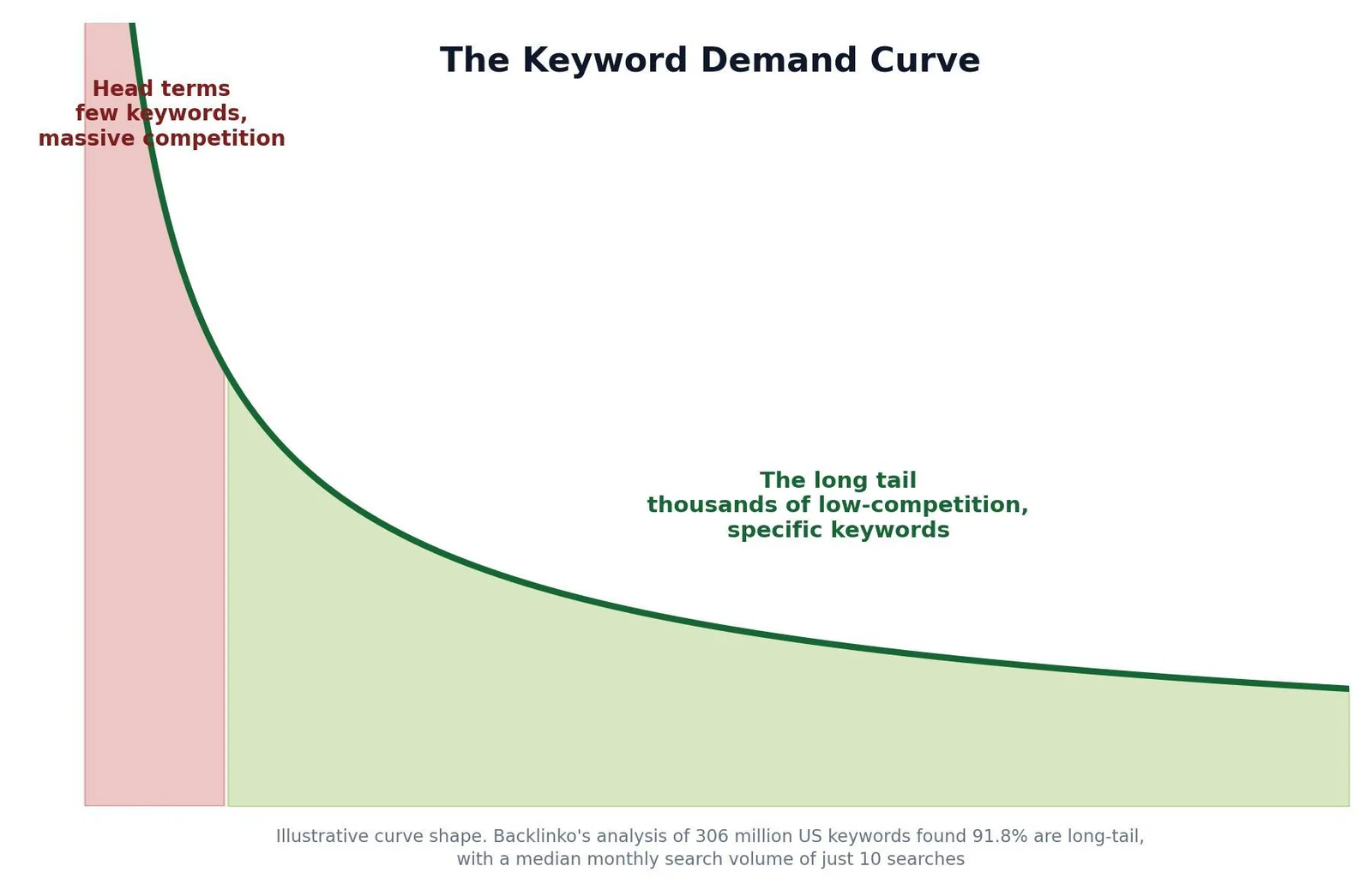
The term "long tail" describes the shape of a demand curve, not a rule about word count. A small number of high search volume head terms sit at the front, fought over by the biggest sites on the internet. Everything else stretches out along a long, thin tail: individually smaller in volume, but making up the overwhelming majority of actual search terms. According to Backlinko's analysis of 306 million US keywords, published in Backlinko's own study, 91.8 percent are long-tail, with a median search volume of just 10 searches per month. That's where most of the real, winnable opportunity actually lives.
That gap matters in practice. BloggerSideas' 2026 research found Google Keyword Planner overestimates search volume 54.28 percent of the time, so cross-checking any tool's numbers against real Search Console data before ruling a keyword in or out is worth the extra few minutes.
Ranking Speed: Head Terms vs. Low-Competition Keywords
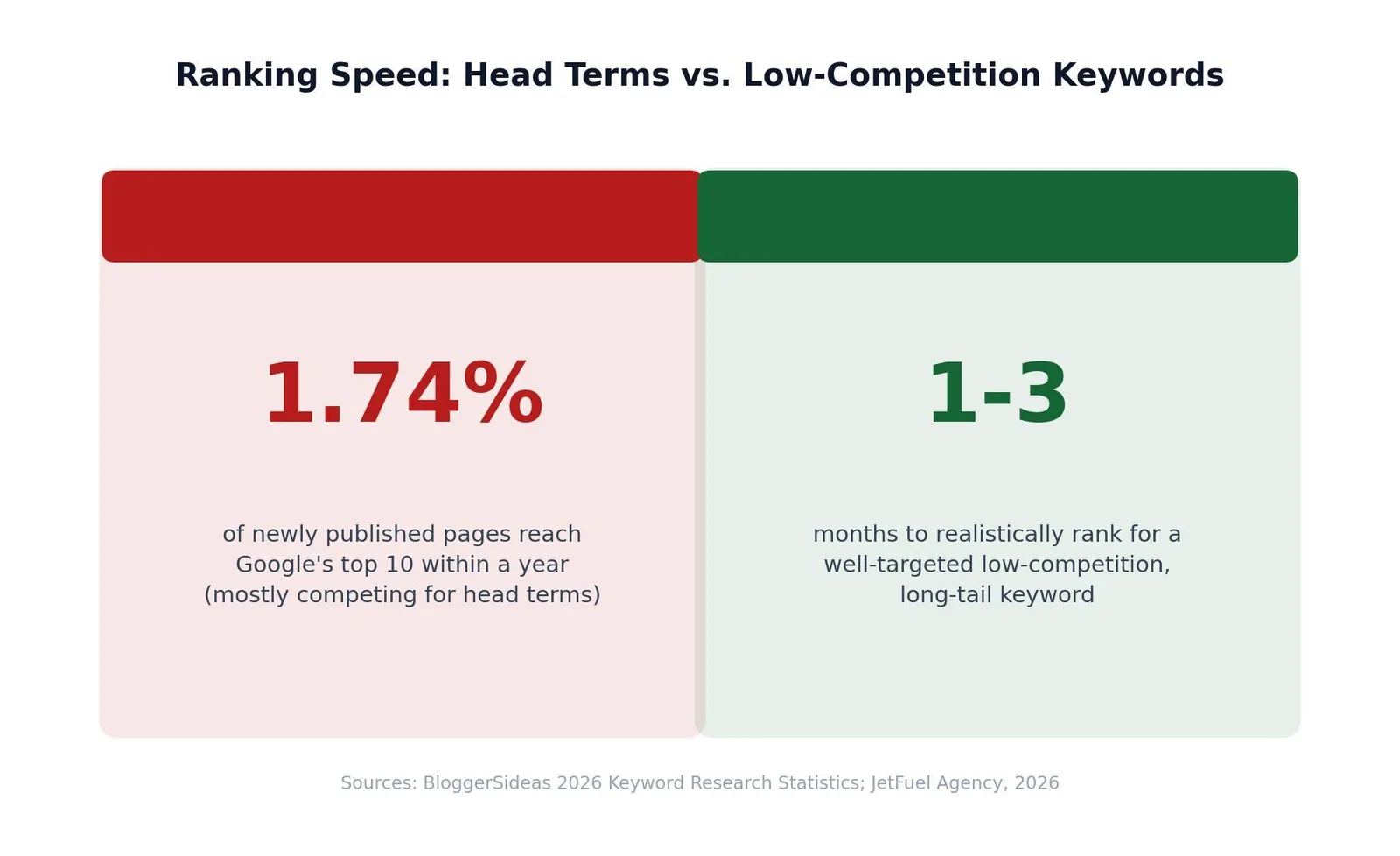
The time difference between chasing a head term and targeting a low competition keyword is stark. According to BloggerSideas' 2026 keyword research statistics, only 1.74 percent of newly published pages reach Google's top 10 within a full year, and most of those pages are competing for high-volume, high-authority terms. A well-targeted, low difficulty long tail keyword, by contrast, typically shows realistic ranking movement within 1 to 3 months.
Long-Tail Keywords Convert More Than 3x Better
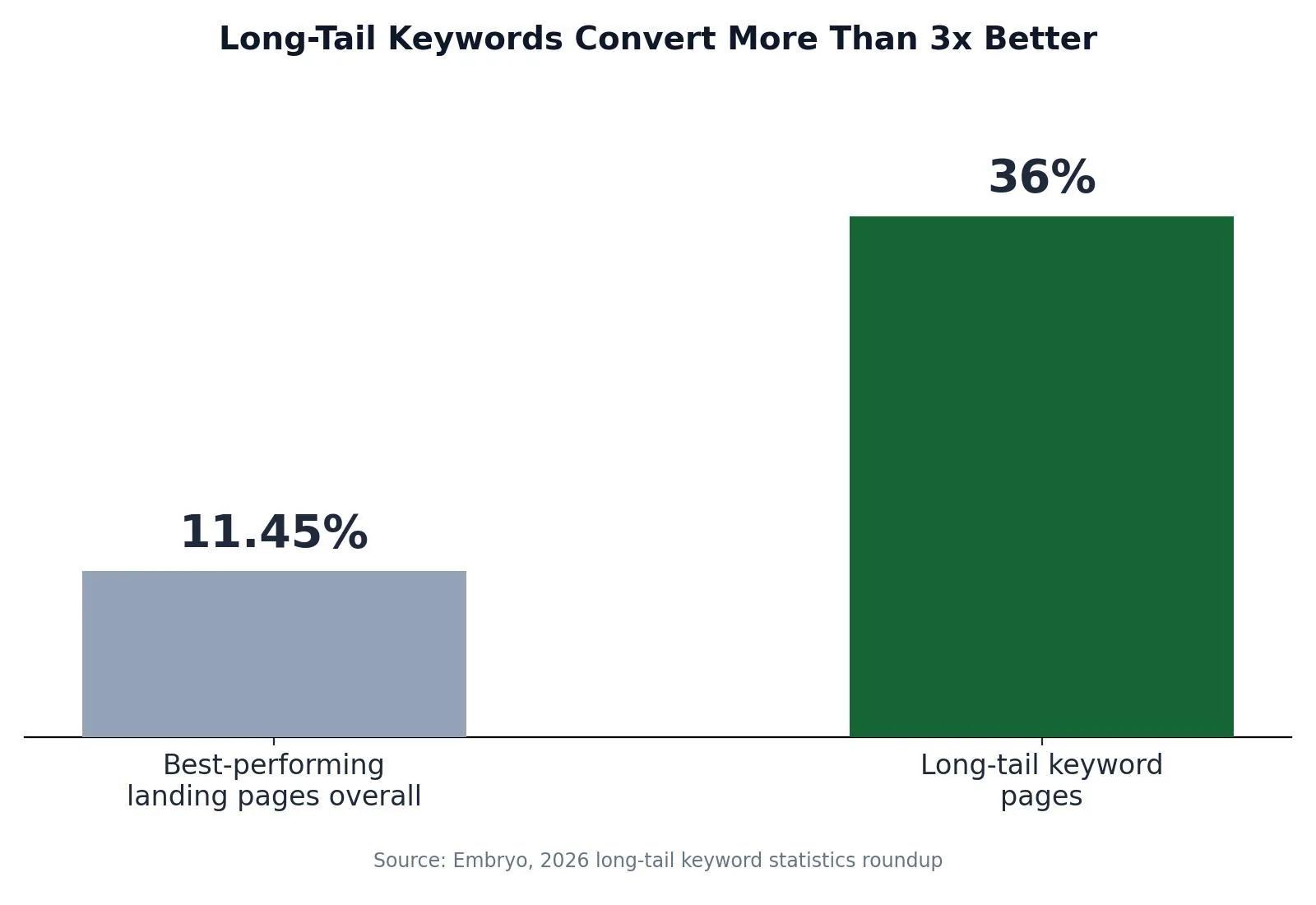
Lower volume doesn't mean lower value, it usually means the opposite. Long tail keywords reflect specific intent, and specific intent converts. Embryo's 2026 roundup of long-tail keyword statistics found that long-tail pages convert at an average of 36 percent, compared to just 11.45 percent for the best-performing landing pages overall. Fifty visitors who are exactly the right audience will consistently outperform 5,000 visitors who were only vaguely curious.
Keyword Research Tools Compared
| Tool | "Low Competition" Threshold | Starting Price (USD) | Best For |
|---|---|---|---|
| Ahrefs | KD 0-10 recommended for new sites | From $29/month (Starter plan) | Deep keyword and competitor difficulty data |
| Semrush | KD 0-14 "Very Easy," 15-29 "Easy" | From $139.95/month (Pro plan) | Keyword difficulty scoring with content tools |
| Ubersuggest | Simplified difficulty score, budget-friendly | Reported prices vary widely ($12-$29/month depending on source; verify current pricing before quoting) | Solo bloggers and small sites on a budget |
| Google Keyword Planner | No difficulty score, only competition level (low/medium/high) | Free | Free volume estimates, best paired with Search Console |
Every keyword tool calculates difficulty differently, and none of them are precise measurements, they're directional signals. Ubersuggest, created by Neil Patel, fits that budget positioning well for solo bloggers, though current pricing is worth confirming directly since published figures vary. Cross-checking a promising keyword idea across two tools, and then manually reviewing who's actually ranking, catches the cases where a low score doesn't match reality.
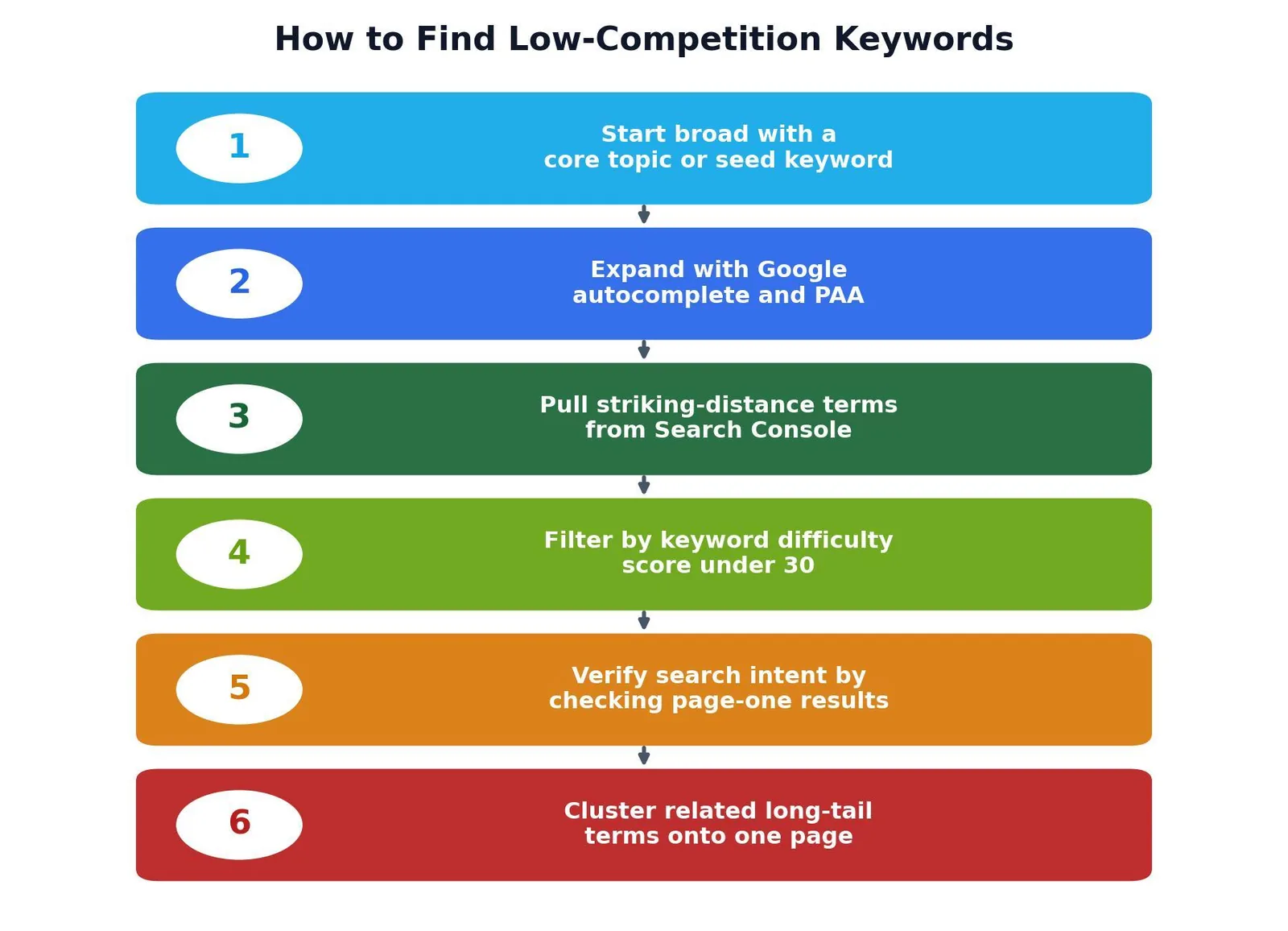
How to Find Low-Competition Keywords: The 6-Step Process
Keyword research tool
Is this a realistic keyword to target?
Check off what's true for your keyword. Your score updates as you go.
0 of 5
Check off items above to see how realistic this keyword is to target.
Step 1: Start broad with a core topic or seed keyword
Every keyword search starts with a topic, not a finished phrase. Pick the core subject your content or business actually covers, then let that seed expand into specific variations in the next steps.
Step 2: Expand with Google autocomplete and People Also Ask
Typing a seed term into Google and reading what autocomplete suggests, along with the People Also Ask box, surfaces real phrasing people actually search, often long tail keyword variations a tool wouldn't suggest on its own.
Location modifiers are one of the fastest ways to turn a broad seed term into a genuinely low-competition long tail keyword. "Digital marketing agency" is a brutal fight. "Digital marketing agency in Etobicoke" or "Toronto SEO consultant for small business" narrows the field to a handful of realistic competitors instead of the entire internet. The same pattern works in any market, whether that's Chicago, Austin, or a neighborhood most national brands never bother targeting.
Step 3: Pull striking-distance terms from Search Console
Google Search Console shows queries your site already gets impressions for, sitting on page two or three. These are genuine low hanging fruit: terms Google already associates with your site, needing only a content push to reach page one.
Step 4: Filter by keyword difficulty score under 30
Run the expanded list through Ahrefs, Semrush, or a similar keyword research tool and filter out anything with a difficulty score above 30. This is the fastest way to separate realistic targets from high competition keywords disguised as opportunities.
Checking CPC alongside the difficulty score is worth the extra step too. A low competition keyword with a CPC above $2-3 in Google Keyword Planner signals real commercial intent, even if you have no plans to run PPC ads on it, since advertisers only bid on terms they know convert.
Step 5: Verify search intent by checking page-one results
A low difficulty score means nothing if the search intent doesn't match your planned content. Look at what's actually ranking on page one, if it's all product pages and your plan is a blog post, that mismatch will sink the page regardless of the difficulty score.
Step 6: Cluster related long-tail terms onto one page
Group closely related tail keywords into a single, comprehensive page rather than spreading them across several thin ones. One well-built page targeting a cluster of related terms consistently outperforms several separate pages competing with each other.
Common Low-Competition Keyword Mistakes to Avoid
The most common one is confusing low search volume with low value. A handful of visitors with clear buying intent is worth more than a flood of visitors who bounce immediately, and dismissing a keyword purely for its low volume number misses that entirely.
A single tool's difficulty score often gets trusted without a manual check, which is a close second. Reddit threads on SEO subreddits are full of examples where a "low difficulty" keyword turned out to have a well-optimized Amazon or Quora page sitting at position one, invisible to a tool's raw score.
Separate thin pages for every keyword variation get published instead of one clustered page far too often, which wastes the compounding value a single, comprehensive page would have built.
And Google Search Console data gets ignored in favor of paid tools alone more than it should, skipping the most accurate, free signal available: what your own site is already ranking for right now.
Frequently Asked Questions
Is a low competition keyword the same as a long tail keyword?
Not exactly, though they overlap heavily. Long tail keywords are defined by specificity and volume, typically 3 or more words. Most long tail keywords happen to be low competition, but the two concepts measure different things, and a short phrase can occasionally be low competition too.
What keyword difficulty score counts as low competition?
Anything under 30 is a common rule of thumb in Ahrefs or Semrush, though newer sites with less authority often do better starting closer to 0-10. Always confirm with a manual look at the actual page-one results.
Can I find low competition keywords for free?
Yes. Google Keyword Planner, Google Search Console, autocomplete, and the People Also Ask box all surface real keyword opportunities at no cost. Paid tools like Ahrefs or Semrush add competitive difficulty scoring on top, but they aren't required to get started.
How long does it take to rank for a low competition keyword?
Realistic timelines run 1 to 3 months for a well-targeted, genuinely low-competition long tail keyword, compared to 12 months or more for a competitive head term, assuming the content actually matches search intent.
The Bottom Line on Finding Low-Competition Keywords
Chasing the same high-volume terms as every established competitor is a losing strategy for most sites, no matter how good the content is. The real opportunity sits in the long tail: specific, intent-rich phrases with a difficulty score low enough for a smaller site to actually win. Find them systematically, verify intent before publishing, and cluster them into comprehensive pages, and the traffic compounds page by page.
Start with one core topic this week. Run it through the six steps, publish one well-clustered page, and use that as the template for the next one.
More from Web Tonic: growth marketing services, data & analytics.
Sources: ahrefs.com · rankai.ai · backlinko.com · bloggersideas.com · embryo.com