Table of contents
Meta Advantage+ is the umbrella name for Meta's automation features in Ads Manager: machine learning picks the audience, the placements and the creative combinations instead of you. The real decision is not whether to use it, but which of the five Advantage+ layers you hand over and which you keep on manual control.
Key Takeaways
- 5 distinct Advantage+ layers exist (audience, placements, creative, catalog ads, and the unified Advantage+ campaign objectives) and each one can be enabled or disabled independently.
- Hootsuite reports Advantage+ audiences cost on average 28% less per result than hand-built audience stacks, which is the single strongest reason to test the audience layer first.
- Meta blocked creation of legacy Advantage+ Shopping and App campaigns at Marketing API v25.0 in Q1 2026, with remaining legacy campaigns swept into an auto-pause around v26.0.
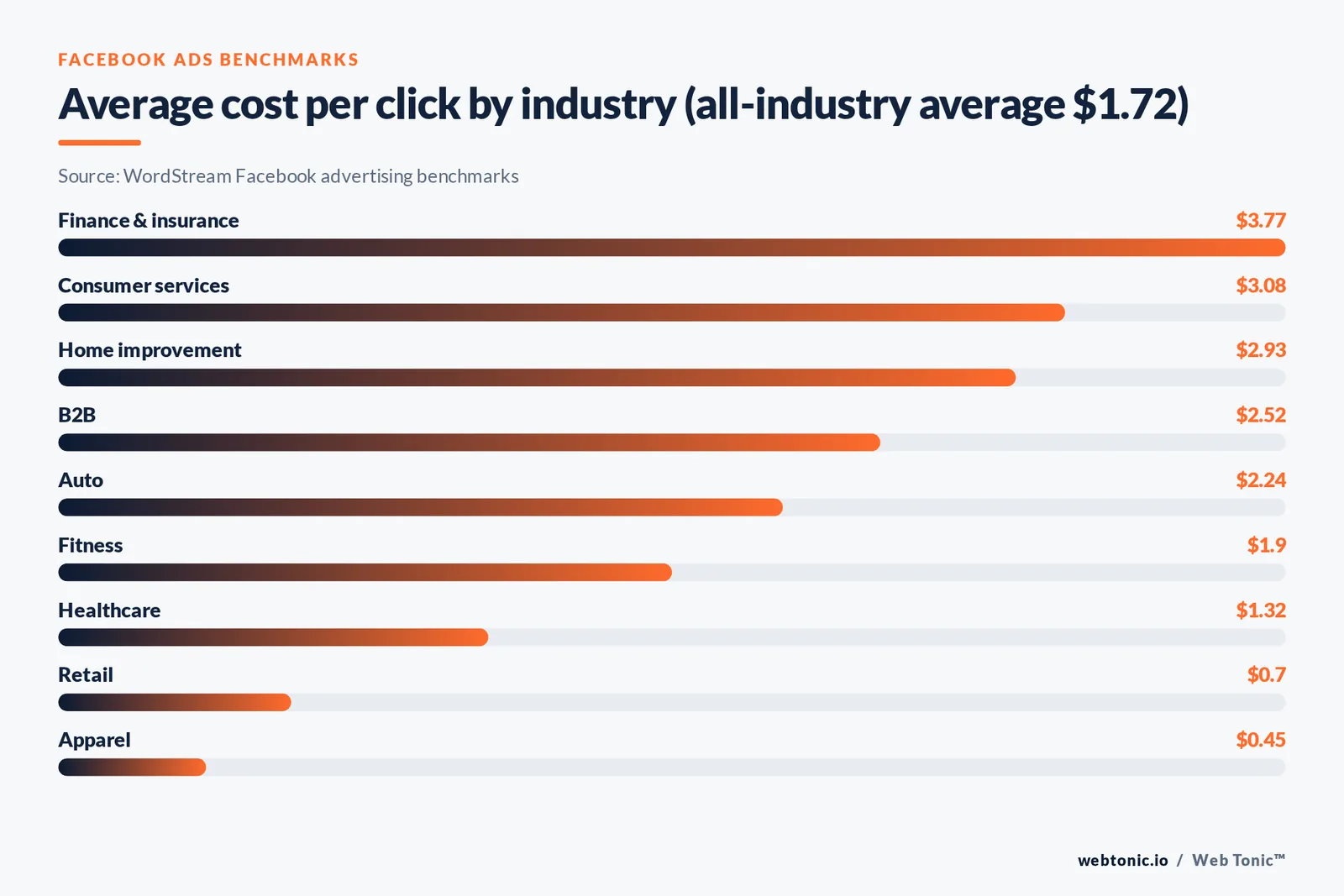
- Facebook ads average $1.72 CPC, 0.90% CTR and an $18.68 cost per action across industries, so judge Advantage+ against your own baseline, never against a blog average.
- Delivery only stabilises after roughly 50 optimised events in 7 days per ad set, which is why fragmented account structures break automation.
What Meta Advantage+ actually covers
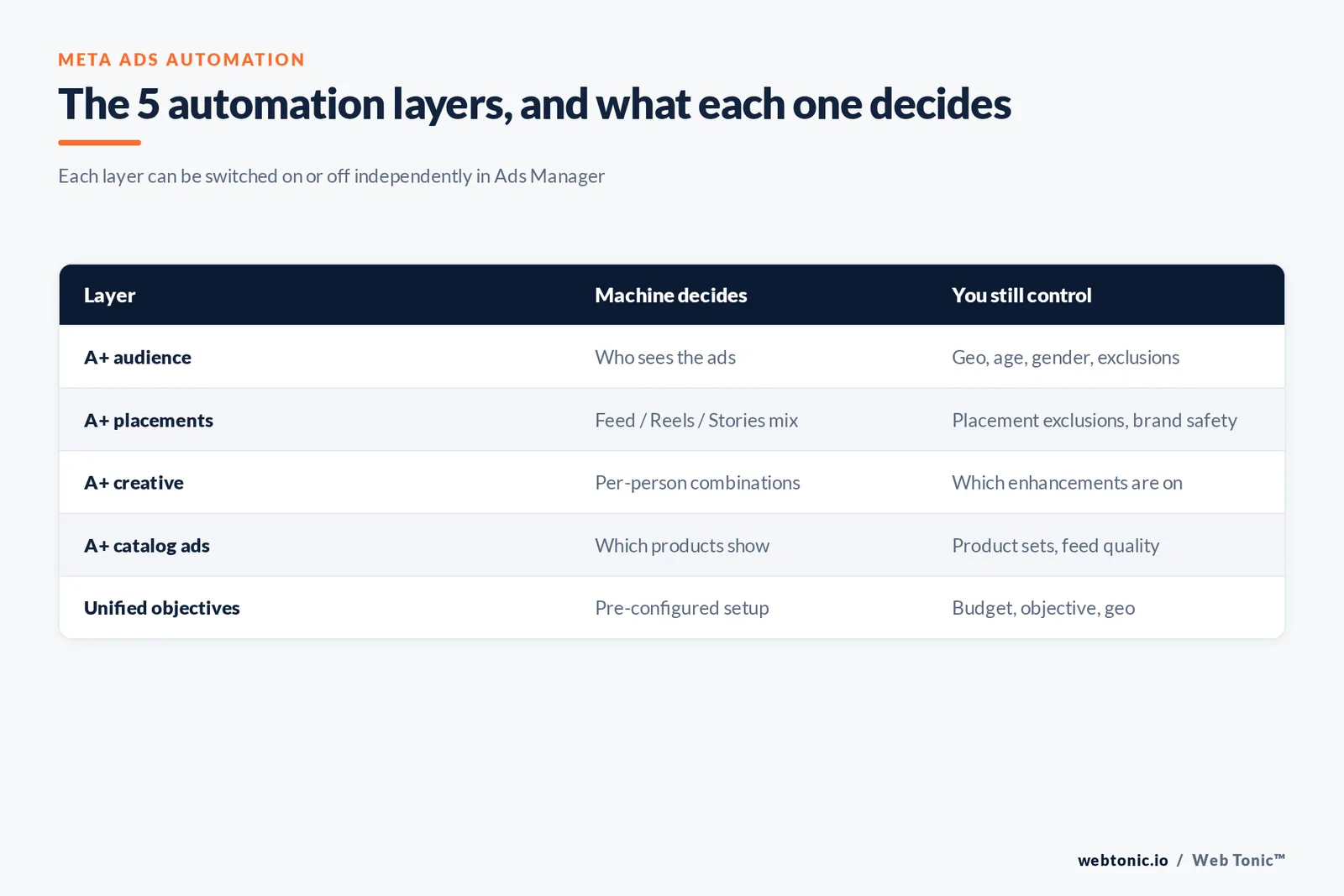
This is not one product. It is a set of automations that were built at different times and behave differently, which is why advertisers report wildly different results from "turning on Advantage+". The table below is the map. Everything else in this guide assumes you know which layer you are talking about.
| Layer | What the machine learning decides | Control you keep | Best first test |
|---|---|---|---|
| A+ audience | Who sees the ads; interests act as hints, not fences | Country/region, age floor, gender, exclusions | Prospecting where lookalikes have gone stale |
| A+ placements | Distribution across Feed, Reels, Stories, Messenger, Audience Network | Placement exclusions, brand safety inventory filter | Anything under 100 weekly conversions |
| A+ creative | Per-person creative combinations: crops, music, text, image touch-ups | Which enhancements are on, per ad | Direct response with a single strong asset |
| A+ catalog ads | Which products from the feed each person sees | Product sets, feed data quality, exclusions | Ecommerce with 50+ SKUs and clean feed data |
| Unified A+ objectives | Campaign creation is pre-configured with all automations on | Budget, objective, geo, existing-customer settings | Sales objectives replacing the legacy type |
Meta's own framing has shifted from "opt in to automation" to "opt out of it". As PPC Land documented, the campaign creation flow now assumes all three automation components are configured; the legacy path is being retired rather than maintained. Practically, that means the skill worth building is knowing the 4 or 5 switches you should still turn off, not resisting Advantage+ wholesale.
Automation versus manual setup: the honest pros and cons
The pros and cons depend almost entirely on how much conversion data your account produces each week. It trades your judgement for pattern matching, and pattern matching needs volume.
| Dimension | Automated | Manual setup | Verdict |
|---|---|---|---|
| Setup time | Roughly 10 minutes each | 1-3 hours with audience research | Wins for small teams |
| Audience precision | Broad, expands past your hints | Exact interest and lookalike control | Manual wins for niche B2B and regulated offers |
| Learning speed | Faster: fewer ad sets share the same 50-event threshold | Slower: each ad set learns alone | Wins under 200 monthly conversions |
| Creative diagnostics | Blurry: combinations shift per person | Clean read per asset | Manual wins when you need creative learnings |
| Incrementality risk | Higher: can re-buy existing customers | Lower with explicit exclusions | Manual wins unless you gate on new customers |
| Cost efficiency | Reported 28% cheaper per result on the audience layer | Depends on audience research quality | Wins on reported cost per result |
Trap 1 — averages are not baselines. Cross-account benchmarks from WordStream put the all-industry Facebook cost per action at $18.68, but the same dataset ranges from $7.85 in education to $55.21 in technology. A 20% swing after switching to Advantage+ only means something against your own trailing 30 days.
How Meta's machine learning decides who sees your ads
Delivery is an auction-time prediction problem, not a targeting list. Every impression is scored on predicted action rate multiplied by bid, adjusted for perceived ad quality. The inputs below are the ones you can actually influence.
| Signal | Where it comes from | How to improve it this month |
|---|---|---|
| Conversion events | Pixel plus server-side Conversions API | Send server events with email, phone and click ID |
| Event match quality | Customer parameters attached to each event | Raise match quality toward the 8.0+ band |
| Creative engagement | 3-second views, holds, saves, comments | Ship 4-6 new hooks per month, not variants |
| Catalog data | Product feed titles, images, availability | Fix missing fields; target 95%+ feed completeness |
| Ad quality ranking | Perceived quality versus competing ads | Drop clickbait framing; Hootsuite notes rankings are grouped into 5 cohorts |
Rule 2 — feed the model before you trust it. Privacy changes since app tracking transparency cut the browser signal that automation depends on, and Hootsuite's cost analysis shows how sharply delivery costs move with signal quality and seasonality: it recorded average CPMs of $5.61 against Black Friday spikes and notes Meta may spend up to 75% above your daily budget on high-opportunity days.
Which switches to flip, by account stage
This is the route table we use inside growth marketing engagements. Read your own monthly conversion count first, then take that row.
| Monthly conversions | Enable | Keep manual | Why |
|---|---|---|---|
| Under 30 | Placements, creative enhancements | Audience, budget splits | Too little data to beat a tight interest set |
| 30-100 | Placements, creative, broad audience on one prospecting campaign | Retargeting exclusions | One ad set can now clear the 50-event learning threshold |
| 100-500 | All layers plus one unified sales campaign | A single ABO creative-testing campaign | You need clean creative reads while automation scales spend |
| 500+ | Everything, with existing-customer budget caps | Incrementality holdouts | Reported efficiency at this spend level hides re-purchase inflation |
Limit 3: two variables, never three. Change one layer at a time and hold budget flat for 7 days. Teams that flip audience, placements and creative in the same week cannot attribute the outcome, and Meta's own delivery reset means the first 3-4 days of data are unusable.
Creative combinations: what the machine does to your assets
The third layer is where advertisers get surprised, because the system edits the ad. Each enhancement is per-ad and reversible, so audit them before launch rather than after a brand complaint.
| Enhancement | Effect on the ad | Leave on when | Turn off when |
|---|---|---|---|
| Standard enhancements | Brightness, contrast, subtle crops | Lifestyle photography | Colour-critical products or strict brand palettes |
| Text improvements | Swaps headline and primary text positions | Generic offer copy | Regulated claims and legal disclaimers |
| Music and animation | Adds soundtrack or motion to statics | Reels-heavy delivery | B2B or bereavement-sensitive categories |
| Catalogue item overlays | Adds price or shipping badges | Prices are accurate in the feed | Feed prices lag your site |
| Aspect ratio adaptation | Reformats 1:1 into 9:16 | Safe margins exist in the asset | Text sits near the edges |
Format matters more than polish. Socialinsider's 2026 Facebook benchmark study found Reels the most engaging organic format at 0.13% in Q2 2026 while link posts sat flat at 0.05%, and brands cut publishing volume by 22% to 39 posts per month. The paid lesson is the same: vertical, motion-first assets are what automation has the most room to work with. Our performance creative team plans asset batches around exactly that split.
The account structure that lets the model work
Consolidated delivery matters here. Every extra ad set divides the same conversion volume and pushes each one further from stable delivery. The consolidated structure below is what most accounts under 500 monthly conversions should run.
| Campaign | Budget model | Ad sets | Job |
|---|---|---|---|
| A+ sales or leads | CBO, 60-70% of spend | 1 | Scale what already converts |
| Creative testing | ABO, 20-30% of spend | 2-3 | Read new hooks cleanly |
| Retention and retargeting | CBO, 10-15% of spend | 1-2 | Warm buyers with explicit exclusions |
Fact 4 — consolidation is arithmetic. An account with 120 monthly conversions split across 8 ad sets averages 15 events per ad set per month, which is roughly a third of what stable delivery needs. Collapse it to 3 ad sets and the same account clears the threshold. Sprout Social's advertising guide and Buffer's ads primer both land on the same conclusion from different angles.
The 2026 migration off legacy shopping campaigns
If you still run legacy Shopping or App campaign types, they are on a clock. The published timeline matters because the migration is not cosmetic: audience configuration changes from lookalike stacks to constraints-plus-hints.
| Milestone | What changes | Action for advertisers |
|---|---|---|
| Oct 2025 announcement | Deprecation of legacy shopping and app campaign APIs announced | Inventory every legacy campaign |
| Marketing API v25.0, Q1 2026 | Creating new legacy campaigns blocked across all API versions | Build replacements under the unified objectives |
| Around v26.0, late 2026 | Remaining legacy campaigns expected to be auto-paused | Finish migration before the sweep |
| Ongoing | Unified objectives default to broad audience | Convert lookalikes into exclusions and interest hints |
Rule 5 — run new alongside old for 24 hours. Launch the replacement campaign paused, compare configuration, then activate at the same daily budget the legacy campaign held. Do not stack both at full budget: you will bid against yourself in the same auctions.
Benchmarks for judging whether it is working
The platform's own reporting flatters itself, so pick metrics that automation cannot inflate. The first four rows below are the ones we put on client dashboards.
| Metric | Reference point | What a bad reading means |
|---|---|---|
| New-customer share of purchases | Target 60%+ for prospecting campaigns | Delivery is re-buying existing customers |
| Cost per action | All-industry average $18.68 | Offer or landing page, not targeting |
| Cost per click | All-industry average $1.72; apparel $0.45, finance $3.77 | Creative fatigue or audience too narrow |
| Click-through rate | All-industry average 0.90%; legal 1.61% | Hook is not stopping the scroll |
| Conversion rate | All-industry average 9.21%, fitness 14.29% | Post-click experience is leaking |
| Frequency | Keep under 3.0 per 7 days on prospecting | Audience constraints are too tight |
Reach context matters too. DataReportal's 2026 global overview and Statista's Facebook advertising topic page both show a platform whose addressable audience is still growing while attention fragments across formats, which is precisely the condition these tools are designed for.
Seven mistakes that cost real money
| Mistake | What it looks like in Ads Manager | Fix |
|---|---|---|
| No customer list uploaded | Existing-customer budget cap unavailable | Upload and refresh the list monthly |
| Interests treated as fences | Delivery spends outside your hints | Accept expansion or move it to a manual ad set |
| One asset per campaign | Frequency above 4 within 10 days | Ship 4-6 fresh hooks per month |
| Editing budgets daily | Permanent "learning" status | Change budget at most 20% every 3 days |
| Browser pixel only | Low event match quality score | Add server-side events |
| All enhancements on for regulated offers | Rejected or reworded ads | Disable text improvements; check the FTC advertising rules |
| Judging week one | Panic pause on day 3 | Hold for 14 days or 50 events, whichever comes first |
A 30-day rollout plan
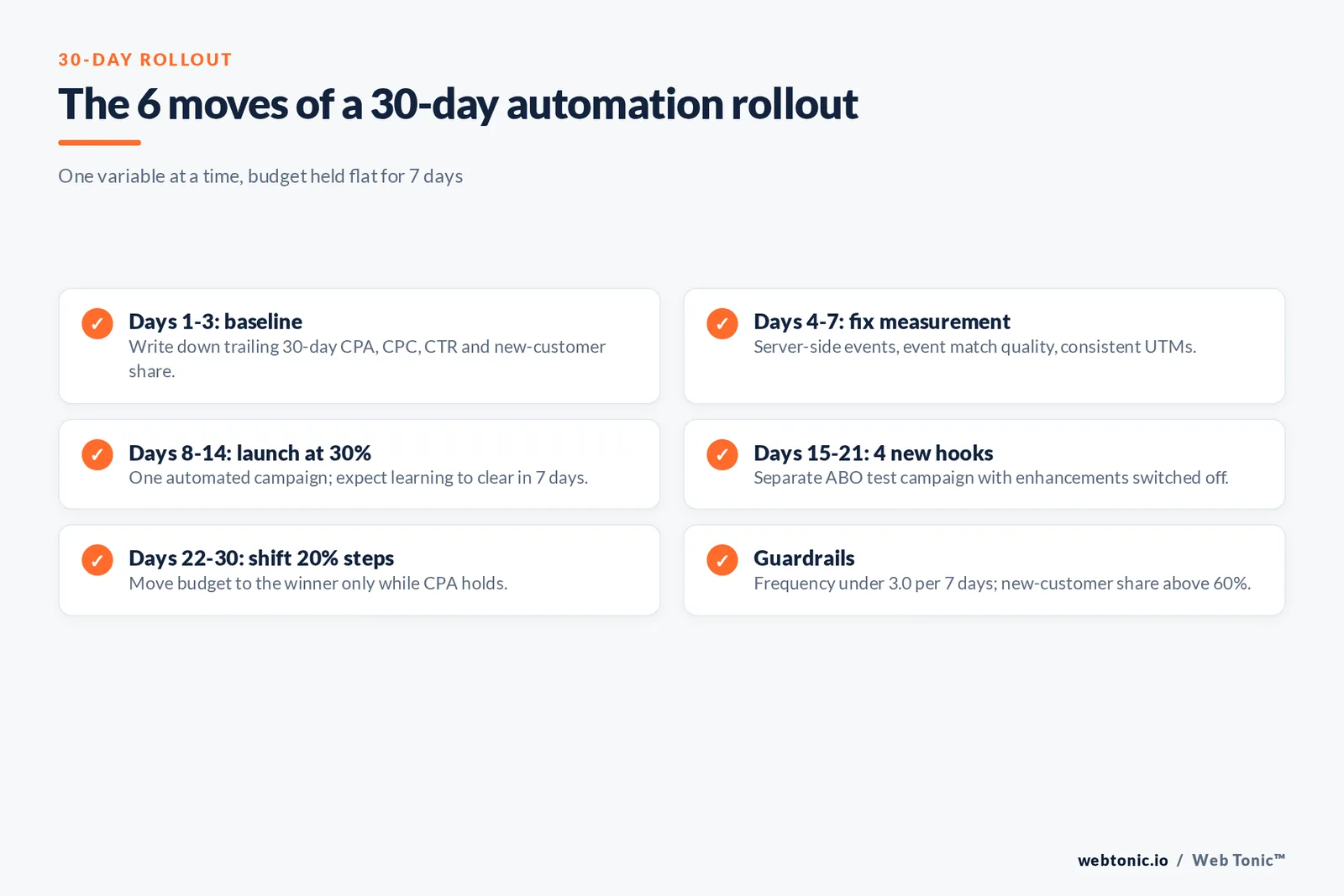
This is the sequence we run when an account moves from manual ad sets to the automated flow without losing the ability to read what happened. It works the same way for lead generation businesses as for ecommerce, and it pairs well with the event-driven approach in our Facebook ads for events guide.
| Days | Move | Success signal |
|---|---|---|
| 1-3 | Baseline trailing 30-day CPA, CPC, CTR, new-customer share | Numbers written down before any change |
| 4-7 | Fix measurement: server events, match quality, UTM structure | Event match quality improving |
| 8-14 | Launch one at 30% of budget | Ad set exits learning within 7 days |
| 15-21 | Add 4 new creative hooks in an ABO testing campaign | At least 1 hook beats the control |
| 22-30 | Shift budget in 20% increments toward the winner | CPA flat or better at higher spend |
None of this is a substitute for a plan; Think with Google's automation research makes the same point across channels, and Shopify's Facebook ads guide is a decent primer if you are setting up a first store campaign. If you would rather hand the whole loop over, that is what our performance media services exist for — or just tell us what is broken.

FAQ
What are the main benefits of Meta Advantage+ campaigns?
Faster setup, fewer ad sets competing for the same conversion data, and delivery decisions made at auction time rather than in a spreadsheet. Hootsuite reports the audience layer alone averages 28% lower cost per result than hand-built stacks. The practical benefit for small teams is time: setup drops from hours to roughly ten minutes.
What are the drawbacks?
Three real ones. Creative diagnostics get blurry because combinations differ per person, incrementality risk rises because delivery happily re-buys existing customers, and niche or regulated advertisers lose the precision that made their manual audiences work. Keep one manual testing campaign running so you never lose the clean read.
How does creative testing work inside these campaigns?
Meta assembles per-person creative combinations from your assets and enhancements, so ad-level results reflect a mix rather than a fixed variant. To test properly, run new hooks in a separate ABO campaign with enhancements off, then promote the winner into the automated campaign once it beats the control.
Is it suitable for every advertiser?
No. Accounts under about 30 monthly conversions usually do better with the placements and creative layers only, keeping the audience manual until volume arrives. Very niche B2B, high-ticket services and special ad category advertisers should expect to keep more manual control than an ecommerce brand does.
Do I have to migrate off the legacy shopping type?
Yes. Creating new legacy shopping and app campaigns was blocked at Marketing API v25.0 in early 2026, and remaining campaigns are expected to be auto-paused around v26.0. Rebuild them under the unified objectives, convert lookalikes into exclusions plus interest hints, and match the old daily budget when you switch.
Sources
Hootsuite, Facebook ads cost analysis (Advantage+ audiences cost per result, CPM, budget pacing) · WordStream, Facebook advertising benchmarks (CTR, CPC, CVR, CPA by industry) · Socialinsider, Facebook benchmarks 2026 (engagement by format, posting volume) · PPC Land, Meta legacy campaign API deprecation timeline · Sprout Social, Facebook advertising guide · Buffer, Facebook ads resource · Statista, Facebook advertising topic · DataReportal, Digital 2026 Global Overview · Think with Google, marketing automation · FTC, advertising FAQs for small business · Shopify, Facebook ads guide. Figures cited as published by each source; verify against your own account data before acting.