Table of contents
77% of aesthetic practices still describe differentiation as moderately to extremely challenging — unchanged from 2025 — while 25 brands absorb 95% of all AI citation share in U.S. aesthetic medicine. Branding in this category is no longer a design exercise; it is the only variable left once the molecules, the machines and the price cards converge.
Key Takeaways
- 77% of practices report differentiation as moderately to extremely challenging in 2026 — flat versus 2025 (survey of 81 practice owners and marketing managers).
- The top 25 brands hold 95% of AI citation share in U.S. aesthetic medicine; the other ~11,500 facilities (96% of med spas) split under 5%.
- AbbVie/Allergan controls 47% and Galderma 33% of drug-and-device AI citations — 80% between two companies.
- Botox scores 95/100 on citation share; marketplace RealSelf scores 86, higher than every med spa chain and dermatology group in the index.
- Botox pricing clusters at $9.69–$18.88 per unit (median $12.23) — a 1.9x spread on the category’s anchor product.
- Practices with a coherent brand are reported to convert leads at 2–3x the rate of generic positioning.
- First-visit trust: 45% rate a generic practice “very trustworthy” versus 78% for a strongly branded one — a 73% lift.
- Referral rate moves from 12–18% to 25–40%, and Botox price premiums of 30–50% become defensible.
- 46.1% of people form a credibility opinion from visual design alone; 75% recognise a brand from its logo.
- Consistent brand presentation is associated with a +23% revenue lift (650-company study), rising to +27% across 8+ digital channels.
- Modernising a logo lifts trust perception +42% to +46% on average and +54% in healthcare.
- 66% of consumers now avoid brands with visually stale identities; under-35s are 2.3x more likely to walk.
- 93% expect continuity in a redesign; ignoring it cost brands 18% favourability while preserving anchors gained 12%.
- 87% of patients say before-and-after photos matter; 84% trust a brand more when marketing includes real client content.
- Median blended acquisition cost is $68 against a median lifetime value of $2,339 — an LTV:CAC of 34.
- The median practice leaks 13.2% of gross revenue to discounts (interquartile range 6.9%–21.2%).
- Supply keeps rising: 10,488 U.S. locations in 2023 (from 8,899 in 2022), with roughly 13,000 projected by end-2026.
The Differentiation Number That Refuses to Move
The single most useful branding statistic in aesthetics is a complaint. In the 2026 State of Aesthetic & Elective Wellness Marketing report — built from a Q4 2025 survey of 81 practice owners, managers and marketing managers — 77% of practices said differentiation was moderately to extremely challenging, and that figure did not budge from 2025 despite higher marketing investment and faster technology adoption. Spend went up. Distinctiveness did not.
The structural reason is visible in the price card. CorralData’s H1 2026 benchmark of 100+ aesthetic brands across 54 dimensions found Botox pricing clustered between $9.69 and $18.88 per unit with a median of $12.23 — a 1.9x total spread, narrower than the spreads on retention, productivity or acquisition cost. When the market prices your anchor product for you, the brand is the P&L. Meanwhile supply keeps compounding: AmSpa counted 10,488 U.S. locations in 2023, up from 8,899 a year earlier, and projections put the count near 13,000 by the end of 2026.
| Structural pressure | 2026 figure | What it does to branding |
|---|---|---|
| Practices finding differentiation hard | 77% (flat vs 2025) | Positioning, not spend, is the bottleneck |
| Botox price spread per unit | $9.69–$18.88 (median $12.23) | Product parity — price cannot carry the brand |
| U.S. med spa locations | 10,488 (2023) → ~13,000 (2026E) | More local competitors per patient every year |
| Median revenue per location per month | $212K (cohort) vs ~$117K (AmSpa avg) | Branded operators run ~1.8x the industry average |
| Discount leakage, median practice | 13.2% of gross revenue | Weak brands buy volume with margin |
| Median blended CAC / LTV | $68 / $2,339 (LTV:CAC 34) | Small conversion gains compound hard |
The Brands You Actually Compete With Are Molecules
The most consequential branding data of 2026 came from an unexpected direction: AI answers. The Med Spa & Aesthetic Medicine AI Visibility Index scored 92 candidate brands across five engines on patient-intent prompts and found that the top 25 brands hold 95% of citation share. The remaining ~11,500 facilities — 96% of every med spa in America — split the leftover 5%.
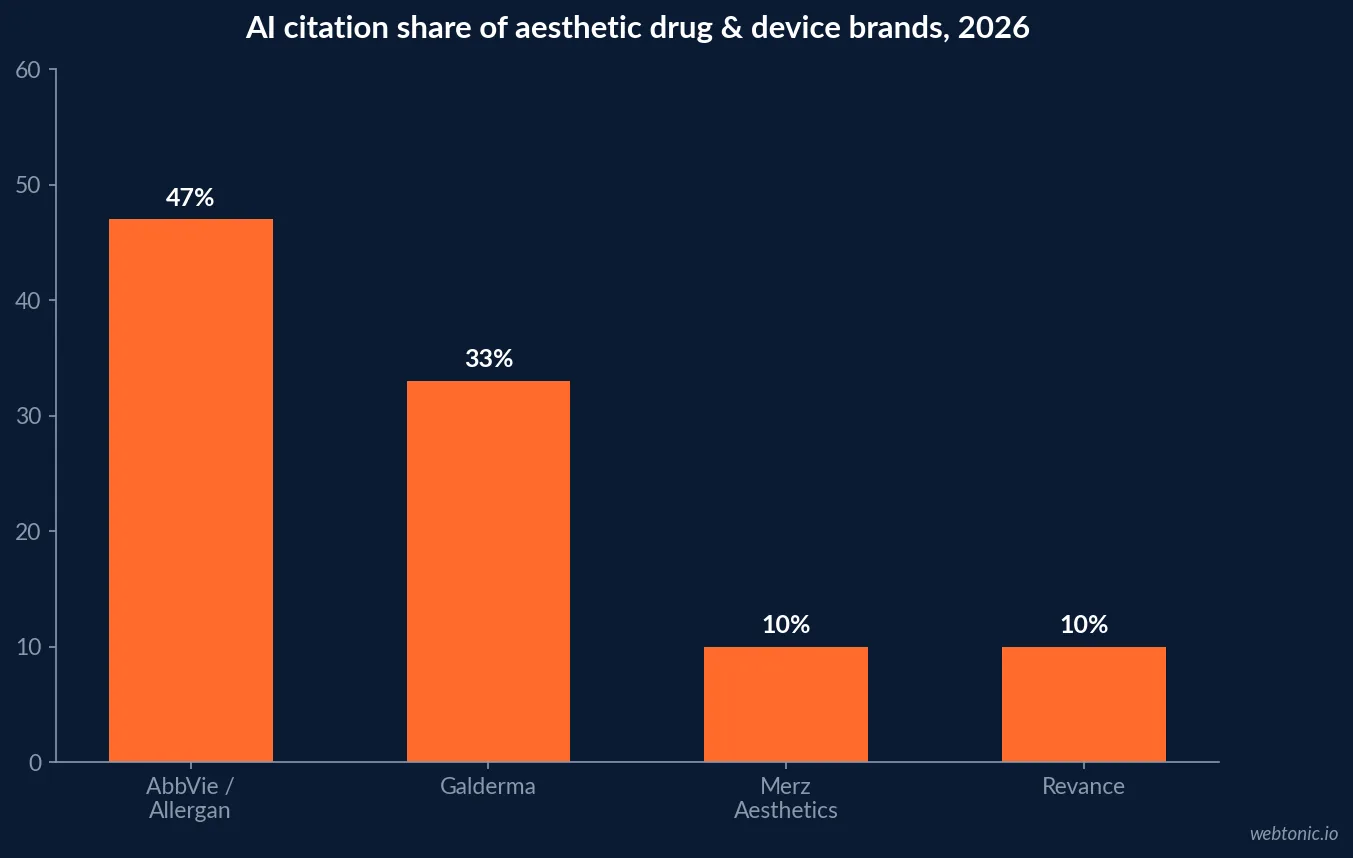
Strip out chains and marketplaces and the concentration is starker: four manufacturers hold every drug-and-device citation, with AbbVie/Allergan at 47% (Botox, Juvederm, CoolSculpting, Kybella) and Galderma at 33% (Dysport, Restylane, Sculptra) — 80% between two companies — while Merz and Revance split the remaining 20%. Botox scored 95/100, the highest in the index, because the drug, the brand and the category are the same word in an AI answer about wrinkles.
Two findings should reset how clinic owners think about brand investment. First, scale does not buy citations: LaserAway (190+ locations, $200M+ revenue) scored 72 and Milan Laser (350+ locations) scored 54, both below the marketplace RealSelf at 86. Second, medical authority does: Schweiger Dermatology (35), U.S. Dermatology Partners (23) and Forefront Dermatology (20) out-cited 19 of the 25 ranked brands. Device makers built around equipment rather than outcomes — Hydrafacial ($300M+ revenue, ~10,000 spas) and InMode (~$500M) — did not break the top 25 at all. If you want to be named in an AI answer, earned media, third-party authority and structured markup do more than another location. That is the same machinery behind med spa search visibility.
What a Coherent Brand Is Worth in the Consult Room
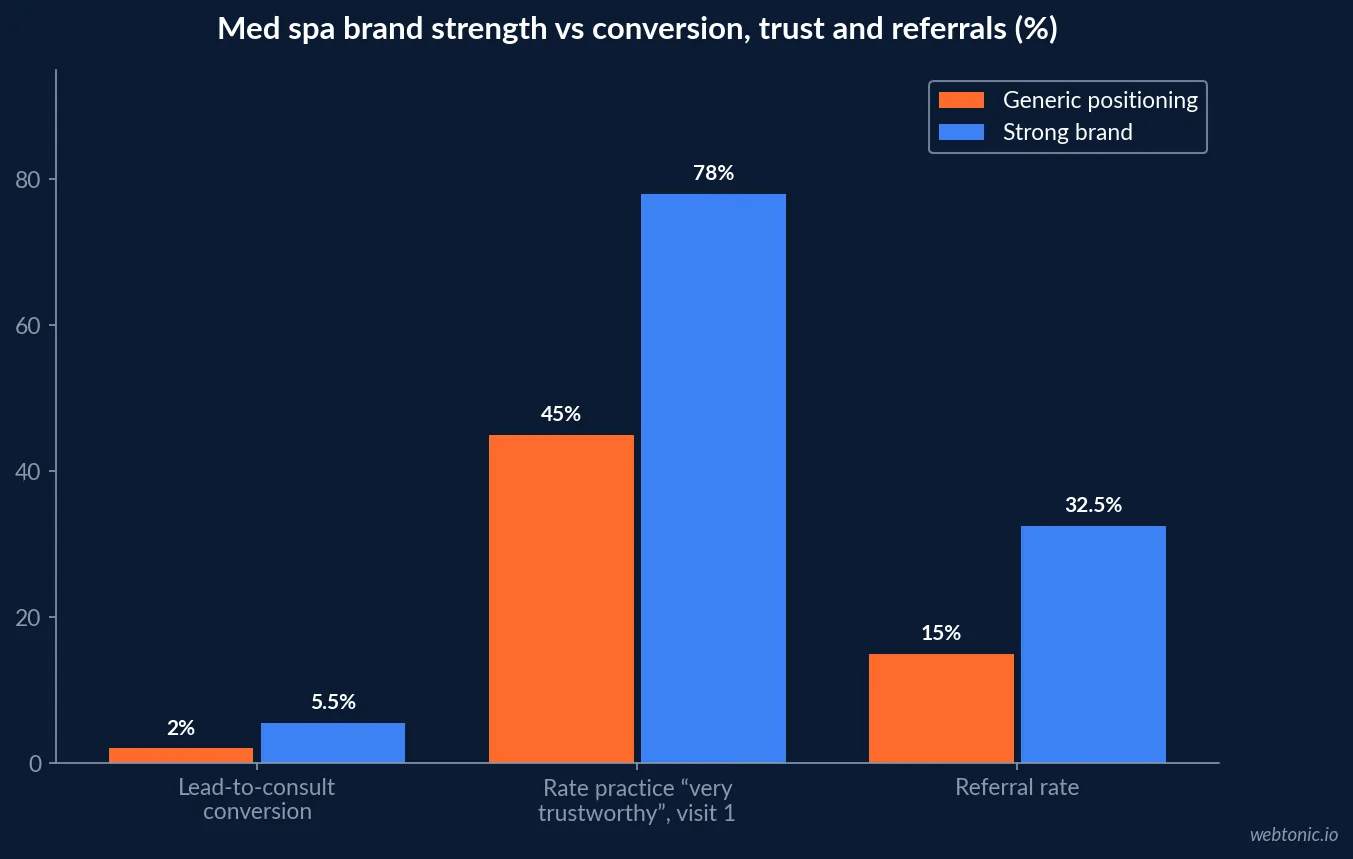
Brand effects in aesthetics land on four measurable lines. A 2026 med spa market briefing puts lead conversion for practices with a coherent brand at 2–3x generic positioning. Aesthetix Media’s comparison of generic versus strongly branded practices puts consult-to-booking at 1.5–2.5% versus 4–7%, first-visit trust at 45% versus 78% rating the practice “very trustworthy”, per-unit Botox pricing at $10–$12 versus $14–$18, and referral rate at 12–18% versus 25–40%.
| Metric | Generic positioning | Strong brand | Delta |
|---|---|---|---|
| Lead-to-consult conversion | 1.5–2.5% | 4–7% | 2–3x higher |
| Botox price per unit | $10–$12 | $14–$18 | 30–50% premium |
| Rate practice “very trustworthy” on visit 1 | 45% | 78% | +73% |
| Referral rate | 12–18% | 25–40% | ~2x higher |
| Discount dependence | Above 21.2% of revenue (top quartile) | Nearer 6.9% (bottom quartile) | Margin retained |
The reason those deltas matter so much is the underlying unit economics. CorralData puts median blended acquisition cost at $68 against a median lifetime value of $2,339 — an LTV:CAC of 34 — with the distribution spanning $4 to $717: injectable chains with referral flywheels acquire below $35, while consult-led surgical or body-contouring brands pay $400–$700 per patient. Brand strength is what decides which end of that range you live in, and it is why creative and brand work belongs in the same budget conversation as media.
Visual Identity: What the Research Supports
Design research is softer than operational data, but the direction is consistent. Roughly 46.1% of people form a credibility opinion from visual design alone — a judgement made before prices, credentials or reviews are read. A consistent colour palette can lift brand recognition by up to 80%, and 75% of consumers recognise a brand from its logo rather than its name.
Logo-redesign research updated for 2026 adds the numbers that matter for a rebranding decision: consistent logo use across touchpoints is associated with a +23% revenue lift (650 companies), rising to +27% for brands consistent across eight or more digital channels. Trust perception rises 42–46% after modernisation, and 54% in healthcare specifically — the highest of any vertical measured across 9,000 consumers in 18 markets. The risk side is equally quantified: 66% of consumers avoid visually stale brands, under-35s are 2.3x more likely to abandon one, and 93% expect a redesign to stay recognisably connected to the previous identity, with an 18% favourability drop for brands that broke continuity versus a +12% gain for those that preserved visual anchors.
| Identity signal | 2026 figure | Source population |
|---|---|---|
| Credibility judged on visual design alone | 46.1% | Consumer design research |
| Brand recognised from logo alone | 75% | Cross-category consumer survey |
| Recognition lift from consistent colour | Up to 80% | Colour-and-recognition studies |
| Revenue lift from consistent logo use | +23% (+27% across 8+ channels) | 650 companies |
| Trust lift after logo modernisation | +46% average, +54% healthcare | 9,000 consumers, 18 markets |
| Consumers avoiding stale visual identities | 66% (under-35s 2.3x more likely) | 4,200 adults |
| Expect continuity in a redesign | 93% | 8,300 consumers |
Proof Beats Polish: The Content Patients Judge
In aesthetics, brand credibility is carried by evidence more than by typography. Survey work compiled for 2026 found 84% of consumers trust a brand more when its marketing includes user-generated content — real testimonials and unscripted treatment video. Separate consumer research puts 87% of patients saying before-and-after photos matter when choosing a provider and 41% saying a provider’s social presence positively swayed them.
That is a brand-system requirement, not a content-calendar note: consent workflows, consistent lighting and framing, watermarking, and a treatment-page architecture where proof sits next to the claim. The formats that carry it are covered in our med spa ad creative benchmarks and med spa social media data.
Where Branded Operators Separate on Economics
The clearest evidence that brand is an operating asset sits in the revenue-per-door numbers. CorralData’s cohort generates a median $212K per location per month, against an AmSpa industry average nearer $117K — and the cohort’s median brand grew 19.2% versus an industry baseline around 6%. Scale was not the differentiator: the larger half of the cohort grew 19.2% at the median against 18.5% for the smaller half.
Two risk numbers belong beside those growth figures. The median brand earns 39.7% of revenue from its top 10% of clients (up to 66% at the extreme), and the median practice gives up 13.2% of gross revenue to discounts, with the interquartile range running 6.9% to 21.2%. Heavy discounting concentrated in a thin high-value cohort is the most fragile profile in the dataset — and it is usually a brand-strength problem being solved with price.
Building a Med Spa Brand That the Data Rewards
- Pick a wedge, not an adjective. With 77% of practices stuck on differentiation, “luxury” and “natural results” are table stakes. Anchor on a treatment category, a patient cohort or a clinical protocol you can defend.
- Build third-party authority, not just listings. Dermatology groups out-cited 19 of 25 indexed brands on MD authority alone — earned media, contributor bylines and structured markup drive AI citations that location count does not.
- Systematise proof. With 87% of patients weighing before-and-after evidence, a consent-and-capture workflow is brand infrastructure.
- Keep continuity in any rebrand. 93% of consumers expect recognisable links to the old identity; evolve the mark rather than replacing it.
- Instrument the brand. Track consult conversion, price realisation, referral share and discount rate as brand KPIs — see our med spa analytics benchmarks.
- Cut discount dependence deliberately. Moving from the top quartile (21.2%) toward the median (13.2%) is a direct margin recovery worth more than most media optimisations.
Med Spa Branding Benchmarks vs All Industries
Compared with the cross-industry branding picture, aesthetics is unusual in two ways: product parity is near-total, and the category vocabulary is owned by manufacturers. That compresses the space for positioning while raising the payoff for the practices that find one.
| Dimension | Med spa / aesthetics | All industries |
|---|---|---|
| Product differentiation | Near-zero — same four molecule families | Varies widely by category |
| Category naming power | Held by manufacturers (Botox scored 95/100) | Usually held by market leaders |
| AI citation concentration | Top 25 brands = 95% of share | Typically less concentrated |
| Revenue lift from brand consistency | 2–3x lead conversion reported | +23% revenue (cross-industry study) |
| Trust lift from identity modernisation | +54% (healthcare) | +46% (average across verticals) |
| Proof requirement | Before-and-after evidence (87% of patients) | Reviews and social proof generally |
Frequently Asked Questions
Does branding actually change med spa revenue, or is it just design?
The measurable effects show up in four places. Practices with a coherent brand are reported to convert leads at two to three times the rate of generic “medical spa” positioning; first-visit trust ratings roughly double (45% versus 78% rating a practice “very trustworthy”); Botox price premiums of 30–50% become defensible; and referral rates move from 12–18% to 25–40%. Against a median blended patient acquisition cost of $68 and a median lifetime value of $2,339, a two-point swing in consult conversion is worth more than any single ad optimisation.
Why is differentiation so hard in aesthetics in 2026?
Because the products are identical. Across practices with true per-unit line items, Botox pricing clusters between $9.69 and $18.88 per unit with a median of $12.23 — a 1.9x total spread on the category's anchor product. Every clinic within ten miles injects the same four molecules from the same four manufacturers. With supply also growing — 10,488 U.S. locations in 2023 and roughly 13,000 projected by the end of 2026 — the only variables left are brand, experience and operations. That is why 77% of practices still report differentiation as moderately to extremely challenging.
What is AI citation share and why does it matter for med spa branding?
It measures how often a brand is named when AI engines answer patient-intent questions. In the 2026 index of U.S. aesthetic medicine, the top 25 brands hold 95% of citation share; the remaining ~11,500 facilities — 96% of all med spas — split under 5%. Four manufacturers own every drug and device citation, with AbbVie/Allergan at 47% and Galderma at 33%. The practical read: local SEO does not equal AI visibility, and clinics get cited through third-party authority, earned media and schema rather than location count.
How much does a logo matter compared to the rest of the brand?
Enough to be worth doing properly, not enough to carry the brand alone. Roughly 46.1% of people form a credibility judgement on visual design alone, 75% of consumers recognise a brand from its logo, and a consistent colour palette can lift recognition by up to 80%. Modernising a logo is associated with a 42–46% lift in trust perception, rising to 54% in healthcare. But 93% of consumers expect a redesign to stay recognisably connected to the old identity — brands that ignored that continuity saw an 18% drop in favourability.
What should a med spa fix first if the brand feels generic?
Start with the assets patients actually judge: the positioning line, the treatment-page hierarchy, and the proof. Eighty-seven percent of aesthetic patients say before-and-after photos matter when choosing a provider and 84% say they trust a brand more when its marketing includes real client content. Then close the leakage: the median practice gives up 13.2% of gross revenue to discounts, with the top quartile above 21.2%. Discount depth is usually a brand problem wearing a pricing costume.
Sources
5WPR — Med Spa & Aesthetic Medicine AI Visibility Index 2026
CorralData — H1 2026 Aesthetics Industry Benchmark (100+ brands, 54 dimensions)
ScaleHaven — 47 Med Spa Industry Statistics for 2026
Emulent — Medical Spa Marketing Report: 2026–2028 Projections
Amra & Elma — Top 20 Logo Redesign Impact Statistics 2026
WebFX — 50+ Branding Statistics for 2026
iBrand Media — Why Branding Matters for Med Spas in 2026
Aesthetix Media — Med Spa Logo Design: Trends & Best Practices
Aesthetic Marketing — Med Spa Marketing Statistics 2026
American Med Spa Association — Industry Report