Table of contents
The medical spa industry has grown into a $22.1 billion global market projected to exceed $36 billion by 2030, and organic search sits at the center of how prospective patients discover and evaluate aesthetic providers. For practice owners and marketing teams, understanding how med spa SEO performs in 2026 is essential for allocating budget, setting realistic timelines, and benchmarking against competitors. This article compiles 35+ verified statistics covering local search visibility, organic traffic benchmarks, content marketing ROI, and conversion patterns specific to the medical aesthetics vertical.
Key Takeaways
- 93% of med spa patient journeys start with a search engine, with Google capturing the vast majority of aesthetic treatment queries.
- "Med spa near me" searches have grown over 200% in the past three years, reflecting rising consumer demand for local aesthetic services.
- Organic search delivers a cost per booked appointment of $8–$25, making it the lowest-cost acquisition channel for established practices.
- Med spas with 100+ Google reviews receive 3.2× more clicks from local search than those with fewer than 20 reviews.
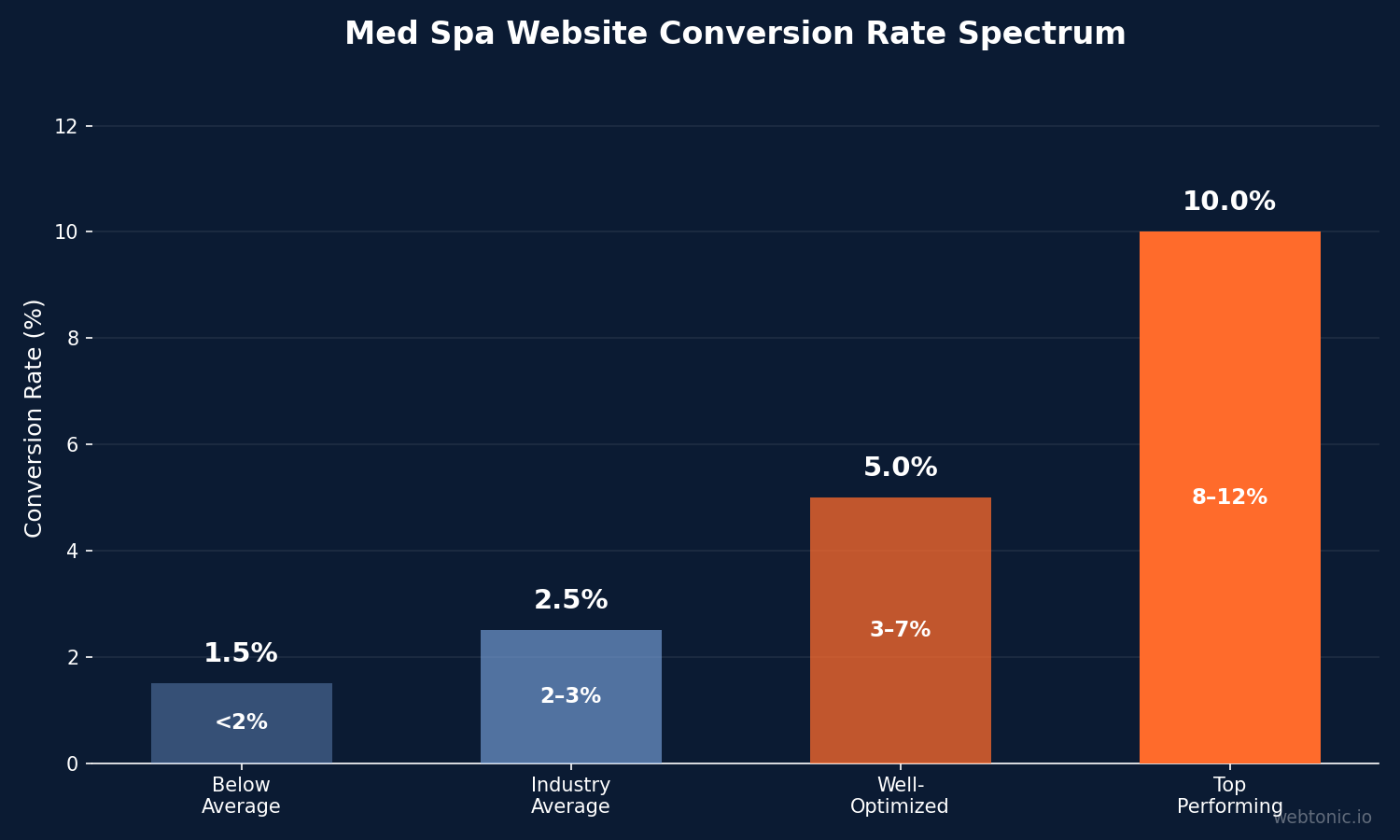
- Average organic conversion rates for well-optimized med spa pages sit at 3–7%, while top-performing sites reach 8–12% through trust signals and friction-reduced booking.
- Content marketing generates 3× more leads than paid advertising at 62% lower cost for aesthetic clinics investing in educational content.
- E-E-A-T author attribution on treatment pages captures 2.1× more organic patient inquiries than pages without verified provider credentials.
Med Spa SEO Benchmarks at a Glance
| Metric | Benchmark | Source |
|---|---|---|
| Organic cost per appointment | $8–$25 | Queen City Growth Lab |
| Avg. organic conversion rate | 3–7% | Authority Specialist |
| Top-performing site conversion | 8–12% | AesthetixMedia |
| "Med spa near me" search growth | 200%+ (3 yr) | SkyHighway Marketing |
| Reviews for 3.2× local clicks | 100+ Google reviews | ScaleHaven / BrightLocal |
| Revenue allocated to marketing | 8–12% | AmSpa Benchmark Report |
| E-E-A-T author attribution lift | 2.1× more inquiries | Authority Specialist |
| Content mktg. lead gen vs. paid | 3× more leads, 62% lower cost | Aesthetic Launch Lab |
Local Search and Google Business Profile Statistics
Local SEO dominates patient acquisition for med spas because aesthetic treatments are inherently location-dependent. Patients search for providers within driving distance, making Google Business Profile optimization and map pack visibility critical growth levers.
- 46% of all Google searches carry local intent, and that share rises further for treatment-specific queries like "Botox near me" or "laser hair removal [city]." (Backlinko)
- Med spas with 100+ Google reviews receive 3.2× more clicks from local search results than those with fewer than 20. (ScaleHaven)
- Review recency matters more than raw count — a clinic with 8 five-star reviews posted last week can outrank one with 60 four-star reviews from two years ago. (Sprout Sage Solutions)
- Practices ranking in the local three-pack capture a disproportionate share of ready-to-book patients, with click-through rates 5–10× higher than positions outside the top three. (Authority Specialist)
- Google Business Profile photo views correlate with patient engagement — med spas posting monthly before-and-after galleries see 35% more direction requests than profiles with outdated imagery. (ScaleHaven)

Organic Traffic and Keyword Trends
Search demand for med spa services continues to accelerate as consumer awareness of non-surgical aesthetic treatments expands. Understanding which queries drive volume helps practices prioritize their digital marketing strategy and content calendar.
| Keyword | Monthly Searches (U.S.) | CPC |
|---|---|---|
| medical spa | 165,000 | $4.74 |
| med spa near me | 110,000 | $6.36 |
| medical spa near me | 74,000 | $5.69 |
| medspa | 40,500 | $4.88 |
| botox near me | 201,000 | $7.12 |
| laser hair removal near me | 90,500 | $5.41 |
- "Med spa near me" searches have grown over 200% in the past three years, reflecting both rising consumer demand and increased awareness of non-surgical treatments. (SkyHighway Marketing)
- 65–80% of organic traffic to med spa websites comes from mobile devices, making mobile optimization a non-negotiable ranking factor. (Authority Specialist)
- Long-tail treatment queries convert at 2–3× the rate of broad terms — "microneedling for acne scars cost [city]" outperforms "med spa" in booking intent. (Authority Specialist)
Med Spa Conversion Rate Benchmarks
Driving organic traffic is only half the equation. The gap between average and top-performing conversion rates represents substantial revenue potential for practices willing to invest in landing page optimization, trust signals, and frictionless booking systems.
- Average med spa website conversion rate (visit-to-inquiry) sits at 2–3% across the industry, while best-in-class sites reach 8–12%. (AesthetixMedia)
- Well-optimized treatment pages with clear CTAs convert at 3–7% from organic traffic, with trust signals, social proof, and friction-reduced booking driving the upper range. (Authority Specialist)
- Consultation-to-booking rate is the critical revenue metric — industry average sits at 60–70%, while top clinics with strong confirmation sequences hit 80–85%. (ScaleHaven)
- A practice doing $100K/month at 2% website conversion leaves $300K–$500K on the table annually compared to optimizing to the 8% benchmark. (AesthetixMedia)
- Pages missing clear trust signals and social proof often convert below 2%, dragging down the overall organic ROI regardless of traffic volume. (Authority Specialist)
Content Marketing and E-E-A-T Statistics
Google's emphasis on Experience, Expertise, Authoritativeness, and Trustworthiness (E-E-A-T) carries outsized weight in the medical aesthetics vertical because treatment pages fall under Your Money or Your Life (YMYL) classification. Practices that build genuine content authority see measurable ranking and conversion advantages.
- Content marketing generates 3× more leads than paid advertising at 62% lower cost for aesthetic clinics investing in educational resources. (Aesthetic Launch Lab)
- Practices with verified E-E-A-T author attribution capture 2.1× more organic inquiries than those without provider credentials on treatment pages. (Authority Specialist)
- YMYL compliance gaps — specifically missing provider credentials — correlate with below-average organic click-through rates, reducing visibility even when rankings are decent. (Authority Specialist)
- Content authored by verified medical professionals sees 15–30% better ranking stability through Google core updates than unsigned or AI-only content. (Authority Specialist)
- 40–50% of a treatment page's authority signal now comes from E-E-A-T factors rather than traditional link metrics alone. (Authority Specialist)
SEO ROI and Patient Acquisition Costs
Med spa SEO delivers the lowest patient acquisition cost among digital channels, but ROI calculations require understanding lifetime value (LTV) rather than first-visit revenue alone. This section compares acquisition economics across channels to contextualize the organic search investment.
| Channel | Cost Per Booked Appointment | Lead Quality |
|---|---|---|
| Organic / SEO | $8–$25 | High (intent-driven) |
| Google Ads | $25–$75 | High (search intent) |
| Instagram Ads | $15–$40 | Medium (interest-based) |
| Referral / Word-of-Mouth | $0–$10 | Very High |
| Aggregator Leads | $50–$120 | Low–Medium |
- Organic search delivers a cost per funded appointment of $8–$25, making it the lowest-cost acquisition channel once SEO campaigns reach 6–9 months of maturity. (Queen City Growth Lab)
- Patient lifetime value for med spas averages $2,500–$7,500+, making even high initial acquisition costs profitable when factoring in repeat treatments and referrals. (Authority Specialist)
- The average med spa allocates 8–12% of revenue to marketing, with top-growth practices pushing toward 15% during expansion phases. (ScaleHaven)
Technical SEO and Site Performance
Technical health directly impacts both rankings and user experience for med spa websites. Mobile speed, schema markup, and HIPAA-compliant form handling are table-stakes requirements in the medical aesthetics space.
- Sites loading under 3 seconds retain 53% more visitors than those exceeding 5 seconds, a critical metric when mobile devices deliver the majority of aesthetic searches. (Authority Specialist)
- Structured data markup (LocalBusiness + MedicalBusiness schema) can improve click-through rates by 20–30% through enhanced search result display with ratings, hours, and treatment categories. (ScaleHaven)
- HIPAA-compliant booking forms must use TLS encryption and BAA-covered hosting — non-compliant forms expose practices to penalties up to $50,000 per violation. (Authority Specialist)
- Practices implementing AEO (Answer Engine Optimization) see early visibility gains in AI-generated search results, though measurement frameworks are still evolving. (Authority Specialist)
Case Studies and Growth Benchmarks
Real-world results illustrate what structured SEO programs deliver for med spa practices over defined timelines.
- Essex Med Spa increased site traffic from 173 to 786 monthly visitors (a 354% increase) and went from 2 to 14 monthly conversions through a targeted local SEO campaign. (Firestarter SEO)
- A Berlin aesthetic clinic grew organic bookings from 8 to 62 per month and built a 3-month waitlist, eventually cancelling paid ad spend entirely by month 8. (Omakaase)
- Practices investing in SEO for 12+ months see acquisition costs drop 45–65% below paid aggregator channels, with compounding returns as domain authority builds. (Authority Specialist)
Best Practices for Med Spa SEO in 2026
- Claim and fully optimize your Google Business Profile — ensure NAP consistency, add treatment categories, post weekly updates with before-and-after photography, and actively manage reviews.
- Build treatment-specific landing pages targeting "[treatment] + [city]" keyword patterns with unique content, provider credentials, and clear booking CTAs.
- Implement verified E-E-A-T signals — display practitioner photos, credentials, medical board verifications, and author bylines on every treatment page.
- Prioritize mobile experience — ensure sub-3-second load times, tap-friendly booking buttons, and click-to-call functionality across all pages.
- Create educational content addressing patient concerns — cost guides, recovery timelines, treatment comparisons, and FAQ pages that target long-tail informational queries.
- Earn local citations and healthcare-specific backlinks — directory listings on RealSelf, Healthgrades, and Zocdoc strengthen local authority signals.
- Monitor and respond to every Google review — review velocity and recency are stronger ranking signals than total count in the medical spa vertical.
FAQ
How long does it take for med spa SEO to show results?
Most med spa SEO campaigns begin showing measurable traffic improvements within 3–6 months, with meaningful patient acquisition cost reductions appearing at the 6–9 month mark. Competitive markets may require 9–12 months before consistently ranking in the local three-pack for high-value treatment keywords.
What is a good organic conversion rate for a med spa website?
The industry average sits at 2–3%, while well-optimized sites with strong trust signals, clear CTAs, and friction-reduced booking convert at 3–7%. Top-performing practices reach 8–12% through strategic page design and social proof integration.
How many Google reviews does a med spa need to rank in the Map Pack?
Research suggests 15–25 reviews as a baseline for map pack eligibility, but review velocity and recency matter more than raw count. A clinic with 8 recent five-star reviews can outrank competitors with 60 older reviews. Practices with 100+ reviews see 3.2× more local search clicks.
Is SEO or paid advertising better for med spa patient acquisition?
SEO delivers the lowest long-term cost per booked appointment ($8–$25) compared to Google Ads ($25–$75) and Instagram Ads ($15–$40). However, paid channels provide immediate visibility while SEO builds momentum. Most successful practices combine both, shifting budget toward organic as SEO matures.
How much should a med spa spend on marketing?
The American Med Spa Association reports that the average practice allocates 8–12% of revenue to marketing. Growth-phase practices often push to 15%, with SEO typically receiving 25–35% of the total digital marketing budget once the channel proves ROI.
Sources
authorityspecialist.com/industry/health/medical-spa/seo-statistics
authorityspecialist.com/industry/health/aesthetic-clinics/seo-statistics
scalehaven.io/blog/med-spa-industry-statistics/
queencitygrowthlab.com/blog/cost-per-booked-appointment-2026
blog.skyhighwaymarketing.com/med-spa-marketing-statistics-2026/
aesthetixmedia.com/blog/best-medspa-websites
sproutsagesolutions.com/how-many-google-reviews-medspa-map-pack/
aestheticlaunchlab.com/blog/content-marketing-roi-aesthetic-clinics
firestarterseo.com/case-studies/essex-med-spa
scalehaven.io/blog/local-seo-for-med-spas/