



Table of contents
Key Takeaways
- Med spa Meta Ads CPL ranges from $18 to $42 depending on creative quality and offer structure (ScaleHaven).
- Before-and-after creative remains the highest-performing ad format in the aesthetics industry when compliant with platform policies (Powerhouse Media).
- Meta Ads beauty/cosmetics average CTR is 1.58%, while optimized medspa campaigns achieve 2.5%–3.8% (Pennock).
- 68% of med spa patients say before-and-after photos are the most influential factor in choosing a provider (ScaleHaven).
- The average med spa spends 8–14% of gross revenue on marketing, with top-growth practices spending up to 16% (ScaleHaven).
- UGC-style ad creative often outperforms highly produced content on Meta platforms because it feels native to the feed (Powerhouse Media).
- Med spas responding to leads within 5 minutes are 21× more likely to convert (ScaleHaven).
Medical Spa Ad Creative Benchmarks at a Glance
| Metric | Value | Source |
|---|---|---|
| Meta Ads CPL (med spa) | $18–$42 | ScaleHaven 2026 |
| Meta Ads CTR (beauty/cosmetics) | 1.58% | Pennock |
| Optimized medspa Meta CTR | 2.5%–3.8% | Pennock |
| Meta Ads CVR (beauty) | 5.93% | Pennock |
| Meta Ads CPC (beauty) | $0.77 | Pennock |
| Google Ads CPC (medspa) | $2.62–$10+ | Pennock |
| Google Ads CTR (health) | 3.27% | Pennock |
| In-platform CPL (Meta forms) | $15–$50 | Pennock |
| Cost per booked consultation | $65–$180 | ScaleHaven 2026 |
| Marketing budget (% of revenue) | 8–14% | ScaleHaven / AmSpa |
Why Ad Creative Is the Biggest Performance Lever for Med Spas
In medical spa advertising, creative quality determines success more than targeting or budget decisions. As Powerhouse Media states, creative is the single biggest performance lever in Meta advertising — often more impactful than targeting or budget decisions. This is because Meta's algorithm has evolved to reward creative diversity and penalize creative fatigue, regardless of production quality.
The aesthetics industry is uniquely positioned to capitalize on visual advertising. ScaleHaven reports that 68% of med spa patients say before-and-after photos are the most influential factor in choosing a provider, and 72% of aesthetic patients research treatments online before booking. This means the creative assets in your ad campaigns are directly shaping purchasing decisions — not just generating awareness. For medical spas seeking comprehensive creative strategies, our performance creative services cover ad design alongside broader paid media.
Meta Ads Creative Performance for Medical Spas
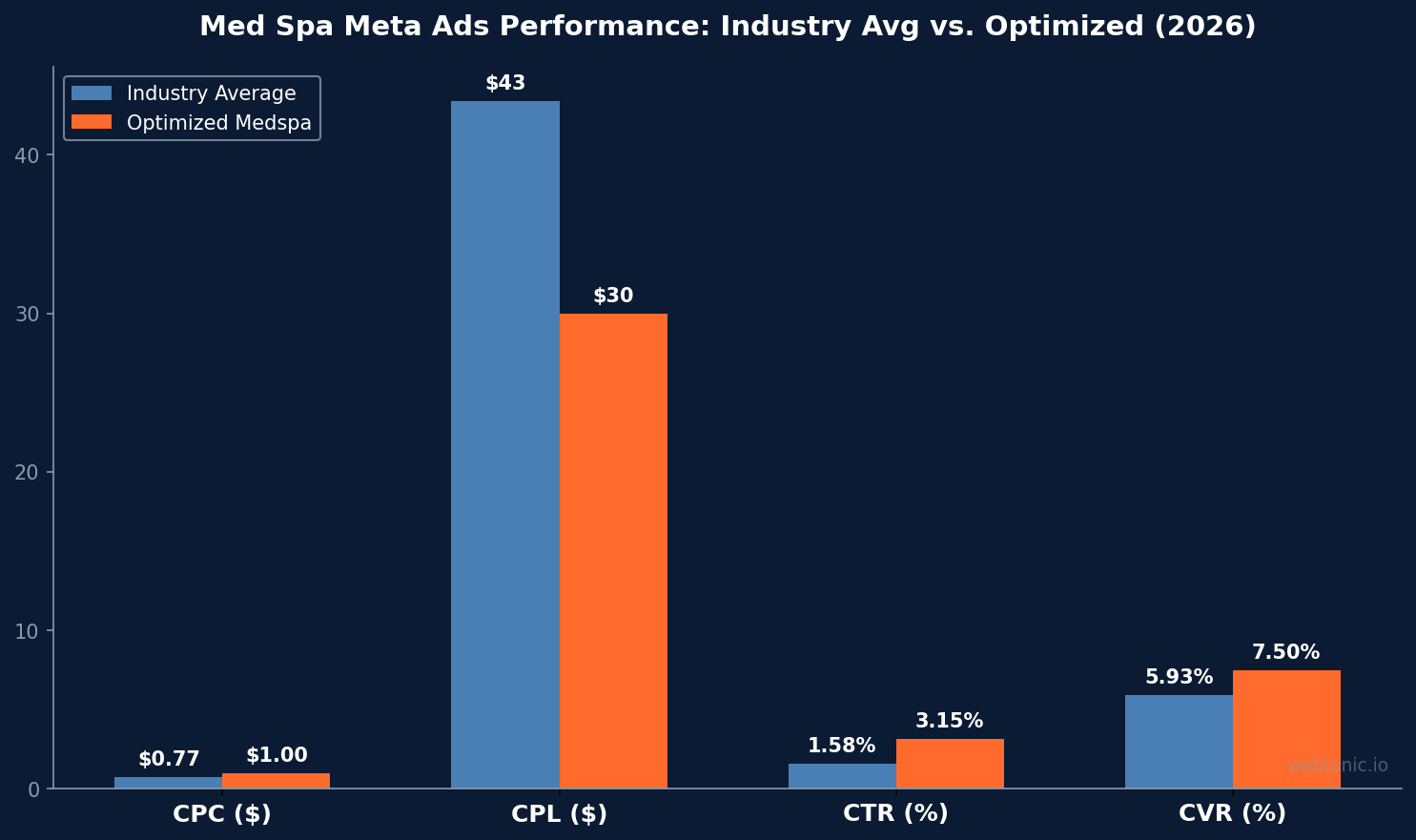
Meta Ads (Facebook and Instagram) remain the primary creative advertising channel for medical spas. Pennock provides the most granular benchmarks for the medspa vertical:
| Meta Ads Metric | Industry Average | Optimized Medspa |
|---|---|---|
| CPM | $12.78 | $10–$18 |
| CPC | $0.77 | $0.50–$1.50 |
| CTR | 1.58% | 2.5%–3.8% |
| CVR | 5.93% | 5%–10% |
| CPL (website) | $43.39 | $18–$42 |
| CPL (in-platform) | $21.98 | $15–$50 |
| ROAS | 1.80× | 3×–5× |
Med Spa Magic Marketing explains that cost per customer acquisition (CAC) moves in an inverse relationship with the attractiveness of the offer. A generic, reputation-based ad may cost $300+ per client, while a high-value introductory deal can drop that to under $100. The creative execution — particularly the offer framing and visual format — is what drives this cost difference. For deeper performance analysis across your campaigns, explore our Meta Ads services.
Creative Formats That Drive Med Spa Results
Multiple sources converge on the same creative format hierarchy for medical spas. Powerhouse Media and Med Spa Magic Marketing identify these top-performing creative types:
- Before-and-after content — remains among the highest-performing creative formats when compliant with Meta's health and wellness content policies. 68% of patients say B&A photos are the most influential factor in choosing a provider (ScaleHaven).
- Patient testimonial videos — authentic, unscripted-feeling testimonials outperform polished, scripted ones. The trust factor is critical in a vertical where patients are evaluating provider competence.
- Procedure/treatment-room video — short videos showing the treatment environment and equipment help demystify procedures and build trust without being overly clinical.
- Provider-led educational content — short videos of providers explaining treatments, addressing concerns, or debunking myths perform well both as ads and as boostable organic content.
- UGC-style creative — user-generated-content style creative (filmed on a phone, casual framing) often outperforms highly produced content because it feels native to the platform rather than like an advertisement.
Ankita Mankotia confirms that visual treatment results — particularly before-and-after photos — generate the strongest emotional response and highest engagement in med spa advertising. However, compliance with Meta's advertising policies is essential: ads cannot make implied health claims, and before-and-after content is closely scrutinized.
Google Ads vs. Meta Ads Creative Benchmarks for Med Spas
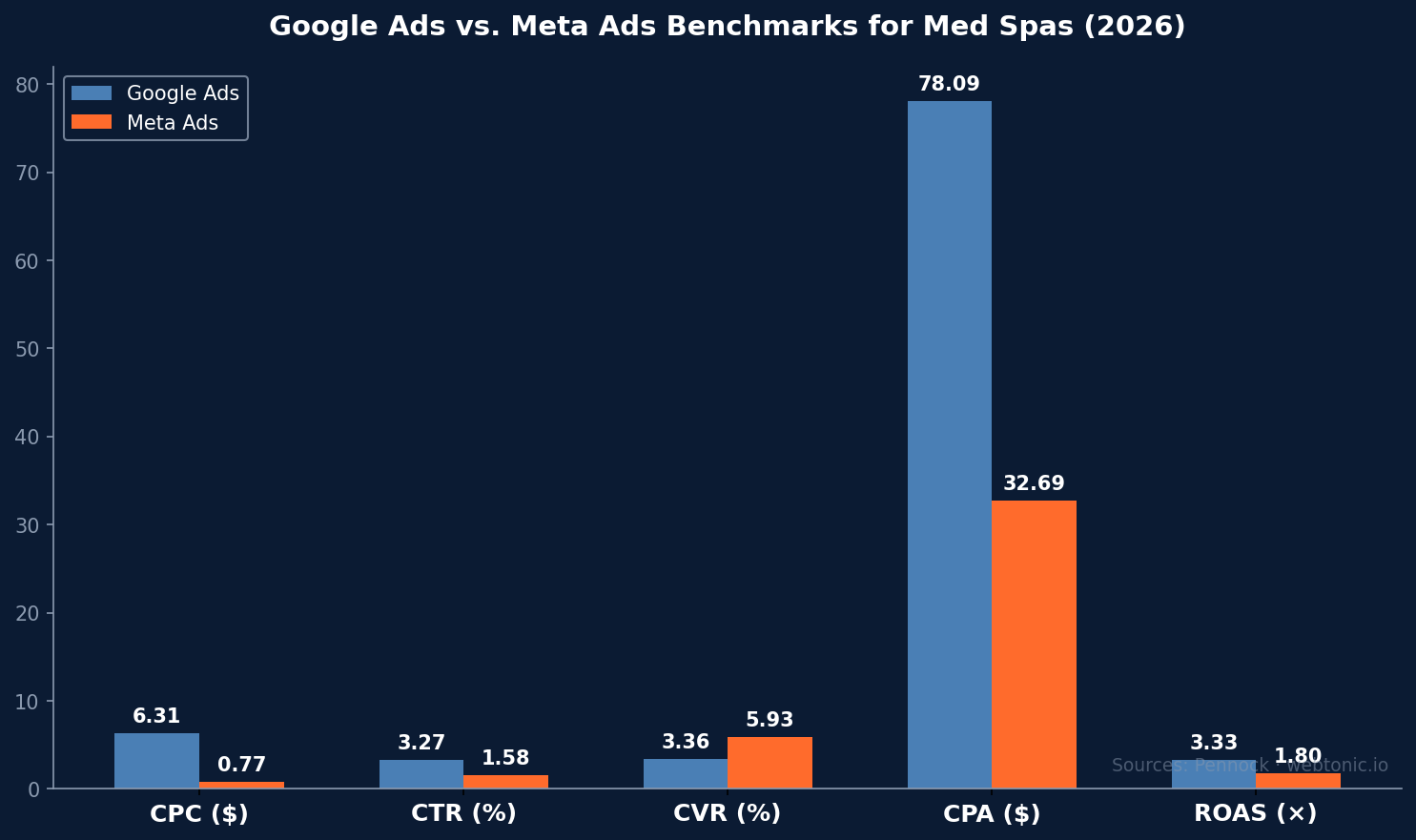
The choice between Google Ads and Meta Ads for medical spas often comes down to creative format and intent capture. Pennock's benchmark data reveals key differences:
| Metric | Google Ads | Meta Ads | Winner |
|---|---|---|---|
| CPC | $2.62–$10+ | $0.77 | Meta (lower cost) |
| CTR | 3.27% | 1.58% | Google (higher intent) |
| CVR | 3.36% | 5.93% | Meta (visual impact) |
| CPA | $78.09 | $21.98–$43 | Meta (lower CPA) |
| ROAS | 3.33× | 1.80× | Google (higher return) |
| Creative format | Text/search | Visual/video | Meta (for B&A) |
As Powerhouse Media explains, Google Ads captures people actively searching for treatments, while Meta Ads create demand by reaching people who fit the profile of potential patients. For ad creative specifically, Meta's visual format is uniquely suited to the aesthetics industry — before-and-after results, treatment videos, and patient testimonials perform exceptionally well in ways that text-based search ads cannot replicate. Our Google Ads pricing guide helps med spas budget across both channels.
The Economics of Med Spa Ad Creative and Offer Strategy
Med Spa Magic Marketing provides a detailed framework for how creative offer strategy impacts advertising economics. Their data from med spa campaigns reveals four key principles:
- The Offer-CAC Inverse Relationship: A generic reputation-based ad costs $300+ per client, while a high-value introductory deal can drive CAC under $100.
- Deal Depth vs. Client Quality: Deeper discounts attract more price-sensitive patients, but higher absolute volume at the bottom of the funnel typically wins. If $1,000 generates 10 clients with 5 retaining vs. 3 clients with all 3 retaining, the volume strategy is stronger.
- Service Tier Strategy: Botox/neurotoxins, dermal fillers, and microneedling are the "Good" tier to lead with in ads. Body contouring and laser treatments are "Maybe" tier (higher ticket, lower volume). Injectable weight loss and highly invasive procedures are "No-Go" tier for Meta creative.
- The Scroll-Stopping Creative Framework: Static images should include a clear offer, real patient imagery (with consent), and social proof elements. Video creative should feel authentic rather than overproduced.
ScaleHaven reports that the average med spa spends 8–14% of gross revenue on marketing, with top-growth practices investing up to 16%. Given that the average med spa generates $1.6 million to $2.8 million in annual revenue (ScaleHaven), that translates to annual marketing budgets of $128,000 to $448,000 — a substantial creative investment that demands data-driven optimization. Our growth marketing services help med spas allocate these budgets across channels.
Creative Compliance and Platform Policies for Med Spa Advertising
Before-and-after content is highly effective but also closely scrutinized by Meta's advertising policies. Powerhouse Media outlines critical compliance requirements for medical spa ad creative:
- Ads cannot make implied health claims that go beyond substantiated results.
- Before-and-after imagery must include proper patient consent and comply with platform-specific formatting requirements.
- Sudden changes to platform policies — particularly around health and wellness content — can impact running campaigns without warning.
- Content showing graphic medical procedures may be flagged or rejected under Meta's health content policies.
- Special Ad Category restrictions do not currently apply to cosmetic/aesthetic procedures in most jurisdictions, but this is subject to change.
Med spas should maintain a continuous creative production cadence rather than relying on occasional, highly produced campaigns. Meta's algorithm rewards creative variety and tends to fatigue quickly on a small number of ads, regardless of production quality. Pronk confirms that blurry photos, stock imagery, and text-heavy graphics are the fastest way to waste ad budget in med spa advertising.
Lead Response Time and Creative Conversion Impact
Even the highest-performing ad creative becomes worthless without rapid lead follow-up. ScaleHaven reports that med spas responding to leads within 5 minutes are 21× more likely to convert those leads into booked appointments compared to clinics responding after 30 minutes. This statistic underscores a critical point: ad creative optimization must be paired with operational readiness.
For clinics using Meta's native lead forms (in-platform CPL of $15–$50), the lead quality tradeoff is significant. Pennock notes that the ease of submitting a pre-filled form can lead to less motivated inquiries, making a rapid and persistent follow-up strategy critical to successfully convert these leads. Clinics with dedicated intake teams should prioritize in-platform forms for volume, while those without should drive traffic to website landing pages for higher-intent conversions at a slightly higher CPL. The patient lifetime value of $1,800 to $5,200 over 12 months (ScaleHaven) justifies aggressive creative testing and fast response infrastructure.
Best Practices for Med Spa Ad Creative
- Lead with before-and-after content. It remains the highest-performing creative format — 68% of patients cite B&A photos as their #1 provider selection factor (ScaleHaven).
- Prioritize UGC-style video over polished production. Phone-shot, authentic content outperforms highly produced creative on Meta because it feels native to the feed (Powerhouse Media).
- Respond to leads within 5 minutes. 21× higher conversion rate when leads are contacted within 5 minutes vs. 30+ minutes (ScaleHaven). The best creative is wasted without fast follow-up.
- Test offers aggressively. A strong introductory offer can reduce CAC from $300+ to under $100 (Med Spa Magic Marketing).
- Maintain creative variety. Meta's algorithm fatigues quickly — rotate 3–5 active creatives per ad set and refresh every 2–4 weeks. Check our Facebook Ads ROI analysis for more on Meta campaign management.
- Lead with Botox, fillers, and microneedling in creative. These are the "Good" tier services that generate the highest volume of qualified leads at the lowest cost per acquisition.
- Use native lead forms for volume. In-platform CPL of $15–$50 is typically lower than website landing pages, but requires a strong follow-up process to convert (Pennock).
Frequently Asked Questions
What is the average cost per lead for med spa Meta Ads?
The average CPL for med spa Meta Ads campaigns is $18 to $42 when driving traffic to a website landing page (ScaleHaven). Using Meta's native in-platform lead forms, the CPL can range from $15 to $50, with lower-intent offers like newsletter signups at the $15–$25 range and consultation requests at $25–$50+ (Pennock).
What ad creative formats perform best for medical spas?
Before-and-after content remains the highest-performing format, with 68% of patients citing B&A photos as the most influential factor in choosing a provider. UGC-style video, patient testimonials, and provider-led educational content are the next-best performers. Highly produced content often underperforms authentic, phone-shot creative on Meta platforms.
How much should a med spa spend on marketing?
The average med spa spends 8–14% of gross revenue on marketing, with top-growth practices investing up to 16% (AmSpa benchmark data). For a med spa generating $2 million in annual revenue, that translates to a marketing budget of $160,000 to $320,000, with Meta Ads typically receiving the largest share of paid media budget.
Is Google Ads or Meta Ads better for med spa advertising?
Both channels serve different purposes. Google Ads captures high-intent search traffic with a 3.33× ROAS but at higher CPCs ($2.62–$10+). Meta Ads generates demand with visual creative at lower CPCs ($0.77) and higher visual impact. Most successful med spas use both channels, saturating Meta first for volume, then adding Google for intent capture (Pennock, Powerhouse Media).
How do I comply with Meta's advertising policies for med spa ads?
Ensure all before-and-after imagery includes proper patient consent, avoid making implied health claims beyond substantiated results, and do not show graphic medical procedures. Maintain creative variety since Meta's algorithm fatigues quickly on a small number of ads. Build a continuous content production cadence with phone-shot content rather than relying on occasional highly produced campaigns.
Sources
scalehaven.io – aesthetic industry statistics 2026
scalehaven.io – med spa industry statistics 2026
pennock.co – medspa paid media benchmarks
phousemedia.com – Meta Ads for aesthetic clinics
medspamagicmarketing.com – Meta Ads guide 2026
ankitamankotia.com – Facebook Ads for med spas 2026
pronkmedspamarketing.com – med spa advertising guide


