



Table of contents

Social media has become the primary discovery and trust-building channel for medical spas, with 73% of practices using social media advertising as a core patient acquisition tool. The aesthetics market — valued at $22.1 billion globally — relies heavily on visual platforms like Instagram and TikTok to showcase treatment results and build clinical authority. This article compiles 40+ verified statistics on med spa social media marketing, covering engagement benchmarks, advertising spend, content performance, and ROI metrics for 2026.
Key Takeaways
- 73% of med spas use social media advertising as a primary patient acquisition channel, with Meta platforms (Facebook and Instagram) generating the highest ROI.
- Before-and-after images generate 2–5× more engagement than generic stock photography on Meta platforms for aesthetic practices.
- Instagram engagement rate for aesthetics averages 1.35–1.45%, roughly double the all-industry average of 0.60%.
- TikTok engagement rate for aesthetics sits at 3.80–4.20%, the highest among all social platforms for the med spa vertical.
- Video ads outperform static image ads by 2.5–3.8× in conversion rate for med spa campaigns on Meta platforms.
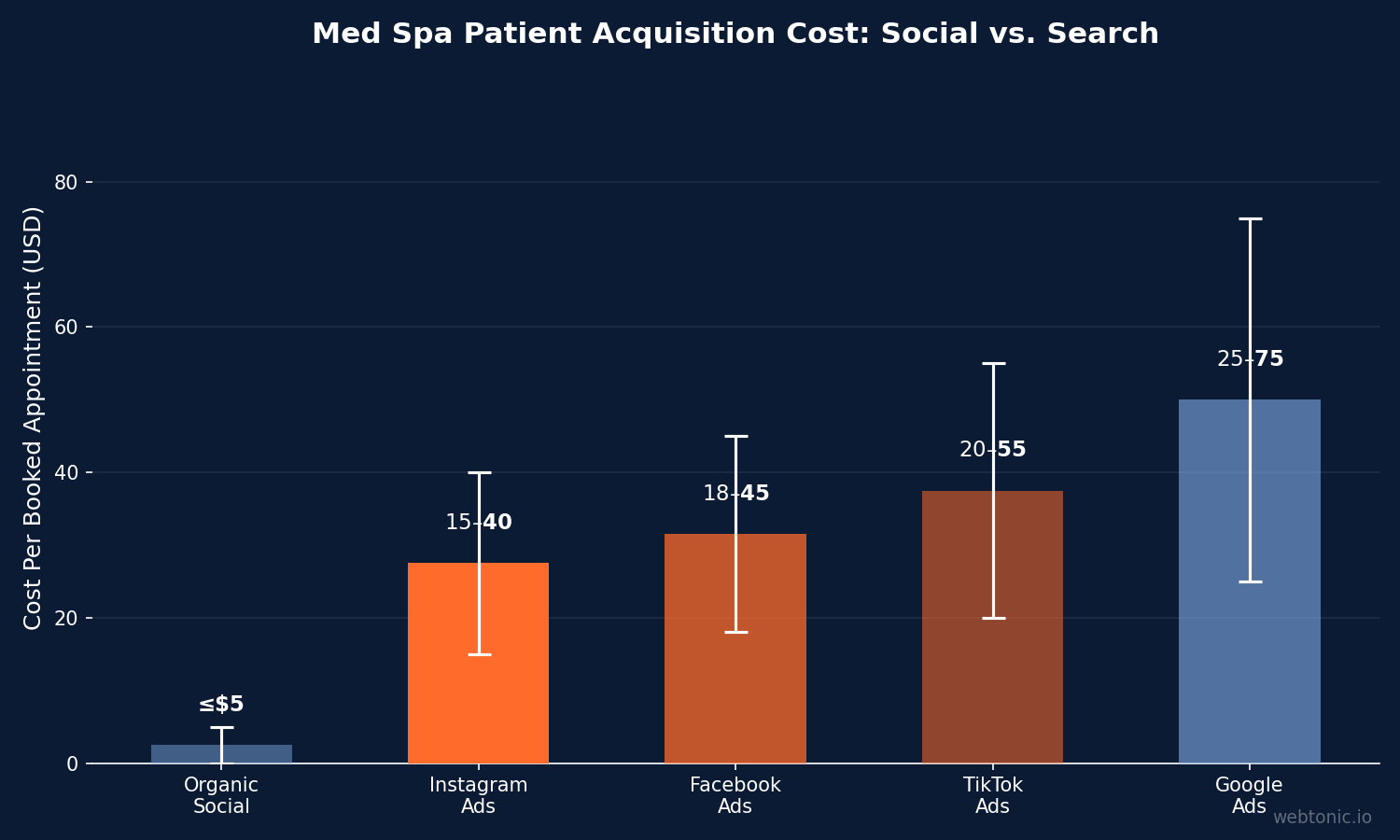
- Instagram Ads deliver a cost per booked appointment of $15–$40, positioning the platform as a mid-cost, high-volume acquisition channel.
- ~50% of consumers say a provider's social media presence influences their decision to book an aesthetic treatment.
Med Spa Social Media Benchmarks at a Glance
| Metric | Benchmark | Source |
|---|---|---|
| Instagram engagement rate | 1.35–1.45% | CuFinder / Apaya |
| TikTok engagement rate | 3.80–4.20% | CuFinder |
| Facebook engagement rate | 0.18% | CuFinder |
| Video vs. static ad conversion | 2.5–3.8× higher | ScaleHaven / AmSpa |
| Instagram Ads cost per appt. | $15–$40 | Queen City Growth Lab |
| Before/after engagement lift | 2–5× vs. stock photos | Pronk Med Spa Mktg. |
| Social influence on booking | ~50% of consumers | Aesthetic Marketing |
| Marketing spend (% of revenue) | 8–12% | AmSpa Benchmark Report |
Platform Engagement Rate Comparisons
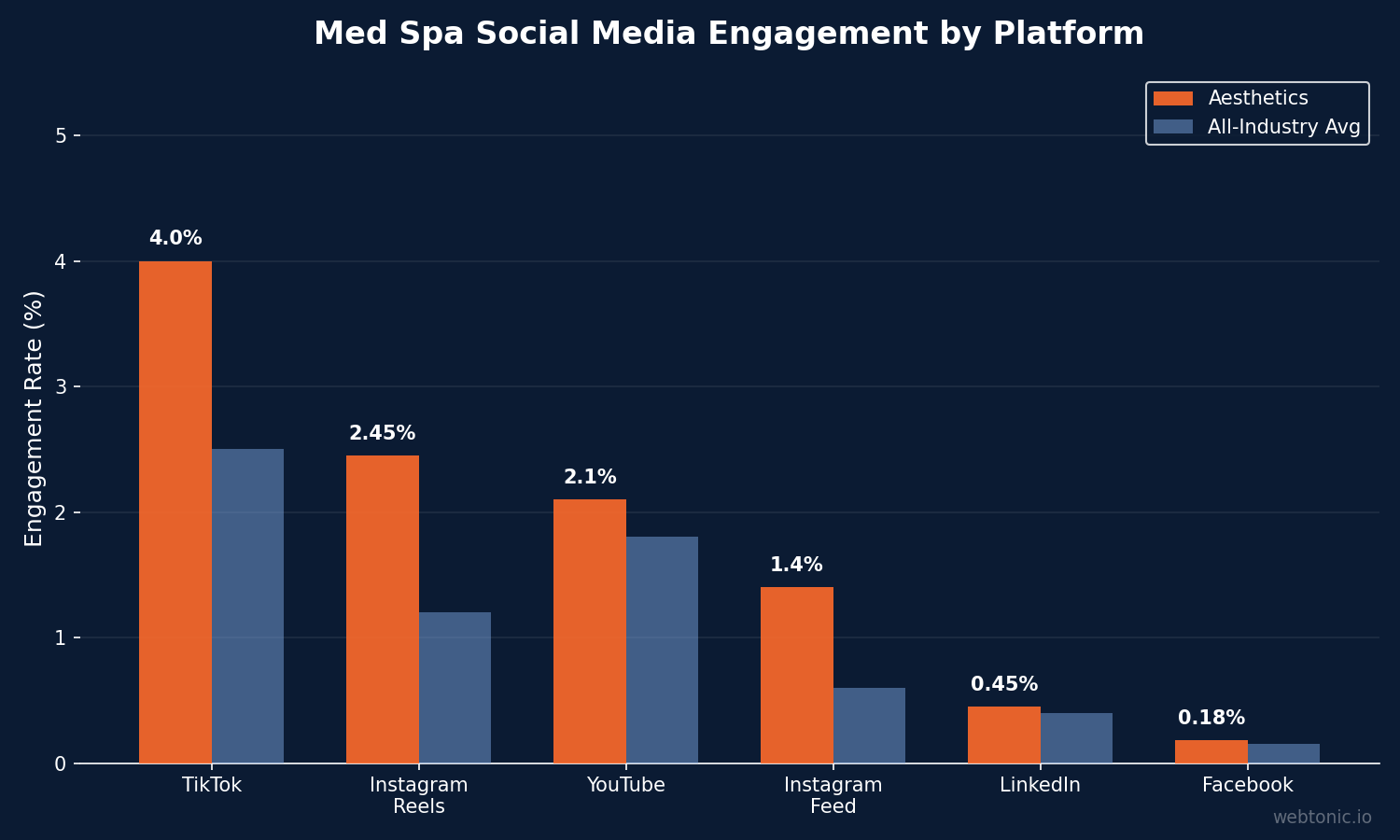
Engagement rates vary dramatically across platforms for the aesthetics vertical. The visual, trust-dependent nature of medical spa services makes certain platforms significantly more effective than others for both organic reach and paid acquisition.
| Platform | Aesthetics Engagement Rate | All-Industry Average |
|---|---|---|
| TikTok | 3.80–4.20% | 2.50% |
| Instagram (Reels) | 2.10–2.80% | 1.20% |
| Instagram (Feed) | 1.35–1.45% | 0.60% |
| YouTube | 2.10% | 1.80% |
| 0.18% | 0.15% | |
| 0.45% | 0.40% |
- TikTok dominates engagement for aesthetics at 3.80–4.20%, roughly 1.5× the all-industry average, driven by short-form treatment reveal videos and educational content. (CuFinder)
- Instagram Reels reach 3–10× a med spa's follower count when performing well organically, outpacing static feed posts by a wide margin. (SkyHighway Marketing)
- Instagram feed engagement for aesthetics (1.35–1.45%) is more than double the all-industry average of 0.60%, reflecting the visual nature of the category. (CuFinder)
- Facebook engagement has declined to 0.18% for aesthetics, but the platform remains critical for paid advertising and community group strategies. (CuFinder)
Content Performance Statistics
Content type determines social media success for med spas more than posting frequency or hashtag strategy. The data consistently shows that authentic, treatment-focused content outperforms polished stock imagery and generic wellness posts.
- Before-and-after images generate 2–5× more engagement than stock photography on Meta platforms. Patients want to see actual results from a specific practice, not generic models. (Pronk Med Spa Marketing)
- Short-form video generates 2–3× higher engagement than still images in beauty and aesthetics categories on Instagram. (Aesthetic Marketing)
- Before-and-after content remains the single most powerful conversion content type for med spas, though it requires careful HIPAA-compliant handling. (SkyHighway Marketing)
- Educational content about treatment processes and recovery timelines drives the highest save rates, which Instagram's algorithm increasingly favors for organic distribution.
- Posting frequency of 4–5 times per week on Instagram correlates with the highest follower growth rates for aesthetic practices, with Reels contributing disproportionately to reach expansion.
Social Media Advertising and ROI
Paid social remains the highest-volume patient acquisition channel for most med spas, with Meta platforms offering the best balance of cost efficiency and targeting precision. Understanding platform-specific benchmarks helps practices allocate their marketing budgets effectively.
- 76% of aesthetic practices use social media advertising (Meta, TikTok, or YouTube) as a primary patient acquisition channel. (ScaleHaven)
- Instagram Ads deliver a cost per booked appointment of $15–$40, positioning the platform between organic SEO ($8–$25) and Google Ads ($25–$75). (Queen City Growth Lab)
- Video ads outperform static image ads by 2.5–3.8× in conversion rate for med spa campaigns, making creative investment in video production a measurable ROI driver. (ScaleHaven)
- UGC storytelling combined with conversion-focused retargeting delivered 8× average ROAS and a 400% increase in booking rate for BodyTonic Med Spa. (Brenton Way)
- Show rate for ad-driven bookings averages 60–70%, while practices with strong confirmation sequences push that to 80–85%, directly impacting cost per actual treatment. (ScaleHaven)
Influencer Marketing and UGC Statistics
Influencer partnerships have evolved from broad brand awareness plays into precision patient acquisition tools for the aesthetics vertical. Micro-influencer and UGC strategies consistently outperform traditional influencer campaigns in driving bookings.
- 92% of consumers trust influencer recommendations over traditional advertising for aesthetic treatment decisions.
- The "lo-fi" aesthetic — authentic, unpolished content — builds more trust than professional production for med spa social media, with audiences favoring creators who look like real patients.
- Micro-influencers (10K–50K followers) in the aesthetics niche generate 3–5× higher engagement rates than macro-influencers, with significantly lower per-post costs and more authentic audience connections.
- An analysis of 48 million impressions across influencer campaigns in aesthetics showed that clinical trust signals — provider credentialing in content, visible facility shots — outperformed pure aspirational content for driving consultations. (EvolveMKD)
Platform-Specific Growth Case Studies
Real-world growth examples illustrate the timeline and magnitude of results med spas achieve through consistent social media execution.
- A Berlin aesthetic clinic grew from 2,800 to 42,000 Instagram followers in 10 months, increasing monthly organic bookings from 8 to 62 and building a 3-month waitlist. Paid ad spend was cancelled entirely by month 8. (Omakaase)
- Belle Visage Med Spa achieved 39.5% follower growth in just 3 weeks, adding 344 new followers through strategic seasonal content.
- Strategic content approaches in adjacent verticals have driven 7+ million impressions for single business accounts, demonstrating the reach potential of consistent social media execution.
- Engagement peaks on Tuesday through Thursday between 7–9 AM and 11 AM–1 PM for service-based businesses on Instagram, with consistent posting during these windows correlating with maximum reach. (MedSpaMarketPro)
Social Commerce and Booking Integration
The gap between social discovery and actual booking represents significant revenue leakage for med spas that rely on bio links or manual DM follow-ups. Practices integrating booking directly into their social presence see measurable conversion improvements.
- ~50% of consumers say a provider's social media presence influences their booking decision, making profile optimization a direct revenue driver rather than a vanity metric. (Aesthetic Marketing)
- Med spas with direct booking integration on Instagram (via link-in-bio tools or Instagram's native booking features) see 25–40% higher conversion rates from social traffic compared to those redirecting to generic homepages.
- DM volume has become a leading indicator of booking intent, with practices that actively manage Instagram DMs converting 15–25% of DM conversations into booked consultations. (Inrō)
Best Practices for Med Spa Social Media in 2026
- Prioritize short-form video content — Reels and TikToks showcasing treatment reveals, provider Q&As, and patient journeys consistently outperform static content by 2–3× in engagement.
- Invest in HIPAA-compliant before-and-after galleries — these remain the highest-converting content type, but require proper patient consent workflows and photography protocols.
- Build a UGC pipeline over polished production — authentic patient testimonials and "lo-fi" provider content builds more trust than studio-quality advertising.
- Integrate booking directly into social profiles — reduce friction by enabling consultation booking within one tap from any social post or profile.
- Test TikTok strategically — the platform offers the highest engagement rates, but track actual attribution back to bookings rather than optimizing for vanity reach metrics.
- Respond to DMs within 15 minutes — DM response speed correlates directly with conversion rate for aesthetic practices where treatment decisions are emotionally driven.
HIPAA Compliance in Med Spa Social Media
Navigating HIPAA requirements while maintaining an active social media presence is a persistent challenge for medical spa marketing teams. Patient privacy violations can result in substantial fines, making compliance protocols non-negotiable.
- Patient consent forms must explicitly cover social media usage before any before-and-after photos, testimonials, or treatment journey content can be posted publicly.
- HIPAA violations related to social media carry penalties of up to $50,000 per incident, with repeat violations potentially reaching $1.5 million annually per violation category.
- Staff social media training should cover what constitutes protected health information (PHI) in visual content — even background details in treatment room photos can inadvertently reveal patient identity.
Paid Social Budget Allocation by Platform
Where med spas invest their social advertising budgets matters as much as total spend. The optimal allocation shifts based on business maturity, treatment mix, and target patient demographics.
- Meta platforms (Facebook + Instagram) command 55–70% of social ad budgets for most med spas, thanks to superior targeting precision, lookalike audience capabilities, and proven retargeting performance for aesthetic treatments.
- TikTok Ads receive a growing 10–20% allocation among forward-thinking practices targeting patients under 40 for preventative Botox, skincare treatments, and body contouring procedures.
- The average med spa spends 8–12% of total revenue on marketing, with growth-stage practices increasing to 15%. Of the total marketing budget, social advertising typically receives 30–40%, translating to $1,000–$4,000 monthly for a mid-size practice. (ScaleHaven)
- Retargeting budgets should represent 15–25% of total social spend, as patients who have already visited a med spa website convert at 3–5× the rate of cold audiences on paid social campaigns.
Social Media Analytics and Measurement
Tracking the right metrics separates med spas that scale profitably from those that waste budget on vanity engagement. The shift toward attribution-based measurement is accelerating across the aesthetics industry.
- Profile visits and follower growth measure audience building, but the metrics that matter most for revenue are DM volume, website traffic from social, and new patient intake forms citing social discovery. (SkyHighway Marketing)
- UTM tracking on all social links is essential for attributing bookings back to specific posts, campaigns, and platforms — without UTMs, practices cannot accurately calculate social ROI.
- Cost per booked appointment should be the primary KPI for paid social, not cost per click or cost per lead. The show rate gap (60–70% average vs. 80–85% top performers) means raw lead costs understate true acquisition cost.
- Geo-grid tracking and Google Analytics referral data together provide the clearest picture of how social media activity influences both direct bookings and branded search volume.
Emerging Trends in Med Spa Social Marketing
The social media landscape for aesthetics is shifting rapidly, with new formats, platform features, and consumer behaviors reshaping how practices connect with prospective patients.
- AI-generated content tools are being adopted by 25–30% of aesthetic marketers for caption writing, ad copy testing, and content calendar planning — but authentic provider-created video content still outperforms AI-generated visuals in trust metrics.
- Social search is replacing traditional search for younger demographics — an increasing share of Gen Z and Millennial patients search "med spa [city]" directly on TikTok and Instagram rather than Google.
- Community-building through private Facebook or Instagram groups is emerging as a retention play, with practices creating VIP patient communities that drive referrals, repeat bookings, and higher lifetime value.
- Shoppable social features are expanding into services, with Instagram and TikTok testing direct appointment booking integrations that could reduce the discovery-to-booking friction that currently costs med spas significant conversion volume.
FAQ
Which social media platform is best for med spa marketing?
Instagram remains the most effective platform for med spa marketing due to its visual format, high aesthetics engagement rate (1.35–1.45%), and integrated advertising tools. However, TikTok delivers the highest organic engagement (3.80–4.20%) and is increasingly important for reaching younger demographics interested in preventative treatments.
How much should a med spa spend on social media advertising?
The average med spa allocates 8–12% of revenue to total marketing, with social media advertising typically receiving 30–40% of that budget. For a practice generating $500K in annual revenue, this translates to approximately $12,000–$24,000 per year on social ads, with Meta platforms receiving the largest share.
Do before-and-after photos still work for med spa social media?
Yes — before-and-after images generate 2–5× more engagement than stock photography on Meta platforms and remain the single most powerful conversion content type for med spas. The key is HIPAA-compliant handling: proper patient consent, consistent lighting and framing, and clear labeling.
What is a good engagement rate for a med spa on Instagram?
An engagement rate of 1.35–1.45% is the industry benchmark for aesthetics on Instagram feed posts, which is already about 2× the all-industry average. Reels typically achieve 2.10–2.80% engagement. Practices consistently above 2% on feed posts are outperforming most competitors.
How does UGC compare to professional content for med spa social?
User-generated content and authentic "lo-fi" videos consistently outperform polished professional production for trust-building. One case study showed UGC-driven retargeting delivered 8× ROAS with a 400% increase in booking rates. The authenticity signals in UGC resonate more strongly with patients evaluating aesthetic providers.
Sources
scalehaven.io/blog/med-spa-industry-statistics/
cufinder.io/blog/benchmarks/plastic-surgery/
cufinder.io/blog/benchmarks/dermatology/
queencitygrowthlab.com/blog/cost-per-booked-appointment-2026
pronkmedspamarketing.com/blog/med-spa-before-after-photos/
aestheticmarketing.net/blog/medical-spa-marketing-statistics/
blog.skyhighwaymarketing.com/med-spa-social-media-marketing-complete-strategy/
scalehaven.io/blog/aesthetic-industry-statistics-2026/
brentonway.com/case-studies/bodytonic-case-study
omakaase.com/portfolio/social-media-healthcare-berlin-clinic


