Table of contents
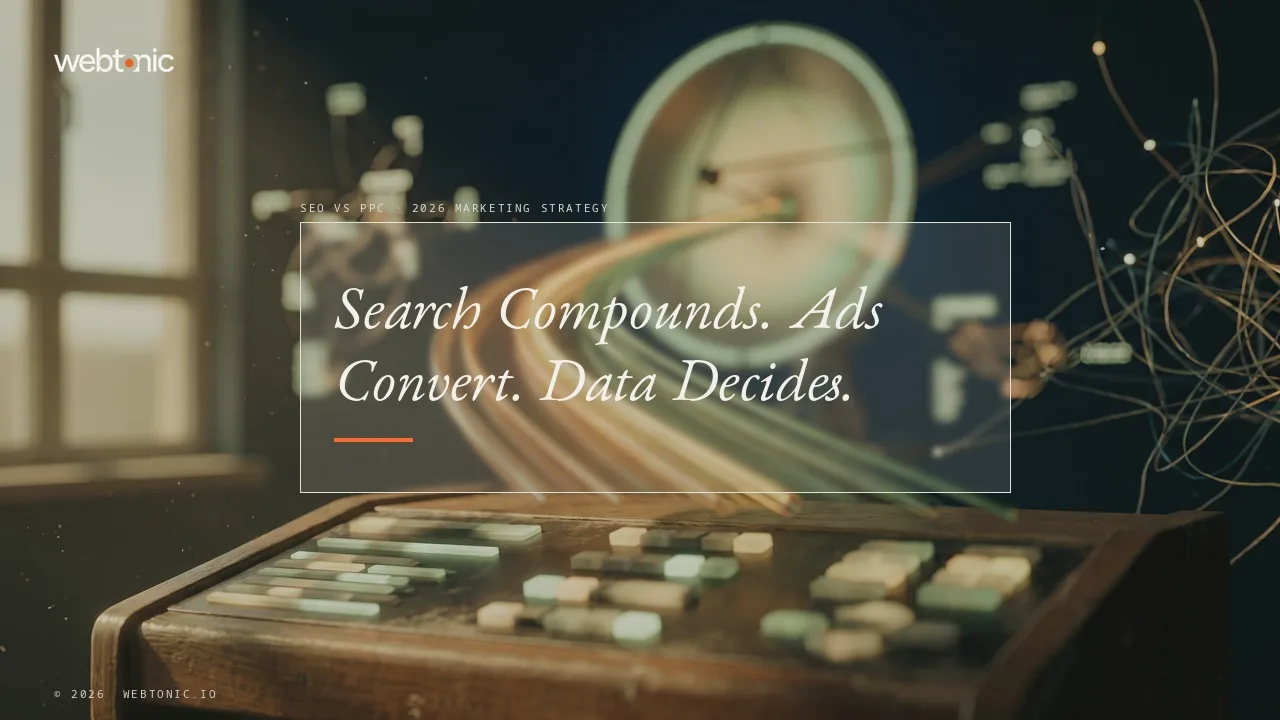
SEO returns 748% over roughly three years; PPC breaks even in four months and stops the day the budget does. Neither claim is marketing copy — both come from named 2026 studies, and this page puts them side by side with cost, speed and traffic-share data so the choice is a calculation, not a preference.
Key Takeaways
- SEO's average ROI is 748% for B2B and 721% for B2C.
- SEM/PPC's average ROI is 36% over the same measurement window.
- SEO breaks even in about 9 months on average.
- PPC breaks even in about 4 months, more than twice as fast.
- Average Google Ads conversion rate is 8.18% across 13,000+ campaigns.
- Average Google Ads cost per click is USD 5.42 in 2026.
- Average Google Ads cost per lead is USD 66.69, its first year-over-year drop since 2020.
- Search still holds 38.8% of US digital ad revenue, USD 114.2 billion in 2025.
- Search ad revenue growth slowed to 11.0%, down from 15.9% the year before.
- Organic search traffic grew just 2.38% across 2025.
- Organic social traffic declined 8.86% over the same period.
- The #1 organic result gets a 27.6% average click-through rate, Backlinko's data shows.
- Organic click-through fell from 44.9% to 40.0% between March and June 2026.
- Zero-click searches rose to 25.3% of all queries by June 2026.
- Real estate SEO returns 1,389% ROI over a 10-month breakeven, the highest tracked industry.
- 35.4% of marketers list SEO/website work as a 2026 priority, per HubSpot.
The headline number: return on investment
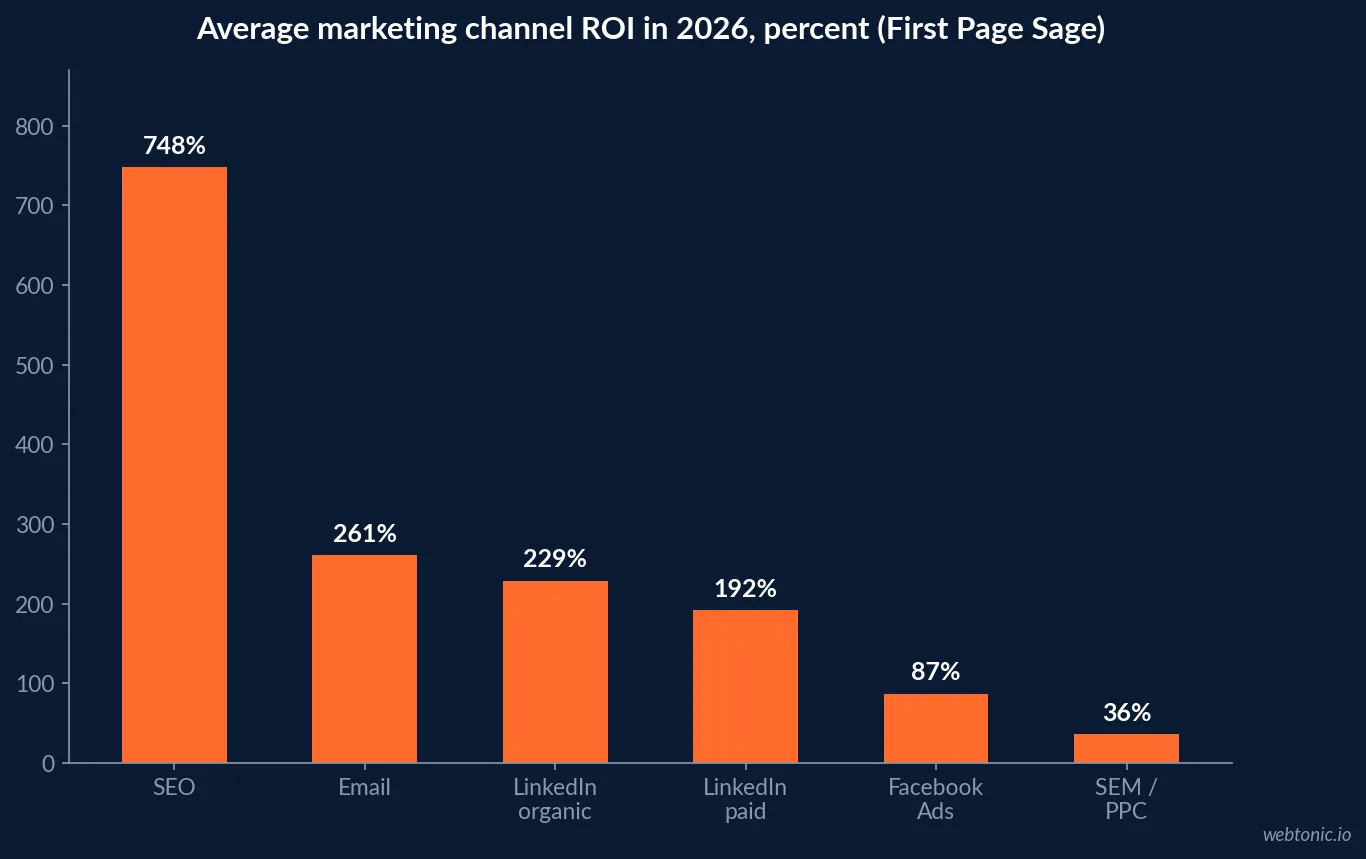
First Page Sage's 2026 channel comparison puts SEO's return at 748% for B2B and 721% for B2C — the highest of any standard marketing channel it tracks — while its companion digital marketing ROI report puts SEM/PPC at 36% ROI with a 4-month breakeven against SEO's 9-month breakeven. The gap in total return is not close; the gap in speed runs the opposite direction.
| Channel | Average ROI | Breakeven timeline | Source |
|---|---|---|---|
| SEO | 748% (B2B) / 721% (B2C) | ~9 months | First Page Sage 2026 |
| SEM / PPC | 36% | ~4 months | First Page Sage 2026 |
| Email marketing | 261% | ~7 months | First Page Sage 2026 |
| LinkedIn, organic | 229% | ~5 months | First Page Sage 2026 |
| LinkedIn, paid | 192% | ~5 months | First Page Sage 2026 |
| Facebook Ads | 87% | ~3 months | First Page Sage 2026 |
SEO's return varies enormously by industry
The 748% figure is an average, and averages hide a wide spread. First Page Sage's SEO ROI report tracks real estate at 1,389% ROI with a 10-month breakeven, PCB design and manufacturing at 1,101%, oil and gas at 906%, pharmaceutical at 826% and solar energy at 770%. Categories with high customer lifetime value and long research cycles reward organic search the most, because a single ranking keeps converting buyers for years without an added click cost.
| Industry | Average SEO ROI | Breakeven timeline |
|---|---|---|
| Real estate | 1,389% | 10 months |
| PCB design & manufacturing | 1,101% | 11 months |
| Oil & gas | 906% | 10 months |
| Pharmaceutical | 826% | 9 months |
| Solar energy | 770% | 9 months |
What a click actually costs in paid search
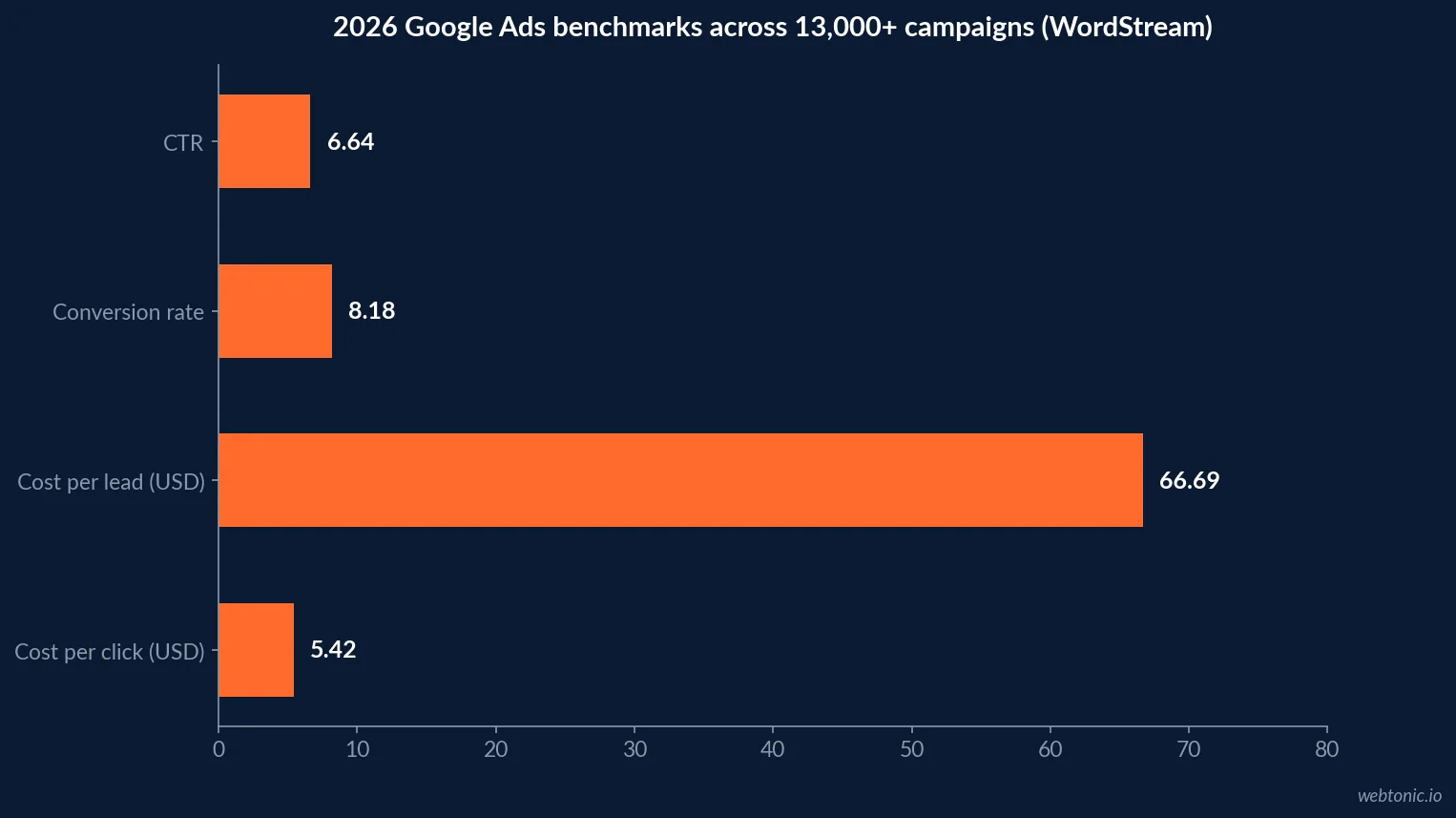
WordStream's 2026 Google Ads benchmarks, built from more than 13,000 US campaigns running April 2025 through March 2026 across 23 industries, put the average click-through rate at 6.64%, cost per click at USD 5.42, conversion rate at 8.18% and cost per lead at USD 66.69. That cost-per-lead figure is the first year-over-year decline in five years, driven by conversion-rate improvements across 87% of the industries WordStream measured — PPC is getting slightly more efficient at the point of conversion even as raw click costs stay flat.
| PPC benchmark (2026) | Figure | Source |
|---|---|---|
| Average click-through rate | 6.64% | WordStream |
| Average cost per click | USD 5.42 | WordStream |
| Average conversion rate | 8.18% | WordStream |
| Average cost per lead | USD 66.69 | WordStream |
| Industries with improving conversion rate | 87% | WordStream |
Search still owns the largest slice of digital ad revenue
Paid search remains the single biggest line item in US digital advertising by dollars, even as its growth cools. The IAB/PwC Internet Advertising Revenue Report for full-year 2025 puts search ad revenue at USD 114.2 billion, or 38.8% of total digital ad spend, up 11.0% year over year — a deceleration from the 15.9% growth search posted the year before, as budget shifts toward faster-growing formats like social and video.
Organic traffic is flat while clicks fragment further
Semrush's 2026 traffic-channel-mix study, built from billions of tracked web visits, found organic search traffic grew just 2.38% across the year while organic social traffic declined 8.86% — organic search is no longer growing meaningfully in most industries, but it is still outperforming organic social by a wide margin. Layered on top of that, Datos and SparkToro's Q2 2026 State of Search report found organic click-through on Google fell from 44.9% in March to 40.0% by June, while zero-click searches climbed from 24.7% to 25.3% over the same three months — a direct signal that AI Overviews are answering more queries before a click ever happens.
| Search/traffic metric (2026) | Figure | Source |
|---|---|---|
| Organic search traffic growth (2025) | +2.38% | Semrush |
| Organic social traffic growth (2025) | -8.86% | Semrush |
| Organic CTR, March 2026 | 44.9% | Datos / SparkToro |
| Organic CTR, June 2026 | 40.0% | Datos / SparkToro |
| Zero-click search share, June 2026 | 25.3% | Datos / SparkToro |
| #1 organic result average CTR | 27.6% | Backlinko |
Where the top organic ranking still wins outright
Backlinko's analysis of roughly 4 million Google search results found the number-one organic position captures an average 27.6% click-through rate — a share no single paid ad position matches at scale, since ad click-through typically runs a fraction of that even in position one. That gap is the practical argument for treating page-one organic rankings as a durable asset rather than a marketing expense that needs re-justifying every quarter.
What marketers are actually prioritizing in 2026
Budget intent lines up with the ROI data more than the speed data. HubSpot's 2026 research finds 35.4% of marketers naming website, blog and SEO work a 2026 priority, while paid search competes for budget against a growing AI-chatbot line item that HubSpot found prioritized by 37.7% of marketers — the two are increasingly budgeted together rather than as alternatives, which matches how most accounts are actually run.
What integrated teams are budgeting for both
The two channels increasingly share a budget line rather than compete for a single one. HubSpot's 2026 research on channel budgeting found organic social content funded by 40.3% of brands and paid social content by 39.4% — a near-even split that mirrors how most accounts now run SEO and PPC in parallel rather than sequentially, using paid media to buy time while organic rankings compound in the background.
| Budget signal (2026) | Figure | Source |
|---|---|---|
| Brands budgeting for organic social | 40.3% | HubSpot |
| Brands budgeting for paid social | 39.4% | HubSpot |
| Marketers naming SEO/website work a priority | 35.4% | HubSpot |
| Marketers naming AI chatbots a priority | 37.7% | HubSpot |
How to choose between them without guessing
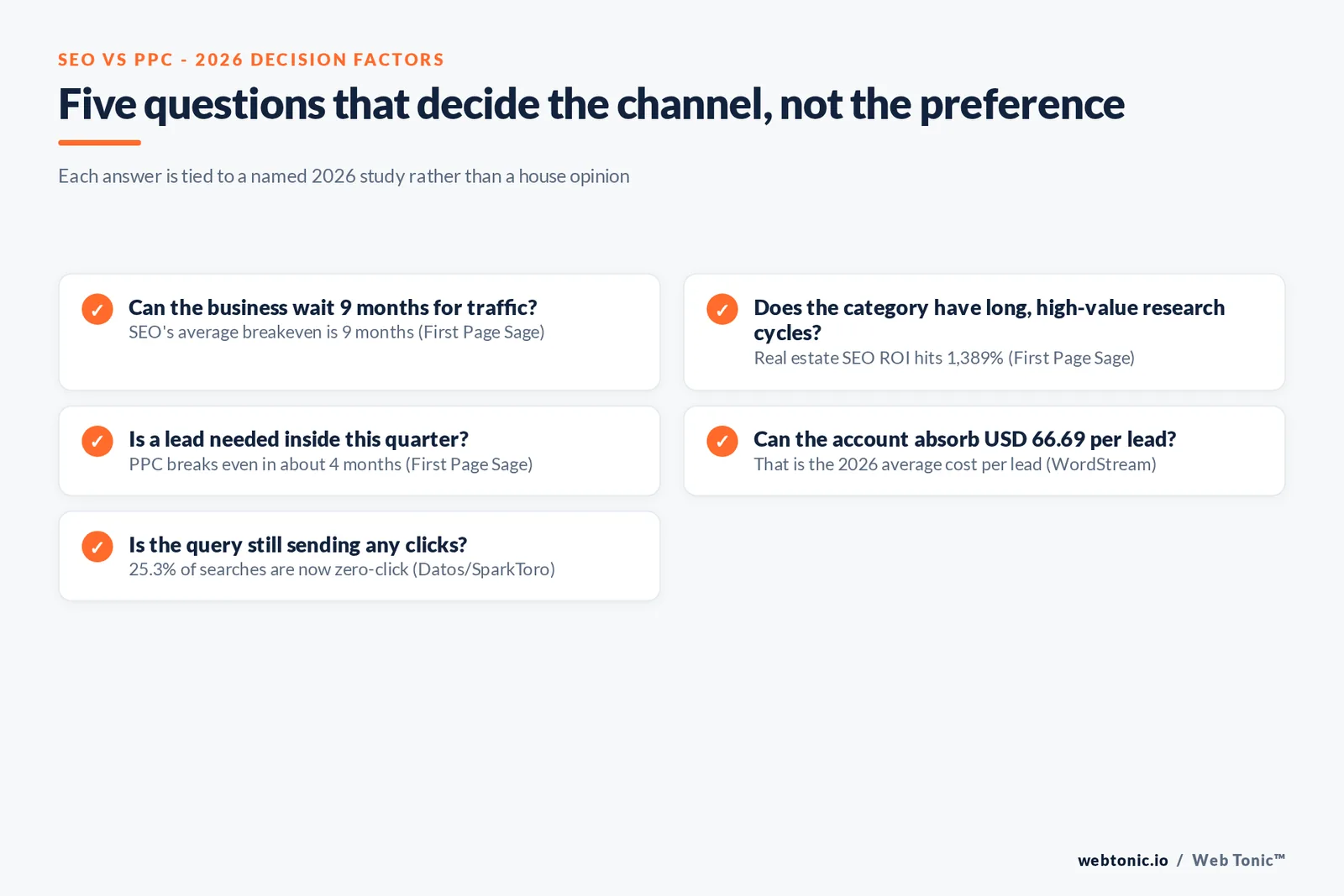
Run PPC when the business needs revenue inside the next quarter and can tolerate a cost per lead near USD 66.69. Run SEO when the business can fund a 9-month runway and the category has enough lifetime value to justify compounding traffic that keeps converting after the work stops. Most accounts that succeed long-term run both at once, using PPC to buy time while SEO's 9-month clock runs in the background.
Our performance creative team can help size the PPC side of that plan, and our breakdown of how to build a Google Ads strategy is a useful next read if paid search is the faster lever you are pulling first.
The AI-search wrinkle both channels now share
Neither SEO nor PPC is immune to the zero-click trend. As AI Overviews answer more queries directly, both organic rankings and paid placements are competing for a shrinking pool of clicks that actually leave the results page — which is why the 25.3% zero-click figure matters as much to a PPC budget as it does to an SEO roadmap. Reviewing which queries still send traffic anywhere, before committing next quarter's spend to either channel, is now part of the exercise.
Talk to us if you want that query-level review done before the budget resets, or see our take on when a paid social channel is worth the spend for the comparison from the social side.
Frequently Asked Questions
Is SEO or PPC a better marketing strategy in 2026?
It depends on the constraint you are solving for. First Page Sage's 2026 data puts SEO's return on investment at 748% for B2B and 721% for B2C over roughly three years, against 36% for SEM/PPC over four months. SEO wins decisively on total return; PPC wins on speed, breaking even in 4 months against SEO's 9 months. Pick PPC when the business cannot wait nine months for traffic; pick SEO when the business can and wants a channel that keeps paying after the campaign ends.
How long does it take to see results from SEO versus PPC?
First Page Sage's 2026 digital marketing ROI data reports a 9-month breakeven for SEO against 4 months for SEM/PPC. PPC traffic starts the moment a campaign is live; SEO traffic compounds only after content and links accumulate authority, which is why most agencies quote a 4- to 6-month lag before meaningful ranking movement even begins.
What is the average conversion rate for SEO versus PPC?
Definitions vary by source, which is why the numbers disagree more than the ROI figures do. WordStream's 2026 Google Ads benchmarks, drawn from over 13,000 US campaigns, put average PPC conversion rate at 8.18% across 23 industries. Comparable organic-conversion studies are thinner and less standardized, so treat any single organic conversion-rate claim with more caution than the PPC figure, which comes from a large, consistently measured dataset.
Is organic search traffic growing or shrinking in 2026?
It is roughly flat and increasingly concentrated. Semrush's 2026 traffic-channel-mix study, built from billions of web visits, found organic search traffic grew just 2.38% for the year while organic social declined 8.86%. Separately, Datos and SparkToro's Q2 2026 State of Search report found organic click-through fell from 44.9% in March to 40.0% by June, as zero-click searches rose to 25.3% — a sign AI Overviews are absorbing clicks that used to land on a website.
Should a new business start with SEO or PPC?
Cash flow determines the honest answer more than strategy does. A business that needs revenue inside the next quarter should run PPC first, since First Page Sage's breakeven data shows it paying back in roughly a third of the time SEO needs. A business with 6 to 12 months of runway and a category worth owning long-term should start SEO immediately, because the 9-month lag does not shrink by waiting to start it.
Sources
First Page Sage - Marketing ROI by channel, 2026
First Page Sage - Digital marketing ROI statistics
First Page Sage - SEO ROI statistics by industry, 2026
WordStream - 2026 Google Ads industry benchmarks
IAB / PwC - Internet Advertising Revenue Report, full-year 2025
Semrush - Traffic channel mix study, 2026
Datos / SparkToro - State of Search, Q2 2026
Backlinko - Google organic click-through rate study
HubSpot - 2026 State of Marketing report