Table of contents
Two quotes for "a marketing strategy" can differ by 10x and both be honest, because they are selling different objects: a document, a decision, or a decision plus the person who defends it for six months. Price the object first and the 2026 ranges below stop looking arbitrary.
Key Takeaways
- Independent marketing strategy work bills at roughly $150 to $400 an hour in 2026, with senior strategists at $175 to $300 and top-tier executive advisory reaching $300 to $500+.
- Project pricing is the most predictable model: a positioning and messaging engagement runs $5,000 to $20,000, a full marketing strategy $5,000 to $20,000, and a go-to-market strategy $10,000 to $30,000.
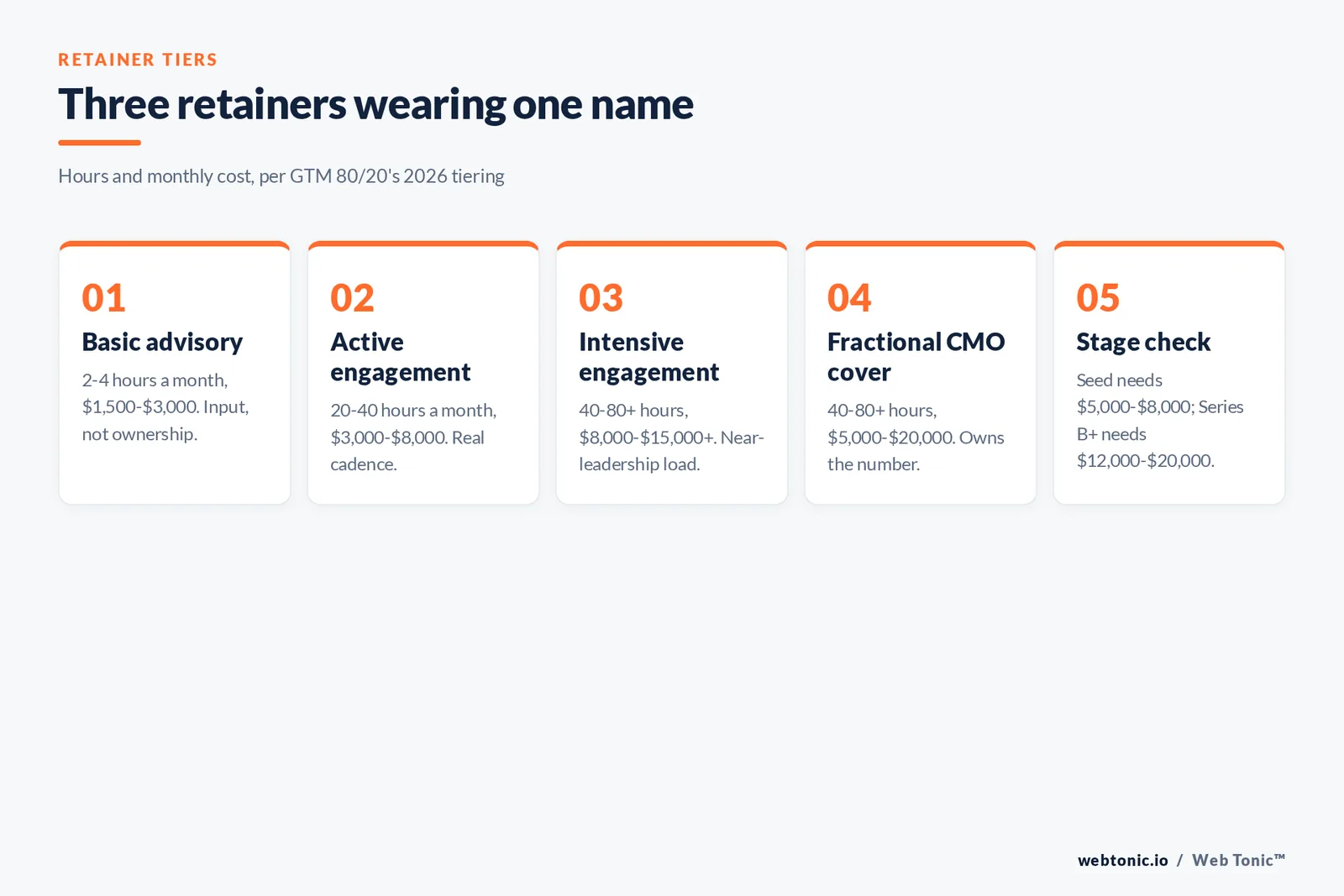
- Retainers split cleanly by intensity — basic advisory at 2 to 4 hours a month for $1,500 to $3,000, active engagement at 20 to 40 hours for $3,000 to $8,000, and intensive work at 40 to 80+ hours for $8,000 to $15,000+.
- Stage sets the budget more reliably than seniority does: pre-seed companies typically need $5,000 to $8,000 a month of support against $12,000 to $20,000 at Series B and beyond.
- The expensive mistake is not the fee. It is buying a $20,000 strategy document nobody has the capacity to implement.
Three things sold under one name
Marketing strategy consulting covers a diagnostic (what is true now), a strategy (what we will do and why), and an operating engagement (someone senior staying close while it happens). Nearly every pricing surprise traces back to a buyer paying for one and expecting another.
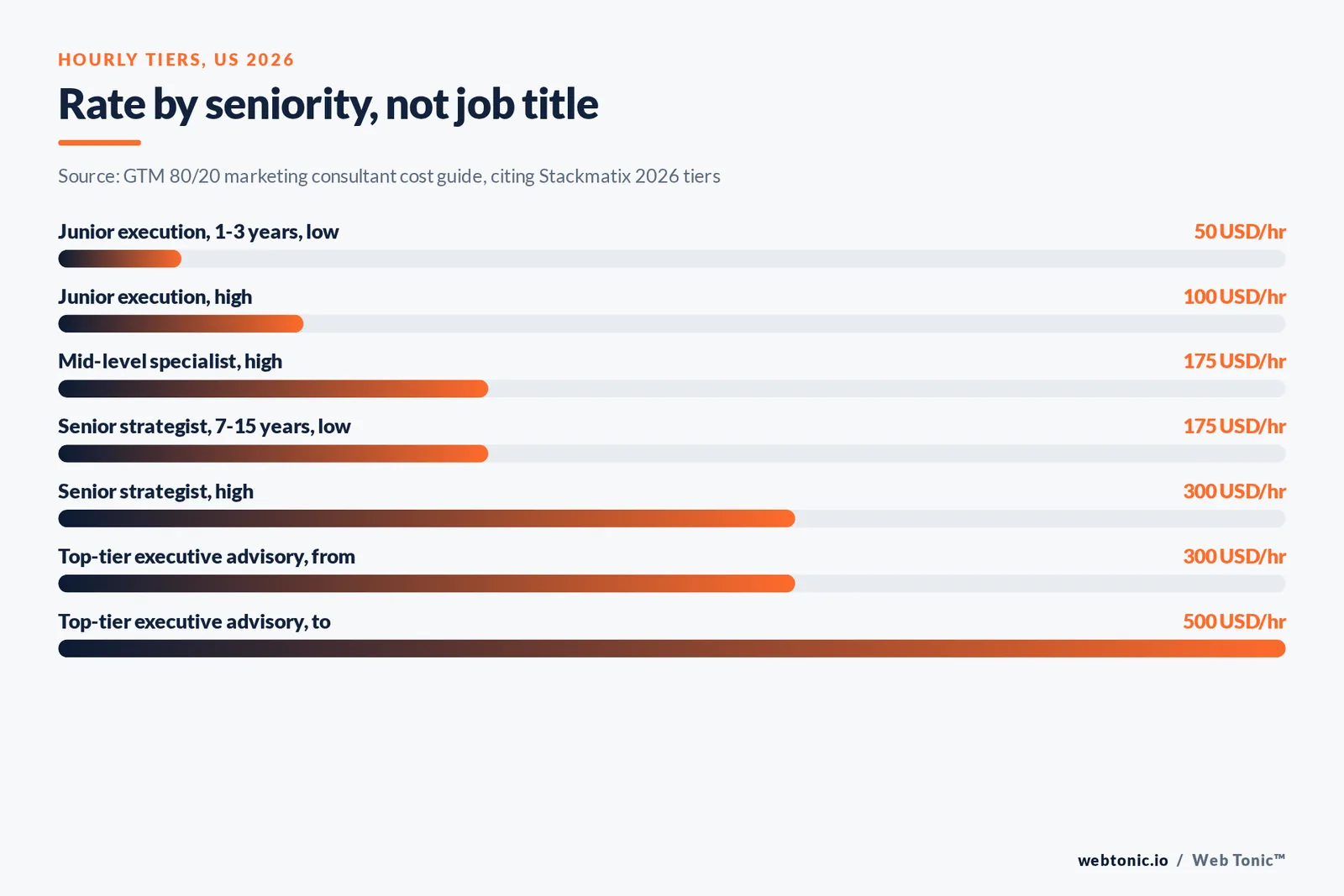
GTM 80/20's 2026 cost guide opens on exactly that problem: one consultant charges $75 an hour, another quotes $15,000 a month, and the scope sounds identical. Its tiering, drawn from the Stackmatix 2026 US cost guide, separates junior execution at $50 to $100 an hour, mid-level specialists at $100 to $175, senior strategists with 7 to 15 years of experience at $175 to $300, and top-tier executive advisory at $300 to $500+. Strategy work sits in the last two rows; the first two are execution capacity wearing the same job title.
Jagatjeet's 2026 breakdown lands in the same place from the other direction: experienced consultants at $150 to $400 an hour, generalists and juniors at $75 to $150, and specialists who have led growth at a Series B company at $350 to $500. OuterBox's 2026 guide adds the honest floor: marketplace tactical help exists at $20 to $60 an hour, and it is not a substitute — "a $40-per-hour tactical freelancer and a $250-per-hour consultant may both be useful, but they are not solving the same problem."
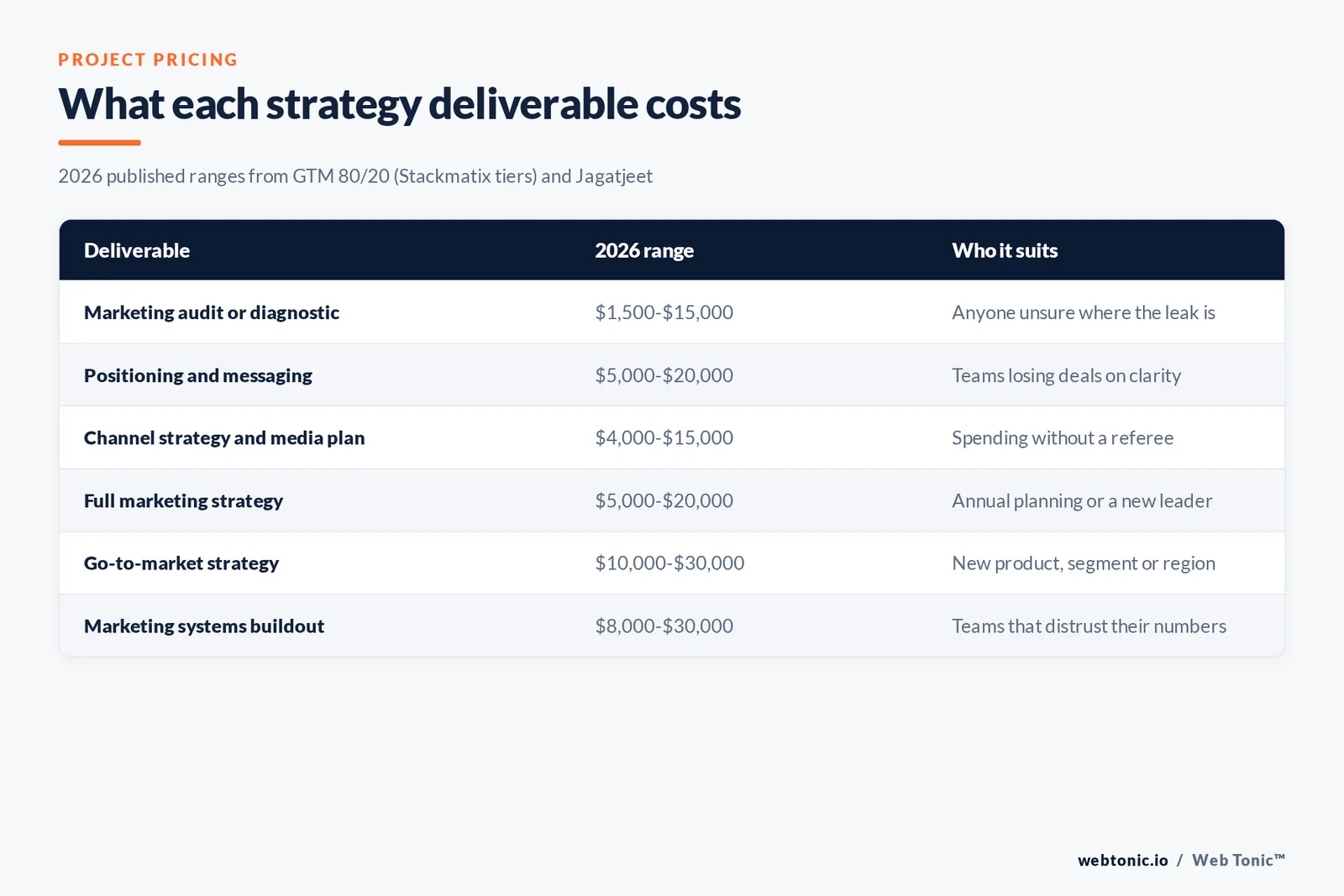
| What you are buying | 2026 price range | Deliverable | Who it suits |
|---|---|---|---|
| Marketing audit or diagnostic | $1,500–$15,000 | Written findings, severity order, priority list | Anyone unsure where the leak is |
| Positioning and messaging | $5,000–$20,000 | Positioning, message hierarchy, customer interviews | Teams losing deals on price or clarity |
| Channel strategy and media plan | $4,000–$15,000 | Channel mix, budget split, test plan | Companies spending without a referee |
| Full marketing strategy | $5,000–$20,000 | Segments, offer, channels, measurement, roadmap | Annual planning or a new leader |
| Go-to-market strategy | $10,000–$30,000 | Launch model, pricing input, sales enablement | New product, segment or region |
| Marketing systems buildout | $8,000–$30,000 | Attribution, CRM, reporting layer | Teams that cannot trust their own numbers |
| Complete marketing overhaul | $10,000–$50,000+ | Strategy plus rebuild across channels and systems | Post-pivot or post-acquisition resets |
Hourly, project, retainer: what each model really costs
Hourly. Best for narrow, defined tasks — a review, a workshop, an ad-hoc decision. Waco3's 2026 pricing guide puts the practical hourly band at $75 to $220 across the whole market, which tells you how much of "marketing consulting" is mid-level rather than strategic. OuterBox reports independent advisory at $75 to $250 and senior or fractional leaders at $150 to $500 when the work carries revenue responsibility.
Project. The most cost-predictable model, because scope is locked up front. Waco3 puts projects at $1,500 to $25,000; Jagatjeet at $5,000 to $50,000 for experienced independents; Inc Marketing Place's 2026 guide at $2,000 to $50,000+ depending on whether the deliverable is an audit or a full strategy build.
Retainer. GTM 80/20's three-tier split is the clearest published version: $1,500–$3,000 a month for 2 to 4 hours of basic advisory, $3,000–$8,000 for 20 to 40 hours of active engagement, $8,000–$15,000+ for 40 to 80+ hours of intensive work, and $5,000–$20,000 for fractional CMO cover at that same intensity. Inc Marketing Place reports retainers at $1,500 to $15,000; OuterBox at $1,500 to $5,000 for narrow support and $5,000 to $10,000+ for broader advisory. Waco3's worked examples are a useful reality check — a 90-day strategy roadmap at $2,200 from a junior consultant, a demand-gen plan with light implementation at $6,800 mid-level, and a senior fractional growth lead retainer at $10,500 a month.
What pushes a quote up
Five multipliers explain most of the variance, and all five are testable before you sign.
Documented results. Tom Wardman's 2026 UK analysis reports that consultants with proven, documented outcomes charge 50 to 100% more than those without. That is the premium you should be most willing to pay, because it is the one you can verify by calling references.
Specialisation. The same analysis puts specialists in regulated industries, SaaS, ecommerce or complex B2B at 25 to 40% above generalists. Vertical fluency shortens diagnosis, so the premium often reduces total cost.
Stakeholder count. Wardman's project bands scale with complexity rather than duration: simple strategy reviews at £5,000–£15,000, comprehensive audits at £15,000–£30,000, full strategic planning with implementation roadmaps at £30,000–£75,000+, and multi-department alignment workshops at £10,000–£25,000. Every extra decision-maker adds interview and alignment time.
Firm tier. Scopecreeper's 2026 benchmarks price the top of the market in day rates rather than hourly: £800 to £8,000+ a day depending on firm tier, with MBB partner rates exceeding £8,000 a day and Big Four engagements at £800–£1,500 a day for junior staff rising to £3,500–£6,000 for senior partners. ConsultingDemand's 2026 data puts second-tier firms at 60–70% of Big Three rates and independent boutique strategists with sector depth at $250 to $400 an hour — often the same expertise without the leverage model.
Geography. The 2026 Global Consulting Fees Survey puts the global median fee at $190 an hour, North America at $290, Western Europe at $200 and Asia and the Middle East at $125. London commands a 20–30% premium over the rest of the UK, per Wardman.
Cost by company stage
GTM 80/20 makes the most practical argument in the whole 2026 literature: budget should follow stage, because "spending $1,500 a month when you need $8,000 a month worth of help is as wasteful as overspending on executive strategy when you need channel execution." Its stage mapping puts pre-seed and seed companies at $5,000 to $8,000 a month and Series B or later at $12,000 to $20,000, with agency retainers at $5,000 to $25,000+ against independent consultants delivering comparable scope at $2,000 to $10,000.
| Stage or size | Sensible monthly spend | What to buy first | What to avoid |
|---|---|---|---|
| Pre-revenue / pre-seed | Fixed-fee project only | Positioning and one channel hypothesis | A retainer with no data to review |
| Seed, under $2M revenue | $5,000–$8,000 | Diagnostic, then a light advisory cadence | Intensive retainers priced for larger teams |
| $2M–$10M revenue | $3,000–$8,000 active engagement | Channel strategy plus a measurement layer | Strategy documents with no owner |
| $10M+ revenue | $8,000–$15,000+ intensive | Full strategy and quarterly board reporting | Junior delivery behind a senior pitch |
| Series B and beyond | $12,000–$20,000 | Fractional leadership or embedded advisory | Paying twice for overlapping agency scope |
The comparison against hiring is the other anchor. GTM 80/20, citing MarkCMO's cost guide, puts a full-time CMO at $400,000 to $720,000 in year one once salary, equity, benefits and recruiting fees are counted, against $96,000 to $180,000 a year for fractional cover — a 50 to 70% difference. Wardman's UK version puts a marketing director at £80,000–£120,000+ base plus 20–25% for employer costs, and notes that consultants score high on strategic input and low on implementation capacity. That trade-off, not the price, is what you are choosing between. Our marketing strategy consulting engagements are scoped as a fixed diagnostic first for that reason, with implementation scoped separately once the priorities are agreed.
Where the money is actually wasted
The shelf document. GTM 80/20 names it directly: a $20,000 go-to-market strategy sounds reasonable until it sits unread because nobody has the bandwidth or expertise to implement it. Budget the implementation before you buy the strategy, or buy a smaller strategy.
Bait-and-switch delivery. Companies that hire a senior strategist at $250 an hour and end up working with a $75-an-hour junior analyst pay for expertise they never receive. Name the person in the contract and ask what share of hours they personally deliver.
Buying reports in an AI-abundant market. The same guide argues the $100 to $150-an-hour consultant whose output is mostly templates and competitive summaries is getting harder to justify now that AI handles research and drafting. What survives is judgement, sequencing and accountability — which is also why the measurement layer matters more than the deck. Data intelligence work is the part of the engagement that keeps proving whether the strategy was right.
Skipping the paid trial. Jagatjeet's framing is the right test of value: a $10,000 engagement that correctly diagnoses why $80,000 a year of paid spend produces poor-quality leads is a good investment; a $3,000 engagement producing a report you cannot act on is not. A small scoped project is the cheapest way to find out which one you are buying.
What the fee should include, whatever the number
Price only becomes comparable once the contents are fixed. Across the 2026 guides, the same six components show up in credible strategy engagements, and most businesses that felt overcharged were missing two or three of them.
A written diagnosis before recommendations. Clients who buy strategies without a diagnosis end up paying twice: once for the plan, once for the rework when the plan meets the data. A named segment and offer decision. Strategies that avoid choosing a customer are the cheapest to produce and the most expensive to run. A channel and content plan with a budget split. Not a list of tactics — a stated allocation, with what gets stopped. A measurement definition. Which numbers prove the strategy is working, how they are calculated, and who reports them. A sequencing plan for the next two quarters, so the client's team knows what happens in week two rather than only in year one. A named owner for each workstream inside the business, because a strategy without owners is a document, not a plan.
Two of those components explain most of the variance between cheap and expensive engagements. Customer research raises cost and quality together: positioning work that includes real interviews with clients and lost prospects sits at the upper end of the $5,000 to $20,000 band and is the part generalist providers skip. And brand-level work — how the business is described, what it refuses to sell, how the content programme reflects that — takes calendar time from senior people, which is exactly what the higher hourly rates buy.
A practical way to hire against that list: ask for the last anonymised deliverable a provider produced for a business of your size, and check how many of the six components it contains. Providers who charge premium rates because their strategies are implementable will show you one; providers selling templates usually cannot.
How to compare two quotes properly
Ask every provider for the same four numbers and the comparison resolves itself: the deliverable, the named person delivering it, the hours behind the fee, and the decision the work is meant to unlock. Then check the fee against the size of that decision — not against the other quote. A fee that is 1% of the budget it reallocates is cheap; the same fee attached to nothing measurable is expensive at any price.
One more discipline: separate the strategy fee from the implementation fee in writing, even with the same provider. It keeps the incentive on closure rather than continuity, and it gives you a natural review point. If you want a worked example of how that split looks in practice, the blog covers the same ground for audits, fractional leadership and scorecard work.

Frequently Asked Questions
How much does marketing strategy consulting cost in 2026?
Expect $150 to $400 an hour for experienced independent consultants, $5,000 to $20,000 for a full marketing strategy project, and $3,000 to $8,000 a month for an active retainer. Go-to-market strategy runs higher, at $10,000 to $30,000, and complete overhauls reach $50,000+.
What is a reasonable hourly rate for a senior marketing strategist?
$175 to $300 an hour is the published band for a senior strategist with 7 to 15 years of experience, rising to $300 to $500+ for executive-level advisory. Rates below $100 generally indicate execution capacity rather than strategy, and the global median across all consulting is $190.
Is a project or a retainer better value?
For a defined question, a project is better value because the scope and the price are both fixed. A retainer only pays off when there is a genuine monthly cadence of decisions — otherwise you are buying availability you will not use. Many buyers get the best of both by starting with a fixed-fee diagnostic and converting to a retainer only if the review cadence proves necessary.
Why is a strategy from a large firm so much more expensive?
Firm rates carry overhead, brand and a delivery team. Day rates run £800 to £8,000+ by tier, with MBB partners above £8,000 a day, while second-tier firms bill at 60 to 70% of Big Three rates and independent boutique strategists with the same sector depth charge $250 to $400 an hour. You are paying for scale and assurance, not necessarily for more senior thinking.
How much should we budget for implementation on top?
Treat the strategy as roughly the front end of a larger number. Systems and attribution buildout alone runs $8,000 to $30,000, and campaign buildout $3,000 to $10,000. If the total available budget cannot cover both the thinking and the doing, buy a narrower strategy that your existing team can execute.
Where to go next
Decide which of the three objects you are buying — diagnostic, strategy, or ongoing engagement — then price only that. If you want the fee tied to a specific decision rather than a scope document, the contact page is the shortest path to a scoped read.
Sources: GTM 80/20, How Much Does a Marketing Consultant Cost? (Stackmatix 2026 tiers) · Jagatjeet, How Much Does a Marketing Consultant Cost? Real Numbers · Waco3, Marketing Consulting Pricing Guide 2026 · OuterBox, Marketing Consultant Cost 2026 · Inc Marketing Place, Digital Marketing Consulting Cost 2026 · Tom Wardman, Strategic Marketing Consultant Cost 2026 · Scopecreeper, Consulting Rate Benchmarks · ConsultingDemand, Consulting Fees & Rates by Industry 2026 · Reinvention Academy, 2026 Global Consulting Fees Survey. All figures accessed September 2026.