Table of contents

Marketing operations consulting is priced by three variables: seniority, whether the provider implements or only advises, and how ugly your stack is. Published 2026 rate cards cluster tightly enough to budget from.
Key Takeaways
- Retainers cluster at $3,000–$12,000 a month for most mid-market engagements, widening to $3,000–$27,000 once agency teams and full RevOps scope are included.
- Senior hourly practitioner rates run $200–$400; generalist and platform-specialist work sits nearer $100–$150, with specialists above $200.
- Scoped projects are the cleanest way to buy: $3,000–$10,000 for a CRM overhaul or attribution build at the small end, $25,000–$150,000+ for enterprise programme work.
- Platform migrations are their own budget line. A partner-led Salesforce-to-HubSpot move typically lands at $15,000–$50,000 mid-market, and $25,000–$150,000+ with heavy custom objects.
- Fractional leadership is the middle option: $3,000 a month for light engagements up to $12,000–$15,000 for senior strategic work at higher ARR.
- The comparison is a salary. A median MOps team carries 1.7 FTE at $10M ARR, 4.2 at $50M and 11.6 at $250M+ — so at small scale the choice is one hire versus bought expertise.
- Advice you must implement yourself is frequently the most expensive option. Confirm which side of that line a quote sits on before comparing numbers.
What you are actually buying
"Marketing operations consulting" covers at least four different products, and mixing them up is why quotes appear to disagree by a factor of ten. There is diagnostic work (what is broken and what it costs you), implementation work (build the thing), ongoing operations (run the thing), and leadership (decide what should exist at all). A $4,000 retainer and a $40,000 project can both be fair prices for different products.
The distinction that matters most commercially is advise versus implement. A 2026 buyer's guide to the category puts it plainly: more important than the rate is whether you are buying execution or only advice, because a framework you then have to implement yourself often costs more in total than a higher quote that includes the build. That is the first question to settle on any call, before rate cards come out.
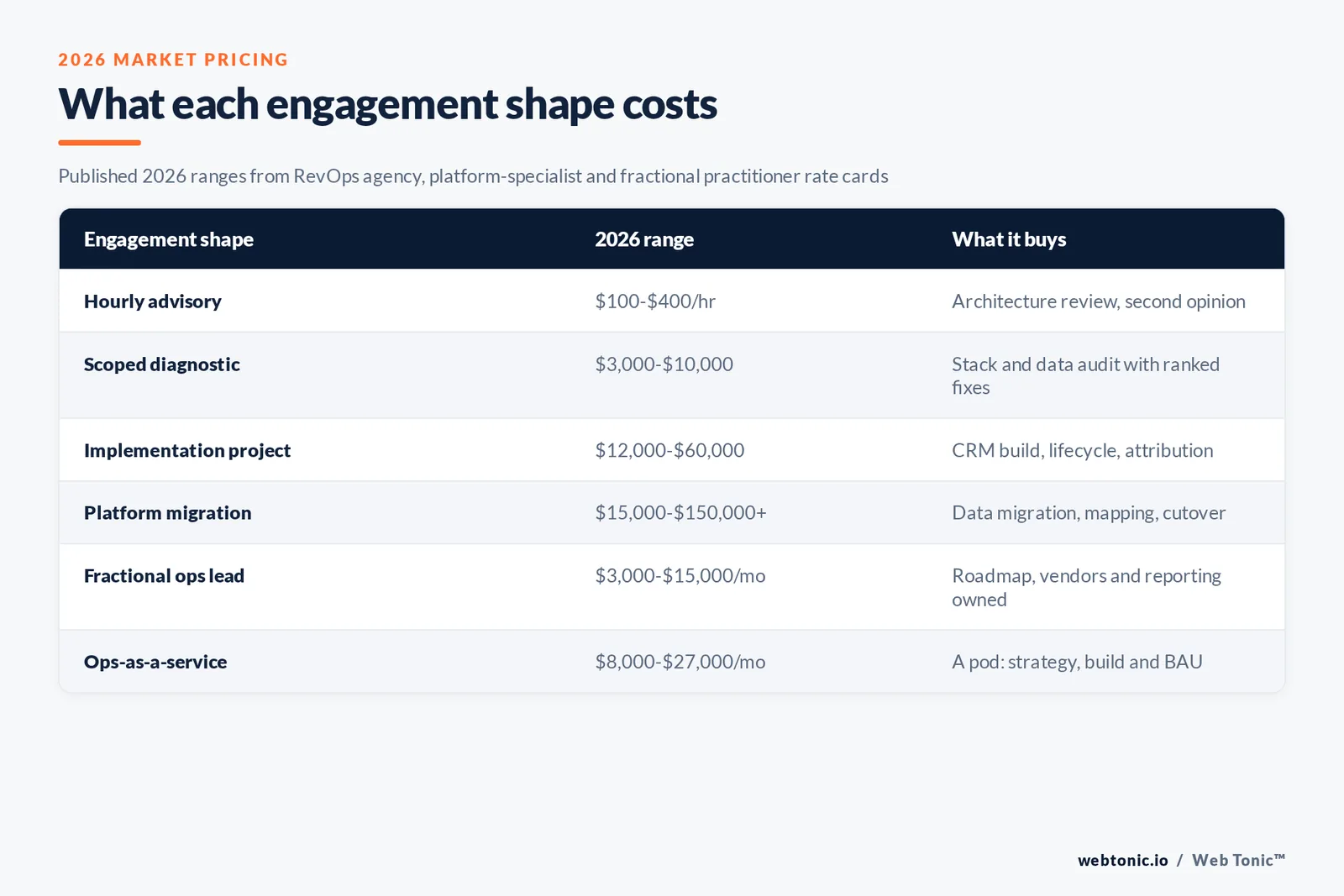
| Engagement shape | 2026 market range | What it buys | Best fit |
|---|---|---|---|
| Hourly advisory | $100–$400/hr | Architecture review, second opinion, escalation cover | One decision or one blocked build |
| Scoped diagnostic | $3,000–$10,000 | Stack, data and process audit with ranked fixes | You know it is broken, not where |
| Implementation project | $12,000–$60,000 | CRM build, lifecycle automation, attribution | A defined system that must exist |
| Platform migration | $15,000–$150,000+ | Data migration, object mapping, integrations, cutover | Changing CRM or automation platform |
| Fractional MOps/RevOps lead | $3,000–$15,000/mo | Ownership of the roadmap, vendors and reporting | No senior ops owner in-house |
| Ops-as-a-service retainer | $8,000–$27,000/mo | A pod: strategy, build and BAU throughput | Continuous backlog, multi-system stack |
The retainer bands, and why they differ
Published rate cards converge more than the marketing copy suggests. One 2026 pricing guide puts the typical ongoing range at $3,000–$12,000 a month, with one-time projects such as CRM overhauls or attribution setup at $3,000–$10,000. Fractional RevOps budgeting guidance starts light engagements around $3,000 a month and climbs to $12,000–$15,000 for senior strategic work at higher ARR. A third practitioner breakdown gives roughly $3,000–$15,000+ monthly or $10,000–$25,000+ as a flat fee for a scoped rebuild, and attributes the spread to three things: who does the work, whether they implement or advise, and how much of the stack is in scope.
The upper bands come from agency delivery rather than individuals. Agency pricing analysis for 2026 reports retainers from $3,000 to $27,000 a month and project work from $10,000 to $150,000+, with senior practitioner hourly rates at $200–$400. A pricing and scope evaluation guide lands in the same place: fractional RevOps at $5,000–$15,000 a month, projects at $25,000–$150,000+, and RevOps-as-a-service retainers at $8,000–$20,000 a month.
Platform work: where budgets actually break
Most overruns are not consulting overruns; they are migration overruns. Migration cost analysis puts a partner-led Salesforce-to-HubSpot move for a mid-market team at $15,000–$50,000, with custom-object-heavy enterprise instances running $25,000–$150,000+. CRM implementation cost benchmarks put a HubSpot implementation at $5,000–$25,000 for most mid-market B2B companies, with CRM-to-support integrations at $3,000–$8,000.
Platform-specialist rates sit lower than generalist RevOps strategy rates, which surprises people. Benchmark data drawn from thousands of projects finds most HubSpot consultants charge $100–$150 an hour, with highly specialised practitioners and agencies at $200+. A practitioner cost guide reports hourly work averaging $50–$300, projects at $12,000–$60,000, retainers at $3,500–$15,000+ a month, and fully loaded in-house development at $10,000–$16,000+ a month — the comparison that usually decides the question.
| Cost driver | Cheap end | Expensive end |
|---|---|---|
| Systems in scope | One CRM, one automation tool | CRM plus billing, support, product and BI |
| Data condition | Clean objects, documented fields | Duplicates, custom objects, no field owner |
| Advise vs implement | Recommendations you build in-house | Provider builds, tests and documents |
| Seniority | Platform specialist at $100–$150/hr | Senior RevOps architect at $200–$400/hr |
| Attribution ambition | Source and campaign hygiene | Multi-touch model plus dark-funnel coverage |
| Change management | Two-team rollout | Multi-region sales enablement and training |
Who the providers are
The supply side has three shapes, and knowing which one you are talking to explains most of the pricing. Independent consultants sell senior technology judgement and a pair of hands; a boutique firm sells a small team with a design and delivery process behind it; and larger digital services organizations sell programme capacity with account management, documentation standards and a bench to cover absence. All three can be the right buy — the failure is comparing an independent's day rate against a firm's programme quote and concluding one is overpriced.
Client experience differs as much as price. With an independent you get direct access to the expertise but a single point of failure; with a firm you get continuity and a defined escalation path, paid for in overhead. If your marketing organization runs a global stack across regions, the continuity is usually worth the premium; if you need one pipeline redesign executed well, it rarely is.
The in-house comparison
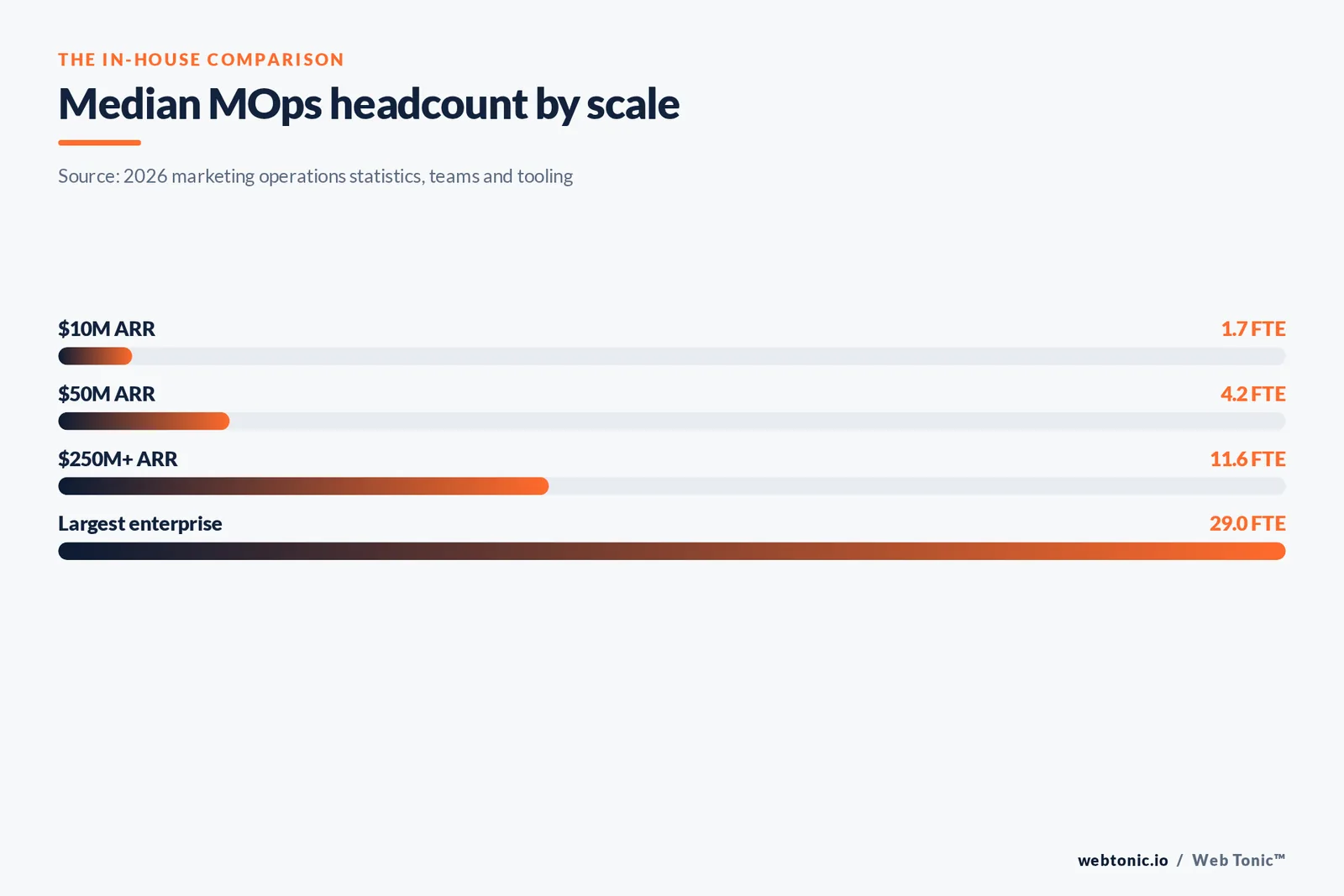
At small scale, the honest comparison is not agency versus agency; it is bought expertise versus your first ops hire. 2026 marketing operations benchmarks put the median MOps team at 1.7 FTE at $10M ARR, 4.2 at $50M, 11.6 at $250M+ and roughly 29 at the largest end. Below about $20M ARR, therefore, most companies are debating one or two people — which means the ops roadmap depends heavily on whichever specialism that hire happens to have.
That is the structural argument for buying breadth early and hiring depth later: a retainer at $4,000–$8,000 a month buys architecture, build and reporting from people who have done all three, where a single hire at a comparable loaded cost buys one skill set plus recruiting lag. The argument reverses once volume of BAU work exceeds what a retainer can absorb, which in practice is when the ops backlog is continuously full rather than occasionally spiky.
What the quoted price usually excludes
Three cost lines sit outside almost every consulting quote and belong in the budget anyway. Software is the first: consolidation is a live theme, with 62% of B2B teams planning to reduce tool count in the coming year according to the 2026 marketing operations maturity model, so an honest engagement may add a licence in one place while cutting two elsewhere. Second is internal time — your team's hours in discovery, testing and training, which typically run several hours a week per stakeholder for the length of a build and are the most common reason a 90-day project becomes a 150-day project.
Third is the maintenance tail. A build handed over without documentation, field ownership and a change process decays, and the next provider prices the cleanup. Ask for the documentation deliverable in writing, along with admin access in your own accounts rather than the provider's, and ask what happens to the automation if the engagement ends mid-quarter. None of those requests moves the price much when they are agreed upfront; all of them cost real money when they are not.
How to buy it without overpaying
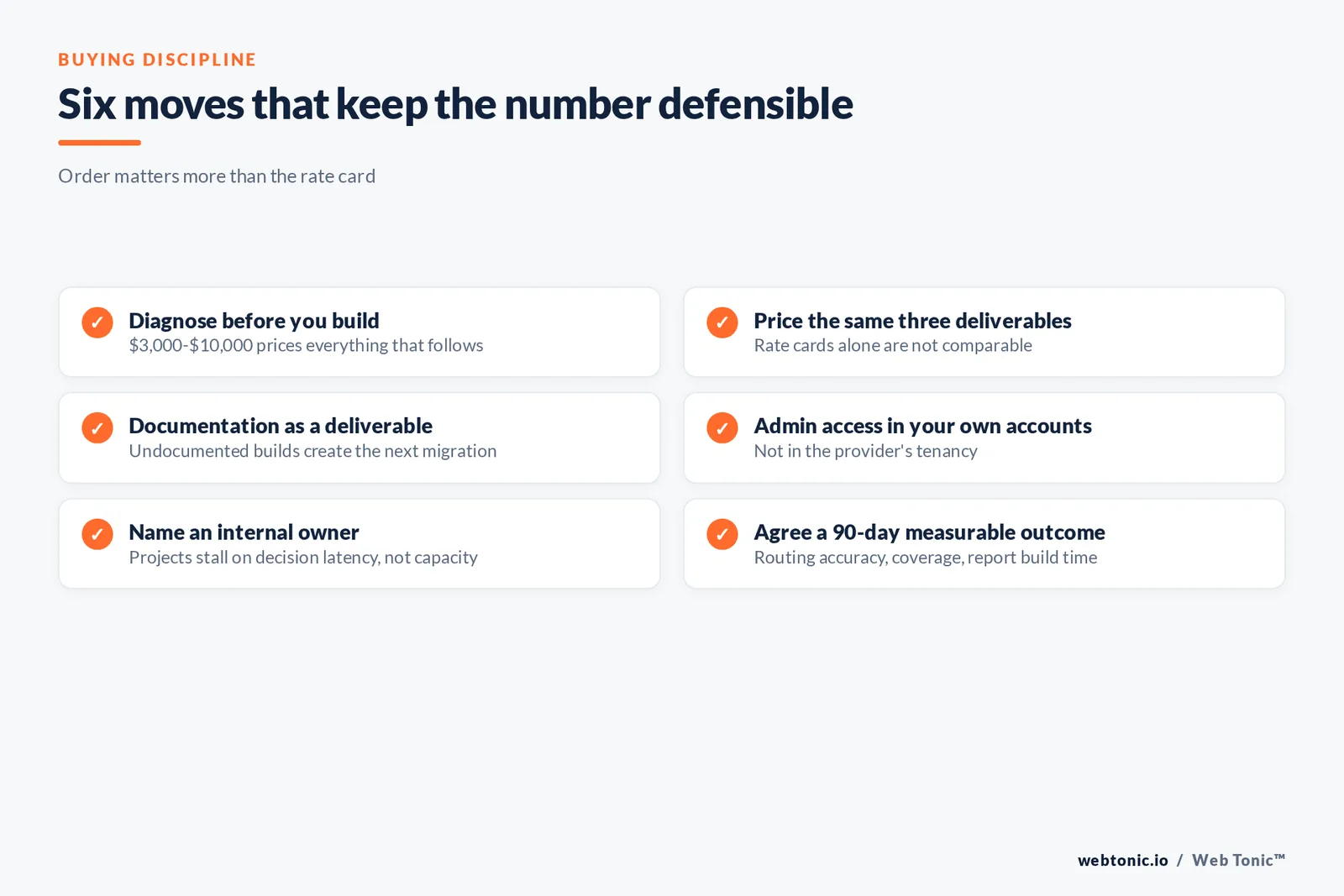
Four moves keep the number defensible. First, buy a diagnostic before a build: at $3,000–$10,000 it prices the rest of the work honestly and is the cheapest way to discover the problem is process rather than platform. Second, ask every provider to price the same three deliverables so quotes are comparable — a rate card alone tells you nothing. Third, insist on documentation and admin access as a deliverable, not a favour; undocumented builds are what create the next migration. Fourth, put a named owner on your side, because ops projects stall on internal decision latency more often than on vendor capacity.
One more discipline: agree how success is measured before signing. Lead-to-record time, routing accuracy, attribution coverage rate and report build time are all measurable within a quarter, and all of them beat "the stack feels better." If a provider cannot name a measurable outcome for the first 90 days, the scope is not ready.
Sequencing the spend across a year
Spreading the same budget in the right order changes what it buys. A workable annual sequence for a mid-market team is a diagnostic in month one, the highest-value build in months two to four, a light retainer for stabilisation and reporting in months five to eight, then a second build only if the measured gap justifies it. On the bands above, that is roughly a $5,000 diagnostic, a $20,000–$35,000 build and $4,000 a month of stabilisation — a defensible first-year figure that leaves room to stop after any stage.
The wrong order is the expensive one: buying a retainer first, discovering the architecture is wrong in month four, then paying for a build on top of a retainer that is already committed. Diagnose, build, then run. And revisit the plan once measurement is trustworthy, because ops priorities set against unreliable reporting are guesses with invoices attached.
How Web Tonic scopes it
We scope marketing ops work as a diagnostic first, then a build with named deliverables, documentation and admin handover included by default. Every engagement states which of the four products it is — diagnose, build, run or lead — so a client is never comparing an advisory quote against an implementation quote by accident. Numbers in our diagnostics are traceable to the systems they came from, and where a fix is process rather than platform we say so, even when the platform build would be the larger invoice. Detail on the service sits on our marketing operations consulting page, the reporting layer under data intelligence, and scoping questions go through contact.

Frequently Asked Questions
Is the market price rising or settling?
Settling. Independent 2026 rate cards from platform-specialist guides, RevOps agencies and fractional practitioners now overlap heavily, which means a quote well outside the $3,000–$27,000 monthly and $10,000–$150,000 project envelopes needs a specific justification — unusual scope, unusual data volume, or a product you have not been told about.
What is a realistic monthly budget for a mid-market team?
Most mid-market engagements land at $3,000–$12,000 a month, with $8,000–$20,000 for full ops-as-a-service pods carrying build and business-as-usual throughput. Below $3,000 you are generally buying a few hours of advice rather than ownership.
Why are HubSpot specialists cheaper than RevOps strategists?
Because the work is narrower and more standardised. Benchmark data puts most HubSpot consultants at $100–$150 an hour, while senior RevOps architects designing across CRM, billing, support and BI sit at $200–$400. Pay for architecture once, then buy platform hours for execution.
Should we buy a project or a retainer?
Buy a project when the outcome is a system that must exist and can be defined — a CRM rebuild, a lifecycle model, an attribution layer. Buy a retainer when the backlog is continuous. Retainers billed against an undefined backlog are where budgets quietly drift.
How much should a platform migration cost?
Mid-market partner-led migrations typically run $15,000–$50,000, rising to $25,000–$150,000+ where custom objects, heavy automation and large contact volumes are involved. Data condition is the single biggest driver, so a data audit before quoting saves real money.
When does hiring in-house become the better option?
When BAU volume is continuously full rather than spiky, and when the roadmap is settled enough that one specialism covers it. Median MOps teams are only 1.7 FTE at $10M ARR and 4.2 at $50M, so most companies hire depth after buying breadth, not before.
Sources
Marketing operations consulting 2026 buyer's guide · Revenue operations consultant cost guide 2026 · OpsEthic fractional RevOps cost · MIMR Growth Lab RevOps consultant cost · RevOps agency pricing 2026 · RevOps pricing, scope and evaluation · Salesforce-to-HubSpot migration cost · CRM implementation cost benchmarks · HubSpot consultant pricing benchmark · HubSpot consulting cost practitioner guide · Marketing operations statistics 2026 · 2026 marketing operations maturity model. More on our approach: Web Tonic blog.