



Table of contents
Marketing strategy consulting is the work of deciding where growth will come from before anyone spends money trying to find it. It produces choices — segments, positioning, pricing, funded channels — not campaigns.
Key Takeaways
- A marketing strategy consulting engagement is bought for judgement and priorities. The deliverable is a marketing plan with owners, not an activity calendar.
- The symptom that justifies it is almost always the same: activity is high, and nobody can explain which two or three things are producing the revenue.
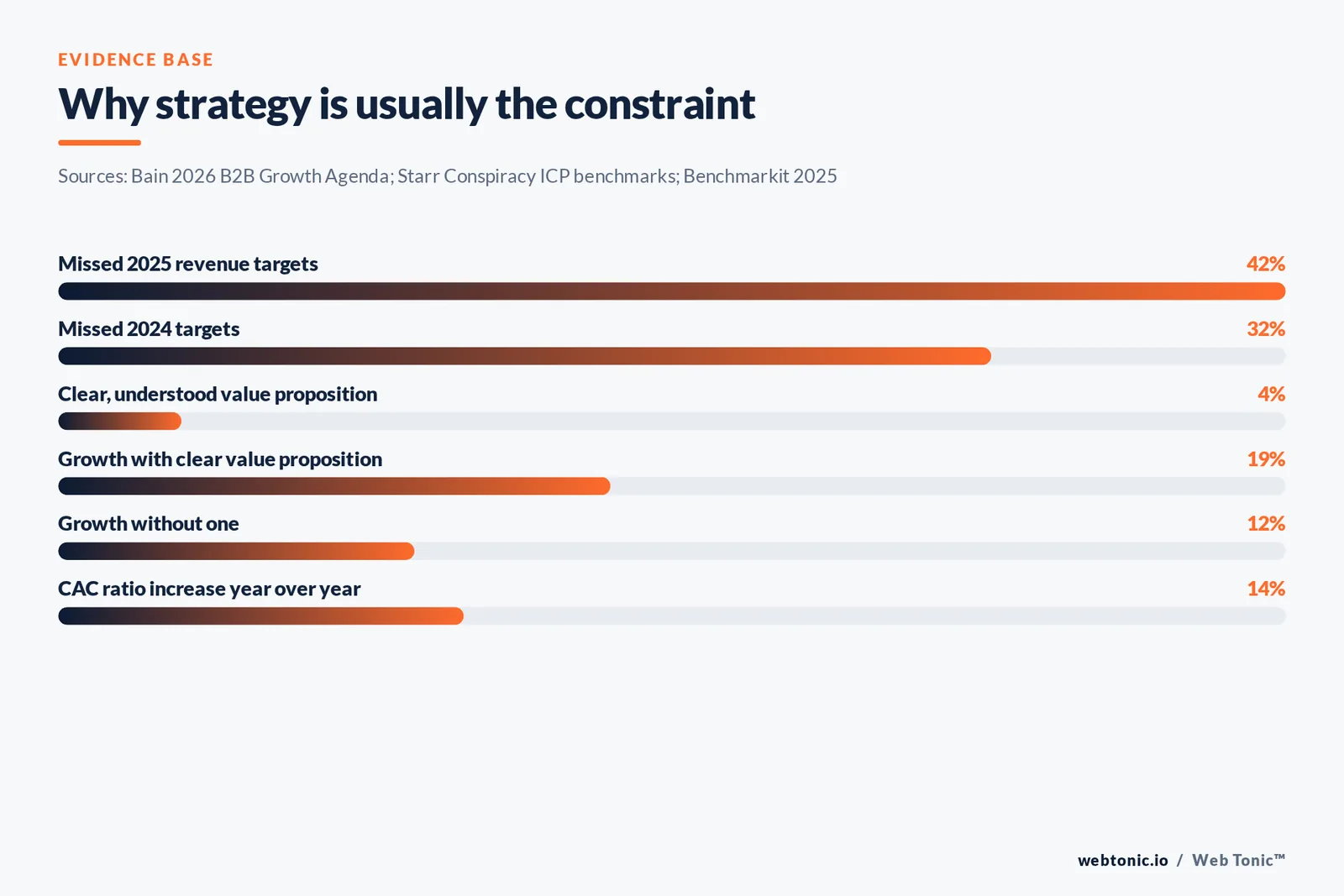
- 42% of companies missed 2025 revenue targets against 32% in 2024, and only 4% of executives say their value proposition is strong and consistently understood.
- Companies with a clear, consistently understood value proposition grew 19% in 2025 versus 12% for those without — positioning is a growth variable, not a branding exercise.
- Targeting discipline is measurable: a defined ideal customer profile is associated with a 68% win-rate lift and CAC payback of 14 months on profile versus 26 months off it.
- Do not buy strategy when the real gap is capacity, when a single channel is clearly broken, or when leadership will not release decision authority.
- Market rates are wide — roughly $150–$300 an hour for strategists and $5,000 to $50,000+ for a defined project — so scope the decision, not the hours.
What the work actually is
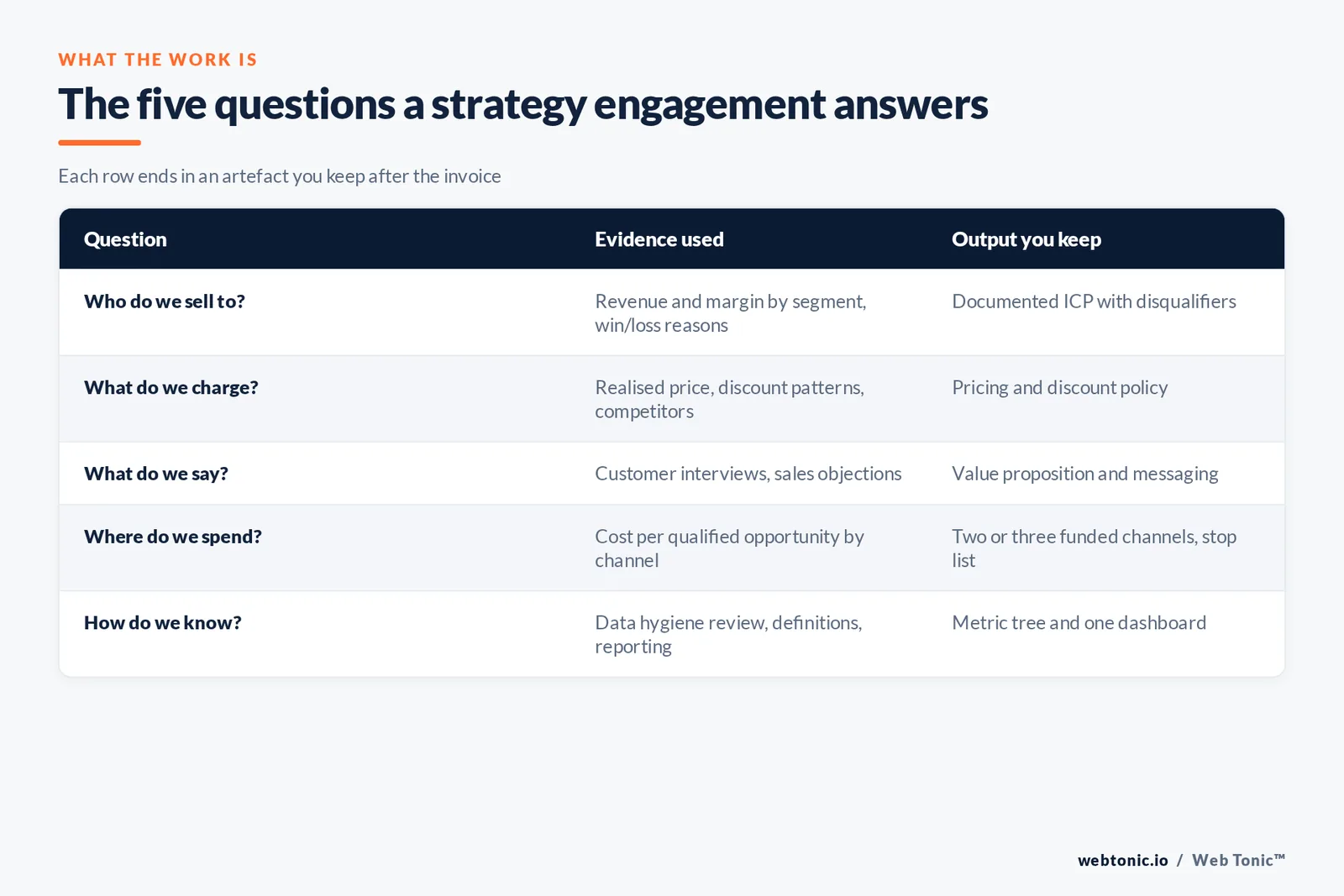
Strip away the language and marketing strategy consulting answers five questions in writing: who we sell to and who we decline, what we charge and why, what we say that competitors cannot credibly say, which two or three channels get funded and what stops, and how we will know within a quarter whether the choices were right.
Everything else is downstream. A content calendar without an agreed segment is guesswork with a schedule. A paid media plan without a value proposition is efficient distribution of a weak message. The consultant's job is to make the upstream decisions explicit, assign them to internal owners, and leave behind a plan the team can execute without them in the room.
The scale of the industry reflects how much of this work gets outsourced. Industry analysis of the consulting market puts the US consulting sector at roughly $466.7bn, with strategy and marketing advisory a growing slice as buyers move from long transformation programmes towards shorter, decision-shaped engagements.
The evidence that strategy is the constraint
The case for buying strategy is not philosophical. Bain's 2026 B2B Growth Agenda, based on over 1,100 senior executives across 18 industries, found 42% of companies missed 2025 revenue targets, up from 32% in 2024, while 91% stayed confident about the year ahead. It also found that firms with a clear and consistently understood value proposition grew 19% against 12% for the rest — and that only 4% believe they have one.
Harvard Business Review's research with Egon Zehnder, covering more than 500 senior leaders, points at the same root cause from a different angle: growth stalls where priorities are unclear and functions are misaligned, not where effort is missing. SBI Growth's study of 300 mid-market companies quantifies the gap in productivity terms: leaders return $0.71 of growth per commercial dollar against a market average of $0.54.
| Question the engagement answers | Evidence used | Output you keep |
|---|---|---|
| Who do we sell to? | Revenue and margin by segment, win/loss reasons, retention | Documented ICP with explicit disqualifiers |
| What do we charge? | Realised price, discount patterns, competitor positioning | Pricing and discount policy with an approver |
| What do we say? | Customer interviews, sales objections, category language | Value proposition and messaging hierarchy |
| Where do we spend? | Cost per qualified opportunity by channel, sales capacity | Two or three funded channels and a stop list |
| How do we know? | Data hygiene review, definitions, existing reporting | Metric tree and one dashboard |
Six signals you need it now
These are the conditions where an outside strategic view reliably pays for itself.
- Flat revenue with rising spend. Efficiency is degrading, and channel-level optimisation has stopped moving the number.
- No agreed ICP. Sales and marketing describe the target customer differently. Benchmark data shows a median 31% of B2B SaaS pipeline sits outside the profile, with payback stretching to 26 months off profile.
- Everything is a priority. Five segments, seven channels and a team of four is a symptom, not a strategy.
- Unit economics drifting. Benchmarkit's 2025 B2B SaaS data puts median CAC at $2.00 per $1.00 of new ARR, up 14% year over year — the trend most businesses notice a year late.
- Pricing never gets reviewed. McKinsey analysis values a 1% price improvement at about 8.7% of operating profit.
- A step change is coming. New market, new product line, funding round or an acquisition — moments where the wrong default choice compounds for years.

When not to buy it
Three situations where a strategy engagement is the wrong purchase. First, when the constraint is capacity: the plan is clear, agreed and simply not being executed because nobody has the hours. That is a staffing or agency problem, and another document will not fix it.
Second, when one channel is visibly broken and the rest of the business is healthy. A conversion-tracking failure or a mismanaged ad account is a specialist repair job with a fast payback, not a strategic reset. Third, when leadership will not release decision authority. If the founder intends to overrule the ICP and reopen the pricing policy in month two, the engagement will produce artefacts nobody uses. Consultants can supply judgement; they cannot supply decisiveness.
There is also a maturity floor. If nobody knows which channel generated last quarter's pipeline, the first 30 days will be measurement hygiene rather than strategy — lead source on every record, one definition of a qualified opportunity, one revenue source of truth. That is worth doing, but scope it honestly instead of paying strategy rates to clean data.
What it costs, and how to read the ranges
Public benchmarks are wide because the label covers very different work. Consulting fee data by industry puts marketing strategists at roughly $150–$300 an hour, execution specialists at $75–$175, and the survey average across marketing consultants at about $142. A 2026 rate report shows $50–$500 an hour and project fees from $5,000 for a campaign audit to $50,000+ for a full go-to-market strategy, while independent rate data puts the global median near $188 an hour.
Use the ranges to detect mismatch rather than to pick a winner. A quote well under the band usually means execution capacity; a quote well above it should come with senior time on your account. The number that matters is the cost of the decision relative to the spend it governs — a $20,000 planning engagement that redirects a $1m annual budget is a cheap insurance policy; the same fee spent to reorganise a $60,000 budget is not.
| Your situation | What to buy | Why |
|---|---|---|
| No agreed target customer or message | Strategy engagement | Every downstream channel decision depends on it |
| Plan exists, execution stalled | Delivery capacity | The constraint is hours, not judgement |
| One channel underperforming badly | Specialist audit | Narrow diagnosis, fast payback |
| Reporting cannot answer basic questions | Measurement project first | Strategy without a baseline cannot be judged |
| Ongoing leadership gap | Fractional leadership | Continuous ownership beats a one-off plan |
How a competent engagement runs
Expect four phases inside roughly 90 days. Weeks one to three: data pull, customer and sales interviews, a written baseline of the numbers as they are. Weeks four to six: the constraint named, with the segment, pricing and messaging work that follows from it. Weeks seven to nine: the channel plan, the stop list, budgets and the metric tree. Weeks ten to twelve: handover — owners named, dashboard live, first review scheduled.
Consulting onboarding practice holds the kickoff itself to 60–90 minutes with three outputs: shared goal, working cadence, immediate next steps. If your kickoff produces a slide deck and no cadence, the engagement has already started drifting.
The signal to watch is who is doing the deciding. In healthy engagements, the consultant supplies analysis and a recommendation, and a named internal owner signs it. In unhealthy ones, recommendations accumulate unsigned, and by month three the plan has become a reading document.
What small companies and larger organizations each get from it
The same engagement produces different value depending on size. For small businesses, the win is focus: one customer segment, one message, two channels, and permission to stop everything else. Most small teams are not short of ideas or digital tools — they are short of the expertise to say which opportunities to decline this quarter. A consultant who has seen the pattern in comparable clients can shorten that decision from a year of experiments to a few weeks of analysis.
For larger organizations, the value is alignment and analytics. Several teams already own pieces of the plan — brand, content, media, sales enablement — and each has its own strategies and reporting. The consulting firm's contribution is a single metric tree that ties those pieces to one revenue target, plus a clear owner for each number. Without that, functions optimise locally and the company grows slower than the sum of its activity.
Industry context matters less than most buyers assume, but it is not irrelevant. Consultants who work across industries bring transferable pattern recognition: pricing discipline, segmentation, message testing and channel economics behave similarly whether the customer is a clinic, a manufacturer or a software company. What genuinely differs is buying process length, regulatory constraint and the media landscape — so ask how a consultant would learn those specifics for your market, and what they would refuse to assume.
Whatever the size of the company, one practical test separates useful strategy from expensive analysis: could a competent marketing manager execute the plan next Monday without asking what it means? If the answer is no, the engagement has produced a point of view rather than a plan, and the best time to say so is at the day-30 review.
Strategy consulting versus the adjacent options
Buyers usually weigh four models. A strategy engagement is time-boxed and produces decisions. Fractional leadership is ongoing and owns the plan as well as writing it. An agency retainer executes channels against a plan someone else set. An in-house hire builds internal capability, at the cost of time to hire and time to impact.
These are sequential more often than they are competitive. The common pattern is a short strategy engagement to settle direction, delivery capacity to execute it, and an internal hire once the role is defined enough to recruit against. Buying the hire first is what produces the 18-month loop where a capable marketer inherits an undefined mandate and leaves before the plan is finished.

Related reading
- Marketing Operations Consulting / RevOps: what it is and when you actually need one
- Marketing Audit / Growth Audit: what it is and when you actually need one
- EOS / Scorecard & KPI Advisory: what it is and when you actually need one
- Marketing Strategy Consulting services at Web Tonic
Frequently Asked Questions
What is the difference between marketing strategy consulting and a marketing audit?
An audit is diagnostic: it describes what is happening and what is broken. A strategy engagement includes diagnosis but ends in decisions — segments, pricing, message, funded channels, owners. An audit is often the first three weeks of a strategy engagement sold on its own.
How long should the engagement last?
Around 90 days for a full plan in most mid-market businesses. Shorter engagements can answer one question well; longer ones tend to drift into delivery, which is usually cheaper to buy elsewhere.
Will a consultant execute the plan too?
Some do, and there is a conflict worth naming: a provider who recommends the channels they will then be paid to run needs to show the reasoning behind the choice. Ask for the analysis, not just the recommendation.
What does the business need to supply?
Access and decisions. Revenue data by segment, CRM access, a few customer conversations, and a named internal owner who can approve the ICP, the price policy and the stop list. Without the last item, the engagement produces documents rather than change.
How do we know it worked?
Agree three layers before kickoff: decisions completed, leading indicators such as cost per qualified opportunity and off-profile pipeline share, then revenue efficiency. Judging a 90-day plan on this month's revenue is how good work gets cancelled early.
Where to take this next
If activity is high and priorities are unclear, the constraint is upstream of your channels. Our marketing strategy consulting engagements end in a signed plan with named owners, growth marketing executes it, the full services lineup covers what follows, and the blog has more method detail. If you want a second opinion on whether strategy is really your bottleneck, tell us what you are seeing.
Sources
Bain & Company — 2026 B2B Growth Agenda survey
Harvard Business Review / Egon Zehnder — Why Some Companies Grow Rapidly While Others Stall
SBI Growth — While Growth Slows for Most, Leaders Take a Different Approach
The Starr Conspiracy — ICP Benchmarks for B2B GTM
Benchmarkit — 2025 B2B SaaS Performance Metrics
IndustryWeek / McKinsey — The Payoff from Investing in Pricing Capabilities
Consulting Demand — Consulting Fees & Rates by Industry
GTM 8020 — Marketing Consultant Rates & Comp Report
Sam Landenwitsch — The 2026 Rate Report
Vanta Insights — Consulting Industry Trends
MyConsultBase — Consulting Client Onboarding Checklist


