Table of contents

A marketing strategy engagement is measured on three clocks at once: whether the decisions got made, whether the leading indicators moved, and whether the revenue math changed. Most engagements are judged on the third clock alone, months before it can possibly have ticked.
Key Takeaways
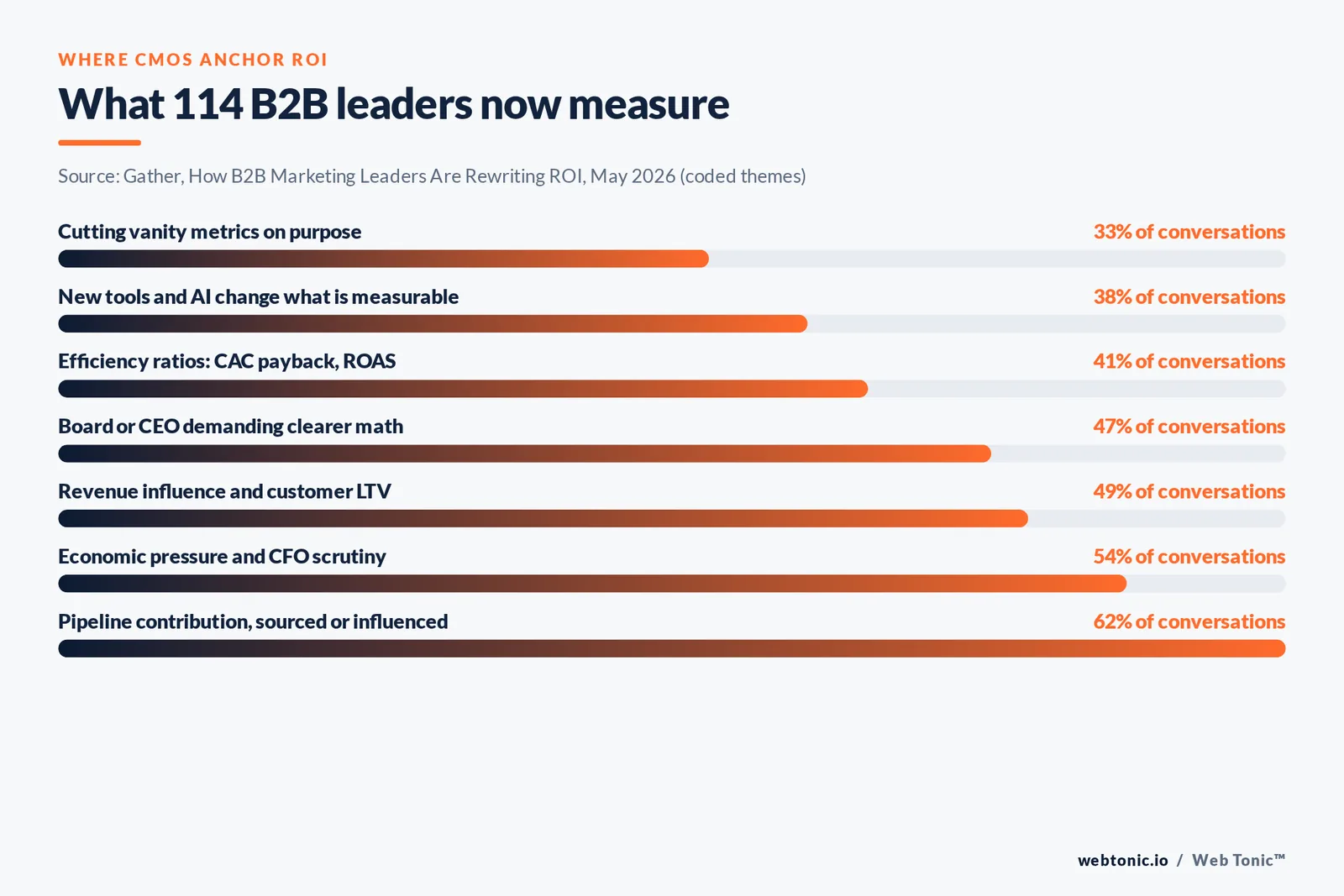
- ROI proof is narrowing, not broadening. Across 114 B2B marketing leaders interviewed in 2026, 62% anchor on pipeline contribution, 49% on revenue influence and LTV, 41% on efficiency ratios, and 33% are cutting vanity metrics on purpose.
- The pressure is coming from finance: 54% of those leaders cited economic and CFO scrutiny and 47% a board or CEO demanding clearer math.
- Leading indicators move first. Typical 90-day outcomes from a senior engagement are 15–25% more qualified leads and 10–20% better conversion rates, before any pipeline or CAC effect is legible.
- Six months is the fair horizon for the money metrics — benchmarks for senior part-time engagements target 30–60% more marketing-sourced pipeline and 15–30% better CAC in that window.
- Measure against a rebuilt baseline, not the old dashboard. If CAC excludes salaries and tooling, or payback is calculated on revenue instead of gross margin, every "improvement" you report is an artefact.
Why strategy engagements get measured badly
Strategy work produces decisions. Decisions produce behaviour. Behaviour produces numbers. Each step adds lag, and the engagement usually ends during step two — so the honest question is not "did revenue rise" but "did we get the decisions, and are the early signals consistent with the thesis".
Gather's 2026 study of 114 B2B CMOs and VPs of marketing describes the change in expectations plainly: leaders are no longer asked whether marketing pays back, they are asked to show the math, and to show it before the quarter closes. Its coded themes put economic and CFO pressure at 54%, board and CEO demands for clearer math at 47%, and new tooling changing what is measurable at 38%. On metrics, the same study found leaders naming two or three priority numbers rather than a dashboard: pipeline contribution sourced or influenced (62%), revenue influence and LTV (49%), efficiency ratios such as CAC payback and ROAS (41%), with 33% deliberately retiring legacy metrics.
That narrowing is good news for anyone measuring a consulting engagement. Fewer, defensible numbers are easier to agree in advance — which is the only moment they can be agreed honestly.
The four measurement layers
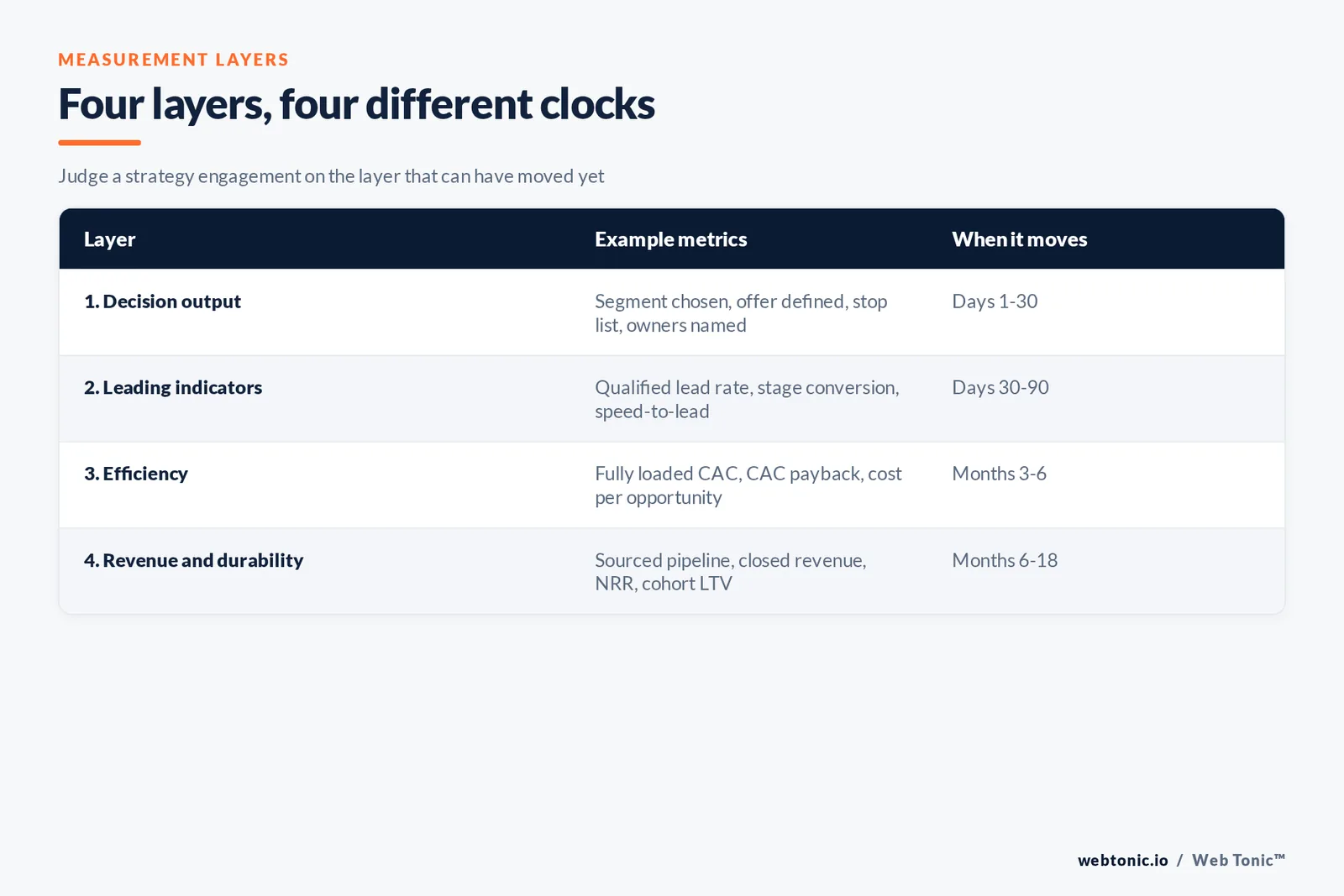
Use four layers, each with its own clock. A strategy engagement that clears layers one and two on time is on track even if layers three and four are still flat.
| Layer | What it measures | Example metrics | When it moves |
|---|---|---|---|
| 1. Decision output | Whether the strategy actually resolved open questions | Segment chosen, offer defined, stop list agreed, owners named | Days 1–30 |
| 2. Leading indicators | Whether behaviour changed in the funnel | Qualified lead rate, stage-to-stage conversion, speed-to-lead, win rate on target segment | Days 30–90 |
| 3. Efficiency | Whether the same money buys more | Fully loaded CAC, CAC payback, cost per qualified opportunity, wasted spend removed | Months 3–6 |
| 4. Revenue and durability | Whether the business compounds | Marketing-sourced and influenced pipeline, closed revenue, NRR, LTV by cohort | Months 6–18 |
Two rules keep the layers honest. First, every metric gets a written definition and an owner before the engagement starts. Second, nothing is reported against a baseline that has not been rebuilt — see the next section, because this is where most measurement quietly fails.
Fix the baseline before you measure anything
An engagement measured against wrong starting numbers will produce a flattering result and a wrong decision. Stackmatix's diligence guide sets the standard an investor would apply: fully loaded CAC includes salaries, tools and agency fees rather than media spend alone; LTV comes from observed cohort retention curves; and payback is gross-margin-adjusted, expected under 12 to 18 months for SaaS. Those are the same three corrections that change how a consulting engagement looks.
Context matters too. Aleph and Benchmarkit's study of 342 companies puts median CAC payback at 16 months, the top quartile at 6 and the bottom at 24 — so a move from 20 months to 15 is a genuine result, not a rounding error. Fairview's Series A metrics guide sets the external bar a strategy is often trying to clear: $1.5M+ ARR growing 150%+, NRR above 110%, payback under 18 months.
The rebuild is unglamorous and it is the highest-return part of the first month. Improvado's marketing audit framework is a reasonable checklist for what to inspect — tracking, data joins, channel definitions, reporting cadence — before any number gets quoted to a board. In our own work this is what the data intelligence layer exists to do, and it is why a marketing audit usually precedes a strategy engagement rather than following it.
What "good" looks like at 30, 90 and 180 days
Benchmarks for senior advisory engagements come mostly from the fractional leadership market, where the same question is asked constantly. Fractional Pulse's ROI framework expects leading indicators to move by day 60 — clearer ICP, sharper messaging, better targeting, a content calendar, team changes started — with typical 90-day outcomes of 15–25% more MQLs and 10–20% better conversion rates, then 30–60% more marketing-sourced pipeline and 15–30% better CAC within six months. It frames the commercial bar as a 3–5x return: a $12,000-a-month engagement, or $144,000 a year, needing $432,000 to $720,000 in attributable revenue or savings.
Treat those as target shapes rather than promises — they come from a marketplace with an interest in the answer, and they assume the engagement includes execution oversight, not advice alone. What they get right is the sequencing: nobody should be reporting CAC improvement at day 45, and everybody should be reporting decision output at day 30.
| Checkpoint | The question to ask | What to do if the answer is no |
|---|---|---|
| Day 14 | Do we have a written diagnosis with numbers we recognise? | Stop the strategy work; fix data access first |
| Day 30 | Are the segment, offer and stop list decided and owned? | Escalate: the engagement is producing analysis, not decisions |
| Day 45 | Is the measurement layer defined and reporting weekly? | Pause new campaigns until the baseline exists |
| Day 90 | Have qualified lead rate or conversion moved at all? | Test the thesis, not the tactics — the segment may be wrong |
| Month 6 | Is loaded CAC or payback better on a like-for-like basis? | Re-scope or end; six months is enough signal |
| Month 12 | Is pipeline contribution defensible to a CFO without caveats? | Rebuild attribution before renewing anything |
Attribution, incrementality tests and media mix modelling
Most disputes about whether a strategy worked are really disputes about method. Three families of analytics answer three different questions, and mature teams use all of them rather than arguing about which is correct.
Attribution assigns credit for conversions across channels and campaigns using tracked customer touchpoints. It is cheap, fast and directional, and it is the layer where tracking quality decides everything — broken consent handling, missing UTMs or a CRM that overwrites source data will corrupt every downstream insight. Use it to spot where performance is shifting week to week.
Incrementality testing answers the causal question attribution cannot: what would have happened anyway. Geo holdouts, audience holdbacks and staggered launches let a team estimate lift for a channel or a campaign rather than infer it. It costs traffic and patience, so reserve it for the two or three channels carrying most of the media budget.
Media mix modelling (MMM) works at the portfolio level, using aggregate spend and outcome data to model how channels contribute together, including offline and brand activity that no pixel sees. MMM needs history and analytics capability, which is why it belongs to larger brands and later-stage companies rather than to a first strategy engagement.
For a consulting engagement the practical sequence is: fix tracking, run attribution for direction, use one incrementality test to settle the biggest budget argument, and only consider MMM when the media mix is complex enough that channel interactions genuinely matter. Agree in advance which method settles a disagreement — otherwise the client and the firm will each cite the analytics that flatters their position, and the strategy conversation turns into a tooling conversation.
The same principle applies to KPIs across product, brand and demand work. Marketers running innovation or new-market campaigns should expect longer lags and softer signals, and should pick a small set of KPIs per objective: reach and message recall for brand, qualified opportunities for demand, activation and retention for product-led growth. Mixing those clocks in one dashboard is how teams conclude that everything is failing.
Report it the way a board reads it
Measurement that never reaches the board does not protect the budget. Prooflytics' board report template compresses a quarter into five slides — portfolio scorecard, channel efficiency, revenue contribution, pipeline health, next-quarter plan — and reports that leaders who present a modelled contribution to pipeline win 20–40% more approval on budget asks. MarkCMO's board-ready framework makes the vocabulary point: pipeline sourced, CAC payback and marketing-attributed revenue, not impressions and sessions.
There is a career argument for this discipline as well. Spencer Stuart's tenure study puts average S&P 500 CMO tenure at 4.1 years against 5.0 for the wider C-suite — the shortest seat in the room. A strategy engagement that leaves behind a defensible measurement layer outlives whoever commissioned it; one that leaves a deck does not.
Six ways measurement goes wrong
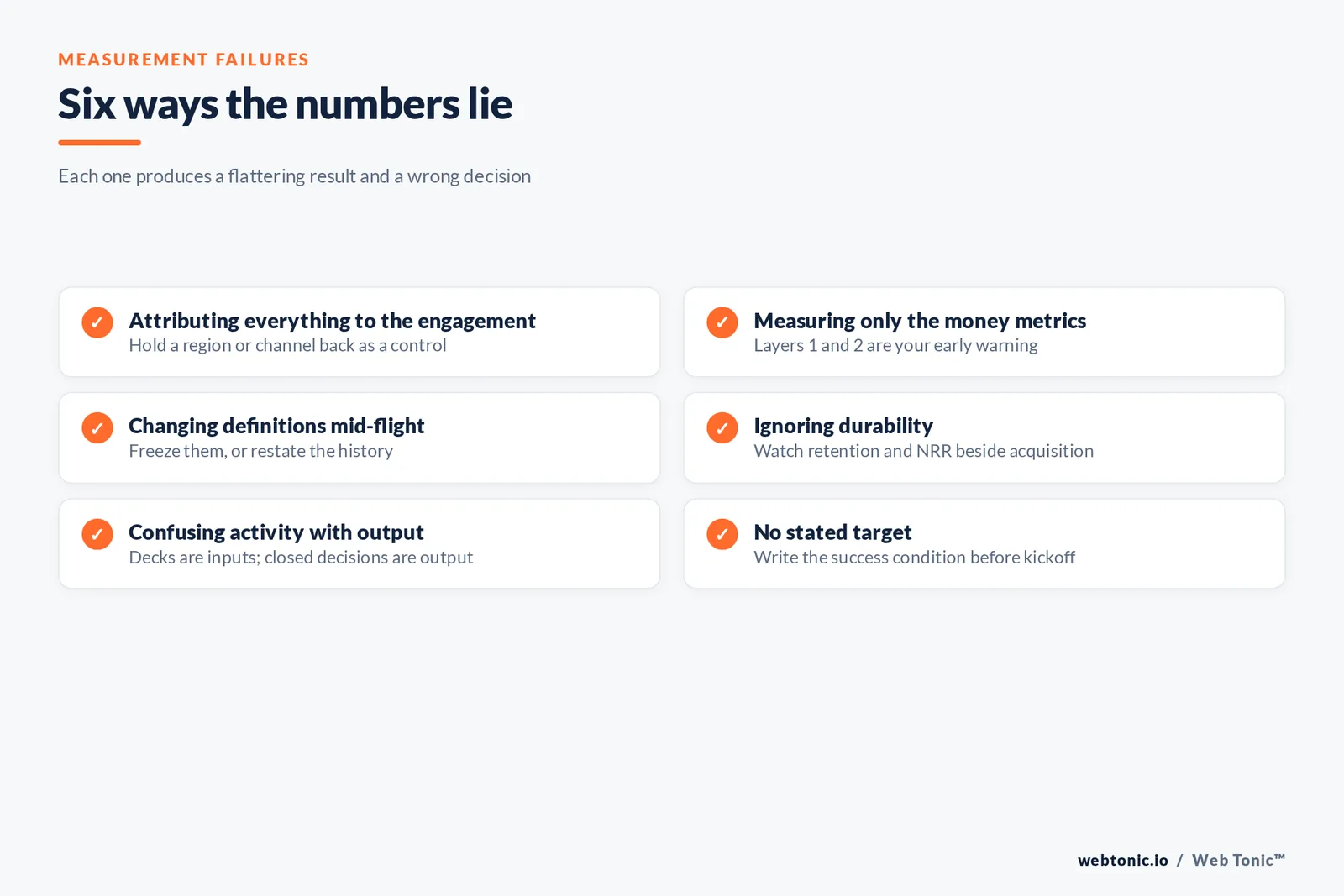
Attributing everything to the engagement. Seasonality, pricing changes, a big deal closing and a competitor's outage all move the same numbers. Where the spend is meaningful, hold a control — a region, a segment, a paused channel — so the counterfactual is not a guess.
Measuring only the money metrics. If layers one and two are not tracked, you have no early warning and no way to distinguish a wrong strategy from a slow one.
Changing the definition mid-flight. Redefining "qualified lead" during the engagement makes every trend line meaningless. Freeze definitions, and if one must change, restate history.
Ignoring durability. A quarter bought with discounting is not a strategy result. Watch retention and NRR alongside acquisition; CB Insights' failure post-mortems attribute 43% of failures to poor product-market fit, 29% to timing and 19% to unsustainable unit economics — all three hide behind a good acquisition month.
Confusing activity with output. Decks delivered, workshops run and meetings held are inputs. The layer-one test is whether a decision that was open in week one is closed and owned in week five.
No stated target. Write down what would make the engagement a success, in your own numbers, before it starts. It is the single cheapest measurement improvement available, and it is the one most often skipped. Our marketing scorecard advisory work exists precisely to fix that gap, and the blog works through the same problem for audits and fractional leadership.
A minimum viable measurement plan
One page, agreed before kickoff, is enough. Name the two or three primary metrics — most 2026 CMOs pick pipeline contribution plus one efficiency ratio. State how each is calculated, including what is inside CAC. Record the current value and the date it was measured. Set the review cadence: weekly for leading indicators, monthly for efficiency, quarterly for revenue and durability. Name one owner per metric on the client side, not the consultant's side. Then add the stop rule — the result that would cause you to end or re-scope the engagement at month six.
Providers who resist that page are telling you something useful. Providers who bring their own version of it before you ask are usually the ones worth hiring; the services overview shows how we sequence the measurement layer ahead of spend, and the contact page is where a scoped read starts.

Frequently Asked Questions
How long before a marketing strategy engagement shows results?
Decisions should be visible inside 30 days and leading indicators inside 90 — typically 15–25% more qualified leads and 10–20% better conversion rates. Efficiency metrics such as loaded CAC and payback need 3 to 6 months, and revenue durability measures such as NRR and cohort LTV need 6 to 18.
Which metrics should we agree on before the engagement starts?
Two or three, no more. The 2026 pattern among B2B leaders is pipeline contribution (62%), revenue influence and LTV (49%) and one efficiency ratio such as CAC payback (41%). Add one operational milestone — usually a working measurement layer — so month one is also measurable.
How do we separate the consultant's impact from everything else?
Hold something constant. A paused channel, an untouched region or a segment excluded from the new messaging gives you a rough counterfactual. Where that is impossible, document the other changes in the period and report the result with that caveat attached rather than claiming clean attribution.
What ROI should we expect for the fee?
Published fractional benchmarks target a 3–5x return, framing a $144,000-a-year engagement as needing $432,000 to $720,000 in attributable revenue or savings. Treat that as a target you set, not a guarantee you are given — and count avoided waste, since removing spend that never converted is as real as new pipeline.
What if the numbers do not move at all by month six?
Test the thesis before the tactics. Either the diagnosis was wrong, the strategy was never implemented, or the baseline was broken and you are measuring noise. All three are answerable in a week with clean data — and all three are reasons to re-scope rather than renew.
Where to go next
Write the one-page measurement plan first, then hire against it. If you want that page built with your own numbers and a rebuilt baseline behind it, the marketing strategy consulting page explains how we scope it.
Sources: Gather, How B2B Marketing Leaders Are Rewriting ROI (114 respondents, May 2026) · Fractional Pulse, Fractional CMO ROI: How to Measure Results · Stackmatix, Marketing Due Diligence for Startups · Aleph and Benchmarkit, CAC Payback Period SaaS 2026 · Fairview, SaaS Metrics Series A Investors Expect · Improvado, Marketing Audit · Prooflytics, CMO Board Report Template · MarkCMO, Board-Ready Reporting · Spencer Stuart, CMO Tenure Study · CB Insights, Top Reasons Startups Fail. All figures accessed September 2026.