



Table of contents
Quick answer: Run the first marketing strategy consulting session as a three-hour working meeting with a pre-read: evidence first, then who you are for, then what you say and why it is believed, then three funded moves with owners and dates.
Last verified: 2026-09-06
The session is not a discovery call
Discovery already happened during scoping. The first strategy session exists to convert evidence into decisions, and it fails when it is used to gather information that a consultant could have collected alone beforehand. If the room spends its first hour explaining the business to you, the session is already lost.
So the entry condition is a pre-read circulated at least 48 hours ahead: the performance data, the customer evidence, and an explicit list of what is contested. Everything in that document is treated as agreed unless someone contests it in writing before the meeting. That single rule removes the most common failure of these sessions, which is re-litigating facts in a room booked for judgement.

Who is in the room
Six people at most, and every one of them either owns a decision or owns the evidence. In practice that is the founder or commercial lead, whoever runs marketing day to day, someone from sales who talks to customers weekly, and the consultant. Anyone who is present to be informed can read the output instead.
The person who can move budget has to be there. A session that produces three prioritised moves and then waits three weeks for approval loses the momentum that justified the meeting format in the first place. If that person cannot attend, move the date rather than running it without them.
Block one: evidence on the table
Forty-five minutes, and it is a summary, not a presentation. Walk the pre-read at speed and stop only on the contested items. The output of this block is a short list of things everyone now accepts as true, which is what makes the later blocks fast.
Where the evidence is qualitative, say so. Structured customer conversations in the customer development tradition are legitimate input, but a room that cannot tell a measured fact from a remembered one will make confident decisions on thin ground. Label each claim with where it came from.
Block two: who we are for
Take the segments one at a time and decide, out loud, keep or drop. This is the positioning work, and it is uncomfortable because dropping a segment feels like losing revenue. It usually is not: the segment being dropped is almost always the one already being served badly.
Force a ranking rather than a set. If everything is a priority, the plan cannot allocate, and the argument you avoided in the session will return as a budget dispute in month two. Write the ranking down with the reason attached to each position.
Block three: what we say and why it is believed
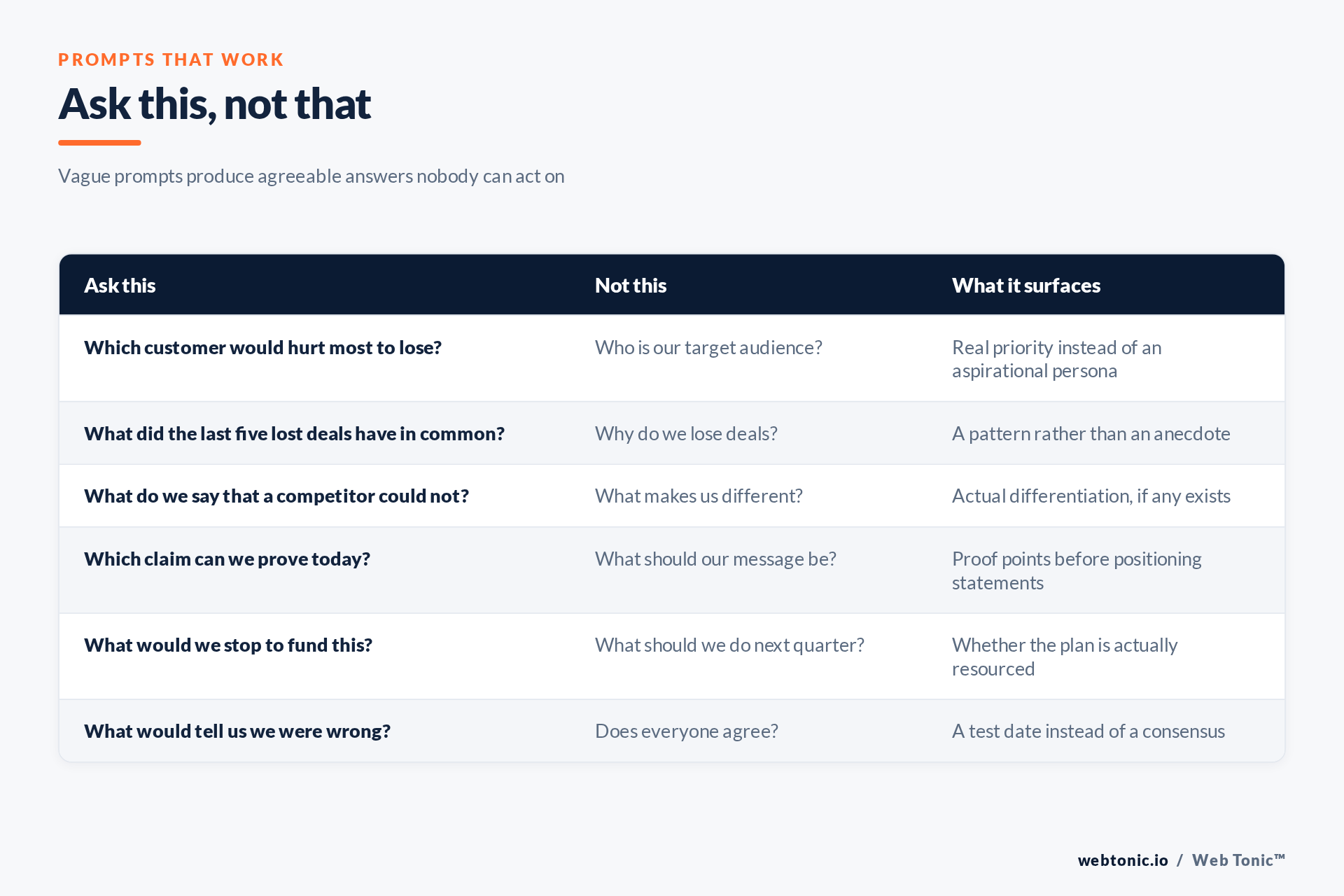
Messaging in this session means claims plus proof. Take the two ranked segments and, for each, write the sentence you want them to repeat back, then name the evidence that makes it credible today. If the proof does not exist yet, the claim is a project, not a message, and it goes on the plan as a project.
The useful discipline here comes from the voice of the customer approach: prefer the customer's own words over internally invented phrasing. Wording that came from a sales call survives contact with the market far better than wording that came from a workshop.
Block four: three moves, owned and dated
Close by naming exactly three moves for the next quarter. Three is not a style choice: it is the number a small team can hold while still doing its existing work, and a list of nine is a list nobody starts. Each move gets one owner, one date and one number it is supposed to move.
Ask what will be stopped to fund each move. A marketing plan that only adds is a plan that will be quietly abandoned, and the abandonment will be blamed on the strategy rather than on the capacity. Where the answer is that nothing can be stopped, the move needs external delivery capacity, which is a separate scoping conversation — our growth marketing and performance creative notes describe what that involves.
| Block | Time | Output |
|---|---|---|
| Pre-read | 48h before | Agreed facts and a list of what is contested |
| Evidence | 45 min | A short list of accepted truths |
| Segments | 60 min | A ranked segment list with reasons |
| Messaging | 45 min | Claims paired with existing proof |
| Moves | 30 min | Three moves, each owned, dated and measured |
What to send afterwards
A one-page note within 24 hours: the decisions, the ranking, the three moves, and the open questions with the date each will be answered. Not the whiteboard photos. Not a deck. The value of the session evaporates in about a week if nothing written replaces the memory of it.
Circulate it to everyone affected, not only attendees. The first sign that the session worked is someone outside the room quoting the segment ranking back at you in an unrelated meeting.
What goes wrong
The failure mode: the session ends in agreement instead of decisions. Everyone nods, nothing is ranked, nothing is dropped, and the written note contains themes rather than owners. Three weeks later the same meeting is scheduled again with a new title.
The second failure is the deck. A consultant who arrives with 40 slides has pre-decided the outcome and reduced the room to an audience, which wastes the one thing you cannot get from analysis: the disagreement inside the company. The third is skipping the disproof question — without a stated signal and a date, a wrong diagnosis will survive the whole quarter. Related steps are covered across the help library.
Related reading
- Marketing Operations Consulting / RevOps — How to Run the First Strategy Session
- Marketing Audit / Growth Audit — How to Run the First Strategy Session
- Marketing Team Structure & Hiring Advisory — How to Run the First Strategy Session
- Marketing Strategy Consulting services at Web Tonic
Frequently Asked Questions
How long should the first strategy session be?
Three hours with a pre-read. Full-day sessions lose the room after lunch, and without a pre-read the first half is spent explaining the business rather than deciding anything.
Who should attend?
Six people maximum, each owning either a decision or the evidence, and the budget holder must be one of them. Anyone attending to be informed can read the one-page note instead.
Should the consultant bring a recommendation?
Bring a hypothesis and the evidence for it, not a finished plan. A finished plan turns the session into a presentation and hides the internal disagreement you needed to hear.
What is the deliverable?
A one-page note within 24 hours: decisions taken, the segment ranking, three owned and dated moves, and the open questions with answer dates.
Sources: Positioning, Marketing plan, Voice of the customer, Customer development (Wikipedia); MIT Sloan Management Review; Harvard Business Review. Verified 2026-09-06.


