



Table of contents

Quick answer: Run the first marketing audit session in 90 minutes: confirm the audit questions, take the business context, interrogate how each reported number is produced, close every access gap live, and leave with a ranked 90-day shortlist.
Last verified: 2026-09-07
The session has one job: make the audit answerable
The first session is not a presentation. Its job is to leave the room with the questions agreed, the data access complete and the definitions behind the client's numbers written down. If all three happen, the rest of the audit is mostly execution. If any is missing, the findings will be argued with later on grounds that have nothing to do with the analysis.
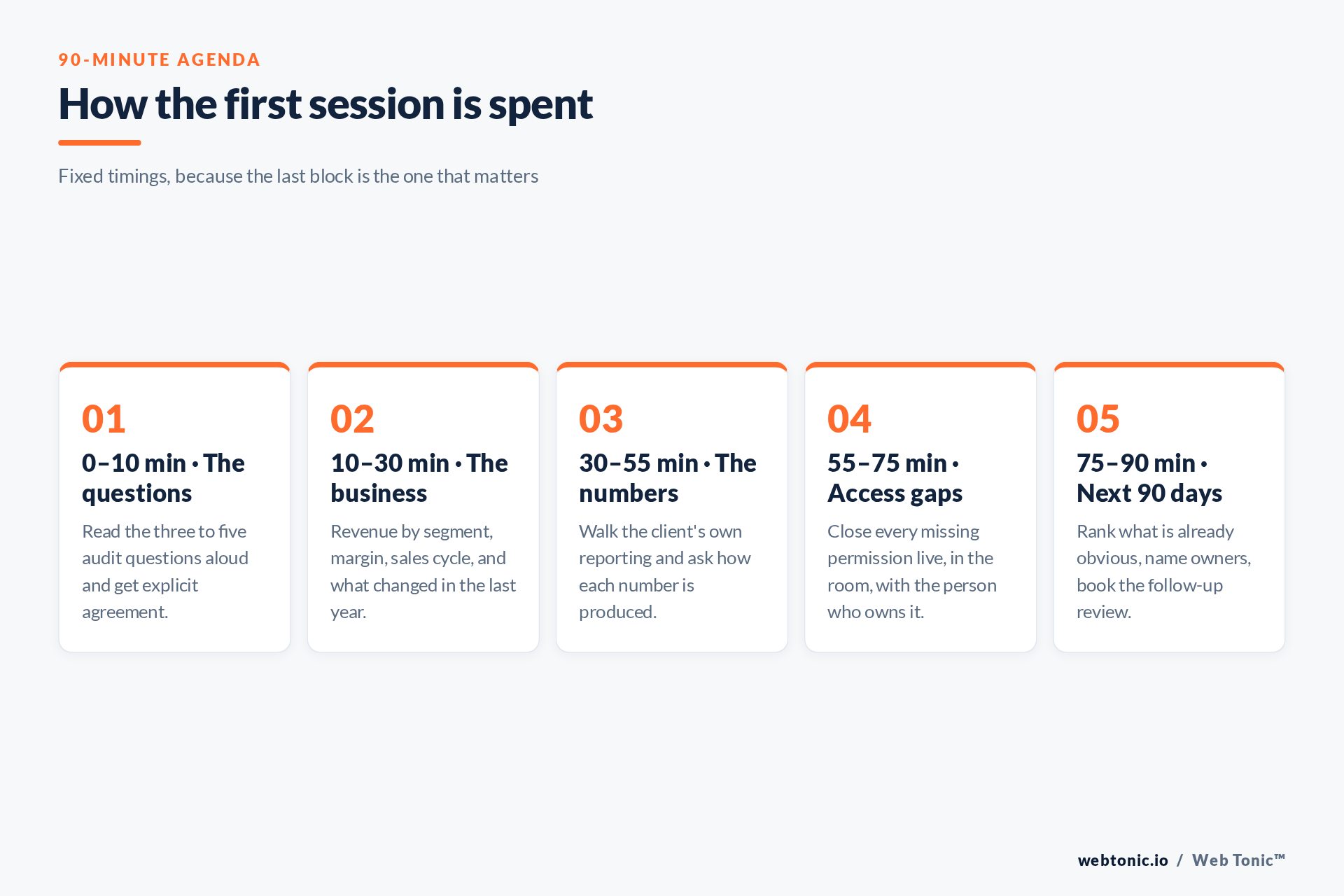
Ninety minutes is the right length, with fixed timings. Sessions without timings spend an hour on company history and three minutes on access, which is exactly backwards.
Open by reading the questions back
Read the three to five audit questions aloud and ask whether they are still the right ones. Two things happen. Sometimes a question is quietly replaced — the real worry turns out to be lead quality, not cost per lead — and that changes the whole work plan. More often the client hears their own questions in plain language for the first time and sharpens them.
Get the final wording written into the notes in the session, not afterwards. Everything downstream, including what you refuse to spend time on, hangs off it. Where the questions touch positioning, note that voice-of-customer input will be needed rather than assumed.
Take the business context, briefly
Twenty minutes on the commercial shape of the business: revenue by segment, gross margin, sales cycle length, average order value or contract value, capacity constraints, and anything that changed in the last twelve months — pricing, a site migration, a team change, a competitor.
This is where the audit's centre of gravity gets set. An audit that optimises the channel mix for a segment the business cannot profitably serve is a well-executed waste of time. Margin and capacity are also what turn a customer acquisition cost number into a verdict rather than a statistic.
Interrogate the numbers in front of them
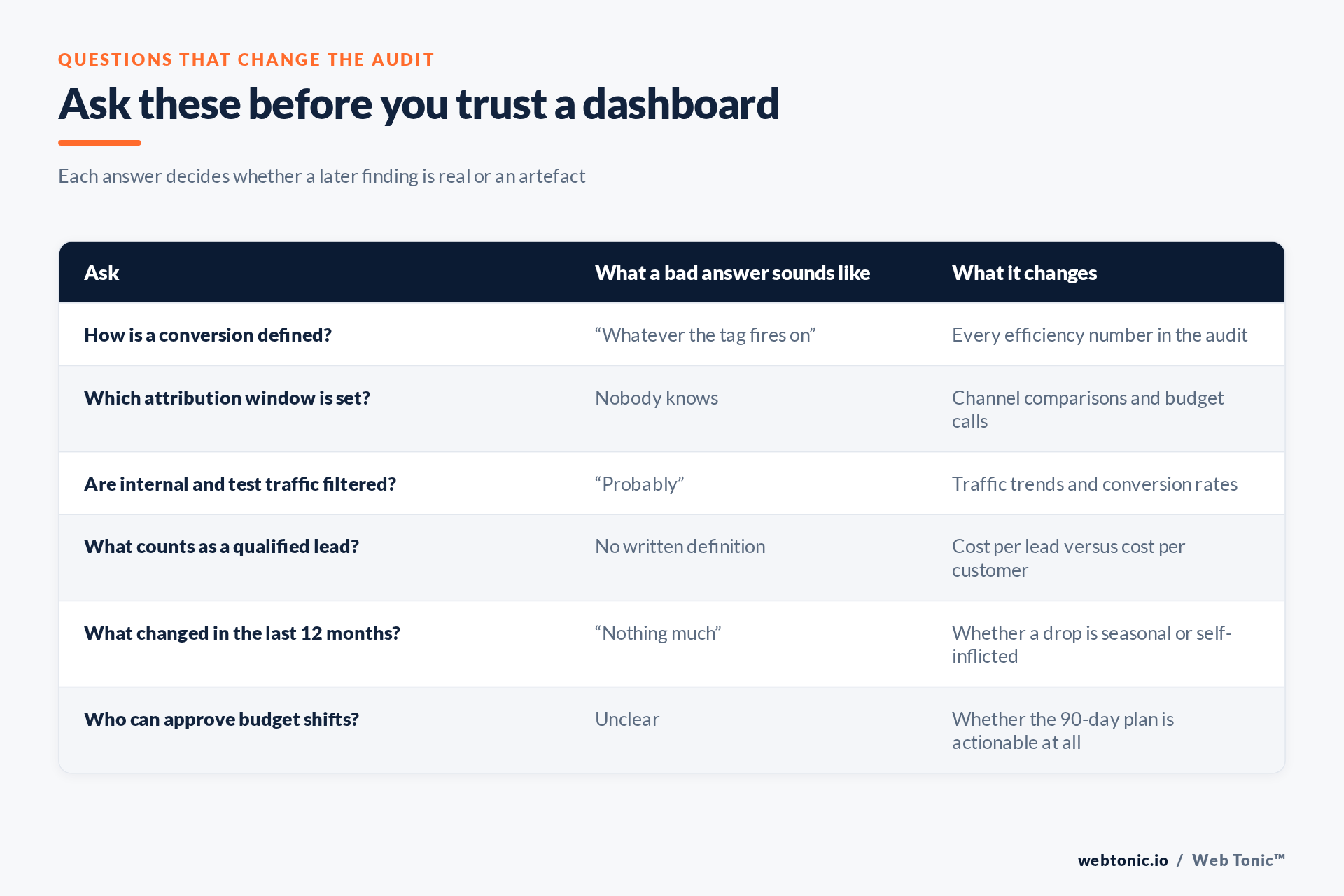
Open the client's own reporting and ask, for each headline number, how it is produced. What fires the conversion, which attribution window is set, whether internal and bot traffic are filtered, whether offline sales are imported, and what counts as a qualified lead.
Do this before promising any conclusions. Definition problems are the most common single finding in a growth audit, and they are cheap to discover in a live conversation and expensive to discover in week three. If a number cannot be explained by anyone present, that is a finding on its own; our conversion tracking and analytics pages cover the usual causes.
Close the access gaps in the room
Access requests sent by email after a session lose days. Instead, block twenty minutes with the person who actually owns the accounts and grant everything live: analytics, Search Console, every ad account, the tag container and the CRM export.
Where access cannot be granted at all, record it as a constraint in the notes and state which questions become unanswerable. That sentence protects both sides when the audit lands.
| Leave the session with | Form it takes | Owner |
|---|---|---|
| Agreed questions | Three to five, final wording | Client sponsor |
| Metric definitions | One line per headline number | Analytics owner |
| Access log | Granted / pending / refused | Account owner |
| Constraints | What cannot be answered, and why | Auditor |
| Obvious fixes | Ranked shortlist, max five | Named per line |
| Review date | Calendar invite, 30 days out | Client sponsor |
End on the 90 days, not on thanks
Spend the last fifteen minutes ranking what is already obvious. There is always something: a conversion firing twice, brand and generic search sharing one budget, a landing page with no measurable form. Cap the list at five, put a name and a date against each, and be explicit that it is provisional and may be reordered once the analysis is done.
Then book the 30-day review before anyone stands up. Audits are actioned when a date exists to be accountable to; that is the same logic behind objective-and-key-result cadences and it applies to a two-person team as much as a board.
What goes wrong
The failure mode: the session becomes a company presentation. Sixty minutes of background, ten minutes of dashboards, no access granted and no definitions written down. The audit then runs on assumptions and its first draft gets rejected on the grounds that "that is not how we count it".
The second failure mode is the wrong people in the room. Without whoever owns the tag container and whoever can approve a budget shift, neither the access block nor the 90-day block can be completed. Name the required attendees in the invite and move the session rather than run it short-handed.
The third is promising findings in the first session. Anything said before tracking integrity has been checked is a guess, and a guess offered confidently in session one gets quoted back for the rest of the engagement. More process notes in the help library.
Related reading
- How to Run the First Marketing Strategy Session
- Marketing Operations Consulting / RevOps — How to Run the First Strategy Session
- Fractional CGO / Head of Growth — How to Run the First Strategy Session
- Marketing Strategy Consulting services at Web Tonic
Frequently Asked Questions
How long should the first audit session be?
Ninety minutes with fixed timings: ten on the questions, twenty on business context, twenty-five on interrogating the numbers, twenty on access, fifteen on the provisional 90-day list.
Who needs to attend?
The sponsor who owns the audit's questions, whoever administers the analytics and tag container, whoever runs the ad accounts, and someone with authority to approve a budget shift.
Should findings be presented in the first session?
No. Until conversion definitions and tracking integrity have been checked, any finding is a guess — and a confident guess in session one gets quoted back for the whole engagement.
What if access cannot be granted?
Log it as a constraint and state in writing which audit questions become unanswerable. That single sentence prevents the dispute when the audit is delivered.
Sources: Google Ads conversion windows, Search Console permissions (Google); Customer acquisition cost, Voice of the customer, OKR (Wikipedia); Harvard Business Review. Verified 2026-09-07.


