



Table of contents

Quick answer: Run the first marketing team structure session as three hours of mapping: agree the outcomes marketing owns, put every recurring task on a wall under the person doing it, mark gaps and overlaps, then assign exactly one owner per outcome.
Last verified: 2026-09-09
Ban job titles for the first ninety minutes
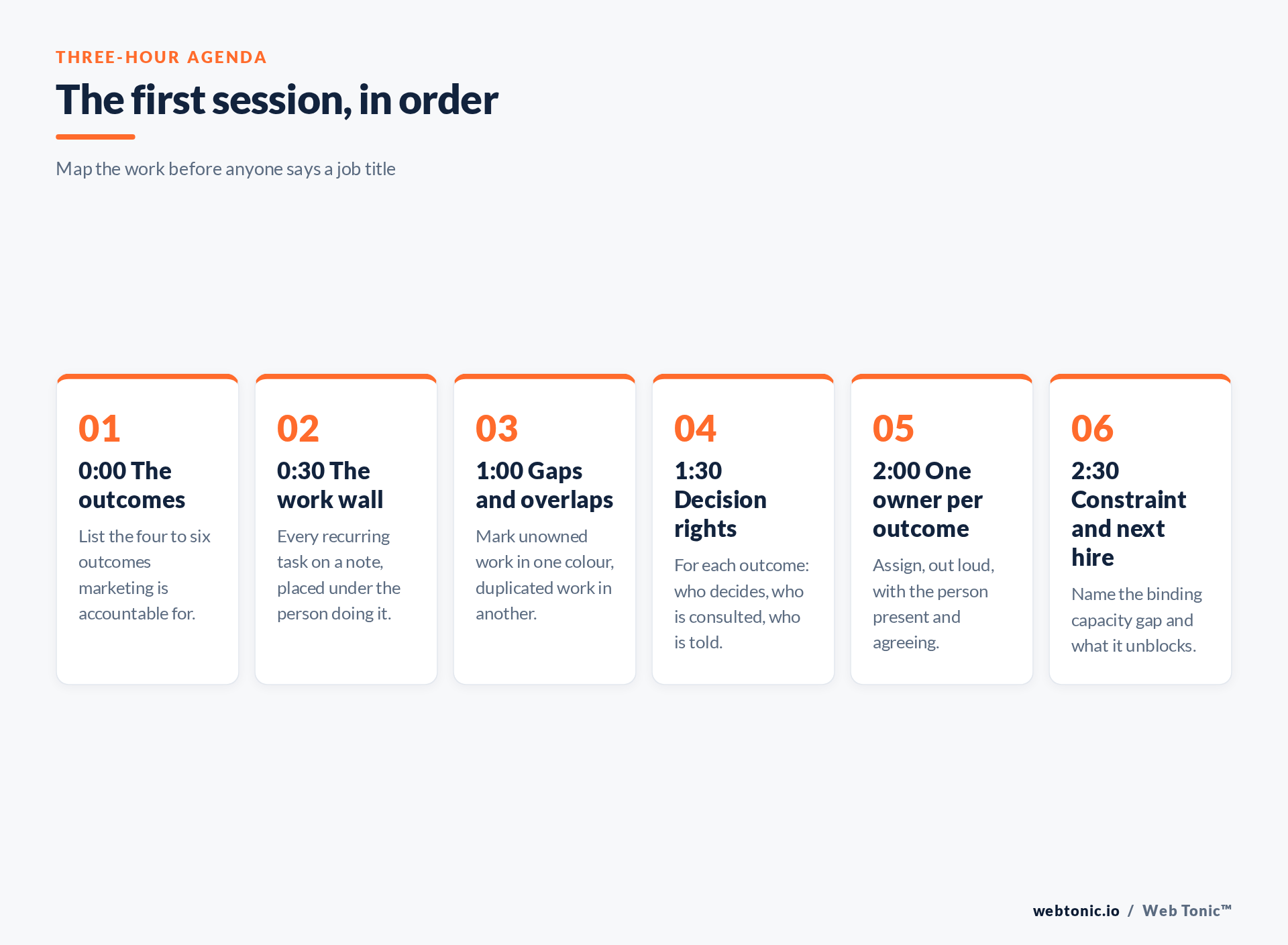
The fastest way to ruin a structure session is to open on titles. People defend their box, the conversation becomes political, and the actual work never gets discussed. So open on outcomes instead: four to six things marketing is accountable for, each in a single line — qualified pipeline, cost per acquisition against payback, retention contribution, brand demand, launch delivery. If the room cannot agree that list in thirty minutes, that disagreement is the real finding and the session pivots to it.
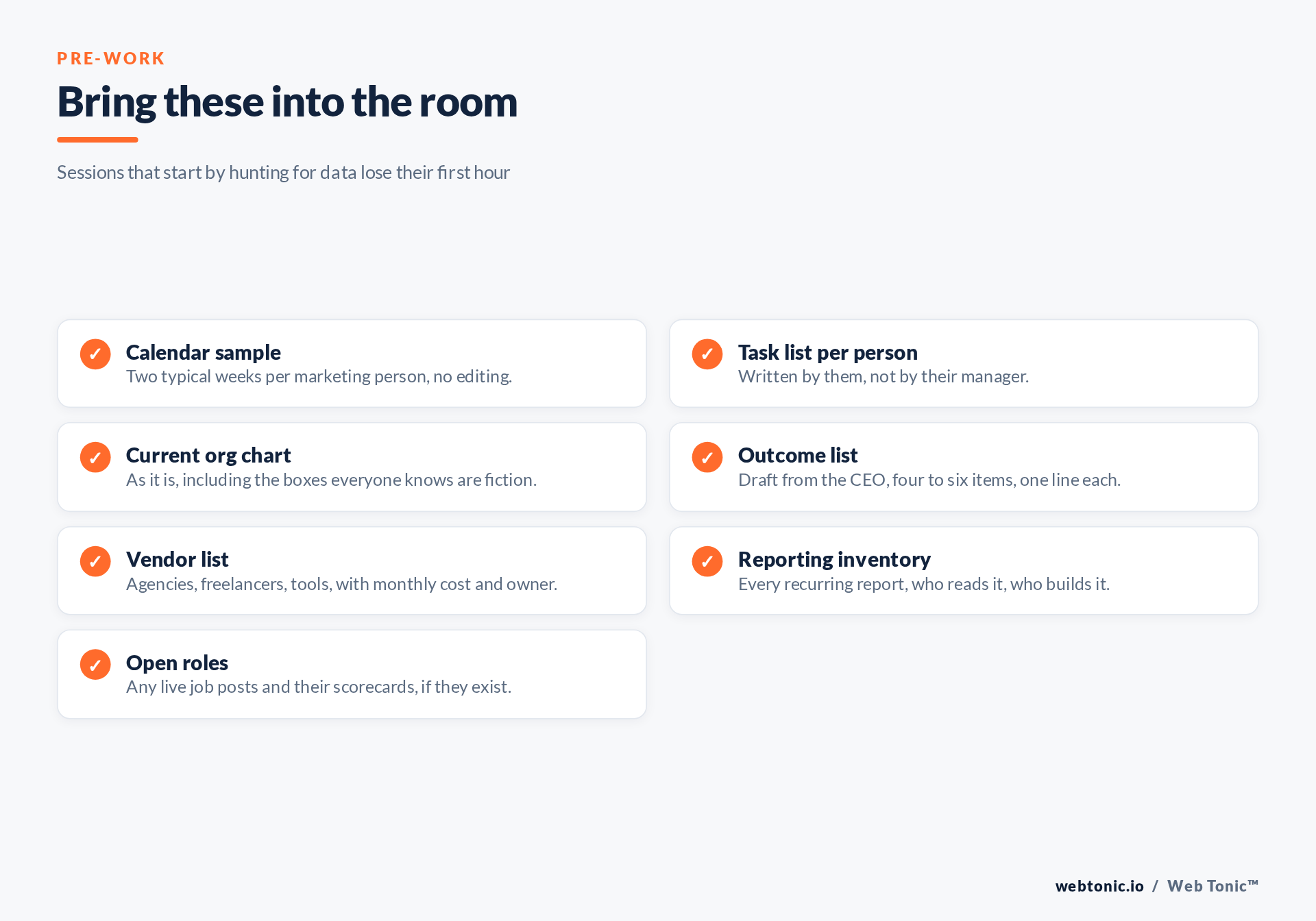
Then map the work. Every recurring task on a note, placed physically under the person who does it today. Use the participants' own calendars and task lists as the source, not their manager's description of the job. The wall usually shows one person holding three roles' worth of notes and one outcome with none, which is far more persuasive than any org chart critique. Sound marketing planning depends on this being honest.
Mark gaps and overlaps in two colours
Two passes over the wall. First pass: unowned work — tasks that matter and sit under nobody, or under a vendor with no internal counterpart. Second pass: duplicated work — two people producing overlapping reports, two teams briefing the same channel, an agency and an employee both "owning" paid media.
Expect measurement to appear in both piles at once: nobody owns the definitions, and several people build numbers from them. That is the single most common structural defect in marketing functions, and it makes every later performance conversation unresolvable. Name it in the session and route the remediation to conversion tracking and analytics rather than debating whose dashboard is right.
Settle decision rights before ownership
For each outcome, write four things: who decides, who must be consulted, who is merely informed, and what threshold escalates. Budget shifts under a stated amount, creative sign-off, channel launches, pricing and offer changes — each needs a name. Most "structure problems" are decision-rights problems wearing a costume, and they resolve in twenty minutes once written down.
Keep the escalation path to one level. If three people must agree before a budget can move between two channels, the function will always be slow regardless of who is hired. Where the company already runs OKRs, attach the outcome owners to the same objectives so the two documents cannot drift apart.
Assign one owner per outcome, out loud
Now the assignment. One owner per outcome, said aloud, with the person in the room accepting it and the measure they will be judged on stated at the same time — a short, stable set in the spirit of a proper KPI definition. Shared ownership is not a compromise; it is how an outcome becomes nobody's. If two people genuinely contribute, one owns the number and the other owns a named input to it.
Some outcomes will have no credible owner. Do not invent one. Write it as an unowned outcome with an interim holder and a date by which either a hire, a vendor or a scope change resolves it. That list is the honest beginning of a marketing hiring plan — and it is short, which is why it gets funded.
| Session output | Form | Owner after the session |
|---|---|---|
| Outcome list | Four to six lines, agreed | CEO |
| Work map | Photo of the wall, transcribed to a sheet | Adviser |
| Gap and overlap list | Two short lists | Adviser |
| Decision rights table | Decide / consult / inform per outcome | CEO |
| Owner assignments | One name and one measure per outcome | Senior marketer |
| Next-hire statement | One role, what it unblocks, a band | CEO and finance |
Close on the constraint and one next hire
End by naming the binding capacity constraint — the one place where lack of a person, a skill or a decision caps everything else — and the single next move against it. One hire, one vendor change, or one piece of work stopped. A session that produces five simultaneous hires produces none.
Attach a scorecard to the named role before anyone writes a job advert: the outcome it owns, the measures, and what good looks like at ninety days. Bands come from published market survey data for the role and city, and any advert should be checked against the EEOC's prohibited employment practices before it goes live. If external delivery is part of the answer, scope it with the same rigour as a statement of work rather than a retainer conversation.
What goes wrong
The failure mode: the session turns into a titles negotiation. Two hours on whether someone is a manager or a head of, no work mapped, and the output is a chart that renames the same problems. If it starts drifting there, go back to the wall and ask who does a specific named task on a specific named week.
Second failure mode: the person doing most of the work is not in the room. Structure decided over the head of the one person holding it together is decided on fiction, and it usually ends with that person leaving. Everyone whose notes go on the wall attends.
Third: no decision maker present, so ownership assignments become suggestions. Whoever controls budget and hiring must be there for the last hour. More process notes in the help library; the delivery side sits under growth marketing.
Related reading
- EOS / Scorecard & KPI Advisory — How to Run the First Strategy Session
- AI Marketing Advisory / AI Readiness — How to Run the First Strategy Session
- How to Run the First Growth Strategy Session
- Marketing Strategy Consulting services at Web Tonic
Frequently Asked Questions
How long should the first structure session be?
Three hours in one block: outcomes, work mapping, gaps and overlaps, decision rights, owner assignment, then the constraint and next hire.
Who should be in the room?
Everyone whose work goes on the wall, the budget and hiring decision maker, and the sales lead if pipeline handoff is in scope. Beyond about eight people it becomes a presentation.
What if two people genuinely share an outcome?
One owns the number, the other owns a named input to it. Shared ownership of a metric reliably turns into nobody owning it.
Should the session produce an org chart?
Not on the day. It produces outcomes, owners, decision rights and one next hire; the chart is drawn afterwards to match those decisions.
Sources: Marketing plan, OKR, KPI, Statement of work (Wikipedia); US EEOC prohibited practices; MIT Sloan Management Review. Verified 2026-09-09.


