



Table of contents

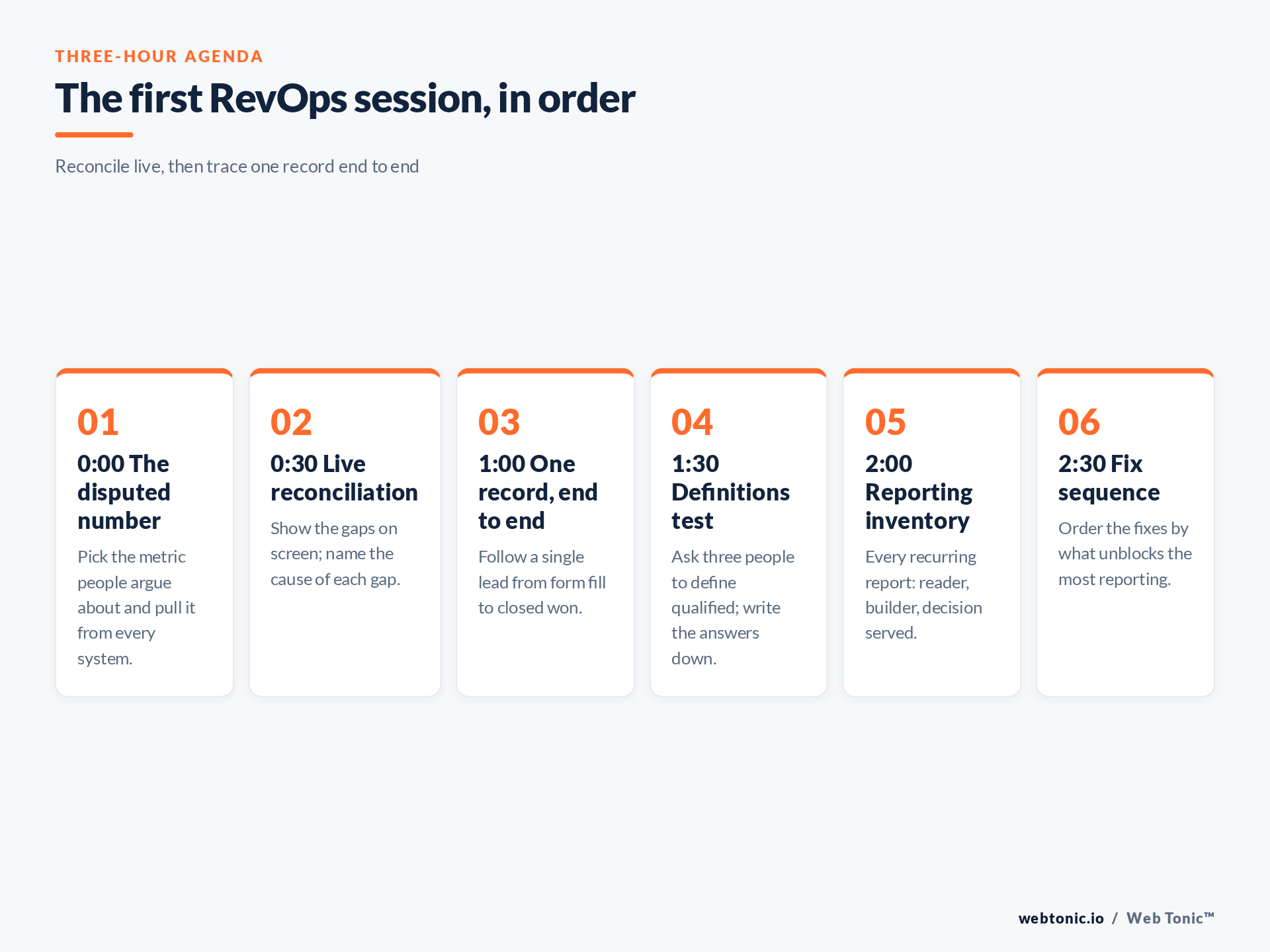
Quick answer: Run the first marketing operations consulting session as a live audit: take the number people argue about, pull it from every system on screen, explain each gap, trace one lead end to end, then agree a fix sequence.
Last verified: 2026-09-10
Open on the number people argue about
Do not open with a stack diagram. Ask which number causes the most disagreement — usually lead volume, cost per acquisition, or how many opportunities marketing sourced last month — and pull that number live from the CRM, the analytics property and the ad platforms while everyone watches. Nothing establishes the state of a RevOps consulting engagement faster than four different values for the same metric on one screen.
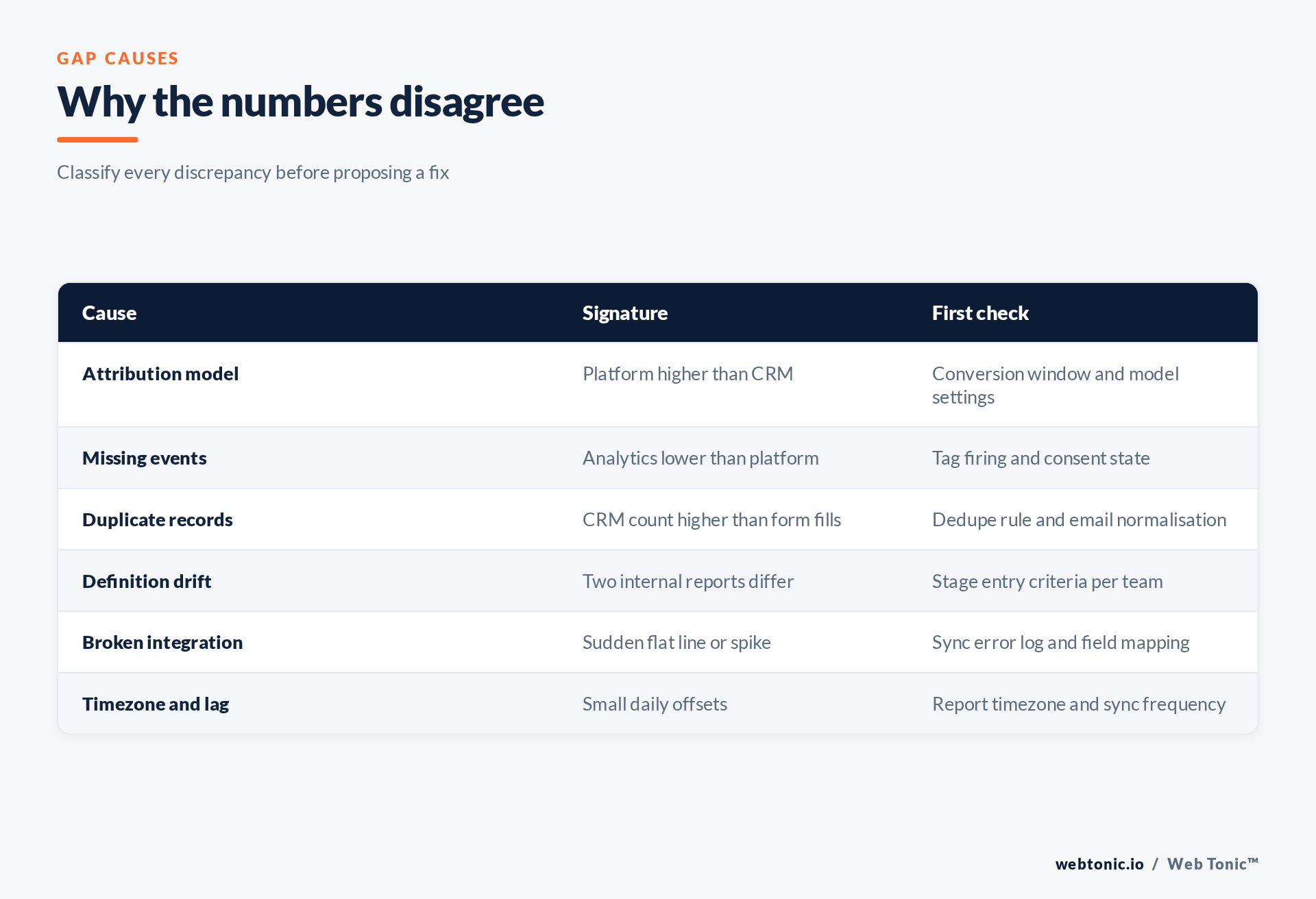
Then explain each gap rather than averaging it away. Some gaps are legitimate and permanent: platforms report on their own conversion windows and attribution, so their totals will never match a CRM count. Other gaps are defects — missing events, broken syncs, duplicates. Separating the two takes forty minutes and immediately kills the recurring "whose number is right" meeting.
Trace one record from form fill to closed won
Pick a single real lead from the last month and follow it. Which form, which page, what UTM parameters arrived, which fields were written, which automation fired, what lifecycle stage it entered, when sales touched it, what stage it sits in now, and whether any revenue is attached. Do it on screen, together, with the CRM open.
This is the fastest way to expose marketing automation and CRM defects that no audit spreadsheet finds: a UTM stripped by a redirect, a required field silently defaulted, an owner assignment rule from a team structure that changed a year ago. Check the event layer at the same time — GA4 event configuration and consent state determine whether the record even exists in analytics, and consent mode plus GDPR obligations explain a good share of "missing" data.
Test the definitions with three people in the room
Ask the marketing lead, the sales lead and the analyst to define a qualified lead, separately, in one sentence, in writing. Read the three answers out. If they differ — they usually do — you have found the real reason reporting is contested, and it is not a systems problem.
Do the same for opportunity creation and for what counts as marketing-sourced. Write the agreed definitions on the board, with the enforcement mechanism beside each one: required field, stage entry criterion, validation rule or weekly hygiene report. Treat these like proper KPI definitions with a single owner each, and note that a definition with no enforcement is a definition that will drift back within a quarter.
Inventory reporting against decisions
List every recurring report and dashboard with three columns: who reads it, who rebuilds it, and which decision it serves. Reports that fail the third column are the cheapest thing to delete in any operations engagement, and deleting them frees the analyst time the fixes will need.
Where a decision has no report, note it as a gap. Budget reallocation, channel pause thresholds and lead-routing changes are the usual orphans: the decisions get made in meetings from memory. The remediation path normally runs through conversion tracking, analytics and, where collection is genuinely lossy, server-side tracking — decided from the traced record, not from preference.
| Session block | Output | Owner afterwards |
|---|---|---|
| Live reconciliation | Gap list with a cause per gap | Consultant |
| Record trace | Annotated path from form to revenue | Consultant |
| Definitions test | Agreed definitions plus enforcement | Marketing and sales leads |
| Reporting inventory | Keep, fix, delete per report | Analyst |
| Access review | Named admin and MFA status per system | Client system owner |
| Fix sequence | Ordered list, first fix scheduled | Consultant and sponsor |
Close on a sequence, not a backlog
End with the fixes ordered by how much reporting each one unblocks. Identity and deduplication first, because everything downstream counts records; then event and conversion collection; then definitions enforcement; then dashboards. A flat backlog of forty tickets invites cherry-picking and the visible symptoms get fixed while the counting stays broken.
Confirm access and security before the room empties: a named administrator per system, MFA on every admin account per CISA guidance and NIST SP 800-63, and a revoke date for consultant accounts. Then schedule the first fix with a date and an owner; a session that ends with "we'll circle back" produces nothing.
What goes wrong
The failure mode: the session becomes a tool demo. Ninety minutes of walking the stack, admiring workflows, no number reconciled and no record traced. The output is a stack diagram, which nobody can act on. Reconcile something live in the first half hour or the session has failed.
Second failure mode: sales is not in the room. Half the definition disputes and most of the lifecycle-stage damage live on the sales side, and decisions taken without them will be reversed quietly by whoever actually updates the records.
Third: the analyst who builds the reports is excluded because they are "too junior for a strategy session". They know where every manual patch is. Invite them. Related process notes sit in the help library; delivery sits under data intelligence.
Related reading
- How to Run the First Marketing Strategy Session
- Marketing Audit / Growth Audit — How to Run the First Strategy Session
- Fractional CMO: How to Run the First Strategy Session
- Marketing Strategy Consulting services at Web Tonic
Frequently Asked Questions
Who must attend the first RevOps session?
The marketing lead, the sales lead, whoever builds the reports, and a system administrator with live access. Without admin access the reconciliation cannot happen on screen.
Why reconcile live instead of sending an audit report?
Because agreement is the deliverable. Seeing four values for one metric together removes the political argument that a document invites.
Should platform and CRM numbers ever match exactly?
No. Ad platforms report on their own attribution and conversion windows, so a permanent gap is expected; the work is knowing which part of the gap is a defect.
What if nothing can be reconciled because access is missing?
Stop and fix access first. Run the session with read-only admin credentials in hand rather than screenshots, or reschedule — a session without live systems produces opinions.
Sources: Google Ads conversion windows, GA4 events, Consent Mode (Google); GDPR; CISA MFA; NIST SP 800-63-3; KPI (Wikipedia). Verified 2026-09-10.


