



Table of contents
Quick answer: Scope marketing operations consulting around one decision: which system is the source of truth. Then fix definitions, map the data chain from field to report, name an owner per system, and list deliverables a successor can open without you.
Last verified: 2026-09-10
Start with the source of truth, not the tool list
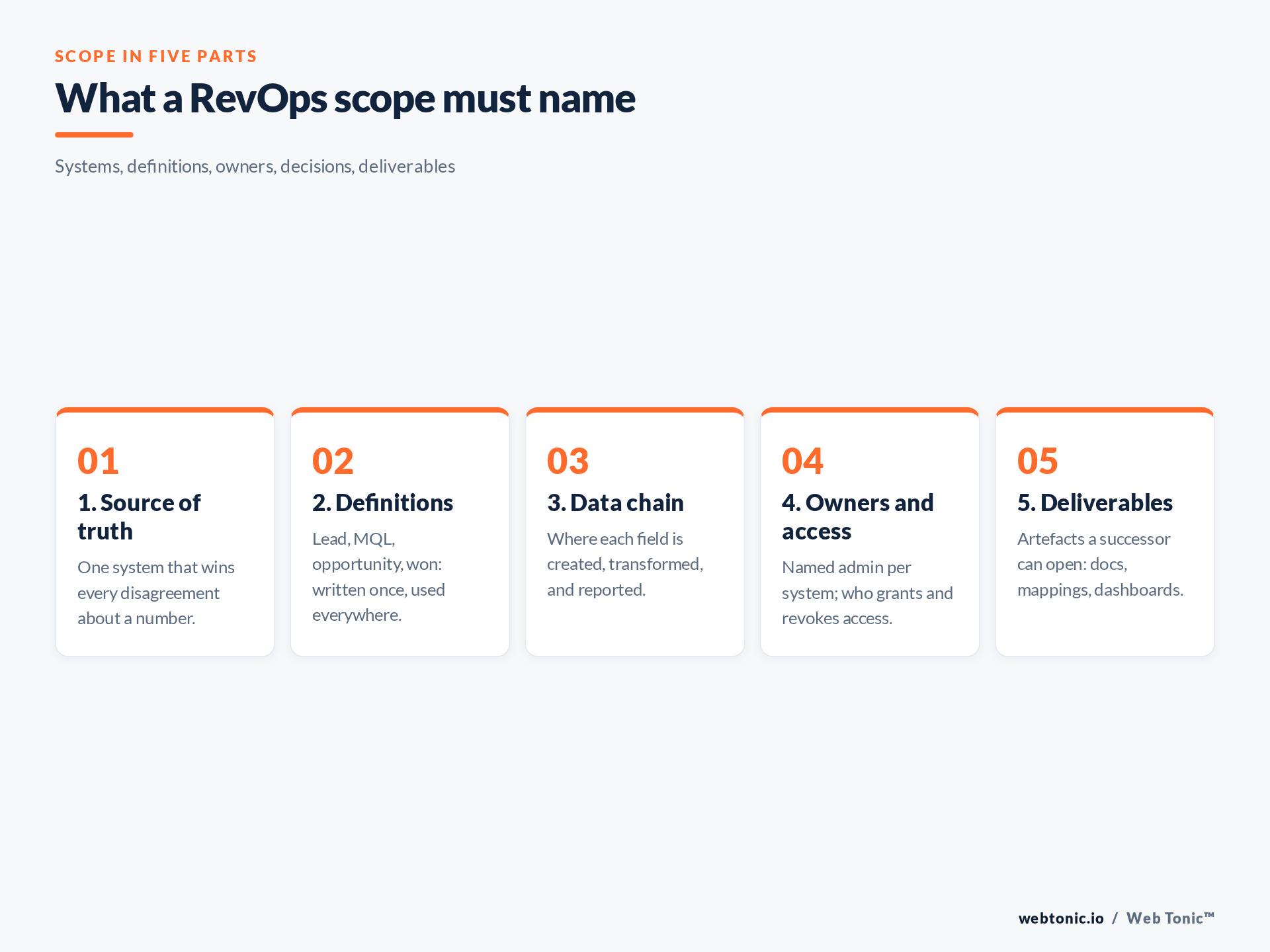
Almost every RevOps consulting engagement that fails does so because two systems were both allowed to be right. The ad platform reports conversions on its own attribution, the analytics property reports sessions and events, the CRM reports opportunities, and no document says which one wins when they disagree. Pick one system as the reporting source of truth for revenue-adjacent numbers — in most B2B setups that is the CRM — and write down what the others are for.
That single decision reshapes the rest of the scope. Once the CRM is authoritative, platform numbers become optimisation signals rather than reporting inputs, and the work becomes getting reliable conversion data into the CRM and back out to the platforms. Google is explicit that its own platform reporting uses its own conversion windows and attribution, which is why platform totals will never reconcile line-for-line with a CRM and should not be scoped as if they will.
Write the definitions before touching the automation
Second scope item: the object and stage definitions. What is a lead, when does it become qualified, what makes an opportunity, who can move a stage, and what closes it. These are business decisions, not system settings, and consultants who skip them end up encoding one team's assumptions into workflows that the other team then quietly bypasses.
Keep the list short and inspectable, in the spirit of a real KPI definition rather than a glossary nobody reads. Then decide how those definitions are enforced: required fields, validation, stage entry criteria, or a weekly hygiene report. Definitions without enforcement decay within a quarter, and the decay is invisible until someone builds a board slide from them.
Map the data chain from field to decision
The core deliverable of marketing automation and CRM work is a map: for each number that matters, where the data is created, what transforms it, where it lands, and which decision it feeds. Web form to CRM field to lifecycle stage to report to budget decision. Anything that cannot be traced end-to-end is either unused or untrustworthy, and both findings are useful.
Include the measurement layer explicitly. Event collection and identity resolution belong in scope alongside CRM plumbing — event configuration and a consistent UTM scheme are usually where the chain first breaks. Consent handling is part of the same chain, not a legal afterthought: the GDPR requirements and your consent mode configuration determine what data exists at all. Remediation typically routes through conversion tracking, server-side tracking and analytics.
Name owners and access rules in the scope document
Every system in scope gets a named administrator on the client side, plus a rule for how the consultant's access is granted and revoked. Vague access is the most common cause of stalled operations work: nobody can change a field, so the project waits, and the wait is billed. Where you need elevated access, ask for it in writing with the specific objects named.
Access hygiene is also a security deliverable. Multi-factor authentication on every admin account is the baseline — CISA's MFA guidance and NIST SP 800-63 are the references to cite in the document — and shared logins should be replaced rather than inherited. Put offboarding in the same section so the engagement ends cleanly instead of leaving a consultant's account live for a year.
| Scope element | Written as | Failure if omitted |
|---|---|---|
| Source of truth | One named system per number class | Endless reconciliation meetings |
| Definitions | Short list, one line each, enforced | Workflows encode one team's view |
| Data chain map | Field to report to decision | Untraceable numbers on board slides |
| Consent and privacy | Banner, consent mode, retention | Data gaps discovered after launch |
| Owners and access | Named admin, MFA, revoke date | Work stalls on permissions |
| Deliverables | Inspectable artefacts, not hours | Nothing survives the handover |
Price the phases, not the platform tour
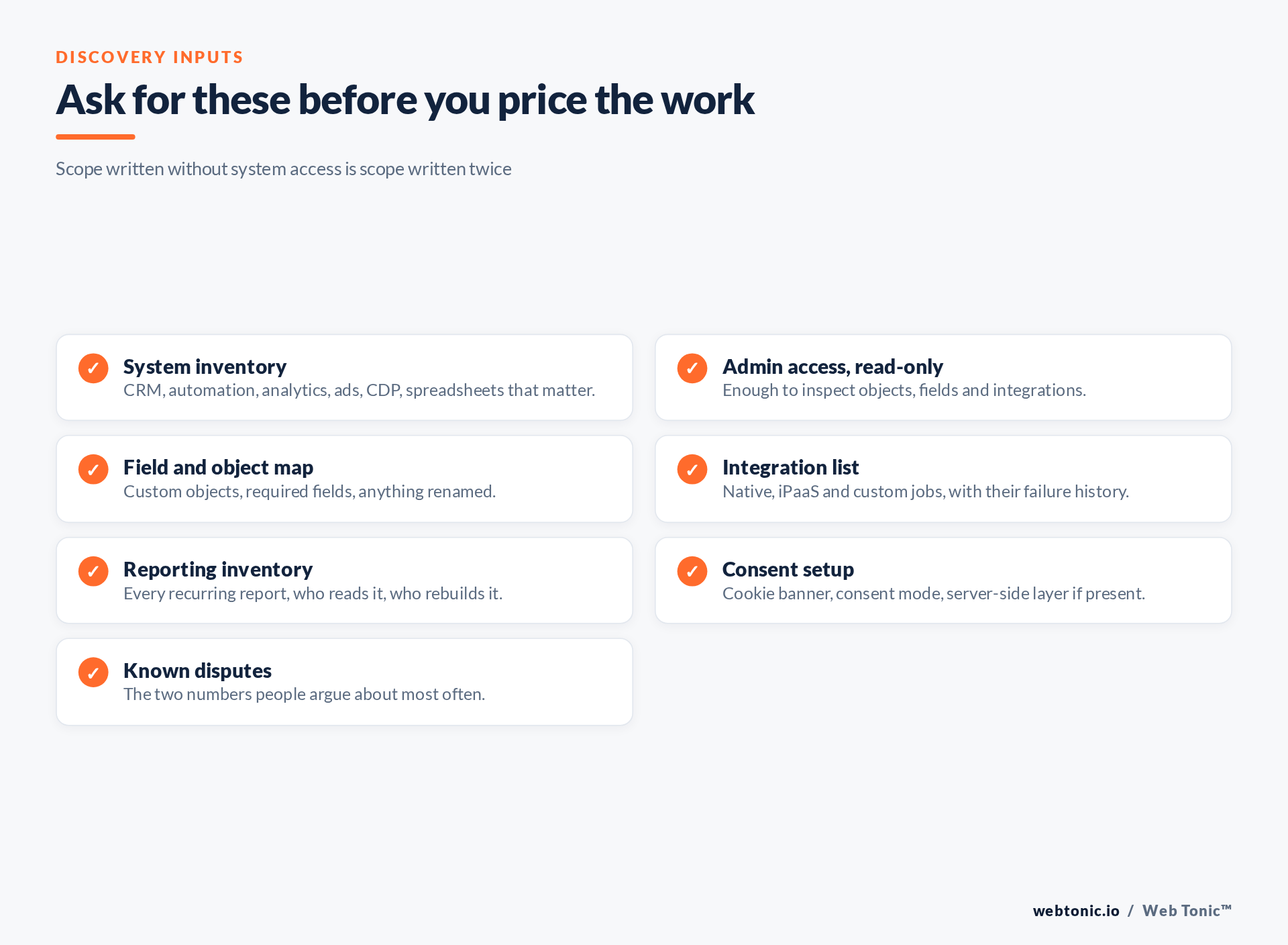
Structure the engagement as a short diagnostic phase with a fixed fee, then a build phase priced once the systems have been seen. Scoping a full rebuild before anyone has opened the CRM is how estimates double mid-project. Two to three weeks of inspection produces the map, the dispute list and a remediation sequence; the build is then quoted against a known object model. Contract it with the discipline of a statement of work — deliverables, acceptance criteria, dates.
Published market rates for operations and RevOps consulting span a very wide range, from low four figures for a scoped diagnostic to mid five figures for a multi-system rebuild, and any honest range depends on system count, data volume and how much definition work sits upstream. We quote after scoping rather than publishing a rate card. If the systems are healthier than expected, the build phase shrinks — that is the point of separating the phases.
What goes wrong
The failure mode: the engagement is scoped as a tool implementation. Automation gets rebuilt beautifully on top of contested definitions and two competing sources of truth, and six weeks later the same arguments happen with nicer workflows. Definitions and the source-of-truth decision come first, always.
Second failure mode: no client-side owner. The consultant becomes the only person who understands the system, which is comfortable for exactly one quarter and then becomes a dependency risk. Name an internal owner in the scope and make knowledge transfer a deliverable with a date.
Third: reporting is scoped without the decisions it serves. Twelve dashboards, no decision rhythm, nobody looking. Tie each report to a recurring meeting and a decision, or delete it. Related notes sit in the help library; delivery sits under data intelligence.
Related reading
- How to Scope a Marketing Strategy Consulting Engagement
- Marketing Audit / Growth Audit — How to Scope the Engagement
- Marketing Operations Consulting / RevOps: vs hiring in-house
- Marketing Strategy Consulting services at Web Tonic
Frequently Asked Questions
What is the difference between marketing ops and RevOps in a scope?
Marketing ops covers the marketing stack and its data; RevOps extends the same discipline across marketing, sales and success with one shared funnel definition. The scope differs mainly in how many teams must agree on definitions.
How long should the diagnostic phase be?
Two to three weeks with read-only admin access. Long enough to inspect objects, integrations and reports; short enough that the build is not delayed waiting for a perfect map.
Do we need server-side tracking in scope?
Only if the data chain shows loss that client-side collection cannot fix, or consent and platform restrictions require it. Decide from the map, not from fashion.
Who should own the systems after the engagement?
A named internal administrator per system, with documentation and access handover as a contractual deliverable rather than a goodwill gesture at the end.
Sources: Google Ads conversion windows, GA4 events, Consent Mode (Google); GDPR; CISA MFA; NIST SP 800-63-3; Statement of work, KPI (Wikipedia). Verified 2026-09-10.


