



Table of contents

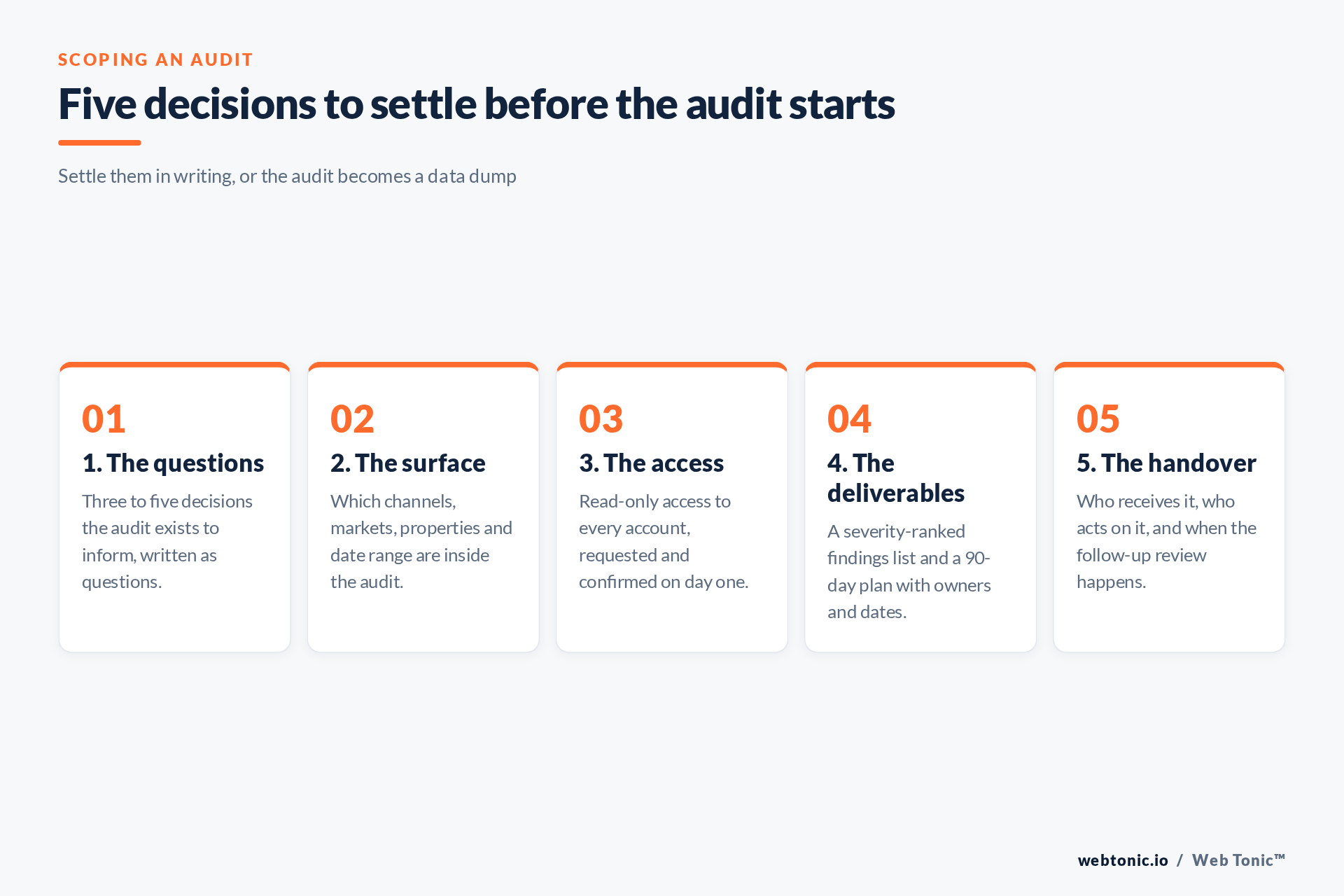
Quick answer: Scope a marketing audit by settling five things in writing first: the three to five questions it answers, the channels and date range inside it, the read-only access required, the deliverables, and who acts on the findings.
Last verified: 2026-09-07
Start from questions, not from a channel list
An audit scoped as "review our marketing" produces a document nobody reads. An audit scoped around three to five questions produces decisions. The questions are usually blunt: is our tracking telling the truth, which channel is actually paying for itself, why did organic traffic fall in March, and where is the next unit of budget best spent.
Write them down and get them signed off before pulling a single report. The questions decide the depth of every later section, and they are the only defence against the audit turning into an inventory of everything that is slightly imperfect. A growth audit that names five problems with owners beats one that names fifty without.
Fix the surface and the date range
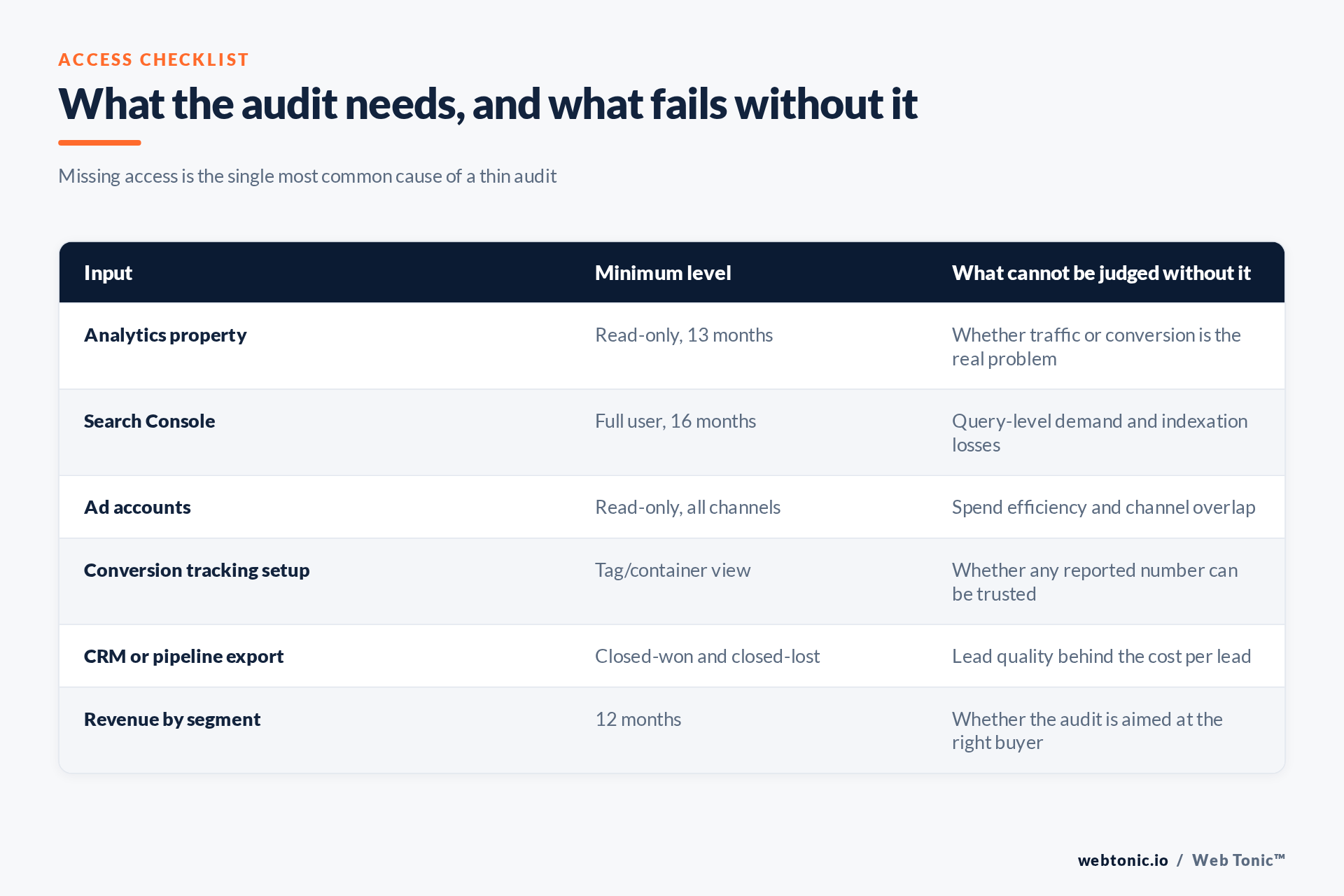
Name what is inside the audit: which properties, which markets and languages, which ad accounts, and which date range. Thirteen months is the practical minimum for an analytics comparison, because it lets you read the same season twice; Search Console holds sixteen months of query data, per Google's own documentation, so use all of it.
Also name the surface that is out. Brand identity, creative production, sales process design and CRM cleanup all sit next to a digital marketing audit and will be assumed to be included unless excluded by name. Say where each would be scoped instead.
Get access before you promise a date
The delivery date should start counting from the day access is complete, not the day the contract is signed. Read-only access to analytics, Search Console, every ad account, the tag container and the CRM is the raw material; without it the audit degrades into an opinion piece about the website.
Two access items are chronically forgotten and both change conclusions: the tag or container view, without which no reported conversion can be trusted, and a closed-won/closed-lost export, without which cost per lead cannot be separated from lead quality. Our conversion tracking and analytics pages describe how those two are usually broken.
Deliverables are objects, with severity
Two artefacts do the work. First, a findings list where every item carries a severity, the evidence behind it, and the cost of leaving it alone. Second, a 90-day plan that sequences the findings by impact and effort, with a named owner and a date against each line. Anything else — slide decks, benchmark appendices — is packaging.
Severity has to be defined in the scope, not improvised at the end. A workable three-band split: critical means a number in the business is wrong or money is being lost now; important means measurable upside is being left on the table; minor means it should be fixed on the next touch of that page or campaign.
| Scope element | Good version | Version that fails |
|---|---|---|
| Questions | Three to five, written as decisions | "Full review of marketing" |
| Date range | 13 months, stated explicitly | "Recent performance" |
| Access | Listed per platform, confirmed day one | Requested midway through |
| Findings | Severity, evidence, cost of inaction | Unranked list of observations |
| Plan | 90 days, owners and dates | "Recommendations" section |
| Handover | Working session plus a 30-day review | PDF emailed on the last day |
Sizing and fees
Depth follows the decision at stake. A single-channel efficiency question on one market is roughly a week. A cross-channel audit covering tracking integrity, paid, organic and lifecycle across several markets is a multi-week engagement, and squeezing it into a week produces a report that repeats the client's own dashboards back to them.
On price, published commentary on audit and consulting fees spans an extremely wide range depending on scope, seniority and market, so a figure quoted before the questions exist is not comparable to anything. Agree the questions, surface and deliverables, then price them — ask us for a scoped quote once those are settled.
Tie findings to the measurement plan
Audits that change behaviour end with a short list of metrics the client will watch afterwards, not just fixes. Pick a small set of key performance indicators tied to the questions, define each one, and say where it will be read from. Where spend allocation is one of the questions, note whether the account has enough volume for anything like marketing mix modelling — most do not, and the honest answer is a simpler incrementality test.
Keep the after-audit metric set to what the business already tracks or can track within the 90 days. A measurement plan that requires a new data warehouse quietly guarantees the audit is never actioned.
What goes wrong
The failure mode: the audit is scoped as coverage rather than as questions. Everything gets reviewed, nothing gets ranked, and the client receives a sixty-page document with no order of operations. If the scope does not name the questions, this outcome is already decided.
The second failure mode is auditing on top of broken tracking without saying so. When conversion data is wrong, every efficiency conclusion drawn from it is also wrong. Tracking integrity is therefore the first section of the work, and if it fails, the scope needs to be renegotiated rather than continued.
The third is no owner on the other side. An audit delivered to someone with no authority to change budget or roadmap dies on receipt. Name the recipient and the decision-maker in the scope, and book the follow-up review before the work starts. More process notes in the help library.
Related reading
- Marketing Operations Consulting / RevOps — How to Scope the Engagement
- Fractional CMO for SaaS: How to Scope the Engagement
- Fractional CMO: How to Scope the Engagement Before You Sign
- Marketing Strategy Consulting services at Web Tonic
Frequently Asked Questions
What should a marketing audit scope include?
The three to five questions it answers, the channels, markets and date range covered, the read-only access required per platform, the deliverables with severity definitions, and the handover and review dates.
How much data access does an audit need?
Read-only analytics for at least 13 months, Search Console, every ad account, the tag container view, plus a closed-won and closed-lost export. Without the container and the CRM export, tracking integrity and lead quality cannot be judged.
How long does a growth audit take?
A single-channel efficiency question is about a week. A cross-channel audit covering tracking, paid, organic and lifecycle across several markets takes several weeks, counted from the day access is complete.
What does a marketing audit cost?
Public ranges are extremely wide because scope and seniority vary so much. Settle the questions and deliverables first, then get a scoped quote; a price given before that is not comparable between providers.
Sources: Search Console performance data, Search Console users and permissions (Google); Key performance indicator, Marketing mix modeling, Statement of work (Wikipedia); MIT Sloan Management Review. Verified 2026-09-07.


