



Table of contents
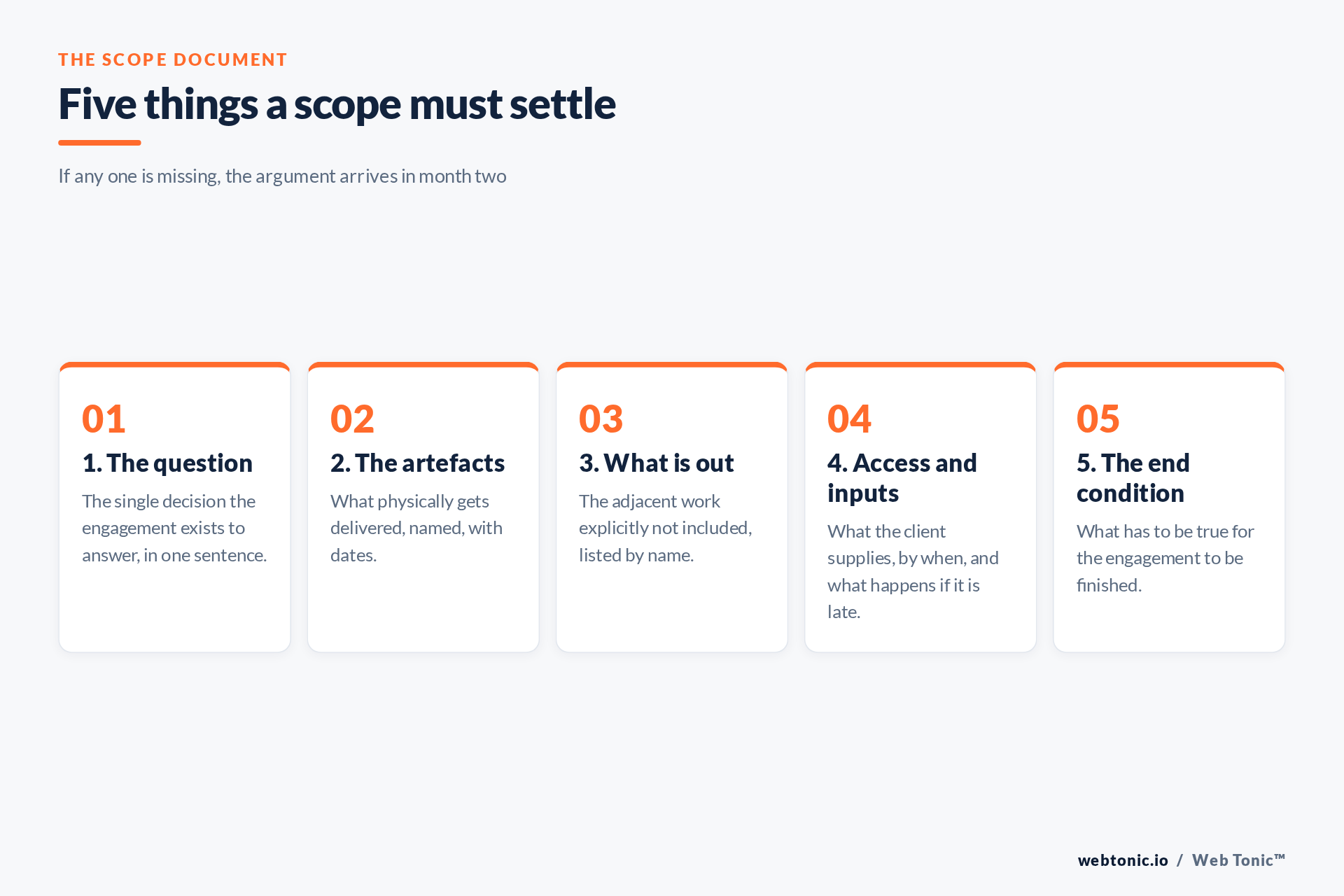
Quick answer: Scope a marketing strategy consulting engagement around five written points: the one question it answers, the named artefacts and their dates, what is explicitly out of scope, the access and inputs the client owes, and the condition that ends the engagement.
Last verified: 2026-09-05
Scope the question, not the hours
A strategy engagement priced in hours drifts, because hours have no natural end. A strategy engagement scoped around a question has a finish line the client can see: the question is answered, the artefacts exist, and the work stops.
Write that question down before anything else. "Which segment should we build the next twelve months of demand generation around?" is a scopeable question. "Help us with marketing" is not, and it is the opening line of most engagements that later go wrong. If the client cannot state a question, the first paid piece of work is a short diagnostic to find one — scoped and priced on its own.
Name the artefacts
Deliverables must be objects, not activities. "Positioning workshop" is an activity; "a written positioning statement with three supporting proof points, delivered by 14 March" is an artefact. Only artefacts can be checked off, and only artefacts survive the person who commissioned them.
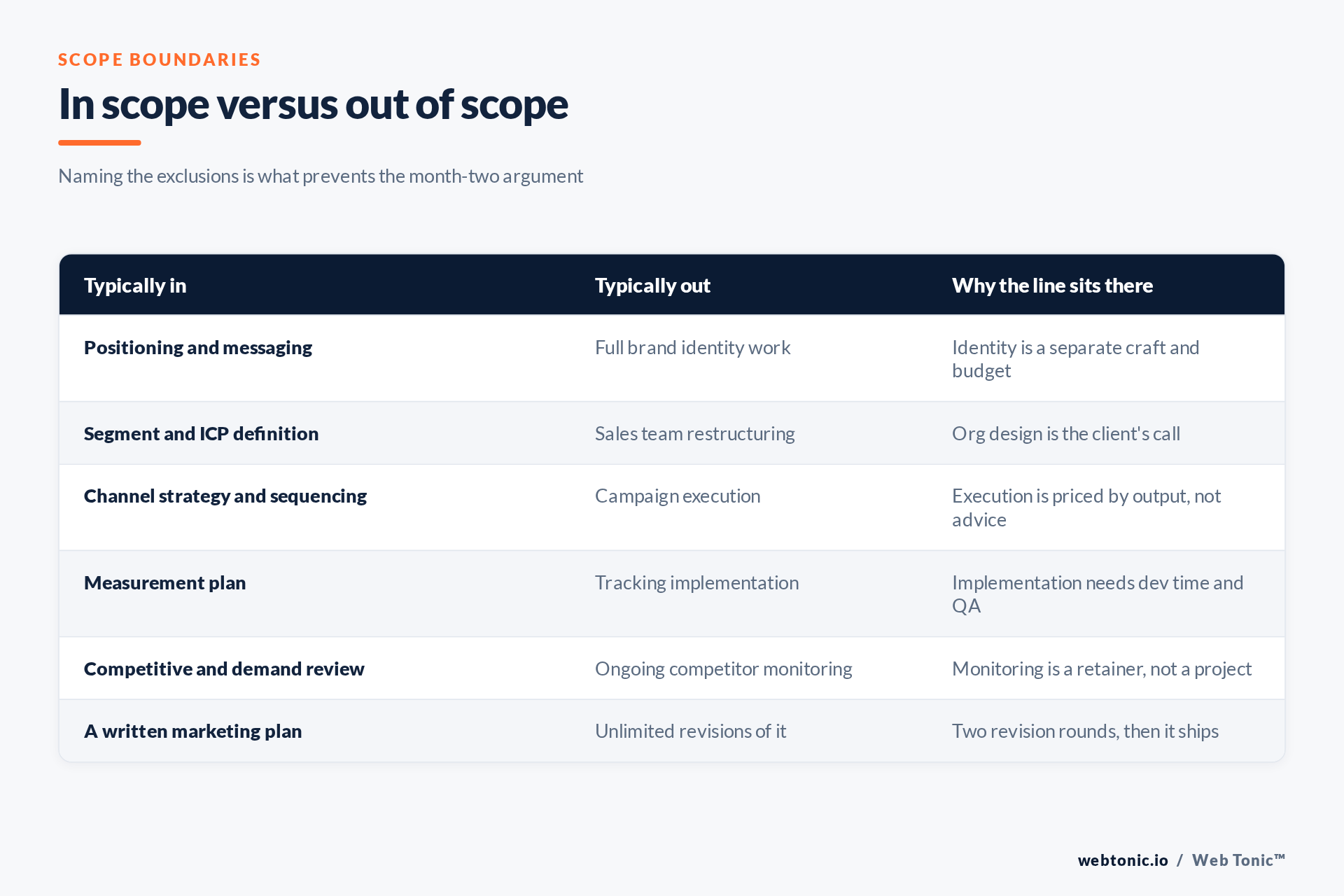
For most marketing plan engagements the artefact list is short: a segment and ICP definition, a positioning and messaging document, a channel strategy with sequencing, a measurement plan, and the plan itself in writing. Five objects, each with a date. Anything a client asks for beyond that list is a change to the scope, which is a conversation rather than a favour.
Write down what is out
The exclusions section is the part junior scopes skip and the part that prevents the month-two argument. Strategy work sits next to brand identity, sales enablement, campaign execution and tracking implementation, and a client who was not told otherwise will reasonably assume adjacent work is included.
List the exclusions by name, in plain language, and say where each one would go instead. "Tracking implementation is not included; it is scoped separately once the measurement plan is agreed" is a sentence that has saved more engagements than any methodology. Our conversion tracking and analytics pages describe what that separate work involves.
Inputs, access and the late clause
A strategy engagement is only as good as what it is fed. State the inputs in the scope: revenue by segment, pipeline and win rate by source, channel spend against outcomes, closed-lost reasons, and access to analytics, search and ad accounts — read-only, requested on day one.
Also state what happens when inputs are late, because they will be. The workable clause is that dates shift by the length of the delay rather than the work compressing, since compressed strategy work simply becomes worse strategy work. Add customer interviews if the question touches positioning at all: voice-of-customer input is usually the difference between a positioning document that is defensible and one that is invented in a room.
Say how it ends
Every scope needs an end condition. Usually: the artefacts are delivered, one revision round is complete, and a handover session has been held with the people who will execute. After that the engagement is finished, and any continuation is a new agreement.
Do not leave the ending implicit. Engagements without an end condition become low-grade retainers where neither side is quite sure what is owed, and they end badly regardless of the quality of the strategy. This is standard statement-of-work practice, and it applies at any size.
| Scope section | Length | Test it must pass |
|---|---|---|
| The question | One sentence | A stranger can tell when it is answered |
| Artefacts | Bullet list with dates | Each item is an object, not an activity |
| Exclusions | Bullet list | Names the adjacent work by name |
| Inputs and access | Table | Owner and date against every line |
| End condition | Two sentences | Both sides would agree it is done |
Sizing the engagement honestly
Match depth to the decision at stake. A channel sequencing question for a single product line is a two-to-three week piece of work. A repositioning that will change the website, the sales script and the pricing page is a multi-month engagement with primary research in it, and scoping it as three weeks guarantees a thin answer.
On fees, resist quoting a rate before the scope exists. Published market commentary on consulting fees covers an extremely wide range — by seniority, market and depth — so a number given before the question is settled is not comparable to anything. Agree the question and the artefacts first, then price them. Where the client wants execution as well, keep it as a separate agreement alongside growth marketing delivery.
What goes wrong
The failure mode: the scope lists activities instead of artefacts. Workshops, sessions, "strategic support". Three months later both sides are certain they are owed something different, and neither can point to a document that settles it. If a line item cannot be attached to a file or a page, rewrite it.
The second failure mode is silent scope growth. A small extra request each week is invisible individually and consumes a third of the engagement by month two. Log each one, price it, and let the client choose — most say yes, and the ones that say no were never going to value it.
The third is scoping strategy and execution as one blended engagement. When both live in the same budget line, execution always eats the strategy hours, because execution has deadlines and strategy does not. Split them, even when the same people do both. More on the surrounding process in the help library.
Related reading
- Marketing Operations Consulting / RevOps — How to Scope the Engagement
- Marketing Audit / Growth Audit — How to Scope the Engagement
- Marketing Strategy Consulting Statistics: Adoption and Tooling
- Marketing Strategy Consulting services at Web Tonic
Frequently Asked Questions
What should a marketing strategy scope contain?
Five sections: the question the engagement answers, the named artefacts with dates, explicit exclusions, the inputs and access the client owes, and the condition that ends the engagement.
How long should a strategy engagement run?
Match the depth to the decision. A channel sequencing question is two to three weeks; a repositioning that touches the site, sales script and pricing is a multi-month engagement including primary research.
Should execution be in the same scope as strategy?
No. When both sit in one budget line, execution consumes the strategy hours because execution has deadlines. Scope and price them separately, even with the same team.
What happens if the client is late supplying data?
Dates shift by the length of the delay rather than the work compressing. Write that clause into the scope before it is needed, not after.
Sources: Statement of work, Marketing plan, Market research, Voice of the customer (Wikipedia); MIT Sloan Management Review; Harvard Business Review. Verified 2026-09-05.


