



Table of contents
The choice is not consultant versus employee. It is whether you are buying a build or a standing capability — and those two things have different price tags, different failure modes and different exit costs.
Key Takeaways
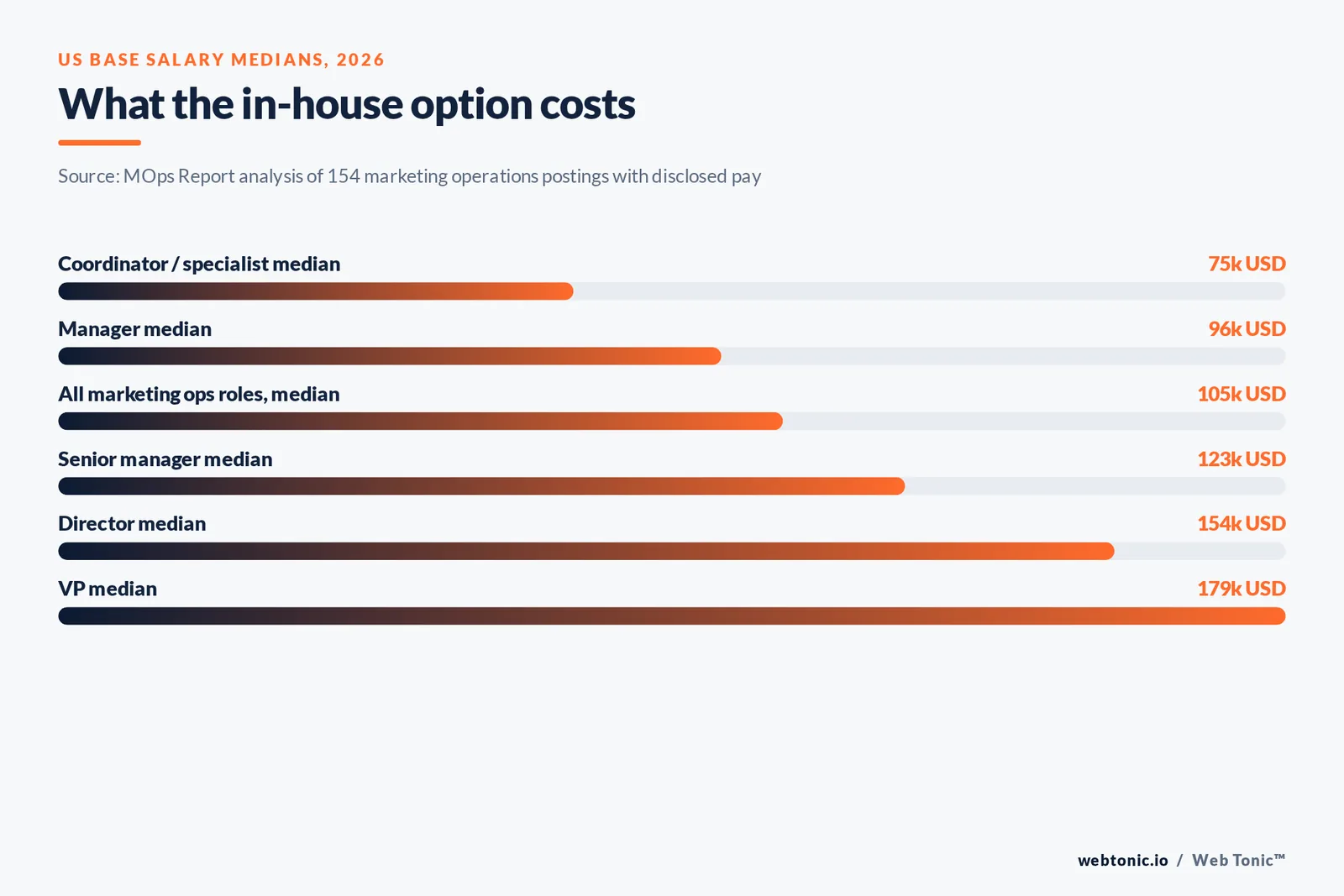
- An in-house marketing ops manager is a fixed annual commitment. Median advertised base pay is $105,400, with mid-level roles at $96,000, senior at $123,000 and directors at $153,800.
- Loading changes the comparison. Total compensation adds 10–25% at manager level and 30–60% at director and VP level, before search fees of 25–35% of salary.
- External help is variable and faster: $3,500–$10,000 a month for a solo fractional operator, $9,800–$15,000 for a mid-tier pod, $15,000–$27,000 for a full pod.
- ARR is the cleanest dividing line in the market's own guidance: fractional under $5M, service pod from $5M to $100M, in-house above it — and adoption data mirrors it, from 41% to 96%.
- One person is rarely the right in-house answer. The benchmark ratio is 1 ops person per 25–30 revenue team members, and top performers run 1:15–20.
- Buy the build externally, own the running internally. A migration or data-model rebuild is a project; hygiene, requests and reporting are a job.
What each option really buys
An in-house hire buys availability and institutional memory. They sit in the standups, absorb the political context, know which sales manager quietly renames deal stages, and can be interrupted. That last point is underrated: most marketing ops value is delivered in small, fast interventions — a routing rule, a field, a broken sync — and those are cheap when someone is already in the building.
External marketing operations consulting buys pattern density and installation speed. A team that has migrated forty CRMs will make your data model decisions in days rather than months, and will have opinions formed by outcomes rather than by your history. The 2026 buyer's guide to revenue operations services frames the trade cleanly and recommends choosing the engagement model by ARR: fractional under $5M, RevOps-as-a-service between $5M and $100M, in-house above that, on the grounds that in-house ramp time can burn months of salary before impact.
The two options also fail differently. Under-scoped in-house hires get absorbed into ticket-taking and never finish the structural work. Under-scoped consultants deliver a beautiful architecture nobody maintains. Both failures are avoidable, and both are avoided by the same discipline: write down which decisions the role owns, not which tools it touches.
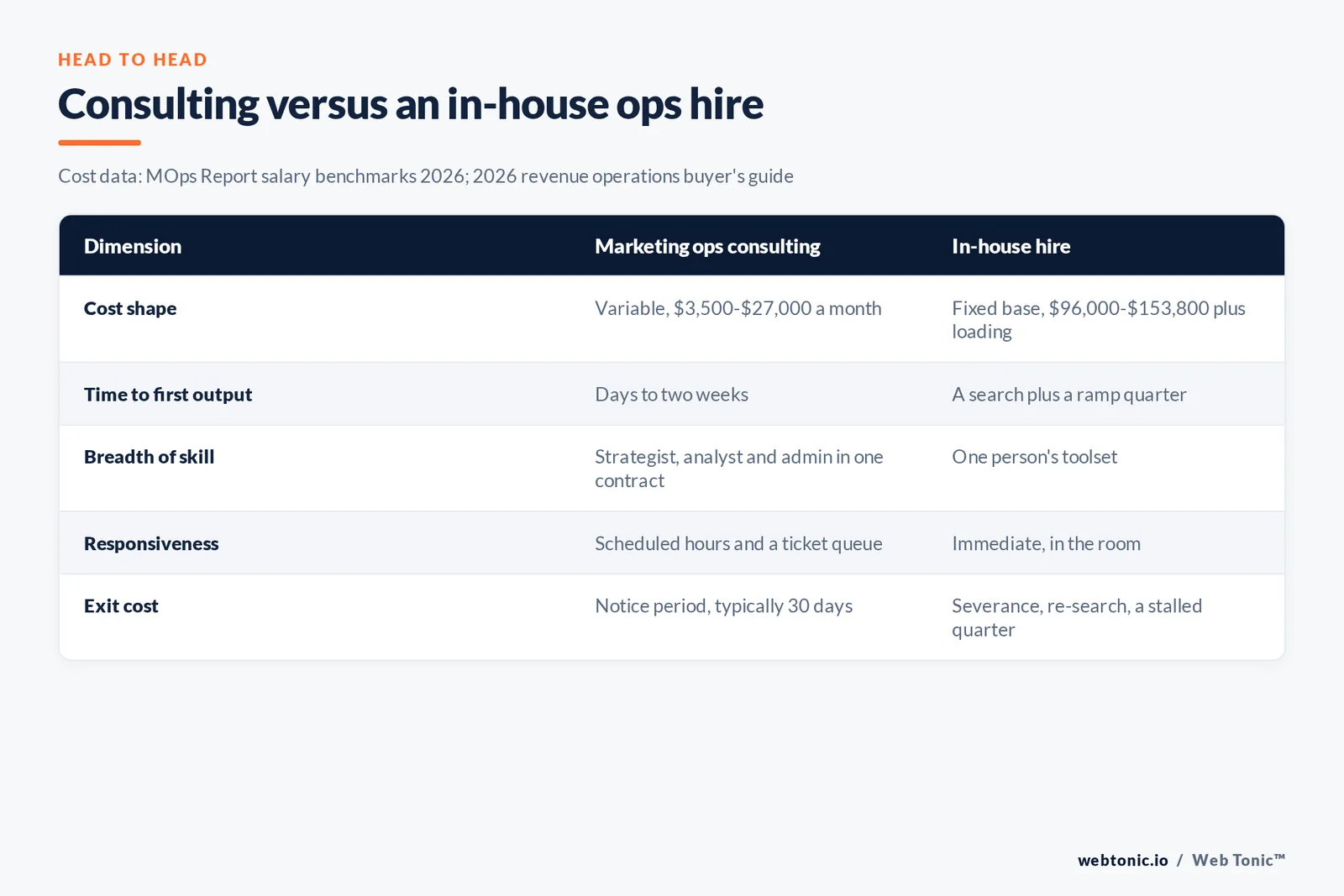
| Dimension | Marketing ops consulting | In-house hire |
|---|---|---|
| Cost shape | Variable, $3,500–$27,000 a month by pod size | Fixed, $96,000–$153,800 base plus loading |
| Time to first output | Days to two weeks | A search plus a ramp quarter |
| Breadth of skill | Strategist, analyst and admin in one contract | One person's toolset and certifications |
| Day-to-day responsiveness | Scheduled hours, ticket queue | Immediate, in the room |
| Institutional memory | Documented, portable, can walk out | Accumulates, but concentrates in one head |
| Exit cost | Notice period, typically 30 days | Severance, re-search, a stalled quarter |
The cost comparison, done honestly
Start with real salary data rather than a gut number. Marketing operations salary benchmarks built from 154 job postings with disclosed pay report a median of $105,400, a full range of $31,200 to $365,000, and five title bands: coordinator or specialist at a $75,000 median, manager at $96,000, senior manager at $123,000, director at $153,800 and VP at $178,500. Those are base figures only; total compensation typically adds 10–25% at manager level and 30–60% higher up.
Independent hiring research lands in the same neighbourhood. A 2026 study of marketing operations manager hiring costs reports an average around $112,000 with total pay including bonuses near $138,000, and a US median of $115,000 with a $88,000 25th percentile and $148,000 at the 75th. A 2026 sourced-benchmark roundup repeats the $105,400 median and the $75,000-to-$153,800 spread across seniority.
Now add the parts that never make the spreadsheet: employer taxes and benefits, equipment, certifications, and recruiting. Retained search alone runs 25–35% of salary for senior roles. Tooling is separate again. A $120,000 base is realistically a $165,000-plus year-one commitment. Against that, the consulting bands from the same buyer's guide are $3,500–$10,000 a month solo, $9,800–$15,000 for a mid-tier pod and $15,000–$27,000 for a full pod, with one-off project consulting at $15,000–$75,000.
Rate arithmetic: what an hour costs either way
Comparing monthly retainers to salaries is apples and oranges until you divide by hours. A 2026 study of seventeen named RevOps consultancies found only four publishing usable rate cards. Where hours are disclosed, the published tiers run from $9,850 a month for 10 hours a week to $27,000 for 30 — that is $227 down to $208 an hour, a discount of just 8.6% across three times the capacity. Another firm publishes $5,499 a month for 32 hours, or $172 an hour.
An in-house manager at a $120,000 base plus loading works out to roughly $80–$95 an hour of capacity. So per hour, in-house is cheaper — and that is exactly the point. You are not buying hours from a consultancy, you are buying the ability to have senior judgement for a quarter without carrying it for five years. Once the volume of ops work reliably fills a week, the arithmetic flips hard toward hiring.
The three-person comparison is where most mid-market decisions actually sit. The buyer's guide prices a three-person in-house team at roughly $270,000 a year, about $22,500 a month before tools and overhead — which is the same territory as a full external pod, but with recruiting risk, ramp time and fixed commitment attached. Below that team size, external usually wins on coverage; above it, internal usually wins on cost per hour.
Coverage: the argument nobody prices
Marketing ops is not one skill. It is process design, systems administration, data modelling, analytics engineering and reporting. One hire covers two or three of those well. That is why a 2026 report drawn from 1,200-plus B2B companies benchmarks staffing as a ratio rather than a headcount: 1 ops person per 25–30 revenue team members, with top performers at 1:15–20. Teams under-invested at 1:40 or worse consistently report weaker CRM data quality, longer sales cycles and more pipeline leakage.
The same report shows why complexity, not size, drives the need: dedicated RevOps adoption is 41% under $5M ARR, 74% at $5M–$20M, 89% at $20M–$100M and 96% above $100M. If your revenue motion has one product, one region and one channel, one internal generalist can hold it. Add a second motion, a partner channel and a renewal team, and coverage gaps appear faster than headcount can close them.
There is also the certification problem. Salary data shows candidates certified in a major automation platform, a CRM and at least one BI tool land in the top quartile of pay for their band — which means the well-rounded hire you want is competitive and expensive. Buying a pod for the build phase and hiring a mid-level owner for the run phase is often how teams get both.
The hiring market, and why the applicant pool misleads
Posting a marketing ops role produces a large applicant list quickly, and that volume is deceptive. A lot of candidates describe platform experience — a Salesforce admin here, a Marketo build there, a HubSpot certification — without ever having owned a data model or a reporting definition. The scarce profile is the operator who can hold process, technology and analytics at once, and that operator is usually employed and expensive.
Interviewing for it is genuinely hard if nobody on your side has done the job. Marketing leaders tend to test tool familiarity, which is the easiest thing to acquire, and skip architecture judgement, which is the thing that compounds. This is one honest argument for buying external help early even if you intend to hire: an experienced consultant can write the job specification, sit in the interview loop, and set the technical bar for the person who will inherit the stack.
Agency and freelance supply has widened at the same time. A single contract can now cover a strategist, a platform specialist and a reporting analyst — three partial skill sets that would otherwise be three hires — while an early-stage company that needs eight hours a week of expert attention can buy exactly that. Neither model is superior in the abstract; what changed is that both are now easy to source, so the decision is genuinely about your own volume and duration rather than availability.
The sequencing answer most teams should use
Buy the build, hire the run. A migration, a data-model rebuild, an attribution implementation or a stack consolidation is a project with an end date: external, fixed scope, documented handover. Hygiene, request handling, campaign QA, reporting and internal training are recurring work that benefits from presence: internal, mid-level, permanent.
Done in that order, the hire is easier and cheaper. You know exactly what the role owns, the system it inherits is documented, and you can hire at manager level for around $96,000 rather than reaching for a director at $153,800 to figure out the architecture from scratch. Done in the reverse order — hire first, discover the scope later — you pay a senior salary for a specification exercise.
Two guardrails make the handover real. Insist that every external deliverable includes documentation your team can operate, and name the internal owner before the project starts, even if that owner is currently a marketing manager wearing a second hat. With only 41% of organisations reporting a dedicated data governance owner, according to Validity's 2026 survey of 500 marketers, the ownership question is usually the one that decides whether the work survives.
| Your situation | Better option | Why |
|---|---|---|
| Under $5M ARR, one system | Fractional consultant | Volume does not fill a role; the build is finite |
| Replatforming or migrating | External pod, fixed scope | Pattern density beats learning on your data |
| Daily request queue, many stakeholders | In-house | Value comes from being interruptible |
| Reports disagree, nobody owns data | External audit, then hire | Buy the diagnosis before writing the job spec |
| Above $100M ARR | In-house team plus specialists | Ratio benchmarks demand real headcount |
| Hiring freeze, board deadline | External | A search plus ramp will not land in time |
Risk, on both sides of the ledger
The in-house risk is a mis-hire in a technical role that few marketing leaders can interview well. Senior mis-hire research puts the direct cost at up to 213% of salary, and the practical damage in marketing ops is subtler: a year of automations built on a model nobody else understands. The mitigation is a paid trial project, a written scenario test, and a reference who can describe the candidate's data model decisions.
The external risk is expensive overhead. Practitioner forums report the most common complaint about ops engagements is more meetings and more dashboards without the fundamentals moving. The mitigation is contractual: published or disclosed hours, deliverables tied to system states rather than activity, exit criteria, and a scope that names data hygiene before attribution. The 2026 buyer's guide is blunt about it — demand published pricing and a statement of work with exit criteria before signing anything.
There is a third risk both options share: doing this while your demand problem is unsolved. Operations makes a working engine legible; it does not create demand. If the constraint is that not enough qualified buyers know you exist, put the money into growth marketing first and instrument as you scale. When the spend is large enough that measurement error costs real money, the operations case makes itself.
Deciding in one afternoon
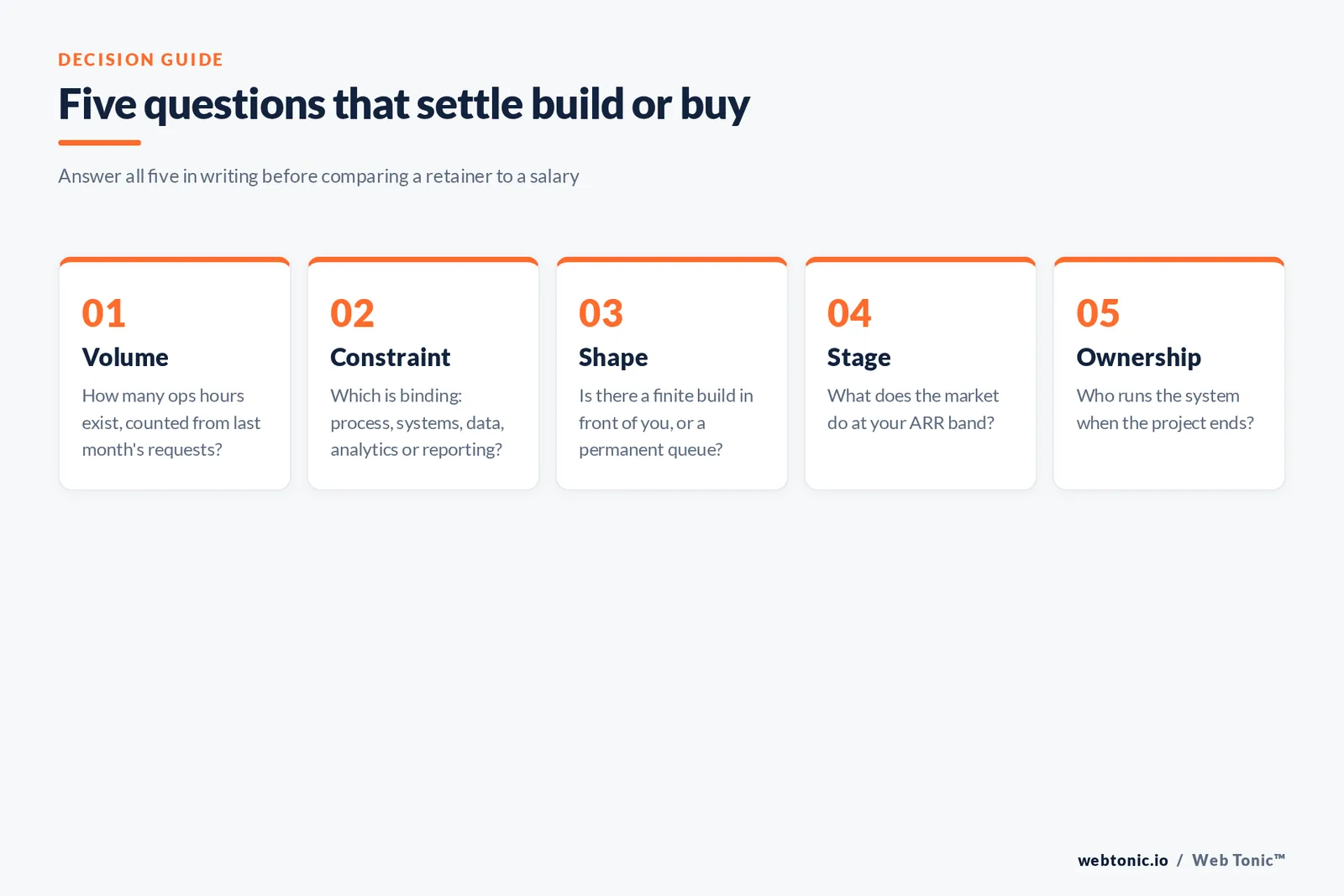
Answer five questions in writing. How many hours a week of ops work exists today, honestly counted from the last month of requests? Which of the five skill areas — process, systems, data, analytics, reporting — is the binding constraint? Is there a finite build in front of you, or a permanent queue? What is your ARR band, and what does the market do at that band? And who will own the system when the project ends?
If the honest hour count is under twenty a week and there is a build to finish, external wins. If it is over thirty with a permanent queue, hire. In the middle — which is most companies between $5M and $50M ARR — the blend wins: an external pod to install, one internal owner to run, and a quarterly review with the pod for the things that only come up occasionally.
That is how we structure marketing operations consulting, with the measurement layer handled through data intelligence so the internal owner inherits definitions rather than mysteries. More on the operating side of growth sits across the blog; if you want a view on your own numbers before you post a job ad, start there.

Related reading
- Marketing Strategy Consulting: vs hiring in-house
- Marketing Audit / Growth Audit: vs hiring in-house
- Marketing Strategy Consulting Statistics: Hiring vs Outsourcing
- Marketing Strategy Consulting services at Web Tonic
Frequently Asked Questions
Is a consultant cheaper than hiring a marketing ops manager?
Per month at the small end, yes — a solo fractional operator at $3,500–$10,000 sits below the fully loaded cost of a $105,400-median hire. Per hour, no: published consultancy rates work out to roughly $172–$227 an hour against $80–$95 for a salaried manager. Choose on volume and duration of the work, not on the monthly headline.
At what point should we hire in-house?
When the request queue reliably fills a week, when the structural build is finished, or when you cross roughly $100M ARR — the point at which market guidance and adoption data both flip to internal teams. Staffing ratios of 1 ops person per 25–30 revenue team members are the practical test.
Can we use both?
That is the most common good answer. An external pod installs the data model, integrations and reporting; one internal owner runs hygiene, requests and campaign QA; the pod stays on a light retainer for migrations and quarterly reviews. Keep a documented handover between the two phases.
What does an in-house hire cost beyond base salary?
Benefits and employer taxes, equipment, tooling and certifications, plus recruiting — retained search alone is 25–35% of salary. Total compensation adds another 10–25% at manager level and 30–60% at director and VP level, so budget well above the headline base.
How do we test a candidate's real ability?
Give a scenario, not a quiz: two systems disagree on last quarter's pipeline, here are the field definitions, tell us what you would check and in what order. Strong candidates start with definitions and record creation rules; weaker ones start with a dashboard.
Sources
MOps Report (marketing operations salary benchmarks, 154 postings with disclosed pay, June 2026), Stealth Agents (cost of hiring a marketing operations manager 2026), LeadFox (marketing operations statistics 2026), Prospeo (Revenue Operations Services: 2026 Buyer's Guide), RevPack (fractional RevOps pricing study, seventeen consultancies, July 2026), SyncGTM (2026 RevOps Report, 1,200+ companies), Talentfoot (senior leadership mis-hire benchmarks 2026), Validity via PR Newswire (State of CRM Data Management in 2026). Accessed September 2026.


