



Table of contents

Quick answer: Run the first session as a diagnosis, not a brainstorm. Three hours, numbers on screen, in this order: outcome, what you know, customer, channels, team, then three ranked priorities with named owners. Leave with written decisions and a next date.
Last verified: 2026-09-03
What this session is for
The first strategy session with a part-time CMO has one job: convert everything the business already knows into a ranked set of priorities. It is not a kickoff call, not a brainstorm, and not the place to approve a plan. A plan built in the first three hours is a plan built on assumptions nobody has tested.
The structural mistake is starting with ideas. Someone suggests a channel, the room gets excited, and ninety minutes later the group has designed a campaign without agreeing what problem it solves. Good marketing leadership resists that by putting diagnosis first, which is the same discipline behind any credible marketing plan: situation analysis precedes strategy, and strategy precedes tactics.
Send the inputs 48 hours ahead
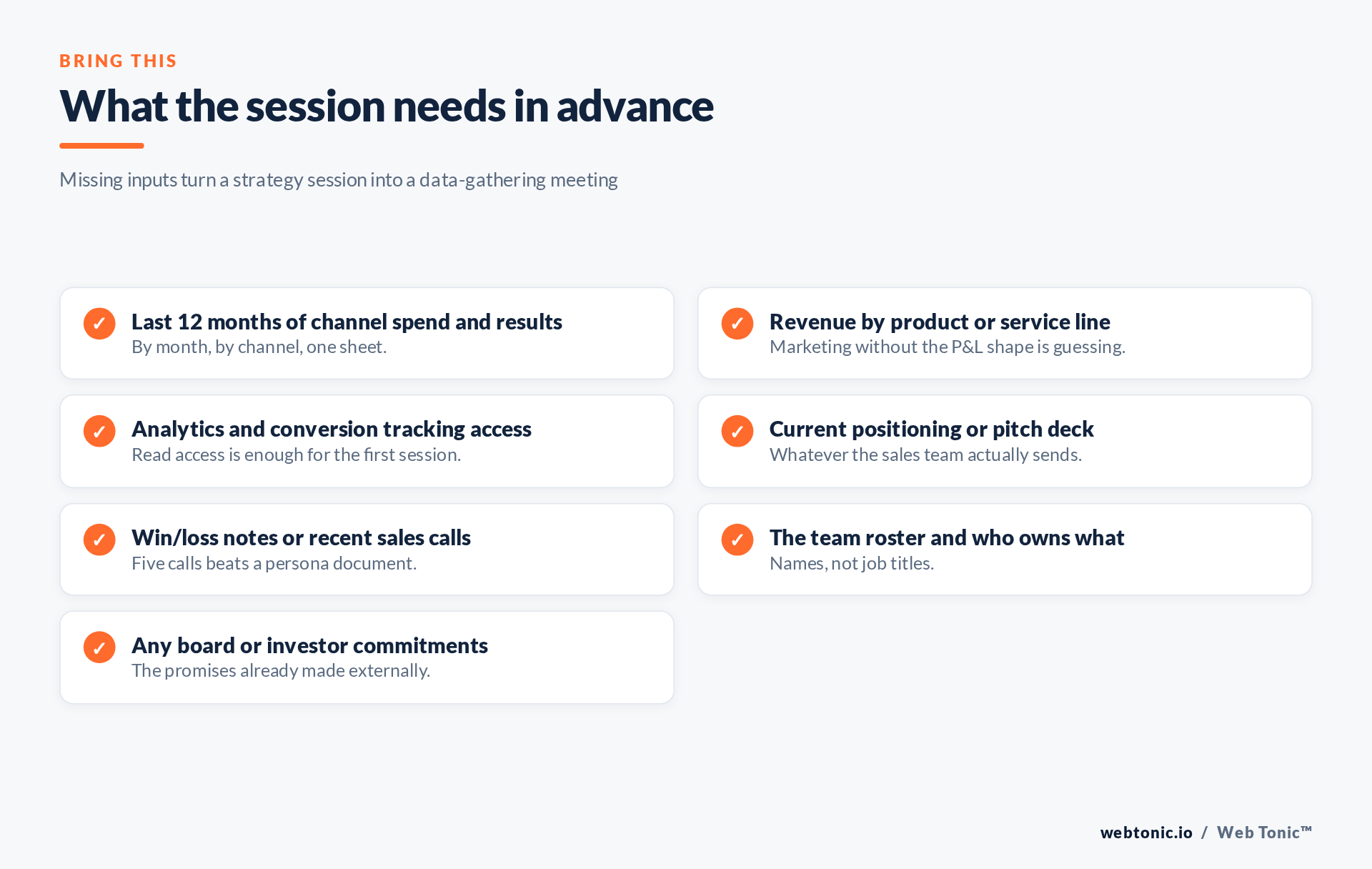
Every hour the session spends locating a number is an hour it does not spend deciding anything. Send the pack in advance and expect your interim marketing director to arrive having read it, with questions already written.
The agenda, section by section
Outcome and constraints
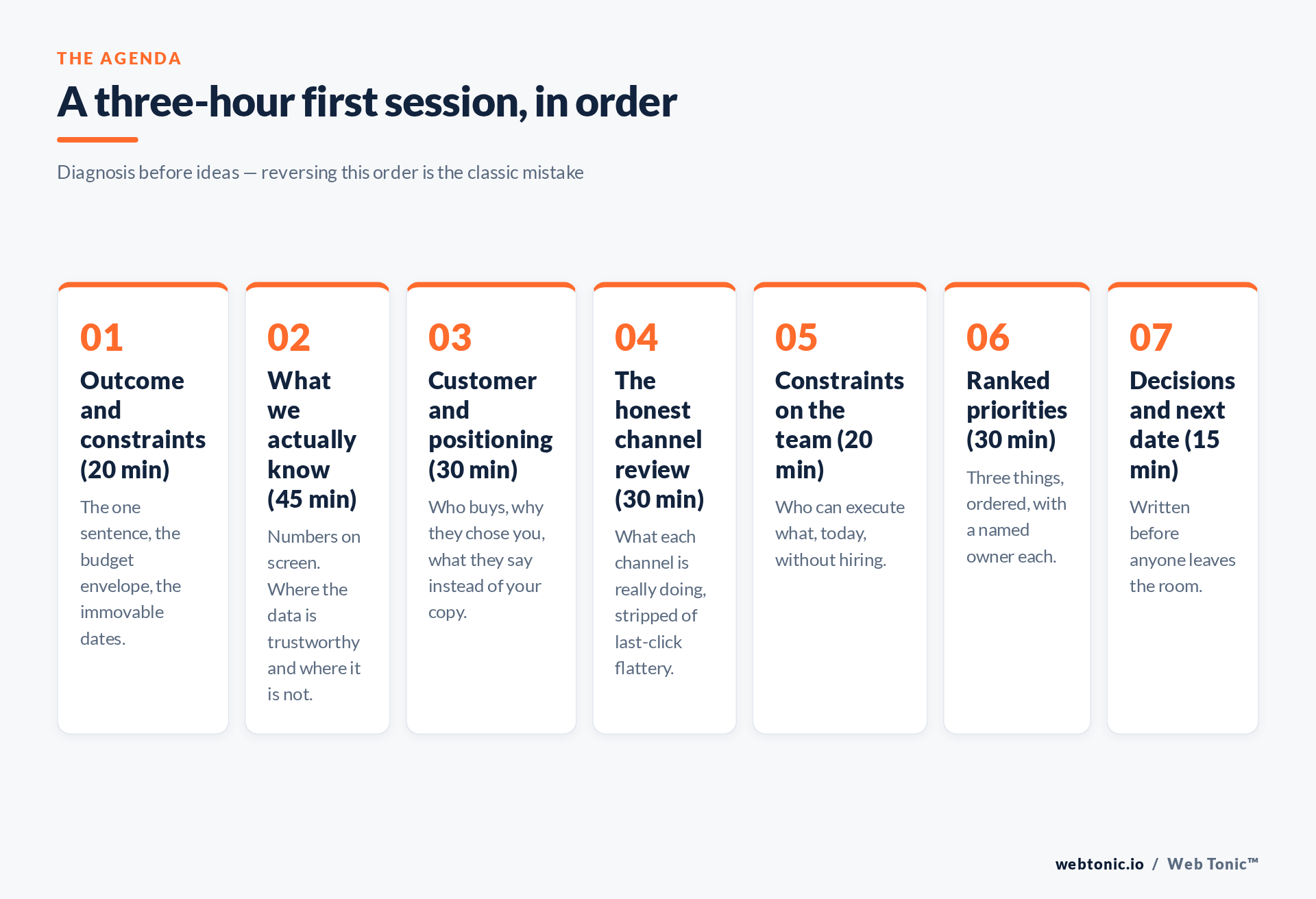
Open by reading the engagement's one-sentence outcome aloud, then list the constraints that are genuinely immovable: the budget envelope, a funding round, a product launch date, a contract that cannot be broken. Constraints stated early prevent strategies that die on contact with the calendar.
What we actually know
The longest section, and the one that earns the fee. Put the numbers on screen and separate them into three buckets: trustworthy, directionally useful, and unusable. Most companies discover here that a metric the board has been quoting for a year cannot be reproduced. Expect to spend time on measurement quality before anything else — our analytics and conversion tracking notes cover the baseline required for channel decisions to mean anything.
Customer and positioning
Ask what customers say in their own words, not what the website says. Recent voice-of-the-customer notes and five real sales calls are worth more than a persona deck. The output is a sharper statement of who you are for, and who you are explicitly not for.
The honest channel review
Go channel by channel and ask what each is actually producing, not what the platform dashboard claims. Channels that look excellent under last-click attribution and poor under any other model deserve a flag, not a verdict — attribution disagreement is a measurement problem to resolve later, and marketing mix modelling exists precisely because single-touch models mislead.
Constraints on the team
A strategy the current team cannot execute is a hiring plan in disguise. Establish what can be delivered with today's people, what needs an agency, and what needs a hire. Naming this early stops the plan from quietly assuming capacity that does not exist.
Ranked priorities and decisions
Close on exactly three priorities, ordered, each with a named owner and a date. Three is not arbitrary: it is roughly what an under-resourced marketing function can genuinely progress in a quarter. Write the decisions down in the room and circulate them the same day.
| Section | Time | Leave with |
|---|---|---|
| Outcome and constraints | 20 min | One sentence, agreed out loud |
| What we actually know | 45 min | Metrics sorted into trustworthy vs unusable |
| Customer and positioning | 30 min | Who you are for, and who you are not |
| Honest channel review | 30 min | A keep / fix / stop flag per channel |
| Team constraints | 20 min | What today's team can actually ship |
| Ranked priorities | 30 min | Three priorities, ordered, owned |
| Decisions and next date | 15 min | Written decisions, circulated same day |
What goes wrong
The failure mode: the session produces enthusiasm instead of decisions. Everyone leaves energised, nothing is written down, and the second meeting reopens the first. The test is mechanical — if you cannot circulate a numbered list of decisions with owners within 24 hours, the session did not happen.
The second failure mode is inviting the wrong room. Ten people makes a presentation; four makes a decision. Bring whoever owns the revenue number, whoever owns the budget, and whoever will execute. Everyone else gets the written summary.
The third is approving a plan on the day. A fractional CMO who commits to a full channel plan in the first session is guessing, and you are paying for judgement rather than guesses. The plan should follow a diagnosis window, not precede it — the shape we describe in our growth marketing engagements.
Frequently Asked Questions
How long should the first session be?
Around three hours, in one block, with the inputs sent 48 hours ahead. Splitting it across two shorter calls tends to mean the diagnosis never finishes.
Who should attend?
Whoever owns the revenue number, whoever controls the budget, and whoever will execute the work. Four to six people is the practical ceiling for a session that makes decisions.
Should we agree a budget in the first session?
Agree the envelope, not the allocation. The split between channels should follow the diagnosis, and locking it on day one wastes the diagnosis you are paying for.
What if the data is too poor to review?
Then that is the finding, and measurement becomes priority one. It is a common outcome and a useful one — it is far cheaper to learn it in hour two than in month four.
Sources: Marketing plan, Voice of the customer, Marketing mix modeling (Wikipedia); MIT Sloan Management Review; Harvard Business Review on the CMO role. Verified 2026-09-03.


