Table of contents

A marketing audit is a structured examination of how your marketing actually works — measurement, channels, funnel, offer and competitive position — that ends in ranked findings, a corrected data baseline and a plan. It is a diagnosis, not a strategy.
Key Takeaways
- An audit answers one question: where is the money going and what is stopping it from working. It does not build campaigns, and buying one expecting execution is the most common disappointment.
- Measurement comes first because everything else is graded on it. Practitioner reviews find conversion tracking errors in roughly 60–70% of newly examined accounts.
- An analysis of more than 2,000 account audits found only about 29% of accounts could actually tell whether campaigns were working.
- Waste is measurable. A 2026 study of 104 B2B accounts covering $78m of spend measured average waste of 34%, with a spread from 13.2% to 49.8% by management quality.
- Published market rates run roughly $2,500–$7,500 for a single-channel review and $8,000–$25,000 for a comprehensive multi-channel audit.
- The trigger is not a bad month. It is an unexplained result, a spend level nobody can defend, a leadership or agency change, or a decision you cannot make with the data you have.
- Judge the deliverable, not the document length: severity-ranked findings with evidence, a corrected baseline, and a 90-day plan where every action names an owner.
What a marketing audit actually contains
The word is borrowed from finance, and the borrowing is useful. An audit does not ask what you should do next; it establishes what is true. HubSpot's framing makes the point with a single example: a 3% conversion rate reads as acceptable in isolation and reads as a problem the moment a direct competitor converts at 7%. Without a comparison set, every number is a mood.
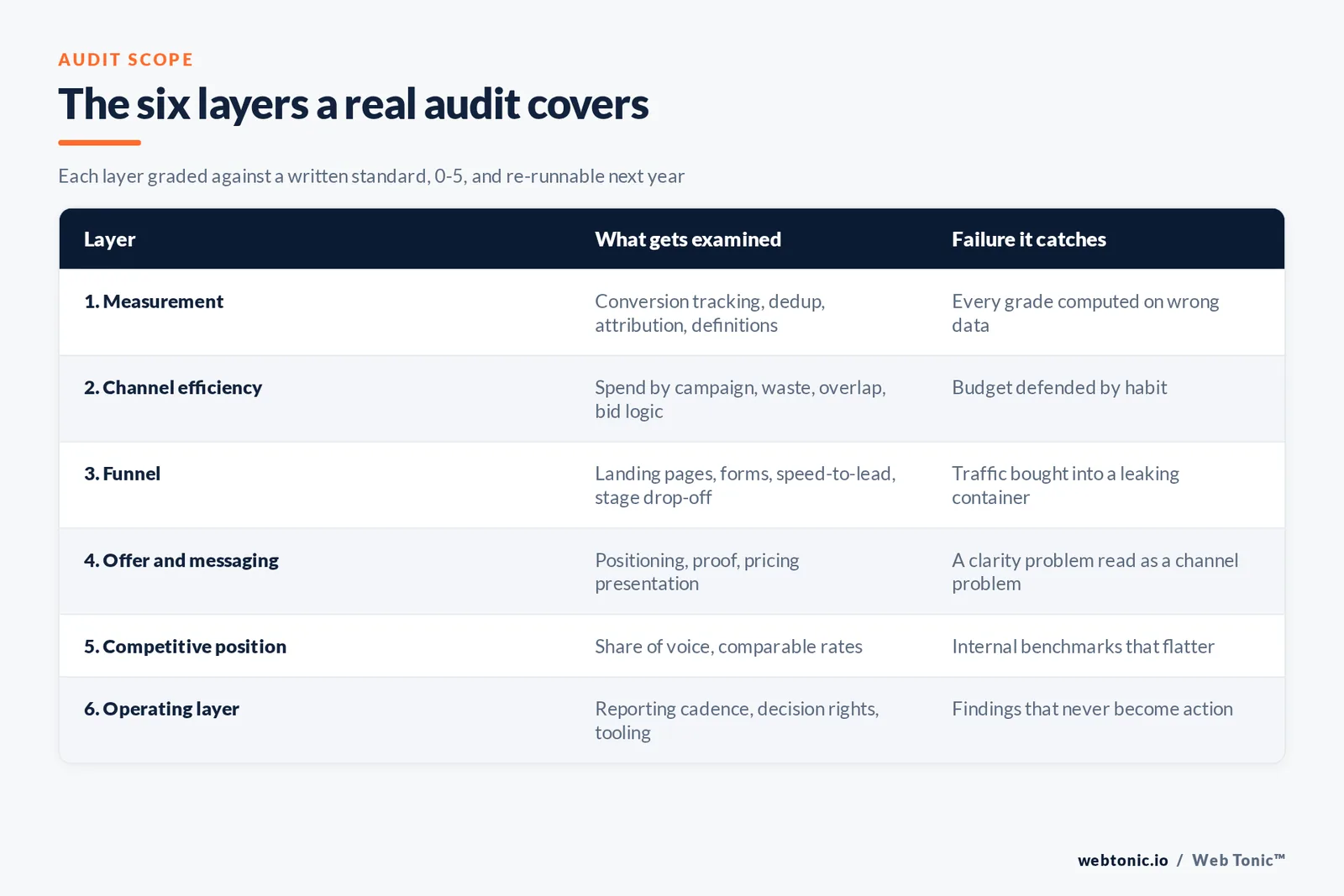
A serious scope covers six layers. Published audit frameworks and practitioner audit guides converge on much the same list: measurement and attribution, channel efficiency, funnel and conversion path, offer and messaging, competitive position, and the operating layer — who decides what, on which report, how often.
| Layer | What gets examined | The failure it catches |
|---|---|---|
| 1. Measurement | Conversion tracking end to end, deduplication, attribution model, report definitions | Every other grade computed on wrong data |
| 2. Channel efficiency | Spend by campaign, waste patterns, targeting overlap, bid and budget logic | Budget defended by habit rather than return |
| 3. Funnel and conversion | Landing pages, forms, speed-to-lead, stage conversion, drop-off points | Traffic bought against a leaking container |
| 4. Offer and messaging | Positioning, proof, pricing presentation, objection handling | A channel problem that is really a clarity problem |
| 5. Competitive position | Share of voice, comparable rates, where rivals out-convert you | Internal benchmarks that flatter mediocrity |
| 6. Operating layer | Reporting cadence, decision rights, agency scope, tooling overlap | Findings that never turn into action |
Why measurement is always the first layer
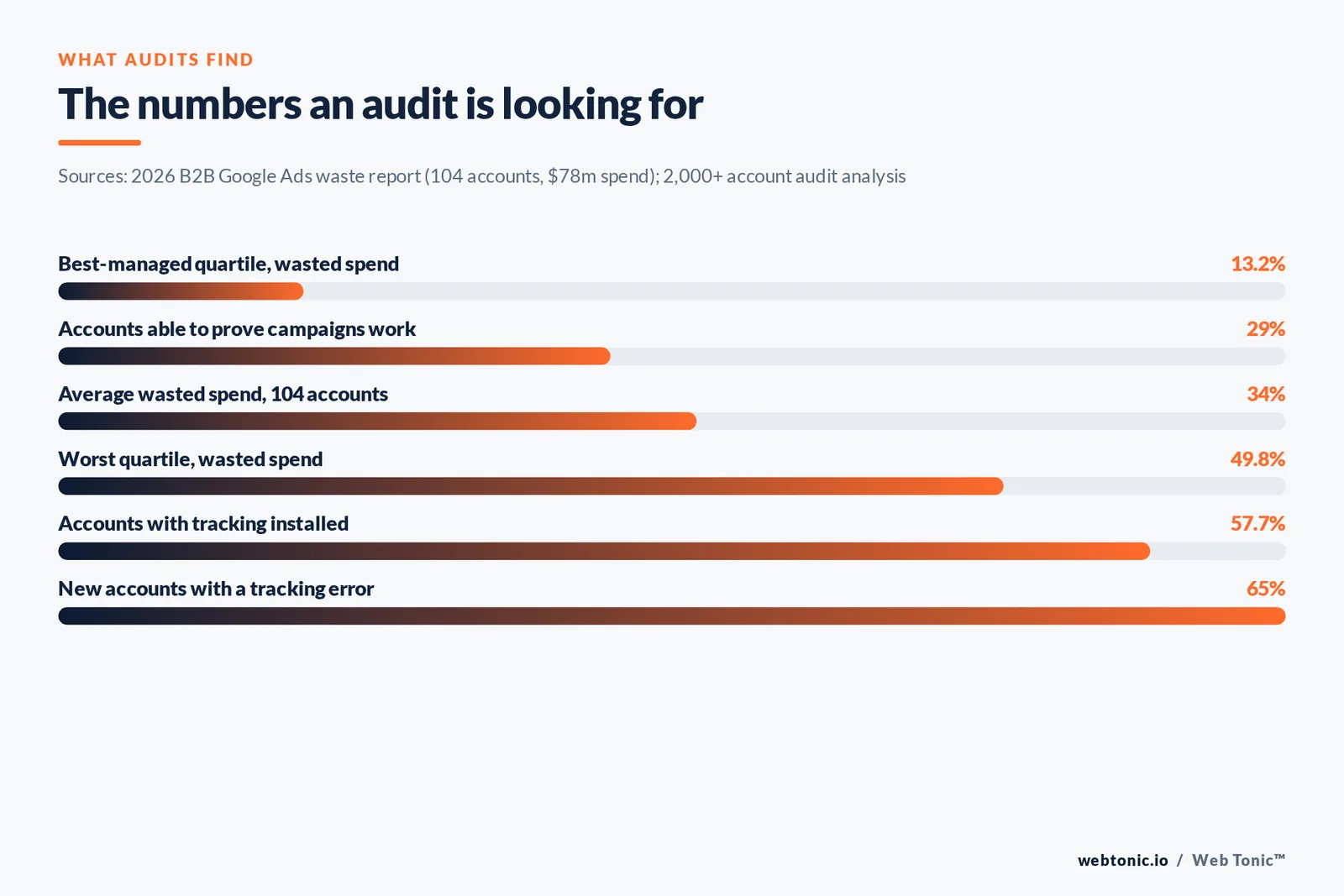
Grading channels before verifying tracking produces confident nonsense. The scale of the problem is documented rather than anecdotal. Practitioner audit method write-ups report a conversion tracking error in roughly 60–70% of newly reviewed accounts, with about 73% of failures clustering into five repeatable categories. An analysis of more than 2,000 account audits found 57.7% of accounts had conversion tracking installed while only about half of those tracked anything meaningful — roughly 29% able to answer whether campaigns worked.
This is why "our paid search is underperforming" is rarely the finding. More often the finding is that two systems count the same lead, or that a form fires a conversion on page load, or that the platform's optimisation has been trained for months on an event nobody trusts. Fixing the measurement layer changes the numbers before anyone touches a campaign, which is precisely why it belongs at the start.
The size of the thing an audit is looking for
Waste is not a rhetorical device. A 2026 waste report covering 104 B2B accounts and $78m of spend measured average waste of 34% — around $255,000 per account — and, more usefully, a spread from 13.2% in the best-managed quartile to 49.8% in the worst. The spread is the interesting part: it says management quality, not channel choice, explains most of the difference.
Wasted-spend analyses add the mechanisms — duplicated tooling, unattributed programmes, campaigns nobody has owned since a staff change. At $50,000 a month in media, an unexamined quarter at the average waste figure is a six-figure question. At $5,000 a month it is not, and a comprehensive audit would cost more than it could recover. Scope has to be proportional to the money at risk.
When you actually need one
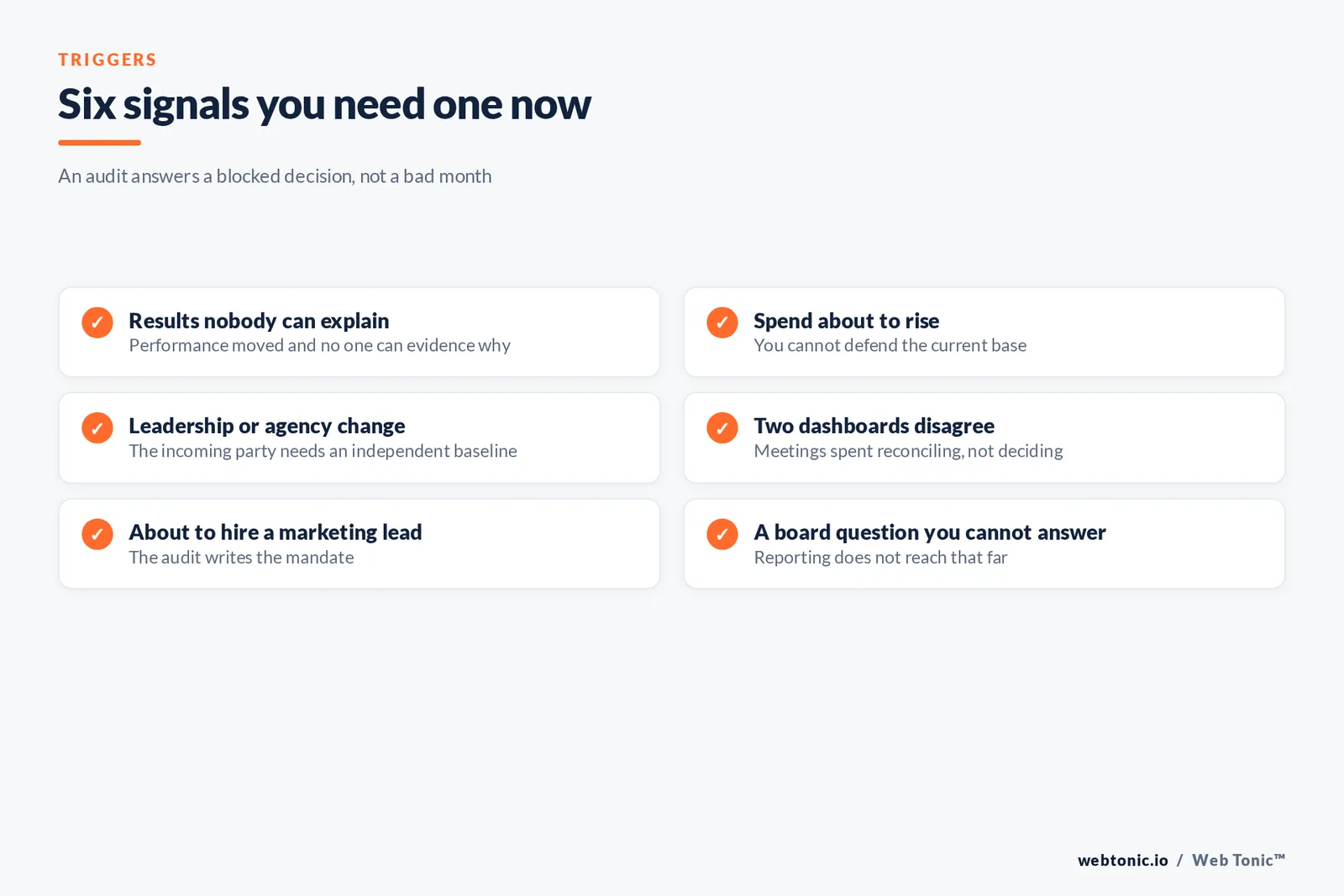
The honest answer is: when a decision is blocked. Not because results dipped for a month, and not annually as a ritual. Six triggers come up repeatedly.
One: the results are unexplained. Performance moved and nobody can say why with evidence. Two: you are about to increase spend materially and cannot defend the current base. Three: leadership or agency is changing, and the incoming party needs an independent baseline rather than an inherited narrative. Four: nobody trusts the reports — two dashboards disagree and meetings are spent reconciling them. Five: you are about to hire a marketing leader and want a written mandate rather than a job title. Six: a board, investor or acquirer has asked a question your current reporting cannot answer.
The mirror image matters as much. An audit is the wrong purchase when the problem is capacity — when everyone agrees on what to do and there is no one to do it. It is also the wrong purchase immediately after a rebuild, when there is not yet enough data to examine, and when the real question is a strategy question: which segment, which offer, at what price. That belongs to strategy work, not diagnosis.
| Situation | Audit is the right first purchase | Buy this instead |
|---|---|---|
| Nobody trusts the numbers | Yes — measurement audit at minimum | — |
| Spend rising, returns flat | Yes — channel plus measurement scope | — |
| About to hire a marketing lead | Yes — it writes the mandate | — |
| Everyone knows the plan, nobody has time | No | Execution capacity or a fractional operator |
| Segment and offer undecided | No | Strategy engagement |
| Site or tracking rebuilt last month | Not yet | Wait for 60–90 days of clean data |
Audit, growth audit, review: the words are not interchangeable
Three products share the shelf. A single-channel review examines one system in depth and suits a localised symptom; published pricing breakdowns put that at roughly $2,500–$7,500. A measurement audit covers only tracking and reporting, and is the correct first purchase when trust is the problem. A growth audit spans all six layers above and belongs to companies that cannot explain their own results; the same pricing work puts comprehensive multi-channel scopes at $8,000–$25,000 or more, and describes tiering from basic at $1,000–$3,000 through comprehensive at $7,000–$15,000-plus.
The distinction is not pedantry. Most disputes about audit value trace back to a buyer who purchased a single-channel review and expected a growth audit, or purchased a growth audit and expected an implementation team.
What good looks like on delivery
Four artefacts separate a diagnosis from a document. First, ranked findings with severity and evidence — every finding carries the number, its source and what it costs. Second, a corrected measurement baseline, so the next quarter is comparable to something. Third, a 90-day plan in which every action names an owner and an acceptance test. Fourth, a scored assessment that can be re-run: rating each area 0–5 against a defined standard turns a one-off report into a quarterly review your own team can repeat.
Two habits protect the value afterwards. Keep the definitions frozen — restating metric definitions mid-quarter destroys the comparison the baseline exists to provide. And require an implementation report at day 90: the share of findings closed, not the share discussed. Audits fail far more often on adoption than on analysis.
What an audit cannot fix
It cannot create demand that does not exist, and it will not rescue a product-market fit problem — diagnosis names it rather than solving it. It cannot substitute for capacity: a plan with no one to execute it decays in weeks. It cannot settle a positioning decision, which requires judgement and a bet rather than evidence alone. And it cannot make a team act against its incentives; if the reporting line rewards volume, findings about quality will lose quietly.
Named honestly, those limits make the purchase easier. An audit converts a vague sense that marketing is underperforming into a ranked, evidenced list with a cost attached to each item. Everything after that is execution, and execution is a different purchase.

How the four weeks actually run
Knowing the shape of the work makes it far easier to judge a proposal. A comprehensive audit tends to run in four passes rather than one long analysis, and each pass has a visible output.
Week one is access and inventory. Ad accounts, analytics, tag manager, CRM, email platform, and the reports leadership currently reads. The output is a list of what exists, what is broken and what nobody owns. Most audits find at least one live campaign or automation whose owner left the business.
Week two is measurement verification. Every conversion action is traced from the user action to the row in the report, then to the number in the board deck. Duplicates, page-load fires, missing offline events and mismatched attribution windows are catalogued here, and the corrected baseline starts to take shape. This is the pass that changes the numbers most.
Week three is efficiency and funnel. Spend is re-cut against the corrected data, waste patterns are quantified rather than described, and the conversion path is examined at the point of loss instead of in aggregate. Comparative benchmarks are attached here, so each grade sits beside a reference point rather than a feeling.
Week four is severity, sequence and handover. Findings are ranked by cost and effort, each one gets an owner and an acceptance test, and the plan is written so a person who was not in the room can act on it. A good audit ends with a working session rather than a document drop, because the ranking is where the argument lives and where the client's context corrects the analyst's.
Two practical notes. Access delays, not analysis, cause most overruns — collect credentials before the kickoff call. And insist the corrected baseline is written down as a set of definitions, not just a dashboard: the definitions are what make the day-90 comparison legitimate.
What the audit checks, area by area
A useful audit is documented as a process, not a personality. Each area is graded against a written standard, and the same process can be re-run by your own team next year.
Goals and strategy. Are the marketing goals written as objectives with numbers and dates, and does each activity in the plan trace to one of them? Audits routinely identify activities that survive because they always have, serving no current goal.
Brand and content. Does the website say what the company does in the customer's words? Content is graded for its role in the buying process rather than volume — a small library that answers real customer questions beats a large one that answers none.
SEO and organic search. Technical health, the pages that earn qualified traffic, and the gap between the queries your customers use and the pages you own. Organic search opportunities are usually the cheapest ones on the list.
Paid media and email. Spend efficiency by campaign, audience overlap, and whether email and lifecycle programmes are doing the retention work the business needs.
Social and audience. Which social activities produce measurable business results, which produce reach the sales team never sees, and where the audience actually gathers.
Sales alignment. Speed-to-lead, lead definitions both teams accept, and whether the process from enquiry to opportunity is documented anywhere. This area, more than any channel, is where small companies find their fastest wins.
Scored 0–5 per area, the result is a picture your team can act on: three areas to fix this quarter, two to leave alone, and a documented process the business owns for the year ahead.
Frequently Asked Questions
What is a marketing audit in simple terms?
A structured, evidence-based examination of how your marketing currently works — measurement, channels, funnel, offer, competition and operating cadence — delivered as severity-ranked findings plus a plan. It diagnoses; it does not execute.
How much does a marketing audit cost?
Published 2026 market ranges are roughly $2,500–$7,500 for a single-channel review and $8,000–$25,000 for a comprehensive multi-channel audit, with basic tiers quoted from about $1,000–$3,000. Scope should stay proportional to the spend under examination.
How long does an audit take?
A focused channel or measurement review typically produces written findings in 7–14 days; a full multi-channel diagnostic usually runs 3–4 weeks because it needs access, data pulls and comparative work.
How often should we run one?
A full external audit is worth repeating roughly every 12–18 months, or on a trigger — a leadership change, a step change in spend, or a result nobody can explain. Between those, re-score the same areas internally each quarter.
Is an audit worth it below $10,000 a month in spend?
Usually only in narrow scope. At low spend, a measurement audit and a single-channel review carry the value; a comprehensive audit at that level can cost more than the waste it could plausibly find.
Where to take this next
Start by writing down the decision you cannot currently make. That single sentence sets the scope, the price and the deadline. Our marketing audit is built around it — ranked findings with evidence and severity, a corrected measurement baseline and a 90-day plan with owners — while data intelligence repairs the measurement layer the findings depend on, growth marketing executes the plan, the wider services lineup covers delivery, and the blog carries more method detail. To scope one against your own numbers, talk it through with us.
Sources
HubSpot — What's a Marketing Audit?
Improvado — Marketing Audit Guide 2026
Improvado — Wasted Marketing Spend
MarkCMO — How to Run a Marketing Audit
MarqOps — Google Ads Conversion Tracking: The 2026 Audit Method
Disruptive Advertising — Lessons from 2,000+ Account Audits
Growth Spree — 2026 B2B Google Ads Waste Report
The it Crowd — What a Marketing Audit Actually Costs