



Table of contents

Quick answer: Scope a fractional CMO around one named outcome, explicit decision rights, a fixed number of days per week, and a written exit test. Scope the decisions they own, not the hours they work.
Last verified: 2026-09-03
Why scoping is the whole job
A fractional CMO is a part-time senior marketing leader, engaged for a slice of the week rather than hired as a full-time executive. The model works because marketing leadership is mostly judgement, and judgement does not need forty hours to be useful. It fails for a boring reason: nobody wrote down what the person was allowed to decide.
The chief marketing officer role is unusually broad, spanning brand, demand, product marketing and increasingly data. That breadth is exactly why a part-time version has to be narrowed deliberately. Executive tenure in the role is famously short, and Harvard Business Review has argued the churn usually traces back to mismatched expectations about what the role controls rather than to individual failure. A fractional engagement compresses that same risk into a few months, so the mismatch surfaces faster and costs more.
Step 1 — Name one outcome
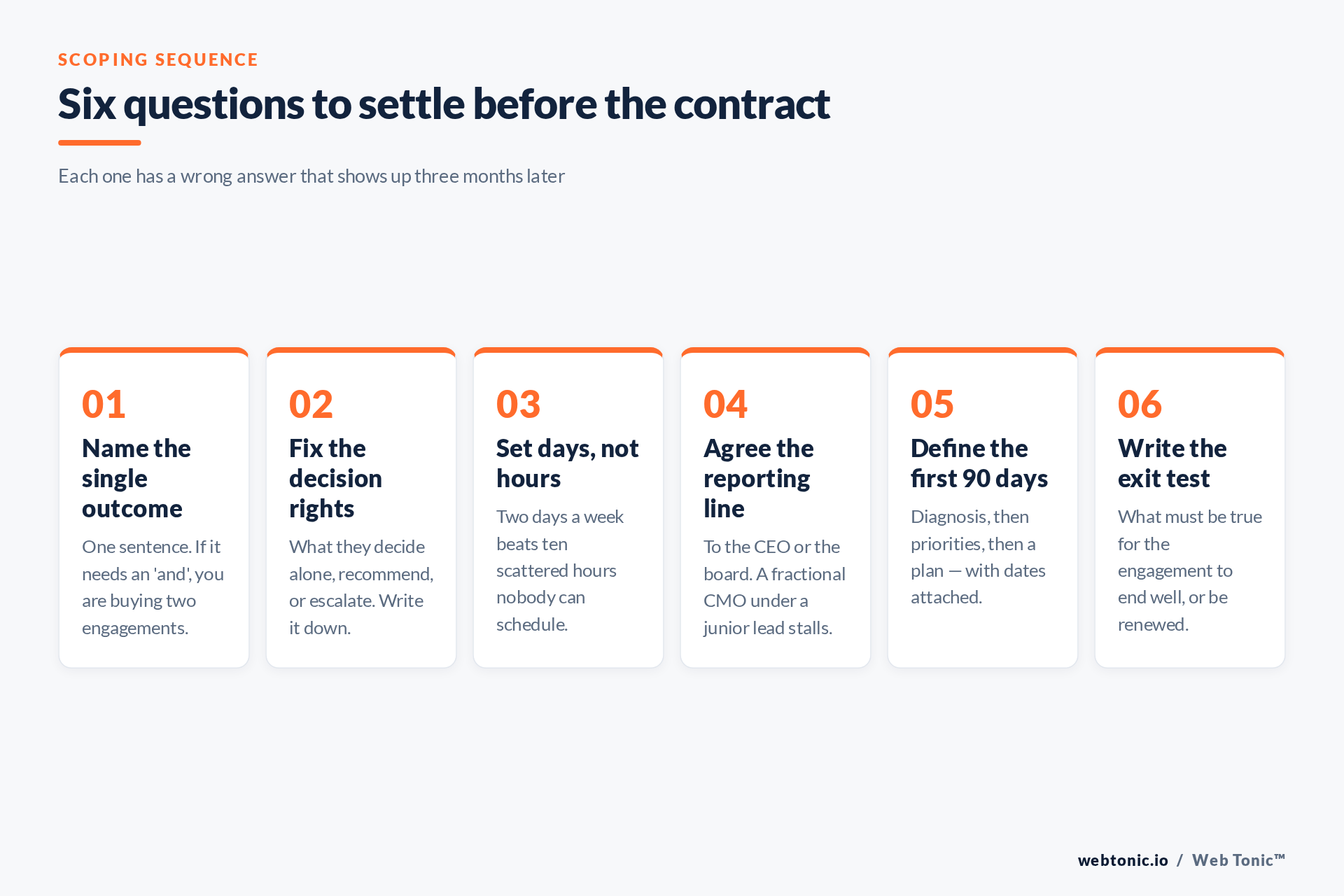
Write the engagement's purpose as a single sentence with a subject, a verb and a measure. "Get us to a repeatable pipeline of qualified demos by Q3" is scopeable. "Improve marketing" is not. If your sentence needs the word "and", you are describing two engagements and should sequence them.
This sentence becomes the tiebreaker for every later argument about priorities. It belongs in the statement of work, not in an email.
Step 2 — Write the decision rights down
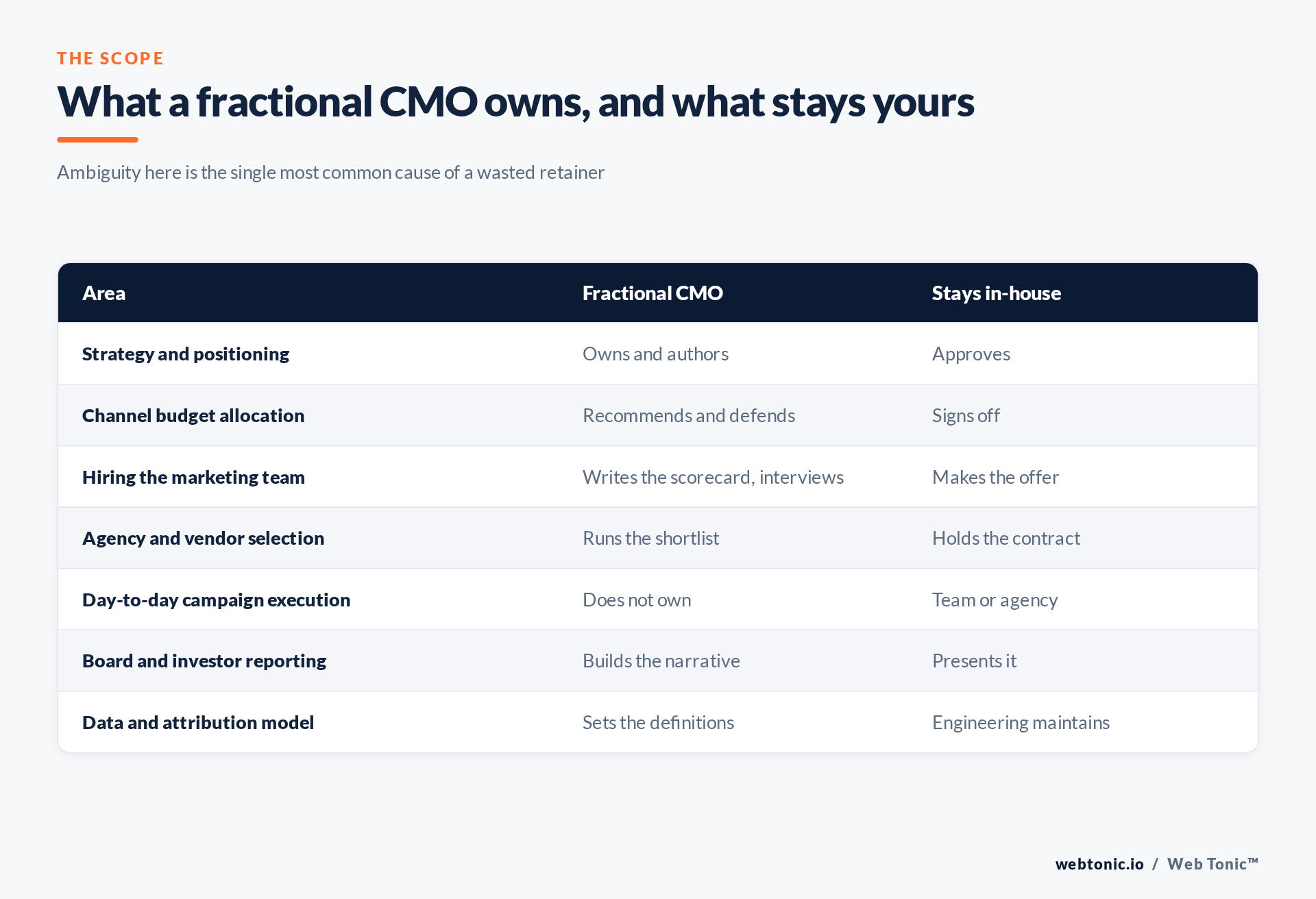
For each area of the remit, decide whether the fractional CMO decides, recommends, or escalates. The table above is a starting template; the point is that you complete it before signing, together, out loud. Most disputes at month three are decision-rights disputes wearing a strategy costume.
The two that matter most: budget reallocation and vendor termination. If your fractional CMO cannot move spend between channels or end a failing agency relationship, they are a consultant producing recommendations, and you should price and expect the engagement accordingly.
| Decision | Weak scope says | Workable scope says |
|---|---|---|
| Move budget between channels | "Advises on budget" | Decides within the approved envelope; escalates above it |
| End an agency or vendor | Unstated | Recommends; CEO signs, within 14 days of the recommendation |
| Hire into the marketing team | "Helps with hiring" | Writes scorecard and interviews; founder makes the offer |
| Change positioning or messaging | "Owns brand" | Authors it; one named approver, one review round |
| Set the reported metrics | Inherited from whoever built the dashboard | Defines them in month one; engineering implements |
| Pause a campaign losing money | Needs a meeting | Decides alone, reports after |
Step 3 — Buy days, not hours
Hourly fractional leadership fragments into calendar dust. Days are schedulable, and they let the person hold a real cadence: a weekly leadership meeting, a monthly review, a quarterly plan. Two consistent days a week is the common floor for an engagement that includes team management; one day a week is realistic for pure advisory.
Step 4 — Fix the reporting line
A fractional CMO should report to whoever owns the revenue number, normally the CEO or founder. Slotting senior marketing leadership beneath a marketing manager creates a structure where the most expensive person in the function has the least authority, and it reliably stalls. If the engagement includes board exposure, agree in advance whether they attend, present, or only prepare the material.
Step 5 — Specify the first 90 days
A credible interim marketing director will want a diagnosis window before committing to a plan, and you should insist on one. A workable shape is: weeks one to three diagnosis, week four a written point of view with ranked priorities, then execution against a dated plan. Ask to see the plan format at the proposal stage.
Insist that the diagnosis covers measurement. If your analytics and attribution cannot distinguish channels, every later recommendation is a guess. Our analytics and conversion tracking notes cover the baseline a strategist needs before they can allocate anything.
Step 6 — Write the exit test
Every fractional engagement should end, convert to full-time, or renew for a stated reason. Define which, up front. A clean exit test names the artefacts you keep: the plan, the measurement definitions, the hiring scorecards, the vendor contracts. Without it you rent judgement for a year and retain none of it.
What goes wrong
The failure mode: the scope is written as a list of activities rather than decisions and outcomes. Activity lists survive contact with reality for about six weeks, after which the fractional CMO is either doing execution work far below their level, or is blocked on approvals nobody agreed to give them. If you only fix one thing from this page, fix the decision rights column.
The second failure mode is scoping for a company that does not exist yet. Senior part-time CMO input assumes there is something to lead — a budget, a team, an agency, a product with customers. Below that threshold, the money is usually better spent on execution, which is how we frame our own growth marketing engagements.
Frequently Asked Questions
How long should a fractional CMO engagement run?
Long enough to see a strategy cycle through: commonly six to twelve months. Anything under three months is a diagnostic project, and it is more honest to scope it as one.
Should the contract include a notice period?
Yes, on both sides, and usually 30 days. It protects the engagement from a single bad month and gives you a clean exit if the fit is wrong.
Can a fractional CMO manage an in-house team?
Yes, and it is common, but only with a stated day count and clear line management authority. Managing people two days a week without the ability to hire, review or exit anyone is not management.
What if we already have an agency?
Then state whether the fractional CMO manages that relationship or works alongside it. Unstated, this becomes the first political problem of the engagement.
Sources: Chief marketing officer, Statement of work, Marketing plan (Wikipedia); Harvard Business Review on CMO role mismatch; Spencer Stuart CMO Tenure Study. Verified 2026-09-03.


