



Table of contents
A feature is what your product is. A benefit is what the customer gets. Most marketing copy stalls because it lists the first and assumes the reader will work out the second — and the reader never does.
Key Takeaways
- Features are factual and product-owned; benefits are outcome-owned and always finish the sentence "so that you…".
- 79% of readers scan a page instead of reading it, so a benefit has to be visible in the first 2 seconds or it is not in the message at all.
- Features are not optional: roughly 1 in 3 lost sales come from a missing specification the buyer needed to compare products, not from weak persuasion.
- Documented cart abandonment sits near 70%, and much of it is unresolved uncertainty about what the product actually does for the buyer.
- The working rule: benefits sell, features justify — lead with the emotional payoff, then let the technical detail close the loop.
Features vs benefits: the decision table first
Before the theory, the practical answer. Which one you lead with depends on how much the customer already knows and how technical the purchase is.
| Situation | Lead with | Support with | Why |
|---|---|---|---|
| Cold audience on social media | Benefit | 1 proof feature | Nobody is shopping yet; the outcome buys the attention |
| Search ad for a specific model | Feature | Benefit in the description | The customer typed the specification themselves |
| Ecommerce product page | Benefit headline | Full technical table | Emotional pull first, comparison data to justify the click |
| B2B software demo page | Business benefit | Features by role | The economic buyer buys outcomes; the technical evaluator vetoes on features |
| Marketplace listing | Feature | Benefit bullets | Filters and search match on attributes, not on adjectives |
| Renewal or upsell email | New feature | Benefit to their workflow | Existing customers already accept the value proposition |
| Regulated purchase | Feature and compliance fact | Reassurance benefit | Claims need substantiation before persuasion |
What a feature is, and what a benefit is
A feature is a factual, measurable attribute of a product or service: 12-hour battery, 316 stainless steel, unlimited seats, 24/7 phone support. It exists whether or not anyone buys.
A benefit is the change the feature creates in the customer's life or business: you finish a working day without hunting for a charger, the fitting survives coastal air, your whole team can log in without a procurement request, someone answers at 3am when the line goes down.
Between the two sits an advantage — the comparative claim that connects them. "12-hour battery" (feature) is "twice the runtime of the previous model" (advantage) so that "you stop carrying a power bank" (benefit). That three-step chain is the classic feature-advantage-benefit structure, and it is the single most useful messaging tool in this article.
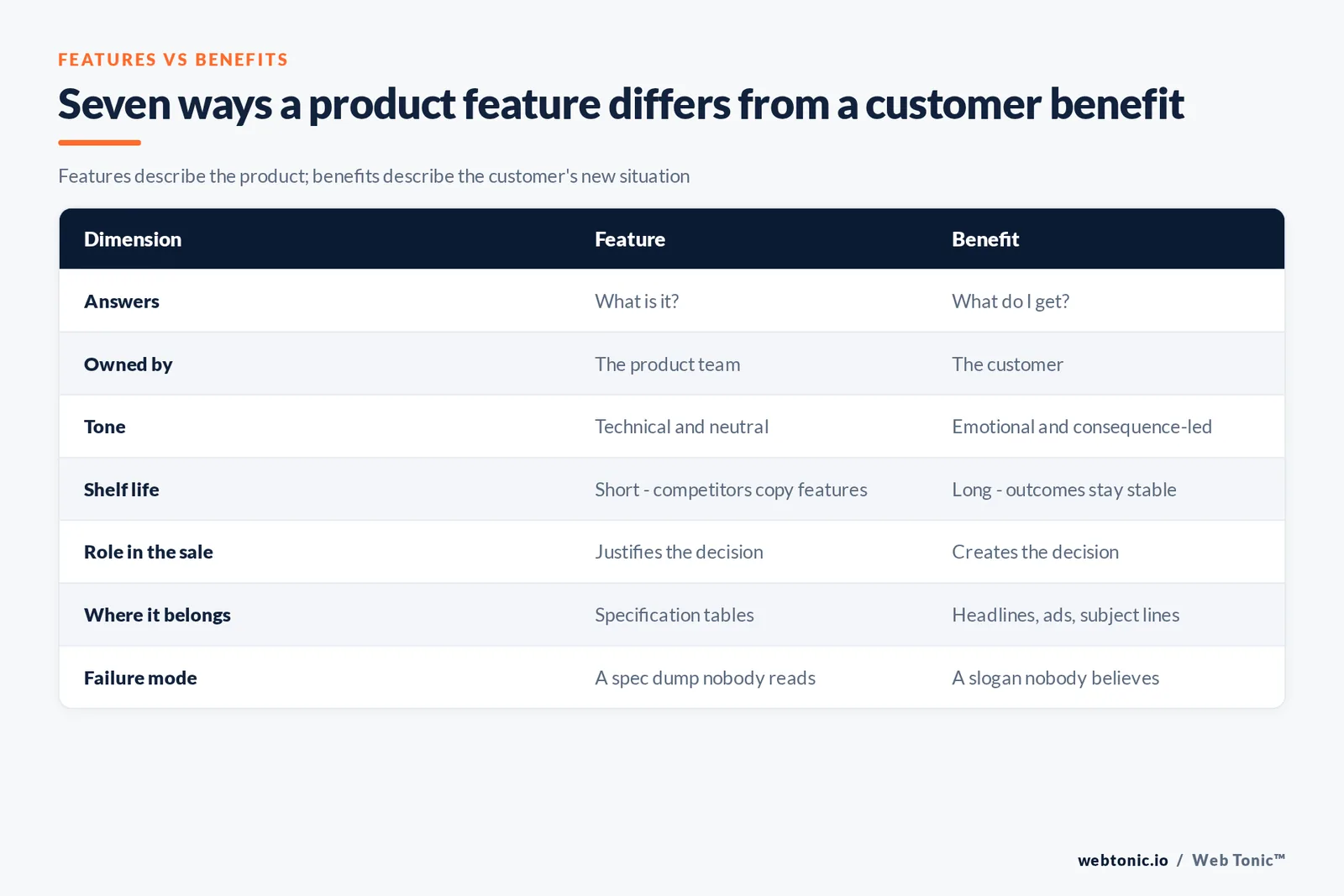
| Dimension | Feature | Benefit |
|---|---|---|
| Answers | What is it? | What do I get? |
| Owned by | The product team | The customer |
| Tone | Technical, neutral | Emotional, consequence-led |
| Verifiable | Yes, by specification | Yes, by customer evidence |
| Shelf life | Short — competitors copy features | Long — outcomes stay stable |
| Role in the sale | Justifies the decision | Creates the decision |
| Where it belongs | Specification tables, comparison pages | Headlines, ads, subject lines |
14 features vs benefits examples across products and services
The fastest way to internalise the difference is to read the same fact written twice. Cover the right-hand columns and try to translate each feature yourself.
| Product or service | Feature | Advantage | Customer benefit |
|---|---|---|---|
| MP3 player | 5GB of storage | Holds a whole music collection | 1,000 songs in your pocket |
| Toothpaste | Contains 1,450ppm fluoride | Clinically effective concentration | Fewer fillings and cheaper dental visits |
| Cordless drill | Brushless motor, 18V | More torque, less heat | Finish the deck in one afternoon, not two |
| Accounting software | Automated bank reconciliation | Removes manual matching | Close the month in 2 days instead of 6 |
| Running shoe | 8mm heel-to-toe drop | Suits midfoot strikers | Longer runs without shin pain |
| Mattress | Zoned pocket springs | Independent support per sleeper | Your partner turning over stops waking you |
| CRM platform | Unlimited user seats | No per-head pricing | Hire without renegotiating your software budget |
| Electric car | 340-mile range | Covers most intercity trips | Drive to the coast and back without planning a charge stop |
| Insurance policy | £0 excess on windscreens | No out-of-pocket cost | A stone chip stops being a £150 decision |
| Coffee subscription | Roasted to order, shipped in 24h | Peak freshness window | Café-grade coffee on a Tuesday morning at home |
| Project tool | Native mobile offline mode | Works without signal | Site teams log work in a basement and it still syncs |
| Marketing agency | Weekly reporting call | Faster feedback loop | You never wait a month to find out spend was wasted |
| Kitchen tap | Ceramic disc cartridge | Rated for 500,000 cycles | No drip, no plumber call-out for a decade |
| Online course | 6 live cohort sessions | Accountability and feedback | You actually finish it, unlike the last 3 courses you bought |
Notice the shape of the benefit column: concrete nouns, a time frame, and a consequence the customer can picture. That is what "speaks to the customer on an emotional level" means in practice — not flowery adjectives, but a specific scene from their own week that becomes easier.
Why benefits usually outsell features
Three reliable reasons, and none of them are about copywriting fashion.
Reason 1 — attention is rationed. Nielsen Norman Group's reading research found 79% of users scan and only 16% read word by word; a concise rewrite tested 58% more usable. Technical features are the first thing a scanner skips.
Reason 2 — customers translate badly. Asking a reader to convert "brushless motor" into "finishes the job faster" is asking for cognitive work they will not do for a brand they do not yet trust.
Reason 3 — expectations are set elsewhere. Research on customer expectations, including Salesforce's State of the Connected Customer and PwC's customer experience work, consistently finds consumers judging brands on experience and outcome rather than on specification alone. Your feature list competes with everyone's feature list; your benefit competes with their memory of being let down.
When features win the argument
Benefit-only messaging is its own failure mode. It reads as marketing noise and it starves the comparison shopper.
| Scenario | Why features matter more | What to publish |
|---|---|---|
| Technical evaluation | An engineer has a checklist and a veto | Full specification table, API limits, integrations |
| Compatibility purchase | Fit is binary — it works or it doesn't | Dimensions, model numbers, tolerances |
| Regulated or medical | Claims must be substantiated | Certifications, standards, documented testing |
| Price comparison | Buyers need a like-for-like grid | Feature-by-feature comparison, no missing rows |
| Ecommerce sizing | Missing detail becomes a return | Measurements, materials, care instructions |
| Enterprise procurement | Security review precedes any benefit story | Audit status, data residency, SSO, uptime |
Nielsen Norman Group's guidance on ecommerce product pages is explicit that incomplete product information is a conversion killer, and Baymard's cart abandonment research documents an average near 70%. A benefit-led headline with no specification table underneath does not remove doubt; it postpones it until checkout, which is the worst place to answer a question.

How to turn any feature into a benefit in 4 steps
This is the "so what?" ladder. Run it once per feature and stop when the answer stops changing.
| Step | Question | Worked example |
|---|---|---|
| Step 1 | State the feature plainly | "Automated bank reconciliation" |
| Step 2 | So what does it do differently? | "It matches 2,000 transactions without a spreadsheet" |
| Step 3 | So what does that save or gain? | "It removes 4 days of manual work each month" |
| Step 4 | So what changes for the person? | "Your finance lead reports on day 2 and stops working weekends" |
Rule 1 — stop at the human. The last rung is always a person, not a process. Rule 2 — keep one number. A benefit with a figure in it is a promise; without one it is a mood. Rule 3 — write both versions. Every feature in your product should have a one-line benefit stored next to it so any writer on the team can pull it. Rule 4 — don't over-climb. "Peace of mind" is 2 rungs too high and belongs to every competitor.
Features and benefits by business type
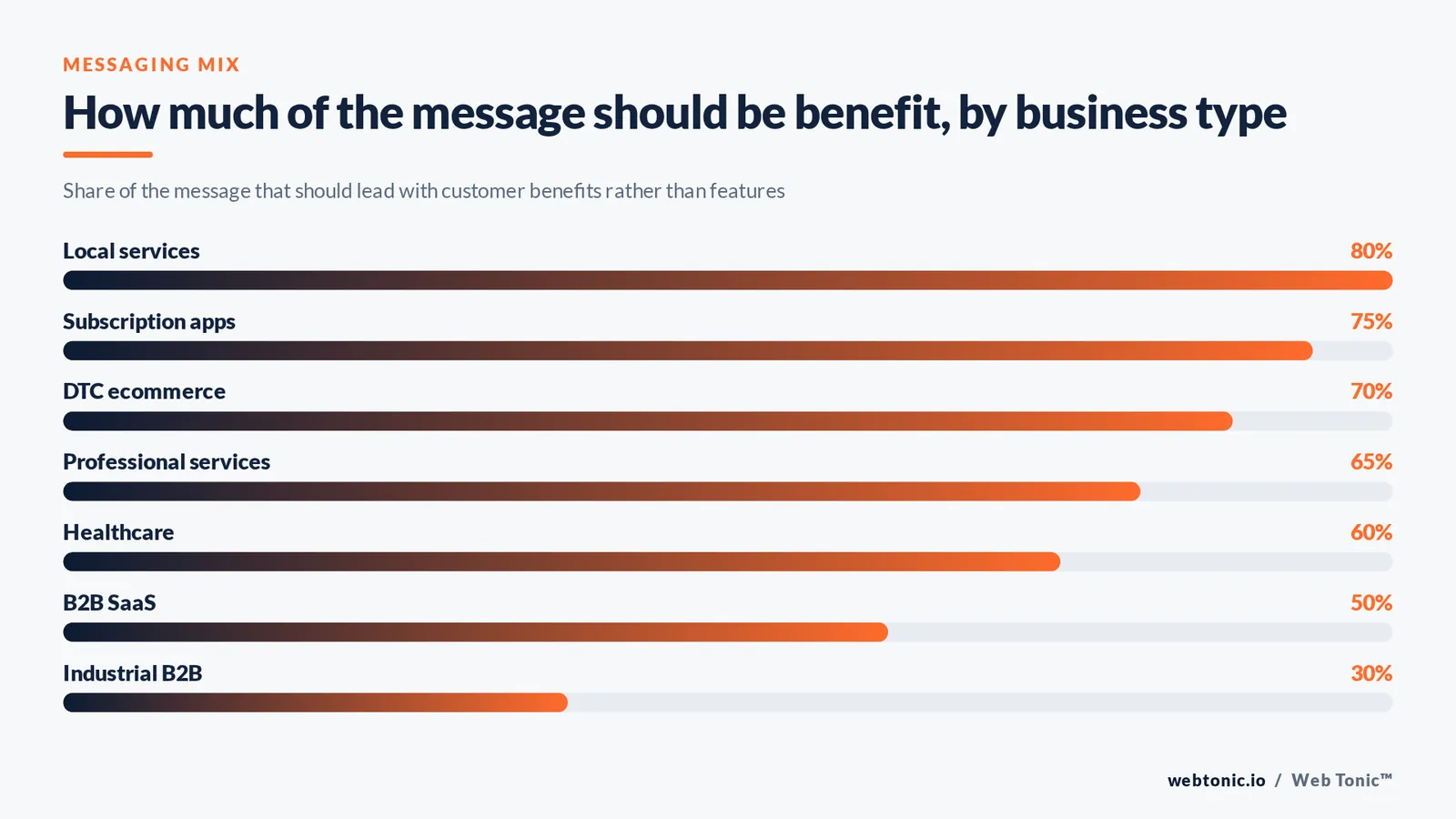
The correct mix is set by what the buyer is risking and how technical they are.
| Business type | Benefit-to-feature weighting | Benefit that converts | Feature that must be visible |
|---|---|---|---|
| DTC ecommerce | 70 / 30 | "Fits first time or free returns" | Sizing, materials, delivery window |
| B2B SaaS | 50 / 50 | "Live in 14 days" | Integrations, security, seat model |
| Local services | 80 / 20 | "Someone here today, price agreed first" | Licences, coverage area, hours |
| Industrial and B2B products | 30 / 70 | "Less downtime per shift" | Tolerances, standards, lead times |
| Professional services | 65 / 35 | "You get the partner, not a junior" | Scope, deliverables, timelines |
| Healthcare | 60 / 40 | "Seen this week, sedation available" | Credentials, equipment, aftercare |
| Subscription apps | 75 / 25 | "5 minutes a day is enough" | Platforms, offline use, cancellation terms |
Where each one belongs on the page
Most "features vs benefits" arguments are really arguments about sequencing. Both belong on the page; they just do not belong in the same place.
| Page section | Content | Example |
|---|---|---|
| Hero headline | Primary benefit, 1 idea | "Close your books in 2 days" |
| Sub-headline | Mechanism, in feature language | "Automated reconciliation for teams of 5-50" |
| Above the fold bullets | 3 benefits, each with a number | "Cut close time 65%" |
| Proof block | Customer outcome, quantified | "6 days to 4 hours" — finance lead, 90-seat SaaS |
| Feature grid | Features with a one-line benefit each | "SSO — no password resets for IT" |
| Specification table | Pure technical detail, no adjectives | Limits, formats, uptime, regions |
| FAQ | Objection-shaped features | "Does it work offline?" |
| Final call to action | Benefit restated plus risk removal | "Try it free. Export your data any time." |
Messaging templates for features and benefits
| Template | Pattern | Use it for |
|---|---|---|
| Feature-advantage-benefit | "[Feature] means [advantage], so you [benefit]" | Product pages, sales decks |
| Benefit-first inversion | "[Benefit] — because [feature]" | Ads, subject lines, social media |
| Before and after | "Today [bad state]. With [feature], [good state]" | Cold traffic, case studies |
| Objection-benefit | "Worried about [risk]? [Feature] removes it" | FAQ blocks, retargeting |
| Comparative advantage | "[Feature] versus [alternative] — [measured gain]" | Competitor and comparison pages |
| Unit of value | "[Price] buys [specific outcome]" | Non-profits, low-ticket offers |
Any comparative claim in this list is a factual claim. In the US, the FTC's advertising FAQ for small businesses is the practical standard: you need substantiation before you publish, and that applies to a benefit statement exactly as it applies to a specification. Plain phrasing helps here too — the federal plain-language guidelines are a good discipline for stripping hedges out of a benefit line.
Features vs benefits by marketing channel
The same product features and benefits need different weighting in each channel, because each channel catches the target audience at a different level of interest.
| Channel | How to write the feature | How to write the benefit | Mix that works |
|---|---|---|---|
| Social media ads | One feature, named late | Benefit as the opening scene, on an emotional level | Benefit first, feature as proof |
| Google search ads | Feature in headline 1 to match the query | Customer benefit in the description | Even split |
| Feature as the news in the subject line | Benefit in the first sentence of the body | Feature hook, benefit payoff | |
| Product page | Full technical features table | Benefit headline plus 3 benefit bullets | Benefit above, features below |
| Sales deck | Features grouped by role | Business benefits quantified per role | Benefit slide, then feature appendix |
| Comparison page | Feature-by-feature grid, no gaps | Benefit summary per column | Features lead, benefits interpret |
| Packaging | Certifications and materials | One benefit line, under 8 words | Benefit front, features back |
Two rules survive every channel. First, a customer benefit written for 1 clearly defined target audience beats a benefit written for everyone, every time — segment the messaging before you polish the wording. Second, the technical features are what make a benefit believable; strip them out entirely and the benefit reads like a slogan.
Turning benefits into a competitive advantage
Features are copied within a quarter. A benefit tied to how your business actually operates is much harder to lift, which is why messaging built on outcomes ages better than messaging built on a feature list.
| Source of advantage | Feature expression | Benefit expression | Copy difficulty for a competitor |
|---|---|---|---|
| Product engineering | A specification nobody else ships | A result nobody else can promise | Medium — 2 to 4 quarters |
| Service model | Named team, weekly cadence | You are never surprised by a report | Hard — requires hiring |
| Supply chain | Roasted and shipped in 24 hours | It tastes like the roastery at home | Hard — capital cost |
| Data | Benchmarks from 4,000 accounts | You know if your numbers are normal | Very hard — needs scale |
| Guarantee | Setup fee refunded after 14 days | The risk of a failed rollout is ours | Easy to copy, costly to honour |
Six traps in features-and-benefits messaging
| Trap | What it looks like | Fix |
|---|---|---|
| Trap 1: the spec dump | 12 features, 0 outcomes | Add a one-line benefit to every row |
| Trap 2: the vapour benefit | "Peace of mind", "next level" | Replace with 1 number and 1 time frame |
| Trap 3: internal language | Feature names only staff use | Rename to the job the customer hires it for |
| Trap 4: benefit without proof | "Save 40% of your week" | Attribute it to a named customer or study |
| Trap 5: one benefit for everyone | Same headline for 4 segments | One benefit per target audience |
| Trap 6: hiding the technical detail | No specification table at all | Publish the full spec below the persuasion |
How to test whether your benefits are the right ones
You do not get to decide which benefit matters — the market does. Four tests, cheapest first, and the sequence our growth marketing team uses when rewriting a value proposition.
| Test | Method | What it reveals | Cost |
|---|---|---|---|
| Test 1: mine the reviews | Read 100 reviews and support tickets, tally the nouns | The benefits customers already name themselves | A morning |
| Test 2: ad headline split | Run 3 benefit headlines against 1 feature headline | Which promise earns the click | Low, 7-10 days |
| Test 3: landing page test | Swap the hero benefit only | Which promise survives contact with the price | Medium, 2-4 weeks |
| Test 4: sales call tally | Log the first question on 20 calls | The features your page failed to show | Free |
Keep the statistics honest: an A/B test on a page converting at 2% needs thousands of sessions per variant before a 20% lift is trustworthy, and Unbounce's conversion benchmark data shows how wide the normal range is by category. Below that traffic, judge messaging on click-through rate and on what people ask in sales calls. Google's own responsive search ad guidance also gives you a cheap testing surface: 15 headlines is 15 benefit hypotheses running at once.

FAQ
What is the difference between a feature and a benefit?
A feature is a factual attribute of the product — 12-hour battery, unlimited seats, 316 stainless steel. A benefit is what that attribute changes for the customer: a full day without a charger, hiring without a budget conversation, a fitting that survives sea air. Features describe the product; benefits describe the customer's new situation.
Should marketing always lead with benefits?
Almost always in headlines, ads and subject lines, because those compete for attention. Not in specification tables, comparison pages or technical documentation, where a missing feature costs you the sale outright. The reliable pattern is benefit-led persuasion supported by complete technical detail on the same page.
What is an advantage in the feature-advantage-benefit model?
The comparative middle step. The feature is "brushless motor", the advantage is "more torque and less heat than a brushed motor", and the benefit is "you finish the deck in one afternoon". The advantage is where competitive positioning lives, so it is the part most likely to need substantiation.
How many benefits should a page communicate?
One primary benefit in the headline and no more than three supporting ones above the fold. Pages that list eight equal benefits communicate none, because the reader cannot tell which one the product is actually best at.
How do I find the emotional benefit without sounding vague?
Take the functional benefit and ask who is affected and when. "Saves 4 days a month" becomes "your finance lead stops working weekends". The emotional level comes from naming a real person in a real moment, not from adding adjectives like effortless or seamless.
Rewriting a product or service page and unsure which promise to lead with? See more teardowns on the Web Tonic blog, browse our services, or talk to us.
Sources: Nielsen Norman Group (how users read on the web; ecommerce product pages) · Baymard Institute cart abandonment rate research · Salesforce State of the Connected Customer · PwC Consumer Intelligence Series on the future of customer experience · US Federal Trade Commission advertising FAQs for small business · PlainLanguage.gov federal plain-language guidelines · Optimizely A/B testing glossary · Unbounce Conversion Benchmark Report · Google Ads Help, responsive search ads.


