Table of contents
Keyword terms are the multi-word searches people actually type — and they carry most of the qualified traffic on any site. This guide defines them, shows how to find them, and explains how they behave in SEO and in Google Ads.
Key Takeaways
- A term is 2 or more words treated as one target — "running shoes for flat feet", not "shoes".
- Roughly 3 in 4 searches that businesses can realistically rank for are long tail terms with low individual volume.
- Google Ads offers 3 keyword match types — broad match, term match and exact match — and each one changes how far a term can stretch.
- Only 1 primary term per page. Two pages chasing the same term split their own signals.
- 6 to 8 supporting terms per page is a healthy target, mapped to headings rather than stuffed into paragraphs.

What Is a Keyword Phrase?
A term is a query term made of two or more words that a page is built to answer, for example "free planning tool" or "best running shoes for marathon training". It carries more intent than a single word because the extra words reveal the searcher's product, constraint, budget or stage of decision.
Single words describe a category. Multi-word terms describe a job to be done. That difference is why terms convert better even though each one attracts fewer searches, and why Google's own helpful content guidance pushes writers toward answering a specific question rather than blanketing a topic.
| Search target | Example | Typical monthly searches | Intent clarity | Realistic use |
|---|---|---|---|---|
| Single word | shoes | 100,000+ | Very low | Category or hub page only |
| Two-word term | running shoes | 10,000–90,000 | Low | Collection page for an established brand |
| Three-word term | women's running shoes | 1,000–10,000 | Medium | Subcategory or comparison page |
| Long tail term | running shoes for flat feet women | 50–800 | High | Blog post, guide or product detail page |
| Question term | how often should I replace running shoes | 20–500 | Very high | FAQ block or supporting article |
Keyword, Keyphrase, Search Query: The Terms Untangled
Three words get used interchangeably and cost teams a lot of confused meetings. A keyword is any term you target. A keyphrase (or key term) is a multi-word target term. A search query is what a real person typed, which you read after the fact in Google Search Console's performance report or in the Google Ads search terms report.
| Term | What it means | Who chooses it | Where you see it |
|---|---|---|---|
| Keyword | Any term you target, 1 word or 6 | You | Research tool, ad group |
| Keyword phrase / keyphrase | A target term of 2+ words | You | Content brief, page title, ad group |
| Long tail target term | A specific, low-volume term, usually 4+ words | You | Blog and FAQ plans |
| Search query / search term | The exact text a person typed | The searcher | Search Console, search terms report |
| Negative keyword | A term you block from matching your ads | You | Google Ads negative lists |
The practical rule: you buy and target phrases, but you learn from real queries. Search campaigns in particular only improve when someone reads the raw queries every 2 weeks and turns the waste into negatives and the winners into new terms.
Why Keyword Phrases Beat Single Keywords
Head keywords look attractive on a slide and lose money in practice. The searcher behind "shoes" might be 4 weeks from buying; the searcher behind "size 11 trail running shoes wide fit" is minutes away. Ahrefs' analysis of long tail keywords shows that the overwhelming majority of all distinct searches are low-volume terms, which is exactly where a smaller site can win.
| Dimension | Single word | Keyword term | Why it matters |
|---|---|---|---|
| Competition | Highest difficulty | Often 10–30 KD | Rankable inside 1 quarter, not 3 years |
| Cost per click | Premium bid | Usually 20–50% cheaper | More clicks from the same budget |
| Conversion rate | Low | 2–5x higher | Intent is already qualified |
| Content fit | One page can't answer it | One page answers it fully | Clean information architecture |
| Reporting | Vanity ranking | Traceable to revenue | Defensible budget requests |
6 Types of Keyword Phrases and What Each One Is For
Sorting your list by type before you write stops the most common planning error: five pages all chasing the same informational term while no page targets the term that actually sells. Moz's research primer frames the same split as intent mapping.
| Phrase type | Example | Intent | Best page format | Priority |
|---|---|---|---|---|
| Informational | what are terms | Learn | Guide or glossary entry | Medium |
| Commercial investigation | best free planning tool | Compare | Comparison table page | High |
| Transactional | buy running shoes online | Purchase | Product or service page | Highest |
| Navigational | google keyword planner login | Reach a brand | Only your own brand pages | Low |
| Local | seo agency in dubai | Buy nearby | Location page | Highest |
| Problem-aware | why is my organic traffic dropping | Diagnose | Troubleshooting article | Medium |
Allocation guide: a healthy content plan is roughly 50% informational, 30% commercial and transactional and 20% problem-aware terms. Our growth marketing team builds that split into every editorial calendar before a single brief is written.
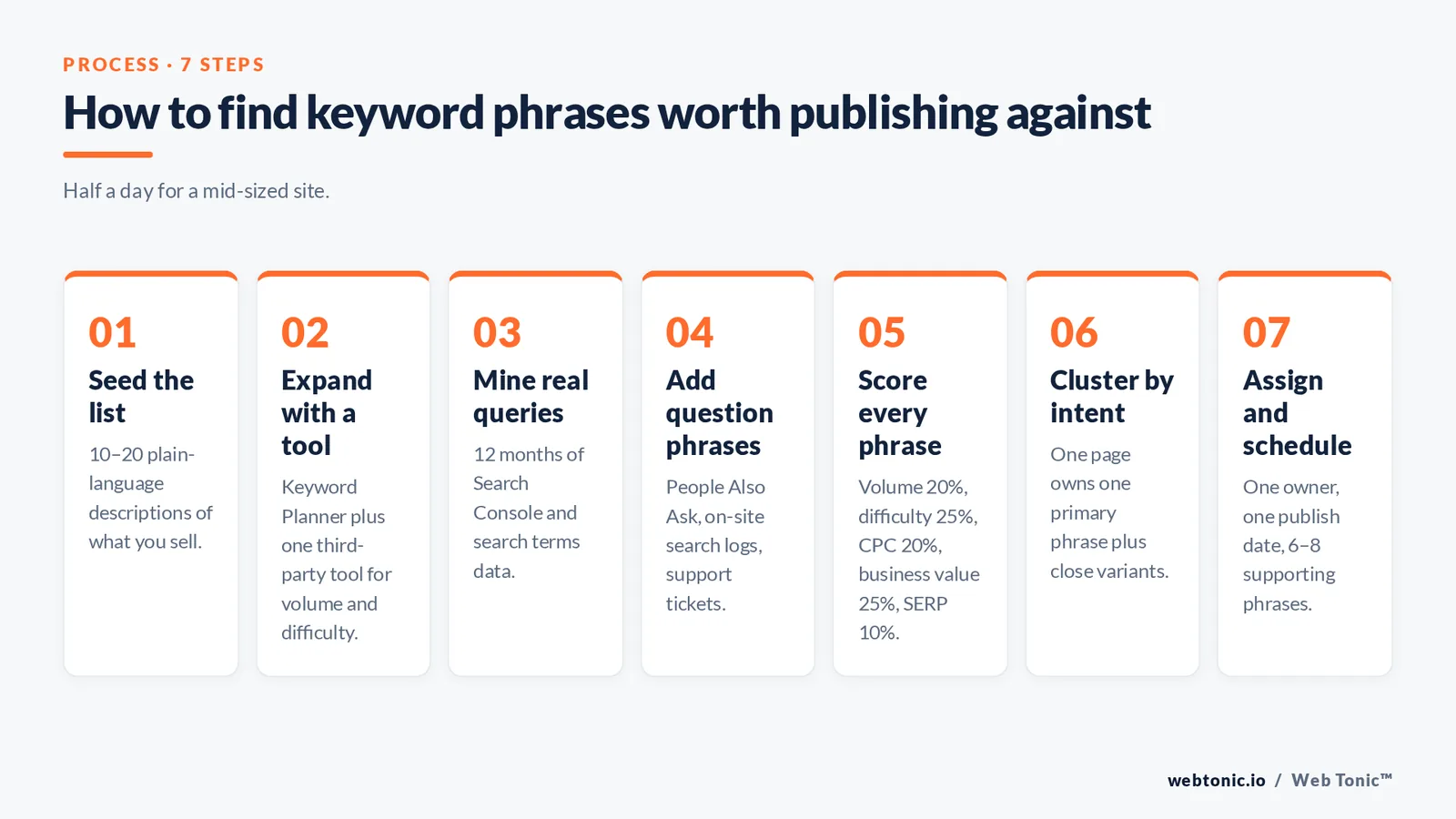
How to Find Keyword Phrases: A 7-Step Process
This is the sequence we run for every new site. It takes about half a day for a mid-sized business and produces a list you can actually publish against.
- Step 1 — Seed the list. Write 10–20 plain-language descriptions of what you sell, in your customers' words, not your internal product names.
- Step 2 — Expand with a research tool. Push each seed through Google Keyword Planner and one third-party tool to get raw volume and competition data.
- Step 3 — Mine real queries. Export 12 months of queries from Search Console and the Google Ads search terms report; these are terms you already earn impressions for.
- Step 4 — Add question terms. Pull People Also Ask, on-site search logs and support tickets. Question terms feed the FAQ blocks that win AI answer placements.
- Step 5 — Score every term on volume, difficulty, cost per click and business value. A $12 CPC term with 90 searches often beats a free-traffic term with 9,000.
- Step 6 — Cluster by intent so that one page owns one phrase plus its close variants. Merge anything that would produce two near-identical pages.
- Step 7 — Assign and schedule. One primary phrase, 6–8 supporting terms, one owner and one publish date per page.
| Scoring input | Where it comes from | Weight we use | Red flag |
|---|---|---|---|
| Monthly searches | Keyword Planner, third-party tool | 20% | Under 20 with no commercial angle |
| Keyword difficulty | Ahrefs, Semrush | 25% | Above 60 for a young domain |
| Cost per click | Keyword Planner | 20% | Under $0.50 in a B2B market |
| Business value | Sales team scoring 1–5 | 25% | Nobody can name the offer |
| SERP feasibility | Manual look at page 1 | 10% | All 10 results are marketplaces |
Free and Paid Keyword Phrase Tools Compared
You do not need an expensive stack to build a first list. You do need at least one source of volume data and one source of real queries. Ahrefs' guide to difficulty scoring is worth reading before you trust any single tool's score, because every vendor calculates it differently.
| Tool | Cost | Volume data | Best for | Main limit |
|---|---|---|---|---|
| Google Keyword Planner | Free with an Ads account | Ranged | Paid search planning | Groups close variants together |
| Google Search Console | Free | Actual impressions | Phrases you already rank for | Only your own site |
| Google Trends | Free | Relative index | Seasonality and rising terms | No absolute numbers |
| Semrush | Paid, mid tier | Estimated | Competitor phrase gaps | Cost at 3+ seats |
| Ahrefs | Paid, mid tier | Estimated + clicks | Difficulty and click potential | Credit limits on exports |
| Yoast or Rank Math | Free tier | None | On-page keyphrase checks | No research data |
Minimum viable stack: Keyword Planner plus Search Console covers 2 of the 3 jobs — volume and real queries — at zero cost. Add one paid tool when you need competitor gaps. For teams that want the whole picture in one dashboard, our data intelligence practice wires query data into reporting so nobody re-exports spreadsheets every month.

Keyword Match Types: How Phrases Behave in Google Ads
In query campaigns, the same phrase reaches wildly different audiences depending on its match type. Google's documentation on keyword match types is the reference; the table below is the working translation.
| Match type | Syntax | Phrase: running shoes | Will match | Won't match |
|---|---|---|---|---|
| Broad match | running shoes | Widest reach | buy trainers, jogging sneakers | Rarely blocks anything |
| Phrase targeting | "running shoes" | Meaning must be included | best running shoes for women | shoe repair near me |
| Exact match | [running shoes] | Same meaning only | shoes for running | running shoes for flat feet |
| Negative phrase | -"free running shoes" | Blocks a segment | n/a | Anything containing that phrase |
Structure rule: start a new search campaign with phrase match and exact match terms only, add broad match once you have at least 30 conversions to teach the bidding model, and review the search terms report every 14 days. Google's guidance on negative keywords explains the syntax differences that trip up most new accounts.
Where to Put Keyword Phrases On a Page
Placement matters more than density. Nielsen Norman Group's research on the F-shaped reading pattern shows readers scan the first words of headings and paragraphs, so a phrase buried in sentence four does nothing for a human even if a crawler finds it.
| Location | Use the primary phrase? | Guideline | Common mistake |
|---|---|---|---|
| Title tag | Yes, near the front | Keep under 60 characters | Brand name first |
| H1 | Yes, once | Natural phrasing, no stuffing | Two competing H1s |
| First 100 words | Yes, once | Inside a real sentence | Bolded fragment with no verb |
| H2 subheadings | Supporting phrases | 2–4 H2s carry variants | Same phrase in every H2 |
| URL slug | Yes, hyphenated | 3–5 words maximum | Changing it after ranking |
| Image alt text | Only where accurate | Describe the image first | Alt text as a target term dump |
| Meta description | Yes, once | 120–158 characters | Duplicated across pages |
Google's own advice on title links and Yoast's focus keyphrase documentation agree on the same point: one clear phrase per page, written for a reader.
5 Keyword Phrase Traps That Cost Traffic
Every one of these shows up in audits we run on sites that have been publishing for a year or more.
| Trap | What it looks like | Cost | Fix |
|---|---|---|---|
| Trap 1 — Keyword cannibalization | 3 pages targeting one phrase | All 3 rank below page 1 | Merge into 1 page, redirect the rest |
| Trap 2 — Volume chasing | Only phrases above 5,000 searches | 6–18 months with no rankings | Add 20 long tail phrases per quarter |
| Trap 3 — Stuffing | Exact phrase 25 times in 800 words | Unreadable page, no gain | Cap at 4–6 natural uses, add variants |
| Trap 4 — Intent mismatch | Blog post for a transactional phrase | Traffic that never converts | Match format to the top 5 results |
| Trap 5 — Set and forget | Research done once, 2 years ago | Whole clusters go stale | Re-score the list every 90 days |
Backlinko's long tail hub and Semrush's research walkthrough both make the same case for depth over volume. If you want a second pair of eyes on your list, talk to us or browse more playbooks on the Web Tonic blog.

FAQ
How many words should a target term phrase be?
Most useful phrases are 3 to 5 words. Two words is usually too broad to win, and beyond about 7 words the phrase gets so rare that a single page cannot justify targeting it on its own — fold those into an FAQ answer instead.
What is the difference between a target term and a keyphrase?
A target term can be a single word; a keyphrase is always 2 or more words. In practice the industry uses "keyword" as the umbrella term for both, which is why tools list "shoes" and "running shoes for flat feet" side by side in the same report.
Should every page have a keyword phrase?
Every page that is meant to attract search traffic should own exactly one primary phrase. Utility pages such as checkout, thank-you screens and internal search results should not be assigned a phrase at all, and are usually better left out of the index.
How do I know if a keyword phrase is too competitive?
Look at page one manually. If every one of the top 10 results is a major brand, a marketplace or a page with hundreds of referring domains, pick a more specific version of the phrase. Difficulty scores are a shortcut, not a verdict.
Do phrases still matter for AI search results?
Yes, and question-shaped phrases matter more than before. AI answers are assembled from passages that clearly resolve a specific question, so pages with direct 40-to-60-word answers under a matching heading are the ones that get quoted.
Sources
Google Search Central — creating helpful content; title links · Google Search Console Help — performance report · Google Ads Help — keyword match types; negative keywords; Keyword Planner · Google Trends · Ahrefs — long tail keywords; keyword difficulty · Semrush — keyword research · Moz — beginner's guide to keyword research · Yoast — focus keyphrase · Backlinko — long tail keywords hub · Nielsen Norman Group — F-shaped reading pattern. All sources accessed August 2026.