Table of contents
Inbound marketing earns attention with content people choose to consume, instead of buying interruptions. The 20 examples below are grouped by the mechanism that makes each one work, so you can copy the mechanism rather than the surface idea.
Key Takeaways
- All 20 examples fall into 6 mechanisms: search assets, free tools, community, data stories, education and product-led content.
- Free tools and templates convert best because the user gets a result before a sales conversation starts.
- The compounding asset beats the campaign — a search-driven page can generate leads for 5 years; a burst campaign lasts 3 weeks.
- Inbound is slower to start: expect 6–9 months before organic content carries a meaningful share of pipeline.
- Measure 4 numbers per asset: traffic, assisted conversions, cost per lead and sales-qualified rate.
- Small companies win with 1 unmistakable asset, not 12 mediocre channels.
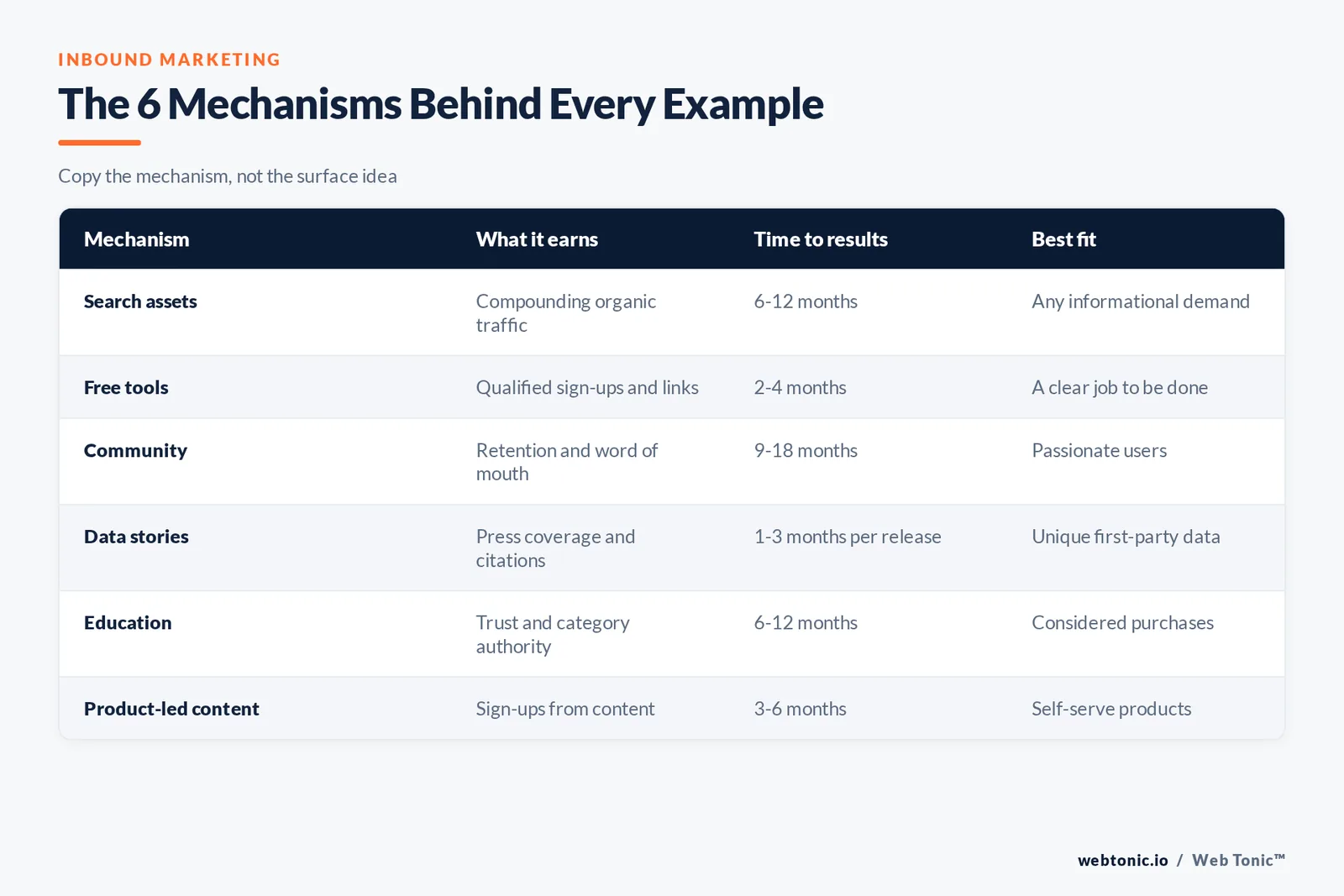
The 6 mechanisms behind every example
6 mechanisms, 20 examples, 13 comparison tables. Before the list, the map. Inbound marketing works when content answers a real question well enough that someone chooses it over an alternative. That is the only thing these campaigns share, and it is why copying a tactic without the mechanism fails.
| Mechanism | What it earns | Time to results | Best fit |
|---|---|---|---|
| Search assets | Compounding organic traffic | 6–12 months | Any business with informational demand |
| Free tools | Qualified sign-ups and links | 2–4 months | Software and services with a clear job to be done |
| Community | Retention and word of mouth | 9–18 months | Brands with passionate users |
| Data stories | Press coverage and citations | 1–3 months per release | Companies sitting on unique data |
| Education | Trust and category authority | 6–12 months | Complex or considered purchases |
| Product-led content | Sign-ups straight from content | 3–6 months | Self-serve products with templates or presets |
Examples 1–4: search assets that compound
The oldest and least glamorous mechanism is still the strongest. Examples 1 to 4 all took over 12 months to reach scale. A page that answers a question a search engine sends people to every month becomes a permanent acquisition channel, and Google's own guidance on creating helpful content is effectively an inbound brief.
| Example | The asset | Why it works | Copy this |
|---|---|---|---|
| Example 1 — HubSpot blog and glossary | Thousands of definitional and how-to pages | Owns the vocabulary buyers search before they buy | Publish a page per term your buyers use |
| Example 2 — Mailchimp benchmark library | Email marketing benchmarks by industry | Answers "is my open rate normal" with first-party data | Turn your aggregate data into a reference page |
| Example 3 — Moz Whiteboard Friday | A weekly video plus transcript | One recording feeds SEO, video and newsletter | Record once, publish in 3 formats |
| Example 4 — REI Expert Advice | Gear and skills guides for outdoor activities | Captures research demand upstream of the purchase | Write the guide your product is the answer to |
Mechanism note 1 — a single evergreen page can outperform a 6-week paid burst over a 3-year window, because the cost is paid once. WordStream's own round-up reaches a similar conclusion from the PPC side of the fence: paid buys reach, content buys equity.
Examples 5–8: free tools and templates
A free tool converts better than an article because the visitor finishes with something. All 4 examples below hand over a usable result in under 60 seconds. It is also the cheapest link-building mechanism in existence — people cite tools they use.
| Example | The asset | Conversion path | Copy this |
|---|---|---|---|
| Example 5 — Canva templates | Editable designs for every format | Template use leads into the editor and a paid tier | Give away the starting point, sell the finish |
| Example 6 — Notion template gallery | User-built workspace templates | Duplicating a template creates an account | Let users publish assets for you |
| Example 7 — Grammarly free checker | Instant writing feedback in the browser | Free corrections, paid suggestions | Show the problem, charge for the full fix |
| Example 8 — Zapier automation recipes | Pre-built app-to-app workflows | Each recipe page ranks for two product names | Build one page per integration pair |
Mechanism note 2 — tools typically convert visitors to sign-ups at several times the rate of a blog post, which is why the pattern is worth engineering budget rather than editorial budget. Track it with a clean funnel definition, whether you use Analytics conversion events or your own warehouse, and read a strict conversion-rate definition before you compare two numbers.
Examples 9–12: community and user-generated content
Community assets take 9 to 18 months to compound. Community is the slowest mechanism to build and the hardest to copy, which is exactly why it defends a brand so well. The content is produced by customers, so the marginal cost falls as the audience grows.
| Example | The asset | Why it works | Copy this |
|---|---|---|---|
| Example 9 — GoPro user footage | Customer video reposted across social media | The product demo is made by the buyer | Make submission and credit effortless |
| Example 10 — LEGO Ideas | Fan-submitted sets voted into production | Participation, then ownership, then advocacy | Let the audience decide something real |
| Example 11 — Airbnb host and neighbourhood stories | Local guides and host profiles | Supply-side stories market the demand side | Profile the people who make your product work |
| Example 12 — Patagonia Worn Wear | Repair guides and resale stories | Values content that a competitor cannot fake | Publish the thing that costs you a sale |
If your programme involves creators or incentivised posts, the disclosure rules are not optional — the FTC's endorsement guidance covers what has to be said and by whom. Mechanism note 3 — user-generated content scales with the size of the audience, so the first 12 months are the hard part.

Examples 13–16: data stories that earn coverage
If your company sits on data nobody else has, the most efficient marketing campaigns you will ever run are the ones that publish it. Journalists link to primary sources, and those links pull organic rankings up behind them.
| Example | The asset | Why it works | Copy this |
|---|---|---|---|
| Example 13 — Spotify Wrapped | Personalised annual listening recap | Every user becomes a distributor of a share image | Give each customer their own version of your data |
| Example 14 — Pew Research style fact sheets | Updated reference data on one topic | Becomes the citation everyone reuses | Maintain one page instead of publishing ten |
| Example 15 — DataReportal global reports | Recurring free digital-adoption reports | A predictable release cycle trains an audience | Commit to a cadence, not a one-off |
| Example 16 — John Deere's The Furrow | A farming magazine first published in 1895 | Content marketing predates the internet by a century | Serve the customer's job, not the product |
Examples 17–20: education and product-led content
Examples 17 to 20 trade speed for a 3-year payback. Certification and course content converts on a longer horizon: the learner adopts your vocabulary, and vocabulary decides which product feels obvious later.
| Example | The asset | Why it works | Copy this |
|---|---|---|---|
| Example 17 — Google Skillshop and Analytics Academy | Free certification on its own products | Trained practitioners recommend what they know | Certify the people who influence purchases |
| Example 18 — Duolingo short-form video | Character-led clips on Instagram and TikTok | Entertainment first, product second | Give the brand a character, not a slogan |
| Example 19 — Ahrefs and Semrush video academies | Tutorials that teach the workflow | Teaching the task sells the tool that performs it | Film the workflow, mention the product once |
| Example 20 — Michelin Guide | Restaurant ratings from a tyre company | Encourages the behaviour that consumes the product | Sponsor the behaviour, not the transaction |
Mechanism note 4 — education assets take 2–3 years to mature but rarely need replacing, and they are the cheapest way to build the trust that a considered purchase requires.
Inbound versus outbound marketing, side by side
Inbound and outbound marketing are not rivals; they price differently. Outbound buys attention on demand, inbound builds a stock of it. Most healthy programmes run both, with paid search and social buying the speed that content cannot.
| Dimension | Inbound marketing | Outbound marketing |
|---|---|---|
| Trigger | The prospect searches or subscribes | You interrupt with an ad, call or email |
| Cost curve | High upfront, falls per lead over time | Flat to rising with auction pressure |
| Speed | 6–9 months to traction | Leads within 48 hours |
| Ceiling | Limited by category search demand | Limited by budget only |
| Asset value | Content keeps working when spend stops | Traffic stops the day spend stops |
| Best role | Compounding base of qualified demand | Launches, seasonality, testing offers |
Which examples suit which business
The right starting mechanism depends on your sales motion far more than your industry. A business with a 90-day sales cycle needs different content from one selling a $40 product.
| Business type | Start with | Skip at first | First asset to build |
|---|---|---|---|
| Local service business | Search assets and reviews | Podcasts, certification | One page per service and city |
| B2B SaaS | Free tools plus education | Broad brand video | A calculator for the buyer's core metric |
| Ecommerce brand | User-generated content and buying guides | Long whitepapers | A comparison guide for your top category |
| Professional services | Data stories and thought leadership | Short-form entertainment | An annual benchmark report |
| Marketplace | Supply-side stories and local guides | Gated ebooks | Profiles of your best suppliers |
| Enterprise | Certification and community | Trend-chasing social | A free course for practitioners |

Buyer personas and the content that matches each stage
Every example above sits at a stage of the funnel. Map your buyer personas against the three stages and the gaps are usually obvious: most companies over-invest in awareness content and starve the decision stage.
| Stage | What the potential customer wants | Content format | Primary CTA |
|---|---|---|---|
| Awareness | To name the problem | Explainers, short video, social posts | Subscribe |
| Consideration | To compare approaches | Comparison guides, calculators, webinars | Use the free tool |
| Decision | Proof it works for them | Case studies, pricing pages, demos | Book a call |
| Onboarding | A fast first result | Templates, checklists, email sequences | Complete setup |
| Advocacy | Recognition and belonging | Community, user spotlights, certification | Share your result |
Channel mix: how these examples get distributed
An asset without distribution is a filing cabinet. Each mechanism has a natural distribution channel, and the mismatch between the two is the most common reason a good piece of content marketing underperforms.
| Channel | Best asset type | Realistic role | Watch out for |
|---|---|---|---|
| Organic search | Evergreen guides and tool pages | The compounding base | 6–12 month lag before payback |
| Email marketing | Data releases, new templates | Highest-converting owned channel | List decay of roughly 20% a year |
| Organic social media | Short video and user content | Discovery and brand character | Reach volatility between platforms |
| Paid amplification | Your 3 best-performing assets only | Speed and testing | Promoting weak content faster |
| Communities and forums | Tools and original data | Credibility with practitioners | Self-promotion rules |
| Partnerships | Co-authored research | Borrowed audience | Diluted brand attribution |
Reader behaviour sets the ceiling on all of it: people scan rather than read online, so front-load the answer in every format. Broader adoption context — how many people are reachable at all — is tracked in long-run internet adoption data from Our World in Data and the ITU's connectivity statistics.
Measuring inbound: the 6 numbers worth reporting
Report 6 metrics, not 30. Anything else is a diagnostic, not a result. Our data intelligence team builds this reporting layer first, because a programme that cannot see its assisted conversions will always look worse than it is.
| Metric | What it tells you | Healthy direction |
|---|---|---|
| Metric 1 — organic entrances per asset | Whether the asset found demand | Up over 2 quarters |
| Metric 2 — assisted conversions | Content's role in closed deals | Rising share of total |
| Metric 3 — cost per lead by mechanism | Where to add budget | Falling for the top 3 assets |
| Metric 4 — sales-qualified rate | Lead quality, not lead count | Above your paid baseline |
| Metric 5 — email list growth net of churn | Owned audience health | Positive every month |
| Metric 6 — referring domains earned | Whether the asset is citable | New domains per release |
5 traps that sink an inbound programme
Most failures are structural, not creative. 4 of these 5 traps are budget or process decisions, not content problems. These are the ones we see most often when a company says content did not work for them.
| Trap | Symptom | Fix |
|---|---|---|
| Trap 1 — quitting at month 4 | Budget pulled before compounding starts | Commit 9 months or do not start |
| Trap 2 — 12 channels, no depth | Weak presence everywhere | Pick 2 channels and over-invest |
| Trap 3 — gating everything | High form counts, low sales acceptance | Gate 1 asset in 5, at most |
| Trap 4 — no distribution plan | Publishing is the last step | Budget 50% of effort to distribution |
| Trap 5 — copying the surface | A Wrapped clone with no personal data | Copy the mechanism, not the format |
A 90-day plan to launch your first example
Pick one mechanism and ship one asset properly. This is the sequence we run with new clients through our growth marketing engagements, and it deliberately puts distribution in the plan before the second asset is written.
| Phase | Days | Work | Output |
|---|---|---|---|
| Phase 1 — evidence | Days 1–15 | Interview 5 customers, pull search demand | A ranked list of 10 questions |
| Phase 2 — pick the mechanism | Days 16–25 | Match questions to the 6 mechanisms | One chosen asset and its CTA |
| Phase 3 — build | Days 26–60 | Produce the asset and its tracking | Published page plus events firing |
| Phase 4 — distribute | Days 61–80 | Email, social, outreach, light paid test | First 20 referring domains |
| Phase 5 — read and decide | Days 81–90 | Review the 6 metrics | Scale, iterate or switch mechanism |

Fact 1 — 1 finished asset with distribution beats 8 half-finished pages. Fact 2 — the second asset should reuse the first one's audience, not start from zero. Fact 3 — a 90-day cycle is long enough to learn and short enough to defend internally. Frameworks from HubSpot's inbound overview and VWO's inbound primer are useful checklists once you have picked a mechanism; more teardowns live on the Web Tonic blog, and if you want ours applied to your own funnel, get in touch.
FAQ
What is the best inbound marketing example to copy first?
A free tool or template tied to your core offer, because it converts faster than an article and earns links without outreach. If you cannot build one, publish the single guide your buyers search for most and make it the best answer available. One finished asset beats six thin ones.
How long before inbound marketing produces leads?
Tools and templates can generate sign-ups within 2–4 months. Search-driven content usually needs 6–9 months before it carries a meaningful share of pipeline, and 12 months to compound properly. Budget for that window explicitly, or the programme gets cancelled just as it starts working.
Is inbound marketing cheaper than paid advertising?
Per lead, usually yes over a multi-year horizon, because the asset keeps working after production is paid for. Upfront it is more expensive and much slower. The practical answer for most companies is both: paid for speed and testing, inbound for the compounding base.
Do small businesses need buyer personas for this?
You need to know the questions your buyers ask and where they ask them — a documented persona is one way to record that. Five customer interviews will get you further than a template filled in from assumptions, and they surface the exact wording to use in headlines and CTAs.
How do I measure inbound marketing without a big analytics setup?
Track entrances per asset, form or sign-up conversions, sales-qualified rate and referring domains earned. Four numbers, one spreadsheet, reviewed monthly. Add assisted conversions once you can see multi-touch paths, since single-touch attribution consistently under-credits content.
Sources
Google Search Central — helpful content guidance · Google Analytics Help — conversion events · HubSpot — inbound marketing overview · VWO — inbound marketing primer · WordStream — inbound marketing examples · Mailchimp — email marketing benchmarks · Pew Research Center — social media fact sheet · DataReportal — global social media users · Spotify Newsroom · Airbnb Newsroom · Nielsen Norman Group — how users read on the web · FTC — endorsement guides FAQ · Our World in Data and ITU — internet adoption. Timeframes and ranges reflect Web Tonic client programmes, not vendor benchmarks.