Table of contents
A sales promotion is a short-term offer designed to pull a purchase decision forward. Below are 30 sales promotion examples grouped by the job each one does, with the mechanics, the margin cost and the situation where it works.
Key Takeaways
- Baymard Institute's roll-up of 50 studies puts the average documented cart abandonment rate at 70.22%.
- Extra costs such as shipping, tax and fees are the single biggest fixable abandonment reason at 40% — which is why free shipping outperforms most discounts.
- 42% of US online shoppers abandon a cart simply because they were browsing, so urgency mechanics matter more than depth of discount.
- A 20% discount on a product carrying a 50% gross margin costs you 40% of the profit on every unit sold.
- The 6 promotion families below — price cuts, value-adds, urgency, loyalty, acquisition and partner offers — cover almost every campaign you will run.
- A promotion needs a defined start date, end date and success metric before launch; 3 numbers decide whether it worked: incremental units, blended margin, and repeat rate at 90 days.
What a sales promotion actually is (and what it is not)
A sales promotion is a time-boxed incentive layered on top of your normal offer to change buyer behaviour inside a defined window. That definition carries three obligations: it must be temporary, it must be incentivised, and it must target a behaviour you can name. "Run a discount" is not a promotion. "Cut the trial-to-paid friction for lapsed accounts during the last two weeks of the quarter" is.
Promotions are distinct from pricing strategy. A permanent price cut resets what customers believe your product is worth. A promotion borrows demand from the future in exchange for volume, cash flow or trial today. That borrowing is the real cost, and it is why classical marketing theory separates promotion from the other three Ps of product, price and place. Confuse the two and you train customers to wait.
Retail spending is also seasonal in ways that decide when a promotion lands. The US Census Bureau's monthly retail trade series is the free way to check whether your category is already in an up-cycle — promoting into a peak amplifies it, while promoting into a trough usually just discounts demand you would have captured anyway.
The 6 sales promotion families at a glance
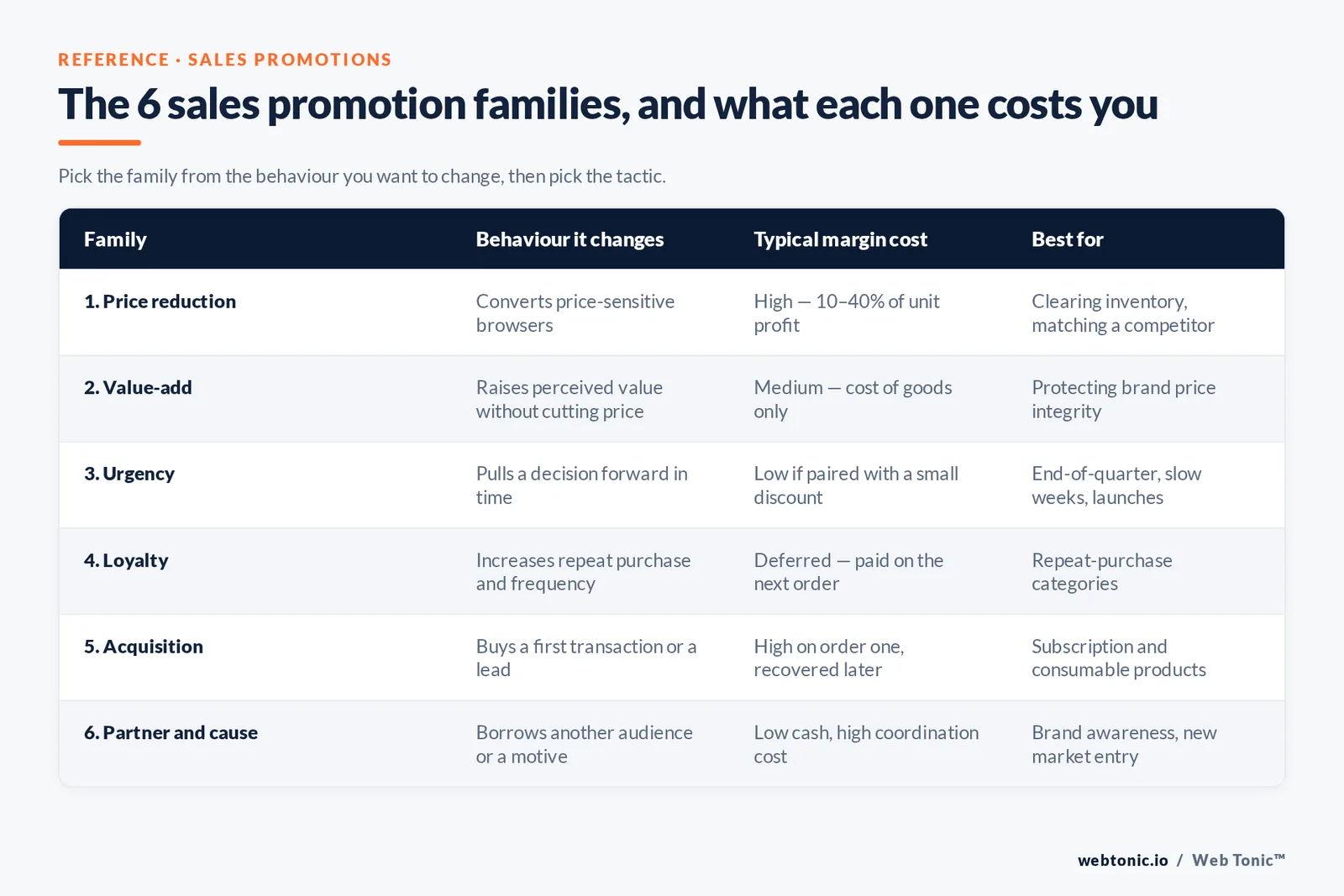
Every promotion example further down belongs to one of these six families. Pick the family from the behaviour you want to change, then pick the tactic.
| Family | Behaviour it changes | Typical margin cost | Best for |
|---|---|---|---|
| 1. Price reduction | Converts price-sensitive browsers | High — 10–40% of unit profit | Clearing inventory, matching a competitor |
| 2. Value-add | Raises perceived value without cutting price | Medium — cost of goods only | Protecting brand price integrity |
| 3. Urgency | Pulls a decision forward in time | Low if paired with a small discount | End-of-quarter, slow weeks, launches |
| 4. Loyalty | Increases repeat purchase and frequency | Deferred — paid on the next order | Repeat-purchase categories |
| 5. Acquisition | Buys a first transaction or a lead | High on order one, recovered later | Subscription and consumable products |
| 6. Partner and cause | Borrows another audience or a motive | Low cash cost, high coordination cost | Brand awareness, new market entry |
30 sales promotion examples that still work
Each example below is written as you would brief it. The "why it works" column is the behavioural mechanic, not a slogan — copy the mechanic, not the wording.
| Promotion example | Family | How to run it | Why it works |
|---|---|---|---|
| 1. Percentage-off sale | Price | 15–25% sitewide for 72 hours | Simple to compute; the reference price does the persuading |
| 2. Dollar-off threshold | Price | $20 off orders over $100 | Lifts average order value instead of just cutting price |
| 3. BOGO | Value-add | Buy one, get one free or half price | Feels like 100% off the second unit but costs one COGS |
| 4. Free shipping | Value-add | Unconditional, or above a threshold | Removes the 40% abandonment driver directly |
| 5. Free gift with purchase | Value-add | Add a sample or accessory over a spend line | Keeps headline price intact; seeds trial of a second SKU |
| 6. Flash sale | Urgency | 4–24 hours, announced by email and SMS | Compresses the decision window; scarcity is time, not stock |
| 7. Limited-time offer countdown | Urgency | On-site timer with a real deadline | Makes the deadline visible at the point of hesitation |
| 8. Limited-quantity drop | Urgency | "Only 200 units at this price" | Scarcity of units, verifiable and honest |
| 9. Early-bird pricing | Urgency | Lowest tier for the first 7 days of a launch | Rewards speed and front-loads launch revenue data |
| 10. Punch-card loyalty | Loyalty | Buy 9, get the 10th free | Goal-gradient effect: effort already spent pulls the finish |
| 11. Points programme | Loyalty | 1 point per $1, redeemable at 500 | Turns discount into a deferred, partially unredeemed liability |
| 12. VIP tier | Loyalty | Early access and free returns above $500 a year | Status beats savings for the top 10% of spenders |
| 13. Win-back offer | Loyalty | 15% for customers inactive 120+ days | Targets a segment where the alternative is zero revenue |
| 14. Referral credit | Acquisition | $20 for you, $20 for a friend | Pays only on a completed acquisition; two-sided |
| 15. First-order discount | Acquisition | 10% for the email or SMS opt-in | Buys a first purchase and a marketing channel at once |
| 16. Free trial or sample | Acquisition | 14 days free, or a sachet in every order | Removes risk when the product proves itself in use |
| 17. Bundle pricing | Value-add | 3 items for the price of 2.5 | Raises units per order and hides the per-item price |
| 18. Subscribe-and-save | Loyalty | 10–15% off for a recurring order | Trades margin for predictable lifetime value |
| 19. Coupon code by segment | Price | Unique codes per list segment | Discounts only the people who need one to convert |
| 20. Cart abandonment offer | Urgency | Reminder at 1 hour, incentive at 24 hours | Reaches a buyer with proven intent, cheaply |
| 21. Seasonal sale | Price | Back-to-school, Black Friday, end of season | Rides demand the calendar already created |
| 22. Clearance markdown ladder | Price | 20%, then 40%, then 60% weekly | Finds the clearing price without dumping inventory |
| 23. Contest or giveaway | Acquisition | Entry by email plus a social share | Cost is one prize; output is reach and list growth |
| 24. User-generated content reward | Loyalty | Store credit for a photo review | Buys social proof and a repeat visit in one action |
| 25. Trade-in or upgrade credit | Acquisition | Credit for returning the old unit | Removes the sunk-cost objection on durable goods |
| 26. Financing or split payment | Value-add | 4 interest-free instalments | Changes the perceived price without changing the price |
| 27. Charitable tie-in | Cause | $5 per order to a named cause | Gives a reason to buy now that is not a discount |
| 28. Co-marketing bundle | Partner | Joint offer with a non-competing brand | Borrows a warm audience at zero media cost |
| 29. Local event or pop-up offer | Partner | In-store-only code tied to an event | Drives measurable footfall and local search demand |
| 30. B2B pilot pricing | Acquisition | 90-day paid pilot at a reduced rate | Gives the sales team a deadline the buyer accepts |
Why free shipping beats a discount in most carts
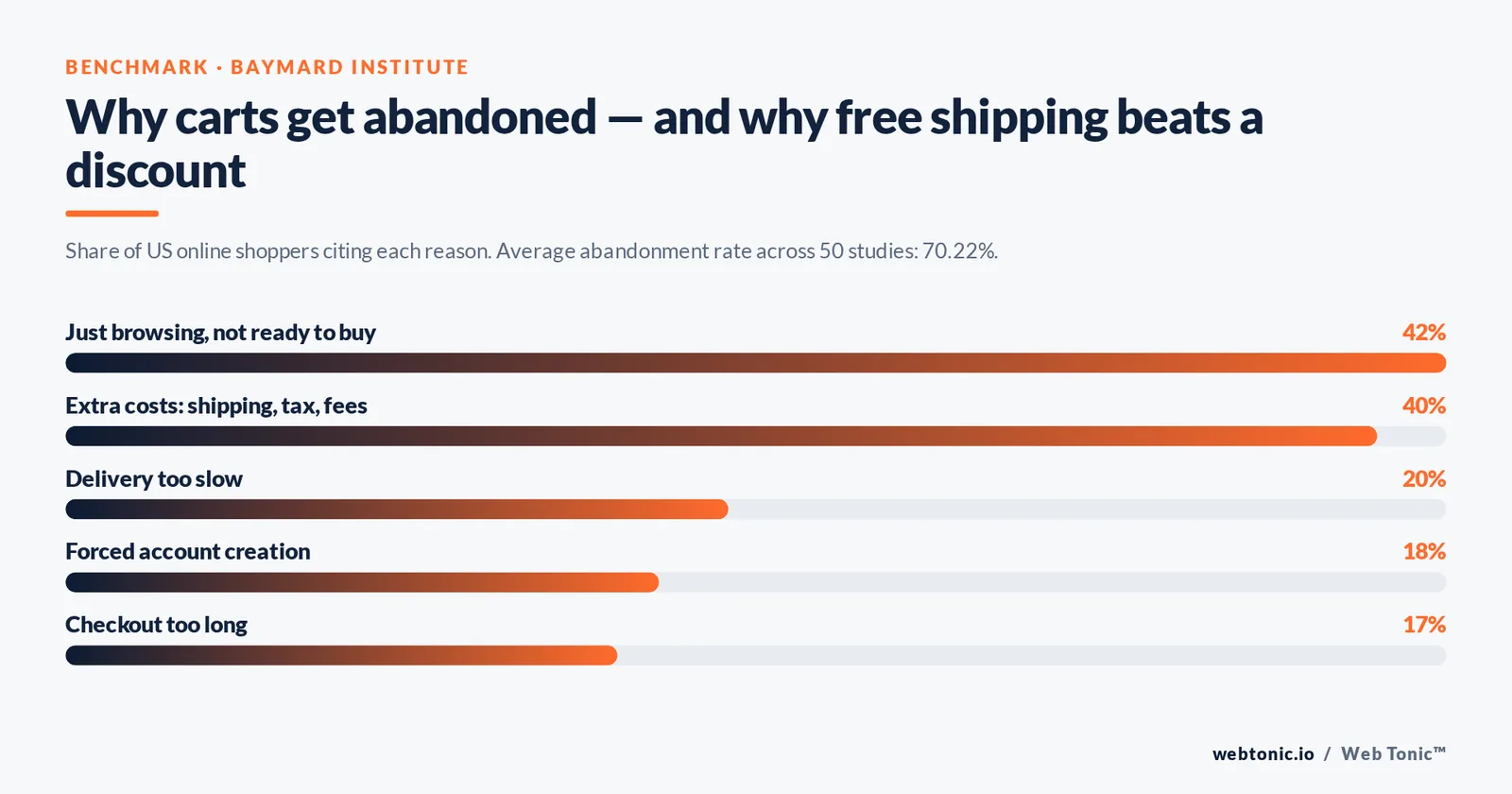
Baymard Institute's ongoing checkout research is the clearest argument for choosing a value-add over a price cut in ecommerce. Its aggregation of 50 abandonment studies lands on an average rate of 70.22%, and when the "just browsing" group is set aside, the leading reason for abandonment is extra costs at 40%, ahead of slow delivery at 20% and forced account creation at 18%.
That distribution tells you where the money is. A 10% discount reduces the total the shopper sees but leaves the surprise shipping line intact; free shipping deletes the surprise entirely. It is also usually cheaper: on a $90 order with a $7 shipping cost, free shipping costs 7.8% of revenue against the 10% the discount would take, and it removes the objection the shopper actually named.
The same logic applies to the 17% who abandon because the checkout is too long. If a design fix removes the objection, spend there before you spend margin. Promotions should not be used to paper over a broken funnel — that is a job for the checkout and site build, not the discount calendar.
Sales promotion examples by business type
The same tactic behaves very differently depending on margin structure and purchase frequency. This table maps the promotions above to business models.
| Business type | Best two promotions | Avoid | Success metric |
|---|---|---|---|
| Ecommerce, low AOV | Free shipping threshold; bundle pricing | Deep sitewide percentage cuts | Average order value, contribution margin |
| Ecommerce, high AOV | Split payments; free gift with purchase | Frequent flash sales that reset price anchors | Conversion rate, return rate |
| Subscription / SaaS | Free trial; annual prepay discount | Permanent monthly coupons | Trial-to-paid rate, 12-month retention |
| Local service business | First-visit offer; referral credit | Daily-deal marketplaces | Booked jobs, repeat within 12 months |
| Restaurant / hospitality | Punch-card loyalty; off-peak hour pricing | Blanket weekend discounts | Covers per shift, visit frequency |
| B2B services | Paid pilot; bundled onboarding at no cost | Public list-price discounting | Pipeline velocity, pilot-to-contract rate |
| Consumable retail | Subscribe-and-save; BOGO | Points schemes nobody redeems | Purchase frequency, share of wallet |
How to design a promotion in 7 steps
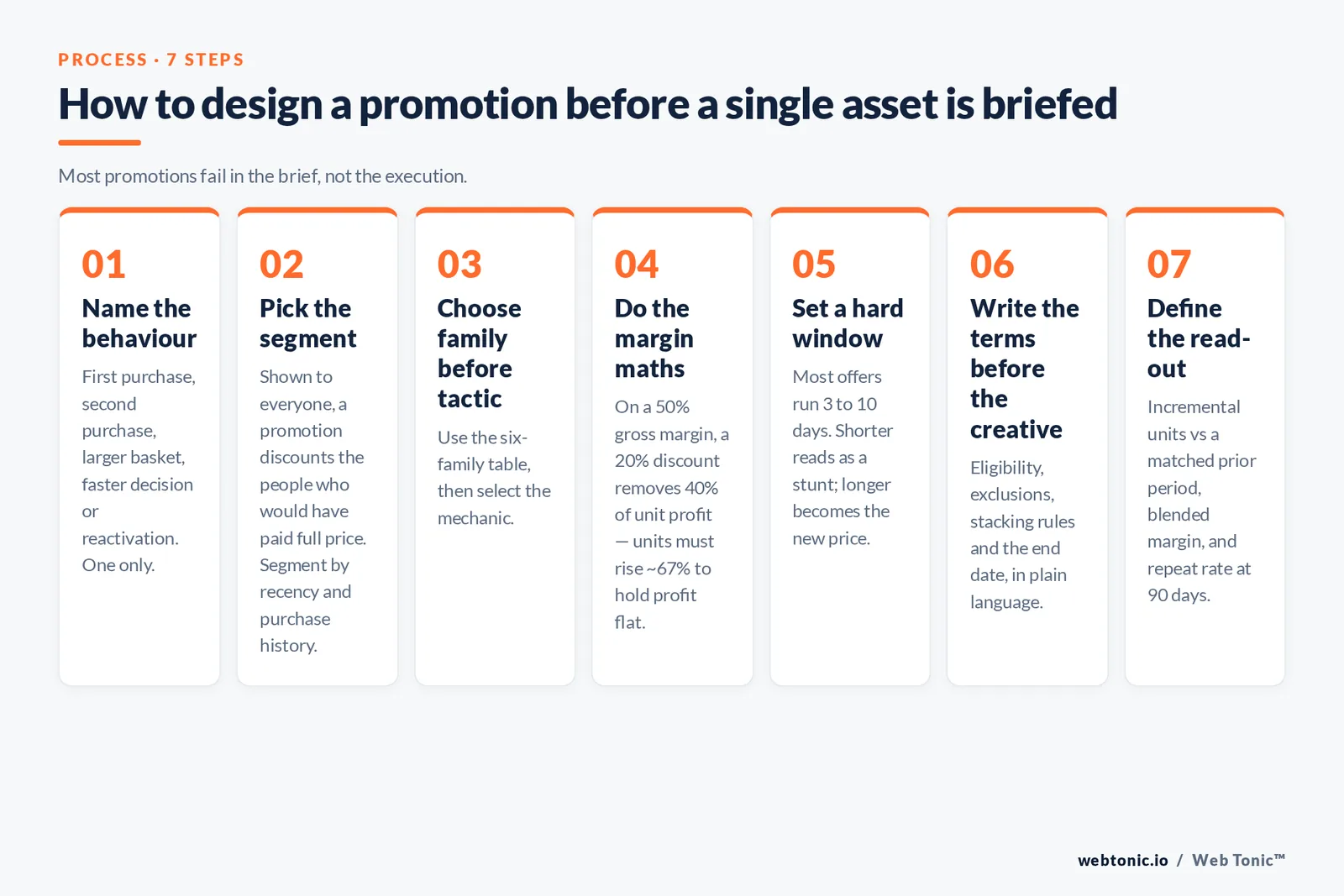
Most promotions fail in the brief, not the execution. Work through these in order before a single asset is designed.
- Step 1 — Name the behaviour. First purchase, second purchase, larger basket, faster decision, or reactivation. One only.
- Step 2 — Pick the segment. A promotion shown to everyone discounts the people who would have paid full price. Segment by recency and purchase history first.
- Step 3 — Choose family before tactic. Use the six-family table above; only then select the mechanic.
- Step 4 — Do the margin maths. On a 50% gross margin, a 20% discount removes 40% of unit profit, so you need units to rise about 67% just to hold profit flat.
- Step 5 — Set a hard window. Most offers should run 3 to 10 days. Shorter reads as a stunt; longer becomes the new price.
- Step 6 — Write the terms before the creative. Eligibility, exclusions, stacking rules and the end date, in plain language.
- Step 7 — Define the read-out. Incremental units versus a matched prior period, blended margin, and repeat rate at 90 days.
The US Small Business Administration's marketing guidance makes the same point in blunter terms: a promotion is part of a marketing plan with a budget and a measurement step, not an improvised reaction to a slow month. If you need help wiring that measurement into the campaign, that is exactly what a data intelligence setup is for.
Promoting the promotion: channels that carry the offer
An offer nobody sees is a margin giveaway to people who were already buying. Email and SMS carry the highest-intent audience because they opted in; retention platform benchmarks consistently show owned channels outperforming paid for promotional revenue per send. Paid social and search extend reach but change the economics, because you are now paying media on top of discounted margin.
Sequence matters more than volume. A workable pattern for a 5-day offer is: announce on day 1 to the full list, remind non-openers on day 2, target cart abandoners on day 3, run a "closing" send on day 4, and send a final 6-hour warning on day 5. That is 4 to 5 touches, which is the point at which most lists start unsubscribing if the offer is not genuinely relevant.
Creative carries as much weight as the discount itself. The offer, the deadline and the code should be legible in the first frame of every asset — a rule that applies equally to a paid social ad and a shelf sign. That is standard practice in performance creative work, and it is the cheapest lift available on a promotion that is already funded.
The legal and brand guardrails
Reference pricing is the most common way a promotion becomes a problem. The FTC's advertising and marketing guidance requires that a claimed former price be a genuine, recent selling price rather than a fictitious anchor, and its enforcement announcements regularly cover deceptive discount and negative-option claims. "Was $199, now $99" is only defensible if the product actually sold at $199.
Three more guardrails are worth writing into every brief. First, disclose the material conditions where the offer appears, not only on a terms page. Second, honour the advertised end time exactly — extending a "final hours" sale teaches your list that deadlines are fake. Third, cap the discount frequency: a brand that promotes more than about 4 times a quarter has effectively repriced itself, and the analysis in Harvard Business Review's sales and marketing library on discount dependence is the standard cautionary reading here.
How to measure whether a promotion worked
Revenue during a promotion always looks good, because it includes customers who would have bought anyway. The number that matters is incrementality: units above a matched baseline period, adjusted for seasonality. Pull the baseline from the same weekday range in the prior four weeks and, for seasonal categories, sense-check it against the wider online shopping trend data so you do not credit a promotion for a calendar effect.
Then run three checks at 90 days. Did discounted buyers come back at a similar rate to full-price buyers, or did you buy one-time deal seekers? Did average order value on the next purchase hold? Did full-price sales dip in the two weeks after the offer, which would indicate you pulled demand forward rather than creating it? A promotion that scores well on all three is repeatable; one that fails the third is a cash-flow tool, not a growth tool. Broader consumer-behaviour tracking from Nielsen's insights library is useful context when your own sample is small.
FAQ
What are the most common types of sales promotions?
Percentage discounts, dollar-off thresholds, BOGO, free shipping, free gift with purchase, flash sales, coupons, loyalty points, referral credits and contests account for the large majority of live promotions. They sort into six families — price reduction, value-add, urgency, loyalty, acquisition, and partner or cause offers — and choosing the family before the tactic prevents the common mistake of defaulting to a discount for every objective.
How long should a sales promotion last?
Three to ten days for most offers. Under 24 hours works only for flash sales to a warm list that checks email daily. Anything past two weeks stops reading as an event and starts resetting the price customers expect, and it makes the incrementality read-out harder because the baseline period drifts. Set the end date before launch and do not extend it.
What are the best sales promotion ideas for a small business on a limited budget?
Referral credits, free gift with purchase using existing stock, punch-card loyalty, off-peak pricing and a co-marketing bundle with a non-competing local business. All five cost little or no cash up front and pay out only when a sale happens. Avoid deep sitewide discounts, which cost real margin on every unit including the ones that needed no incentive.
Do sales promotions damage a brand?
Frequency does the damage, not the promotion itself. Predictable, repeated discounting teaches customers to wait for the next sale, and the waiting period becomes the new normal price. Keeping promotions to roughly four events a quarter, varying the mechanic rather than always cutting price, and leaning on value-adds such as free shipping or bundles protects the price anchor.
How do I know if a promotion was profitable?
Compare units sold against a matched baseline from the same weekdays in the prior four weeks, subtract the discount and any incremental media cost to get blended contribution margin, then check the 90-day repeat rate of promotion buyers against full-price buyers. If margin is positive and repeat behaviour matches, it worked. If the following two weeks show a dip in full-price sales, you moved demand rather than creating it.
Sources
Baymard Institute, cart abandonment rate list — 50 studies, 70.22% average, 40% extra costs, 20% slow delivery, 18% forced account creation, 17% long checkout, 42% just browsing · US Census Bureau, Monthly Retail Trade · US Small Business Administration, marketing and sales guidance · Federal Trade Commission, advertising and marketing business guidance and press releases · Harvard Business Review, sales and marketing topic library · Statista, online shopping topic data · Nielsen insights library · Klaviyo blog, retention and owned-channel benchmarks · Shopify, sales promotion guide · Wikipedia, sales promotion overview. All sources accessed August 2026.