Table of contents
A single bad review can sit on your Google business profile for years, shaping every customer's first impression before they've even walked through your door or opened your website. Business owners searching for how to remove a Google review are almost always hoping for a delete button. There isn't one. Only Google itself can take a review down, and only if it breaks one of Google's own content rules.
This guide walks through what's actually removable, how to flag a negative review step by step in 2026, what happens after you report it, and what to do with the honest, unflattering feedback that isn't going anywhere. That last part matters as much as the removal process itself. Most online reviews business owners want gone are protected, not because Google is being difficult, but because that's the entire point of a review system.
Key Takeaways
- You can't delete a Google review yourself. Only Google can remove one, and only if it violates a specific content policy, not simply because it's negative or unfair.
- Honest, unfavorable reviews describing a real experience are protected and will stay up even after you flag them. Disagreeing with a review isn't grounds for removal.
- Removable categories include spam or fake content, conflicts of interest (employees, owners, competitors), off-topic content, hate speech or harassment, illegal or restricted content, and reviews containing personal information.
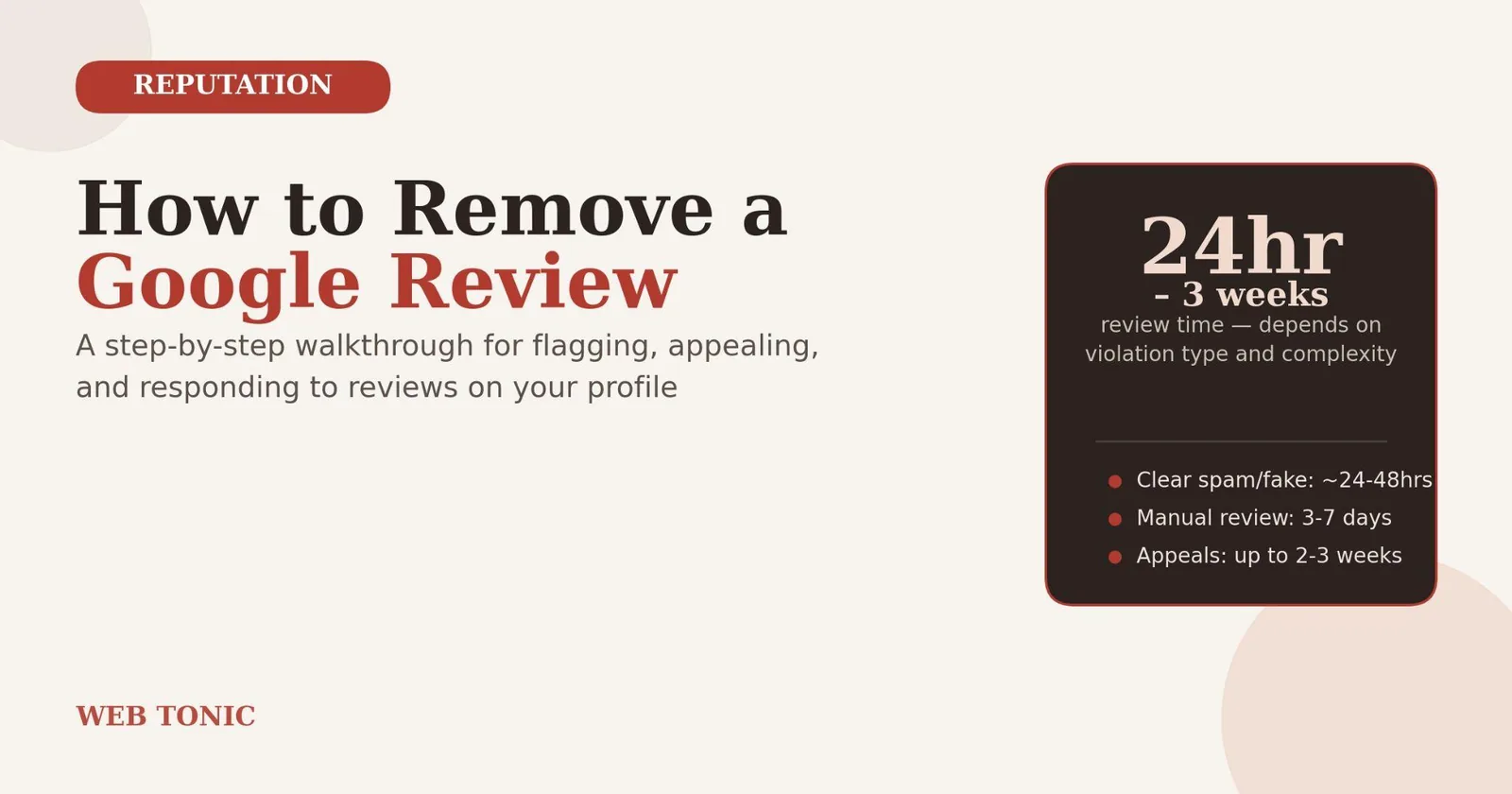
- Review evaluation timelines vary by case: automated detection for clear-cut violations often resolves within 24–48 hours, manual review takes 3–7 business days, and appeals or multi-issue cases can extend to 2–3 weeks.
- You get one appeal per flagged review if Google's first decision doesn't go your way, so use it on your strongest case, not the first review that irritated you.
- 47% of consumers won't consider a business with fewer than 20 reviews, and 74% only trust reviews from the last three months — which is why building a steady stream of new, positive reviews often does more for your reputation than chasing down old negative reviews.
Can You Actually Delete a Google Review?
No. There's no setting anywhere in your Google business profile or Google account that lets you personally delete someone else's review. This trips up a lot of business owners who remember the old "GMB" (Google My Business) interface and assume the control must be somewhere. It isn't, and it never really was.
What you can do is flag a review for Google to evaluate against its own policies. If it violates one, Google removes it. If it doesn't, it stays, even if it's harsh, unfair, or cost you a sale. This is by design: Google's own guidance is explicit that businesses shouldn't report a review just because they disagree with or dislike it, and that negative reviews aren't automatically a sign of poor service.
What Actually Gets a Google Review Removed
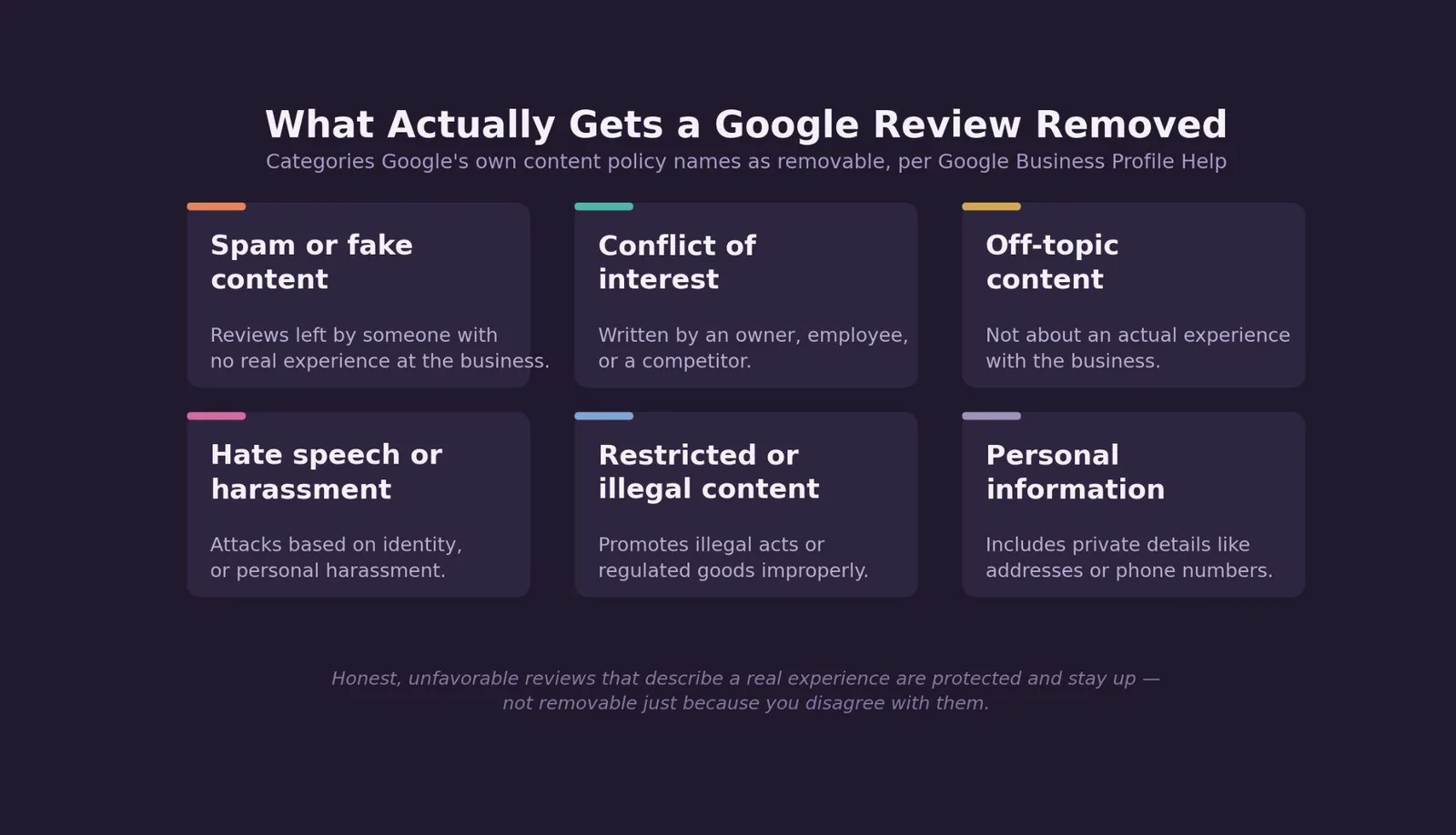
Google's Maps user-generated content policy spells out the categories of content that qualify for removal. Most flaggable reviews fall into a handful of buckets.
Spam or fake content covers reviews posted by someone with no genuine experience at the business, including bulk-posted or bot-generated content. Conflict of interest covers a current or former employee, an owner, or a direct competitor leaving a review about that business. Off-topic content means a review that isn't actually about an experience with the business in question. Hate speech, harassment, or personal attacks targets someone based on identity, or amounts to harassment unrelated to the actual customer experience. Illegal or restricted content promotes illegal activity or improperly references regulated goods and services. Personal information exposes private details like phone numbers or home addresses.
What doesn't qualify, no matter how much it stings: a one-star rating with no text, a customer's honest but harsh opinion, or a review that's simply inconvenient for your online reputation. Sterling Sky's breakdown of real-world review violations is a useful gut check before you spend time flagging something that was never going to come down.
Step-by-Step: How to Report a Review for Removal
Step 1: Open Google Business Profile Manager
On a computer, open Google Maps or go directly to your Google Business Profile Manager, and log into the Google account associated with your business. On mobile, use the Google Maps app instead.
Step 2: Find the review and click the menu
Go to your profile, select "Read reviews," and find the review in question. Next to it, click the three-dot menu and select Report.
Step 3: Select the policy reason
A new tab opens with Google's list of violation categories. Choose the one that actually matches, rather than the closest-sounding option. Matching the right category matters for how the report gets evaluated.
Step 4: Submit and track it in the Reviews Management Tool
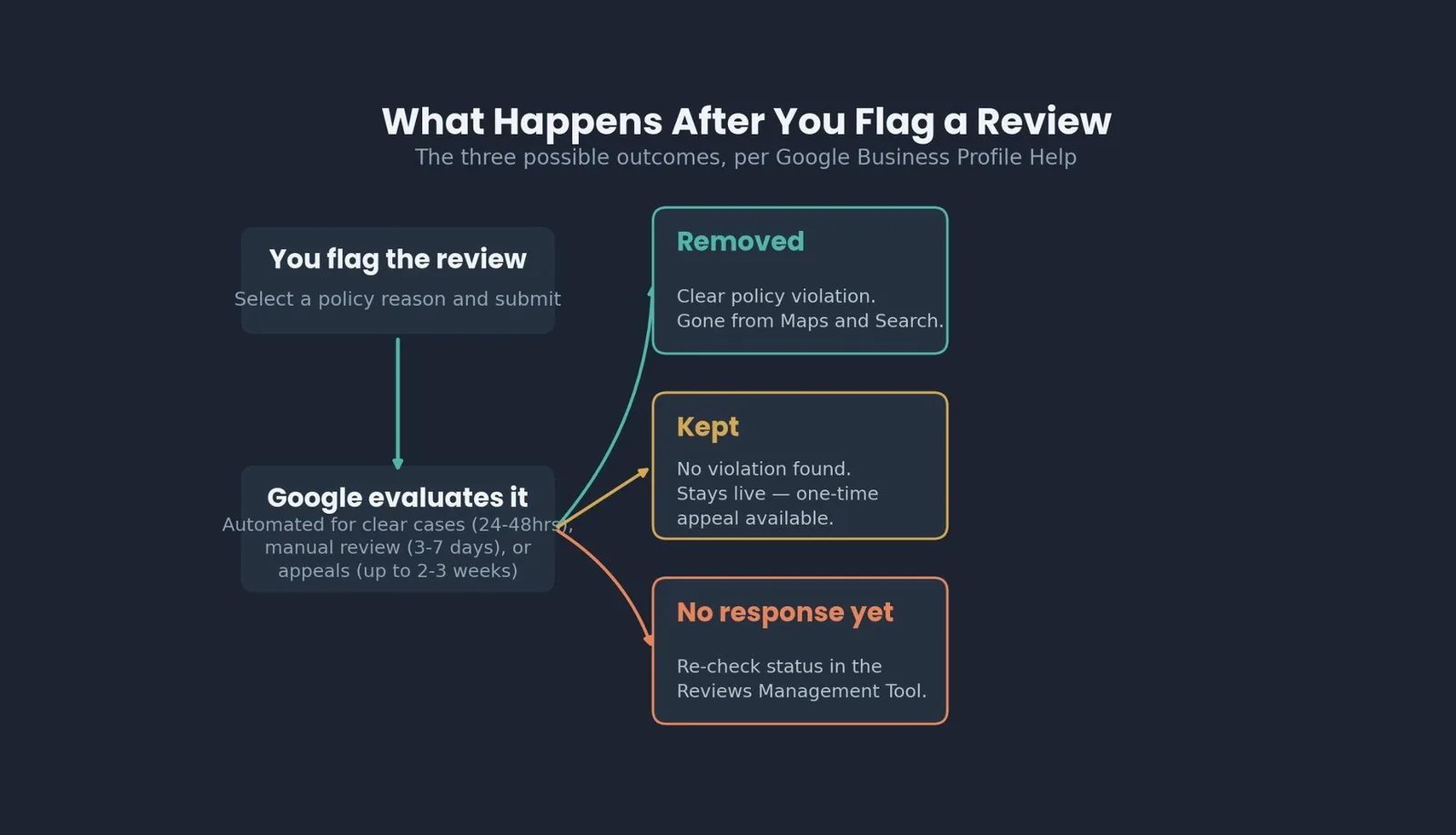
After you submit, you can check the status anytime in the Reviews Management Tool. Timelines vary by case: automated detection for clear-cut violations like spam often resolves within 24–48 hours, manual review for more complex cases typically takes 3–7 business days, and appeals or multi-issue cases can extend to 2–3 weeks. Statuses typically show as "Decision pending," "Report reviewed, no policy violation," or "Removed."
Step 5: Appeal once if it's a clear violation
If Google decides the review doesn't violate policy and you're confident it does, you get a one-time appeal. Be specific: name the exact category, quote the offending part of the review, and explain in a sentence or two why it qualifies. Vague appeals rarely change the outcome; specific, evidence-backed ones have a better shot.
Removable vs. Protected: A Quick Comparison
| Type of review | Removable? | Why |
|---|---|---|
| Fake review from someone with no real visit | Yes | Violates spam/fake content policy |
| Review from a competitor or former employee | Yes | Conflict of interest |
| Review containing hate speech or personal attacks | Yes | Violates harassment policy |
| Review exposing a private phone number or address | Yes | Personal information violation |
| One-star rating with no text | No | Not a policy violation, just an unfavorable rating |
| Detailed, honest complaint about bad service | No | Protected as a genuine customer experience |
| Review you simply disagree with | No | Disagreement alone is never grounds for removal |
What the Data Says About Reviews and Reputation
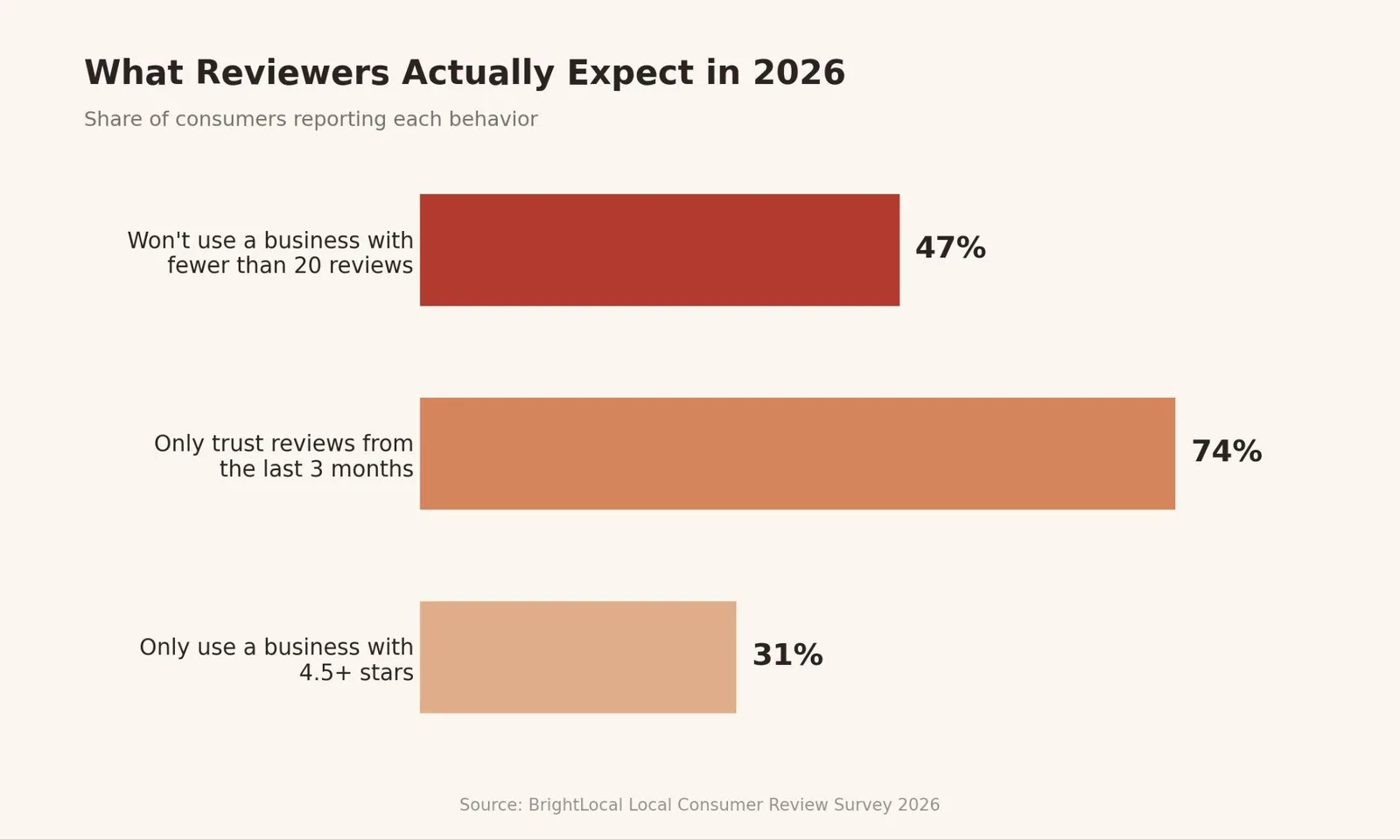
Chasing down every negative review often isn't the highest-leverage use of your time. BrightLocal's 2026 Local Consumer Review Survey found that 47% of consumers won't use a business with fewer than 20 reviews at all, regardless of rating, and 74% specifically care about reviews written in the last three months rather than a business's all-time average. Meanwhile 31% will only consider a business rated 4.5 stars or higher.
The practical implication: a review management strategy built entirely around removing bad feedback is fighting the wrong battle. A steady stream of recent, genuine positive reviews does more for your standing than winning a handful of flagging disputes ever will.
If the Review Can't Be Removed
Most negative reviews don't qualify for removal, and that's the more common outcome than business owners expect. When that happens, a calm, detailed public reply does more for future customers reading your profile than the original review does damage, so respond specifically rather than with a generic "sorry to hear that." Reputation management specialists make the same point: documenting each step of the flagging process, from the report to the supporting evidence, is what actually moves the needle, not shortcuts.
Never threaten or pressure the reviewer. This isn't just bad practice, it can carry real legal exposure. The FTC's Consumer Review Rule, in effect since October 2024, imposes civil penalties of up to $53,088 per violation for suppressing, faking, or paying for reviews, and it applies to any business serving US customers regardless of where they're based.
Steer clear of "review removal services" promising guaranteed takedowns, too. Most either file baseless legal claims or mass-report a target, and both tactics can backfire on the business that hired them. Given how heavily consumers weight recency, discussed above, generating new positive reviews is usually a better use of that same effort than continuing to fight an old one.
Google's policy enforcement has also grown more specific over time. Recent updates now explicitly name practices like review gating and requiring staff-name mentions as violations, which matters when you're deciding which category best matches what you're flagging in the first place.
Quick tool to try: the widget below gives a fast, directional read on whether a specific review is worth flagging, based on the categories covered in this guide.
Quick eligibility check
Does this review qualify for removal?
Check any that apply to the review in question. This is a directional guide, not a guarantee — Google makes the final call.
Likely outcome
Check the boxes above that apply to see a directional read.
The Bottom Line on Removing a Google Review
Removing a Google review is possible, but only under narrow conditions. The review has to violate a specific policy, not just be negative. Spend the time flagging reviews that genuinely qualify, spam, fake content, conflicts of interest, harassment, exposed personal information, and don't waste an appeal on a review that's simply unflattering. For everything else, a thoughtful public response and a steady flow of new, honest reviews will do more for your online reputation than any removal request.
If you manage multi location profiles or a high volume of customer feedback, treat this as an ongoing process rather than a one-time cleanup. New reviews arrive constantly, and so do the occasional ones that genuinely violate policy.
Frequently Asked Questions
Can I delete a Google review myself?
No. Business owners cannot personally delete a review. You can only flag it for Google to evaluate against its content policies; Google decides whether it comes down.
How long does it take Google to remove a review after I report it?
It depends on the type of violation. Automated detection for clear-cut cases like spam often acts within 24–48 hours, manual review for more complex cases typically takes 3–7 business days, and appeals or cases involving multiple policy questions can extend to 2–3 weeks.
What if a competitor is leaving fake negative reviews on my profile?
Flag each one through the Reviews Management Tool using the appropriate violation category, and keep screenshots documenting the pattern, including dates and reviewer profiles, as supporting evidence.
Will Google tell me why a review was removed or kept?
You'll typically see a status update in the Reviews Management Tool (for example, "Removed" or "no policy violation found"), though you may not always receive a separate confirmation email for every step.
Can I get penalized for reviews other people post about my business?
No. You're not responsible for reviews written by others, including fake ones from competitors. You should still flag anything that violates policy, since Google's systems are designed to catch and remove that kind of manipulation.
More from Web Tonic: growth marketing services, data & analytics.
Sources: support.google.com · birdeye.com · sterlingsky.ca · wiserreview.com · ueni.com · brightlocal.com · erase.com · launchcodex.com