Table of contents
To promote your business, pick two or three channels your customers already use, publish consistently on them for 90 days, and measure enquiries rather than impressions. Everything below is organised by cost and effort so a small business owner can start this week without a budget.
Key Takeaways
- A complete Google Business Profile makes a business 2.7x more likely to be seen as reputable and drives roughly 70% more visits — yet only 35% of small businesses have claimed one.
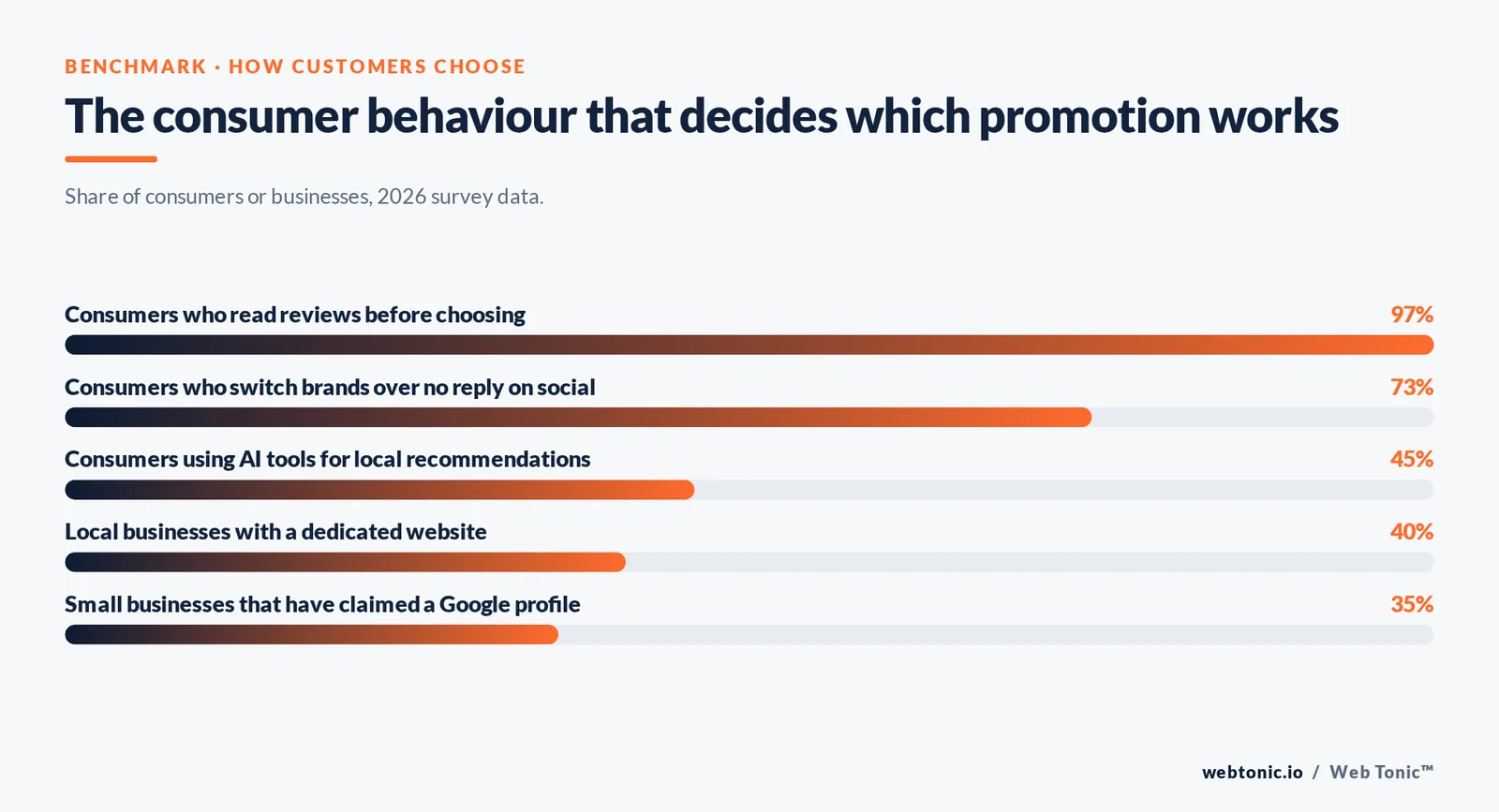
- 97% of consumers read reviews before choosing a business and 41% now do it every single time, up from 29% a year earlier.
- Generative AI tools went from 6% to 45% as a source of local business recommendations in one year, making them the third most-used discovery channel.
- There are 5.66 billion social media users spending an average of 2 hours 40 minutes a day on social platforms, per DataReportal's Digital 2026 report, but each user touches only about 6.75 networks a month.
- Email still returns the strongest measurable performance of any owned channel, with all-industry open rates around 39.6% and click rates near 3.25%.
- 73% of consumers will switch to a competitor if a brand does not respond to them on social media — responsiveness is a promotion tactic, not customer service overhead.
- Paid search averages $5.42 per click and $66.69 per lead across 23 industries, which sets the benchmark any free tactic should be measured against.
Start with the three free assets almost every business gets wrong
Before spending anything, three assets need to be right, because every other tactic sends traffic into them. Get these wrong and paid promotion just buys expensive disappointment.
Asset 1 — your Google Business Profile. This is the highest-return free listing on the internet for any business serving a place. Follow Google's own guidance on completing and editing your profile and on choosing the right categories and service areas. Fill every field, add ten real photos, list your services with prices where you can, and post once a month.
Asset 2 — a website that answers the buying question. Only about 40% of local businesses have a dedicated website, and 54% of consumers visit the website after reading positive reviews, so this is where discovery converts. One clear offer, one price signal, one contact method above the fold.
Asset 3 — a review engine. Per BrightLocal's 2026 consumer review survey, with 47% of consumers refusing to use a business with fewer than 20 reviews and 74% only trusting reviews from the last three months, review collection has to be a repeating process, not a campaign.
25 ways to promote your business, ranked by cost and effort
The table below is the working menu. Pick from the top rows first: every one of them is free or under $100, and most can be done in an afternoon.
| Tactic | Cost | Effort | Time to first result | Why it works |
|---|---|---|---|---|
| 1. Complete your Google Business Profile | Free | 2 hours | 1–4 weeks | Puts you in the map pack where local intent lands |
| 2. Ask every happy customer for a review | Free | Ongoing, 5 min/day | 2–6 weeks | 85% say positive reviews make them more likely to buy |
| 3. Claim Apple Maps and Bing Places | Free | 1 hour | 2–6 weeks | Apple Maps use nearly doubled to 27% |
| 4. Publish a page per service you sell | Free | 1 day/page | 2–6 months | Matches specific searches to specific offers |
| 5. Start a monthly email list | Free tier | 3 hours/month | 1 month | Around 39.6% open rates on an owned audience |
| 6. Post short vertical video weekly | Free | 2 hours/week | 1–3 months | Highest organic reach available on social |
| 7. Reply to every comment and DM | Free | 15 min/day | Immediate | 73% switch brands over no reply |
| 8. Join local community platforms | Free | 1 hour/week | 2–8 weeks | Neighbour recommendations convert unusually well |
| 9. Partner with a complementary business | Free | A few calls | 2–6 weeks | Borrowed trust, zero media cost |
| 10. Build a referral offer | Cost of reward | 1 day setup | 1–2 months | Turns existing customers into a channel |
| 11. Answer questions in niche forums and groups | Free | 2 hours/week | 1–3 months | Builds authority where buyers research |
| 12. Get listed in relevant directories | Free–$50 | 3 hours | 1–3 months | Citations plus referral traffic |
| 13. Pitch local press with a real story | Free | 1 day | 2–8 weeks | Coverage plus a durable backlink |
| 14. Run a workshop or free clinic | $0–$300 | 2 days | Same week | Demonstration beats description |
| 15. Sponsor a local team or event | $200–$2,000 | Low | 1 season | Repeated local exposure and goodwill |
| 16. Collect and publish customer stories | Free | 4 hours/story | 1 month | Proof at the decision moment |
| 17. Set up Google Search ads on your best terms | $300+/month | 1 day setup | Days | Buys intent immediately at $5.42 average CPC |
| 18. Retarget website visitors | $100+/month | Half a day | 2 weeks | Cheapest paid audience you own |
| 19. Run Meta ads to a local radius | $150+/month | 1 day setup | 1–2 weeks | Cheap reach for offers and events |
| 20. Work with micro-influencers | $100–$1,000 | Medium | 2–4 weeks | Credible reach inside a niche |
| 21. Add a loyalty or repeat-purchase offer | Margin cost | 1 week | 1–3 months | Retention is cheaper than acquisition |
| 22. Publish a genuinely useful free tool | $0–$2,000 | High | 3–6 months | Earns links and repeat visits |
| 23. Attend two trade or community events a quarter | $0–$500 | 2 days | Same week | Direct pipeline and partnerships |
| 24. Use vehicle, window and packaging branding | $200–$1,500 | One-off | Ongoing | Repetition with no recurring cost |
| 25. Ask for a review at the moment of delight | Free | Habit | Immediate | Highest yield per ask of anything here |
Limit 1: no more than three new tactics at once. The most common reason small business promotion fails is not choosing badly — it is spreading eight half-executed tactics across a week and concluding that "marketing doesn't work".
Choosing your channels: which ones fit which business
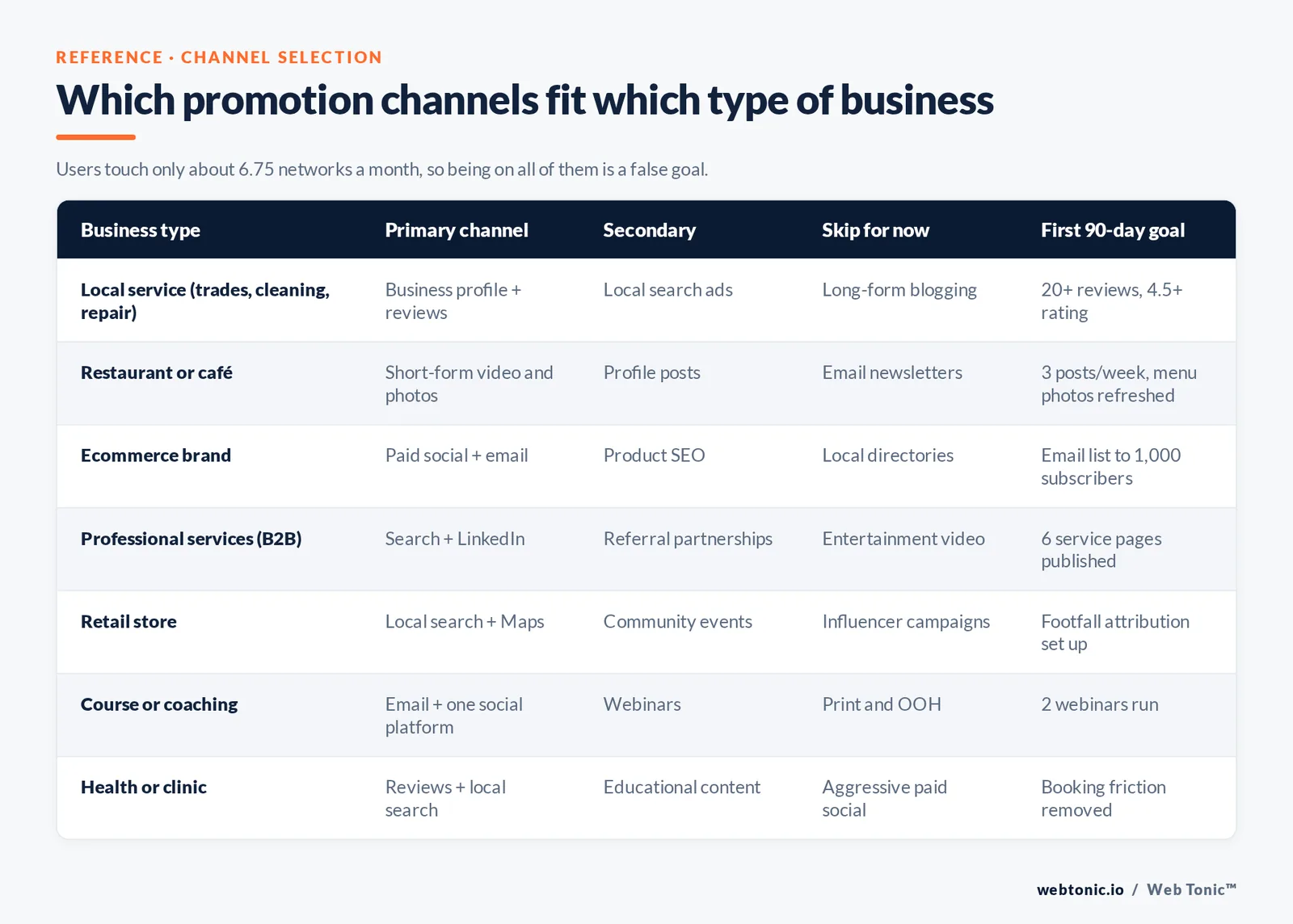
Channel choice is not a matter of taste. It follows from how customers find your category, how visual your offer is, and how long the decision takes. Consumers spend around 2 hours 40 minutes a day on social platforms but use only 6.75 networks a month, so being on all of them is a false goal.
| Business type | Primary channel | Secondary channel | Skip for now | First 90-day goal |
|---|---|---|---|---|
| Local service (trades, cleaning, repair) | Google Business Profile + reviews | Local search ads | Long-form blogging | 20+ reviews and a 4.5+ rating |
| Restaurant or café | Short-form video and photos | Google Business Profile posts | Email newsletters | 3 posts/week, menu photos refreshed |
| Ecommerce brand | Paid social + email | Product SEO | Local directories | Email list to 1,000 subscribers |
| Professional services (B2B) | Search + LinkedIn | Referral partnerships | Short-form entertainment video | 6 service pages published |
| Retail store | Local search + Maps | Community platforms and events | Influencer campaigns | Footfall attribution set up |
| Course or coaching | Email + one social platform | Webinars | Print and OOH | 2 webinars run |
| Health or clinic | Reviews + local search | Educational content | Aggressive paid social | Booking friction removed |
| SaaS or app | Content and search | Paid search on competitor terms | Local listings | Free-trial signups tracked |
Independent baselines are worth reading before committing budget: the US Small Business Administration's marketing and sales guide covers the planning basics, and Sprout Social's platform statistics show where audiences actually spend time. For an outside read on which mix suits your category, our growth marketing team does this as a scoping exercise.
Free and low-cost promotion that still works in 2026
The free tactics that survive are the ones with a distribution mechanism built in: search demand, local recommendation, or an existing relationship. Three shifts are worth adjusting for.
Shift 1 — discovery is fragmenting. Google's share of where consumers read local reviews slid from 83% to 71% in a year, while AI assistants rose from 6% to 45%. Practically, that means your business facts — hours, services, service area, prices — need to be stated in plain text on your own site so any system can read them.
Shift 2 — recency beats volume. 32% of consumers look for reviews written in the last two weeks (up from 20%) and 18% only trust the last week. A trickle of fresh reviews now outperforms a large stale pile.
Shift 3 — local news is fading as a source. Its use as a recommendation source dropped from 48% to 29%, so local PR should be pursued for links and credibility rather than direct reach. Ahrefs' local SEO guide is a good free reference for turning those mentions into search visibility, and Google Trends will tell you whether interest in your category is seasonal before you plan the calendar.
When and how to start paying for reach
Paid promotion is worth starting once you know your average order value and your close rate — not before. Across 23 industries, search advertising averages $5.42 per click, a 6.64% click-through rate, an 8.18% conversion rate and $66.69 per lead. If a lead is worth less than about $70 to you, fix pricing or conversion first.
| Paid option | Sensible starting budget | Best use | What to watch |
|---|---|---|---|
| Google Search ads | $300–$1,000/month | Capturing existing demand | Search terms report weekly |
| Performance Max | $1,000+/month | Ecommerce with a clean feed | Channel and product distribution |
| Meta ads (local radius) | $150–$600/month | Offers, events, awareness | Frequency and creative fatigue |
| Retargeting | $100–$300/month | Recovering considered buyers | Audience size above 1,000 |
| Short-video ads | $300+/month | Visual products, younger audiences | Hook retention in first 3 seconds |
| Micro-influencer collaborations | $100–$1,000 per deal | Niche credibility | Disclosure compliance |
| Directory or marketplace ads | $100–$500/month | Categories with strong aggregators | Lead quality and duplication |
Two rules keep early paid spend honest. Step 1 — start on one channel only, with conversion tracking verified before the first click. Google's documentation on how bidding and budgets work is worth 20 minutes before you launch. Step 2 — never pay for reach into a page you would not send your best customer to; if the offer, price and proof are not on the page, fix that first. If you are running influencer or testimonial promotion, the FTC's endorsement guides set the disclosure rules, and our performance creative team handles the ad assets side of this for clients.
A 90-day promotion plan you can actually sustain
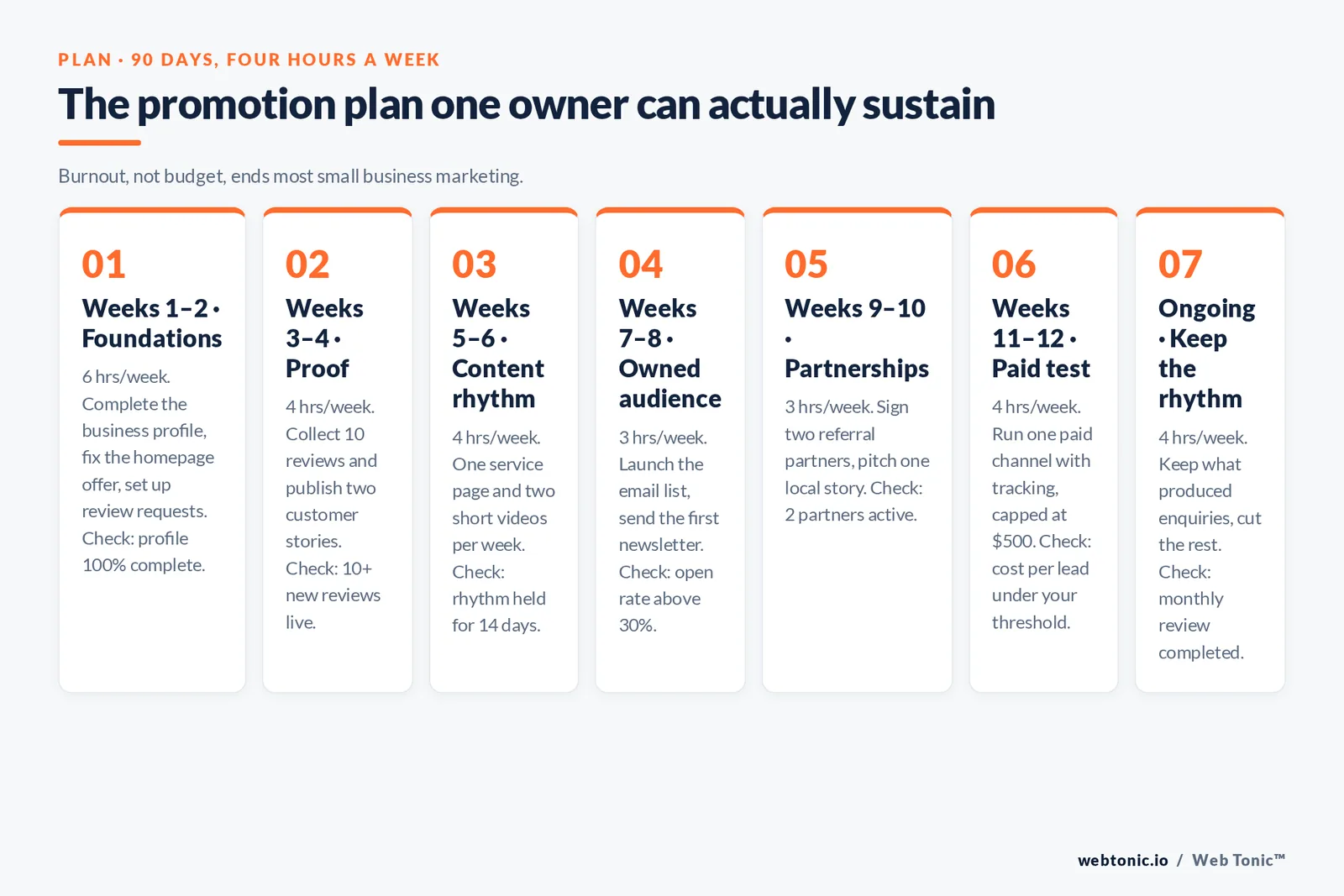
Burnout, not budget, ends most small business marketing. The plan below assumes one owner with roughly four hours a week.
| Phase | Weekly time | Do this | Success check |
|---|---|---|---|
| Weeks 1–2: foundations | 6 hours | Complete the profile, fix the homepage offer, set up review requests | Profile 100% complete |
| Weeks 3–4: proof | 4 hours | Collect 10 reviews, publish two customer stories | 10+ new reviews live |
| Weeks 5–6: content rhythm | 4 hours | Publish one service page and two short videos per week | Rhythm held for 14 days |
| Weeks 7–8: owned audience | 3 hours | Launch the email list and send the first newsletter | Open rate above 30% |
| Weeks 9–10: partnerships | 3 hours | Sign two referral partners, pitch one local story | 2 partners active |
| Weeks 11–12: paid test | 4 hours | Run one paid channel with tracking, cap at $500 | Cost per lead under your threshold |
| Ongoing | 4 hours | Keep what produced enquiries, cut the rest | Monthly review completed |
Rule 3 — protect the rhythm over the ambition. Two short videos a week for a year beats a 30-video sprint in March followed by silence.
Measuring whether the promotion worked
Most owners measure the wrong things because the wrong things are easier to see. Followers, impressions and likes are inputs; enquiries, bookings and repeat purchases are outcomes.
| Metric | What it tells you | Healthy signal | Where to find it |
|---|---|---|---|
| Enquiries by source | Which channel actually produces demand | Up month on month | Form tags plus call tracking |
| Cost per enquiry | Whether paid spend is viable | Below $66.69 benchmark for your industry | Ad platform plus CRM |
| Profile calls and direction requests | Local visibility performance | Up 10–30% per quarter | Business profile insights |
| Review count and rating | Conversion strength before contact | +4–8 per month, 4.5+ rating | Profile dashboard |
| Email list growth and open rate | Owned audience health | Opens near 39.6% | Email platform |
| Repeat purchase rate | Whether growth compounds | Rising share of revenue | POS or ecommerce reports |
| Branded search volume | Whether awareness is building | Up over 6 months | Search Console |
If you cannot attribute enquiries to a source today, that is the first fix — it is the whole reason our data intelligence practice exists, and it is what makes every later decision cheap. You can also browse practical channel walkthroughs on our blog or ask us to review your current mix.
Mistakes that waste the most money
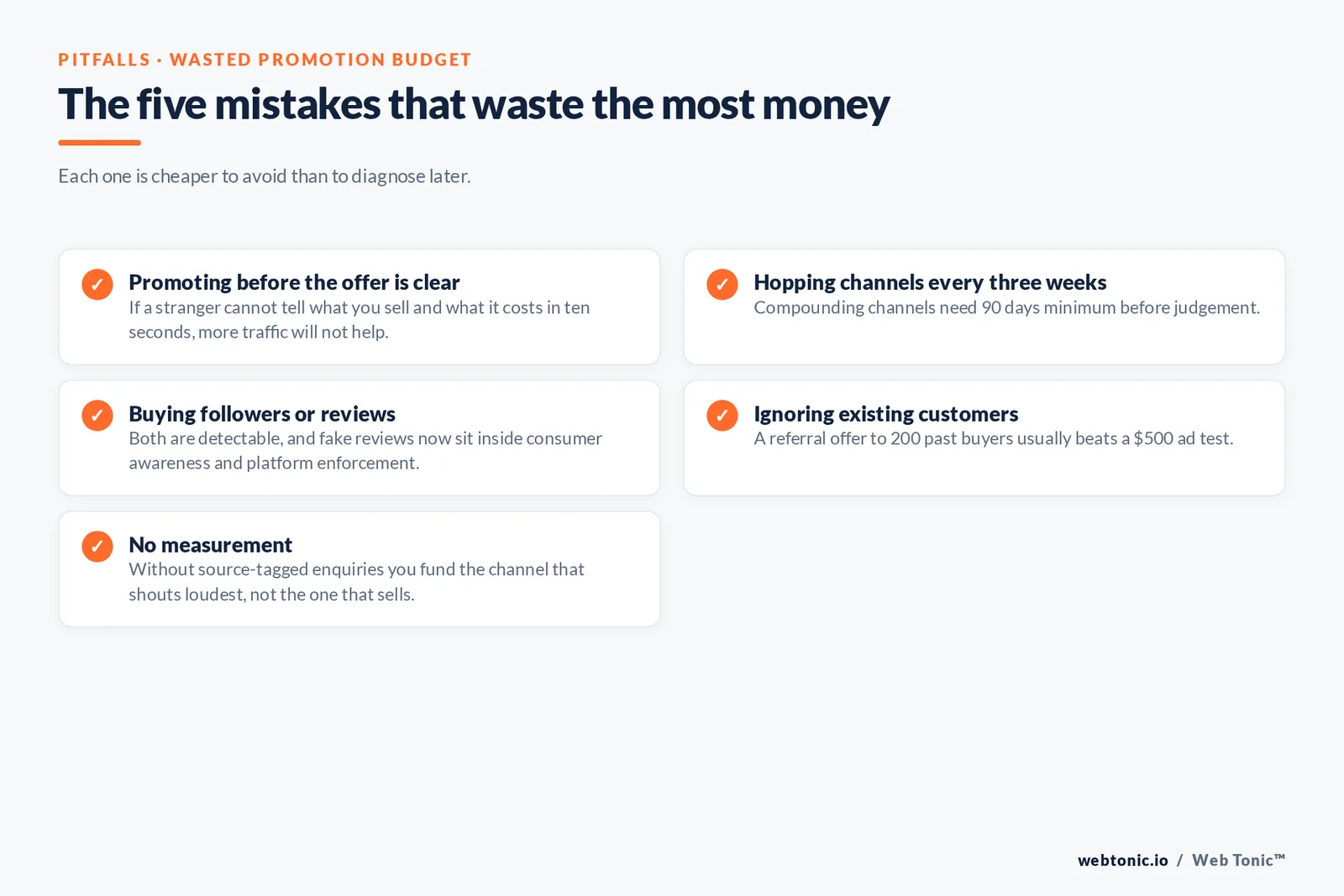
Mistake 1 — promoting before the offer is clear. If a stranger cannot tell what you sell and what it costs in ten seconds, more traffic will not help.
Mistake 2 — hopping channels every three weeks. Compounding channels need 90 days minimum before judgement.
Mistake 3 — buying followers or reviews. Both are detectable, and fake reviews now sit inside consumer awareness and platform enforcement.
Mistake 4 — ignoring existing customers. A referral offer to 200 past buyers usually beats a $500 ad test.
Mistake 5 — no measurement. Without source-tagged enquiries you will keep funding the channel that shouts loudest rather than the one that sells.
FAQ
What is the cheapest way to promote a business?
A complete Google Business Profile plus a steady review habit. Both are free, and the data is unusually clear: a complete profile makes a business 2.7x more likely to be considered reputable, while 47% of consumers will not use a business with fewer than 20 reviews.
How much should a small business spend on promotion?
Start from unit economics rather than a percentage rule. If a lead is worth more than the roughly $66.69 all-industry cost per lead in paid search, paid channels are viable; if not, invest in free local visibility, reviews and referrals until pricing or conversion improves.
Which social media platform should I use?
The one your buyers already use for your category — usually one, occasionally two. Users touch about 6.75 networks a month, so presence is cheap but attention is not; consistent posting on a single platform beats thin posting on five.
How long before promotion produces customers?
Paid search and local listings can produce enquiries within days to four weeks. Content, SEO and social rhythm typically take three to six months, which is why the 90-day plan above front-loads the fast channels while the slow ones build.
Do I still need a website if I have social profiles?
Yes. Only around 40% of local businesses have a dedicated website, yet 54% of consumers go to the website after reading positive reviews — so the site is where discovery turns into a booking, and it is the only channel you control outright.
Sources: Google Business Profile Help; Google Ads Help on bidding and budgets; BrightLocal Local Consumer Review Survey 2026; Ahrefs local SEO and SEO statistics research; Sprout Social social media statistics; DataReportal Digital 2026; GetResponse email marketing benchmarks; LocaliQ search advertising benchmarks; US Small Business Administration marketing and sales guide; FTC endorsement guides; Google Trends.