Table of contents
A business proposal is a persuasive document that names a client's problem, proposes a specific solution and asks for a decision. This guide covers the 9 sections, the writing process, pricing structure and the mistakes that lose deals.
Key Takeaways
- A business proposal has 9 core sections. Anything past that is an appendix, not a proposal.
- Solicited proposals answer an RFP; unsolicited ones create the conversation — and the two need different opening pages.
- Keep the executive summary to 1 page and write it last, because it is the only page many decision-makers read.
- Offer 3 pricing options rather than one number: it moves the conversation from "yes or no" to "which one".
- Send it within 48 hours of the discovery call, while the problem is still vivid for the buyer.

What Is a Business Proposal?
A business proposal is a document sent to a prospective client that defines their problem, sets out a proposed solution with a scope and a price, and ends with a clear way to sign. It is a sales document, not a company brochure and not a business plan — a business plan is written for investors and internal direction, while a proposal is written for one buyer and one decision.
| Document | Audience | Purpose | Typical length | Ends with |
|---|---|---|---|---|
| Business proposal | One prospective client | Win a specific project | 6–15 pages | Signature block |
| Business plan | Investors, lenders, founders | Justify the whole company | 20–40 pages | Financial projections |
| Quote or estimate | A buyer who already decided | Price a known scope | 1 page | Total and validity date |
| Statement of work | A signed client | Govern delivery | 4–12 pages | Acceptance criteria |
| Pitch deck | A room of people | Present narrative live | 10–20 slides | Next-step slide |
The US Small Business Administration's guidance on marketing and sales makes the same distinction: proposals sit at the closing end of the funnel, after the qualifying conversation.
Solicited vs Unsolicited vs Renewal Proposals
The type dictates the structure. A solicited proposal answers a request for proposal (RFP) and is scored against stated criteria, so compliance beats creativity. Government buyers formalize this most strictly — the Federal Acquisition Regulation Part 15 spells out how proposals are solicited and evaluated, and non-compliant submissions are simply removed.
| Proposal type | Trigger | What wins | Length | Win rate reality |
|---|---|---|---|---|
| Solicited (RFP response) | Formal buyer request | Exact compliance with the scoring grid | 15–40 pages | Low per bid, 5–15 bidders |
| Informally solicited | "Send me something" after a call | Speed and problem framing | 6–12 pages | Highest of the 4 types |
| Unsolicited | Your own outreach | A specific insight they didn't have | 3–6 pages | Lowest; treat as a door opener |
| Renewal or expansion | Contract end or new need | Results already delivered | 4–8 pages | Highest close rate overall |
Rule 1: never send an unsolicited proposal longer than 6 pages. Nobody has budgeted attention for a document they didn't ask for.
The 9 Sections of a Business Proposal
This is the structure we use for consulting, marketing and web development work, and it maps cleanly onto most services businesses.
| Section | What goes in it | Target length | Failure mode |
|---|---|---|---|
| 1. Title page | Client name, project name, date, your contact | 1 page | Wrong client name from the last template |
| 2. Table of contents | Linked headings, page numbers | 1 page | Omitted on documents over 10 pages |
| 3. Executive summary | Problem, solution, outcome, price range | 250–400 words | Written about you, not the client |
| 4. Problem statement | Their situation in their own words plus data | 1–2 pages | Generic pain points, no numbers |
| 5. Proposed solution | Approach, phases, deliverables, owners | 2–4 pages | Method described, deliverables missing |
| 6. Timeline | Milestones with dates and dependencies | 1 page | No client-side responsibilities listed |
| 7. Pricing | 2–3 options, inclusions, payment schedule | 1 page | One lump sum with no breakdown |
| 8. Proof | Case studies, results, relevant team bios | 1–2 pages | Logos with no outcomes attached |
| 9. Terms and signature | Validity, terms and conditions, e-signature block | 1 page | Buried on page 14 with no CTA |

How to Write a Business Proposal in 8 Steps
- Step 1 — Qualify before you write. Confirm budget range, decision-maker and deadline. A proposal written without those 3 facts is a guess.
- Step 2 — Restate the problem in the client's language. Quote their phrasing from the call verbatim; it is the single strongest signal that you listened.
- Step 3 — Quantify the cost of inaction. Attach a number to the status quo, such as 40 hours a month of manual reporting or a 2.1% checkout conversion rate.
- Step 4 — Design the solution in phases. 3 phases with named deliverables beats one monolithic scope, and it gives the buyer a smaller first yes.
- Step 5 — Price with options. Build 3 tiers where the middle one is what you expect them to choose.
- Step 6 — Add proof that matches. One case study from the same industry outperforms 6 unrelated ones.
- Step 7 — Write the executive summary last, in under 400 words, using only claims that appear later in the document.
- Step 8 — Edit for plain language. The federal plain language guidelines on concision are the fastest editing checklist available, and they are free.
Asana's guidance on writing a project proposal and PandaDoc's breakdown of a business proposal both follow the same problem-then-solution order, which is a good sign that the sequence is not merely a stylistic preference.
How to Price a Business Proposal
Pricing is where most proposals lose. A single number invites a yes-or-no answer and a comparison against the cheapest bidder. Three structured options change the question.
| Pricing model | How it works | Best when | Risk to you |
|---|---|---|---|
| Fixed fee | One price for a defined scope | Scope is genuinely known | Scope creep eats the margin |
| Time and materials | Hourly or daily rate with a cap | Discovery or R&D work | Buyer fears an open meter |
| Monthly retainer | Recurring fee for ongoing capacity | Marketing, support, maintenance | Value must be re-proven monthly |
| Milestone-based | Payments tied to 3–5 deliverables | Multi-month builds | Disputes over acceptance |
| Performance-linked | Base fee plus an outcome bonus | Both sides control the metric | Attribution arguments |
| Tier | Positioning | Scope | Share of buyers who pick it |
|---|---|---|---|
| Option A — Essential | Solves the urgent problem only | Phase 1 | About 20% |
| Option B — Recommended | The scope you actually advise | Phases 1–2 | About 60% |
| Option C — Complete | Everything, including nice-to-haves | Phases 1–3 | About 20% |
Limit 2: never show more than 3 options. A fourth column reliably stalls the decision. And always attach a 30-day validity date so the price has a natural expiry.
Design and Format: What Actually Affects the Read
Design is not decoration in a proposal; it controls what gets read. Readers scan headings and the first words of paragraphs, as Nielsen Norman Group's work on microcontent and headings shows, so the heading structure has to carry the argument on its own.
| Element | Do this | Avoid this |
|---|---|---|
| Headings | Statement headings that carry meaning | One-word labels like "Approach" |
| Body type | 10–11pt, 1.4 line height, 1 typeface | 9pt justified text edge to edge |
| Tables | Scope, timeline and pricing as tables | Scope hidden inside prose |
| Visuals | 1 diagram of the process, 1 of the timeline | Stock photography of handshakes |
| File format | PDF plus an e-signature link | Editable file with tracked changes |
| File name | Client-Project-Proposal-2026-08.pdf | proposal-final-v7-REAL.pdf |
If you need a starting layout, Microsoft's proposal templates and Miro's template library both offer free skeletons you can restructure around the 9 sections above. Our web development team builds the same logic into client-facing quote pages when volume justifies it.
7 Mistakes That Lose Proposals
| Mistake | Why it kills the deal | Fix |
|---|---|---|
| Trap 1 — Leading with your company | Page 1 is about you, not their problem | Move company history to the appendix |
| Trap 2 — No named deliverables | Buyer cannot picture what arrives | List every artifact with a due week |
| Trap 3 — Sending after 7 days | Urgency from the call has evaporated | Send within 48 hours |
| Trap 4 — Unverified claims | Advertising claims must be substantiated | Cite the source for every number |
| Trap 5 — Ignoring the RFP format | Scored out before anyone reads it | Mirror their headings exactly |
| Trap 6 — No decision path | Nothing tells them how to say yes | One CTA plus a signature block |
| Trap 7 — No follow-up plan | Silence reads as indifference | Book the review call before sending |
Trap 4 is a legal exposure as well as a sales one: the FTC's advertising and marketing guidance requires that objective claims be substantiated, and a proposal is a marketing document. Salesforce's State of the Connected Customer research and PwC's work on customer experience both point the same way: buyers reward clarity and speed of response over polish.
Follow-Up: The Part Most Teams Skip
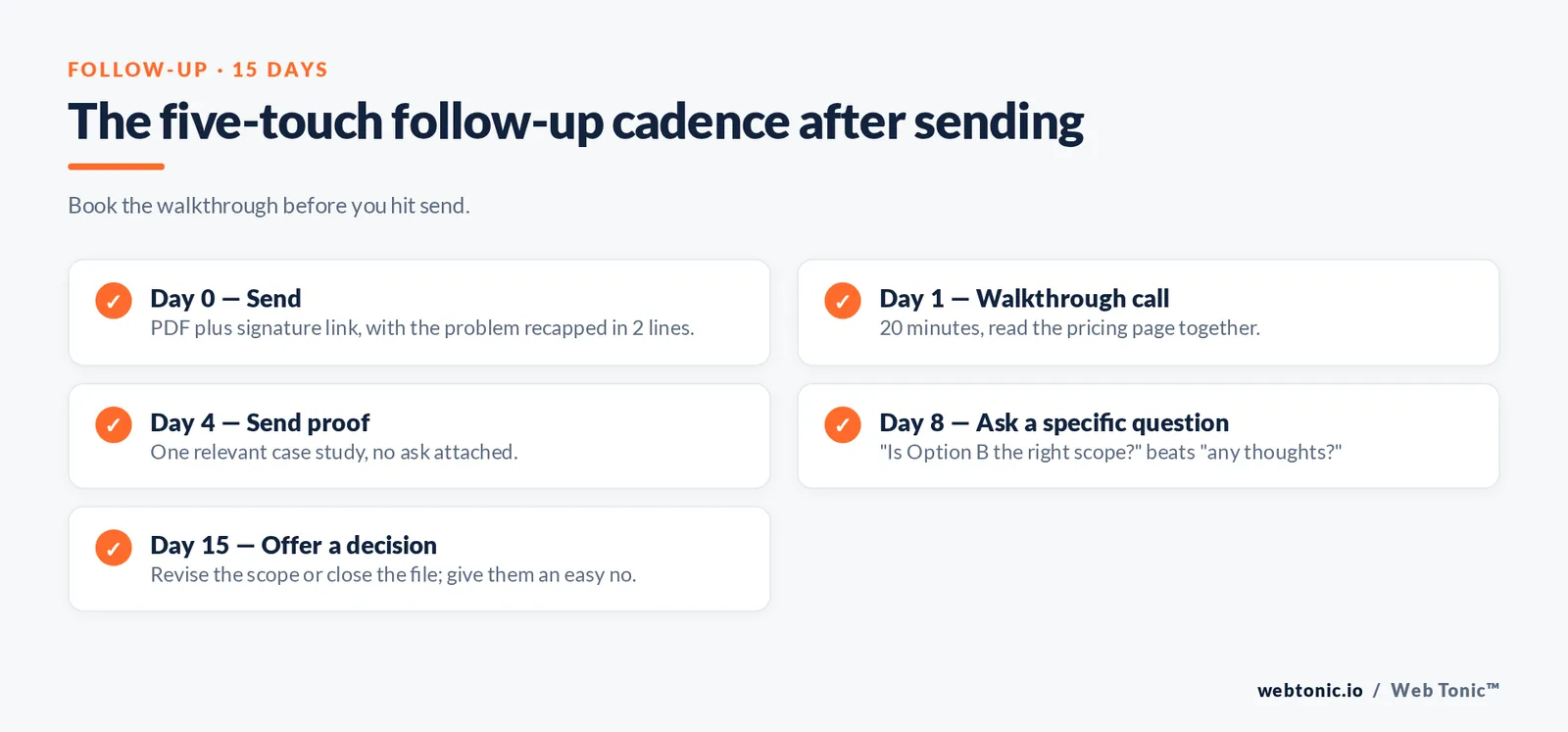
A sent proposal is a live conversation, not a completed task. Book the walkthrough call before you send the document, then run a fixed cadence rather than improvising.
| When | Action | Message angle |
|---|---|---|
| Day 0 | Send PDF plus signature link | Recap the problem in 2 lines |
| Day 1 | Walkthrough call, 20 minutes | Read the pricing page together |
| Day 4 | Send 1 relevant case study | Proof, no ask |
| Day 8 | Ask a specific question | "Is Option B the right scope?" |
| Day 15 | Offer to revise or close the file | Give them an easy no |
Measure 5 numbers across your proposals: send-to-open rate, open-to-call rate, win rate by proposal type, average days to close and average discount given. Teams that track those find their leaks in one quarter. See how we structure client engagements on our services overview, read more playbooks on the Web Tonic blog, or get in touch if you want your proposal template reviewed.

Business Proposal Examples by Industry
The 9 sections stay constant; what changes is which section carries the weight. These are the shapes of business proposals we see win in each market.
| Industry | Heaviest section | Proof that convinces | Typical pricing model | Pages |
|---|---|---|---|---|
| Marketing and social media services | Proposed solution by channel | Before-and-after performance data | Monthly retainer | 8–12 |
| Consulting | Problem statement and diagnosis | Named senior team on the project | Fixed fee per phase | 10–15 |
| Construction and trades | Scope, materials and timeline | Licences, insurance, past sites | Milestone-based | 6–10 |
| Software and web development | Deliverables and acceptance criteria | Live product links and uptime data | Fixed fee plus retainer | 8–14 |
| Design and creative | Process and revision rounds | Portfolio matched to their sector | Fixed fee per deliverable | 6–10 |
| Professional services (legal, accounting) | Terms, scope limits, compliance | Credentials and comparable matters | Hourly with a cap | 6–12 |
Pattern across all 6: the sections that decide the deal are the problem statement and the pricing page. Everything else supports them.
Business Proposal Templates and Software Compared
A template saves formatting time; it does not save thinking time. Judge tools on how fast they get a proposal signed, not on how many themes they ship.
| Option | Cost | E-signature built in | Best for | Main limit |
|---|---|---|---|---|
| Google Docs or Microsoft Word template | Free | No | First 20 proposals | No tracking or analytics |
| Dedicated proposal software | $19–$65 per user per month | Yes | Teams sending 10+ a month | Rigid layouts |
| CRM-native proposal module | Included in mid-tier plans | Usually | Keeping deal data in one place | Weak design control |
| Designed PDF from a brand template | Design time only | No, pair with a signing tool | High-value pitches | Slow to update |
| Web page proposal | Build cost | Yes, with an integration | Productized services | Needs developer support |
Switch trigger: move off free templates once you send more than 8 proposals a month or once 2 people need to co-author one. Below that volume, tooling is a distraction.
Executive Summary and Problem Statement: A Worked Example
Here is the same engagement written badly and then written well, so the difference is visible rather than theoretical.
| Element | Weak version | Strong version |
|---|---|---|
| Opening line | "We are a full-service agency founded in 2014." | "Your paid search spend rose 34% last quarter while leads stayed flat." |
| Problem statement | "You need better marketing." | "3 of your 5 campaigns have no conversion tracking, so bidding runs blind." |
| Proposed solution | "We will optimise your account." | "Phase 1: rebuild tracking in 2 weeks. Phase 2: restructure 5 campaigns." |
| Outcome statement | "Improved results." | "Target: cost per lead down 25% within 90 days, measured in the ads account." |
| Close | "Let us know your thoughts." | "Sign Option B below, or book the 20-minute walkthrough on Thursday." |
Phase 1 of every rewrite: delete every sentence whose subject is your own company. In most drafts that removes 30 to 40% of the words and none of the argument.
Business Proposal Best Practices: The Pre-Send Checklist
Run this before every business proposal leaves your outbox. It takes 10 minutes and catches the errors that cost signatures.
| Check | What good looks like | Fails if |
|---|---|---|
| Client details | Company, contact and project names correct in all 9 sections | Any name from a previous proposal template survives |
| Problem statement | Contains at least 2 numbers the client gave you | It could be pasted into another client's proposal |
| Deliverables | Every deliverable named with a due week and an owner | The word "support" appears with no artifact attached |
| Pricing | 2–3 options, inclusions listed, payment schedule, 30-day validity | One lump sum with no breakdown or expiry |
| Client responsibilities | A short table of what they must provide and by when | Timeline assumes instant client feedback |
| Terms and conditions | Scope limits, revision rounds, cancellation, IP ownership | Terms are implied rather than written |
| Call to action | One signature block plus one booked walkthrough call | The document ends with "let us know" |
Phase 2 of quality control: have someone who was not on the call read only the executive summary and the pricing page. If they cannot state the problem, the scope and the price in 3 sentences, the proposal is not ready.
FAQ
How long should a business proposal be?
Six to fifteen pages for most services work. Unsolicited proposals should stay under 6 pages, and formal RFP responses often run 15 to 40 because the buyer dictates the sections. Length should be driven by the buyer's requirements, never by a desire to look thorough.
What is the most important section of a business proposal?
The executive summary, because it is the only section every stakeholder reads. It should state the problem, the proposed solution, the expected outcome and the investment range in under 400 words, and it should be written last so it only promises what the document delivers.
Should I include pricing in the first proposal?
Yes. Withholding price to force another meeting mostly loses the deal to whoever answered the question. Present 2 to 3 scoped options with a validity date, and make clear what changes the price so the conversation stays about scope rather than discounting.
Where can I find free business proposal templates?
Microsoft's template gallery and Miro's template library both offer free proposal skeletons, and Google Docs includes basic business document templates. Use them for layout only — replace the generic problem and solution language, which is what buyers recognize instantly as boilerplate.
How soon should I follow up after sending a proposal?
Schedule a walkthrough call within 24 hours of sending, then follow up on roughly days 4, 8 and 15. Each touch should add something — a case study, a clarification, a revised option — rather than asking whether they have had a chance to look at it.
Sources
US Small Business Administration — marketing and sales; write your business plan · Acquisition.gov — Federal Acquisition Regulation Part 15 · Plainlanguage.gov — concision guidelines · Asana Resources — project proposal · PandaDoc — business proposal guide · Nielsen Norman Group — microcontent and headings · Microsoft Create — proposal templates · Miro — template library · Federal Trade Commission — advertising and marketing guidance · Salesforce — State of the Connected Customer · PwC — future of customer experience. All sources accessed August 2026.