Table of contents

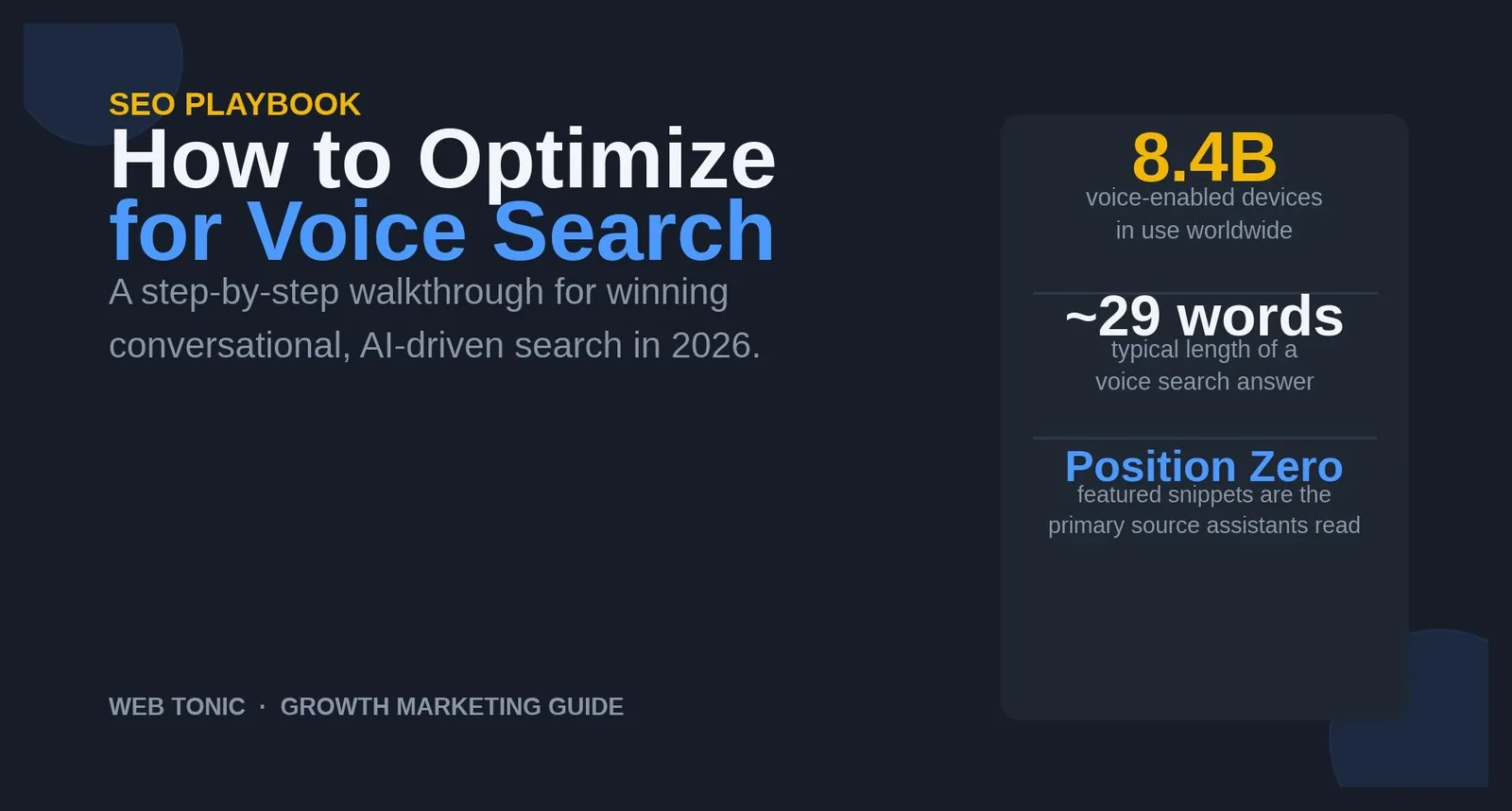
Type "best pizza Boston" into a search bar and you'll get ten blue links. Ask a voice assistant the same thing and it reads you exactly one answer, then stops. That's the entire game of voice search optimization: there's no scrolling past a bad answer, so your content either is the one the assistant reads, or it doesn't exist for that query. This guide covers what voice search actually rewards, the ranking factors that decide which page gets read aloud, and the step-by-step process for optimizing your content for it in 2026.
Key Takeaways
- Voice search optimization means writing for one winning answer, not a ranked list. Featured snippets are the primary source voice assistants read from, so winning position zero is the real goal.
- Voice queries are longer and more conversational than typed searches. Content built around question-based headings and long tail keywords consistently outperforms keyword-fragment content.
- An estimated 8.4 billion voice-enabled devices are now in use worldwide, and local, "near me" style queries make up a majority of voice search volume.
- Structured data (schema markup) helps search engines understand exactly what your content answers, which matters more for voice than for typed search results.
- For any local business, a complete and current Google Business Profile is one of the highest-leverage things you can optimize for voice.
- Google Assistant, Siri, and Alexa each pull from different underlying data sources, so a single-platform strategy will leave visibility on the table.
What Is Voice Search Optimization?
Voice search optimization is the practice of structuring your website content so voice assistants like Google Assistant, Siri, and Alexa can find, understand, and read it aloud in response to a spoken query. It sits inside SEO but plays by a narrower set of rules: instead of competing for one of ten organic positions, your content competes to be the single answer a user hears.
That single-answer mechanic is what makes voice search optimization behave differently from regular SEO strategy. Optimizing for voice in 2026 is essentially the same project as optimizing for AI answer engines, since the two disciplines overlap almost entirely. A page can rank respectably in typed search results and still never get selected for a spoken answer, because the assistant is choosing one source, not compiling a list.
A quick terminology note, since teams label this work differently. Some call it voice search seo, others shorten it to people voice search or optimize voice work internally, and a few just say search voice when talking about the whole category. The mechanics stay the same no matter which label sticks: when you search Google by typing versus ask a voice assistant the same question, a different selection process decides what you see or hear, and Google will typically favor whichever page already answers the question most directly. Any search engine built around spoken queries works this way, not just Google's own assistant, which is why users researching this space will see the terms used almost interchangeably across sources.
Why Voice Search Matters for SEO
The gap between how people type and how people talk to a device is the foundation of voice search seo. A typed query is a fragment. A voice query is closer to a full sentence, with natural phrasing and often a question word attached.
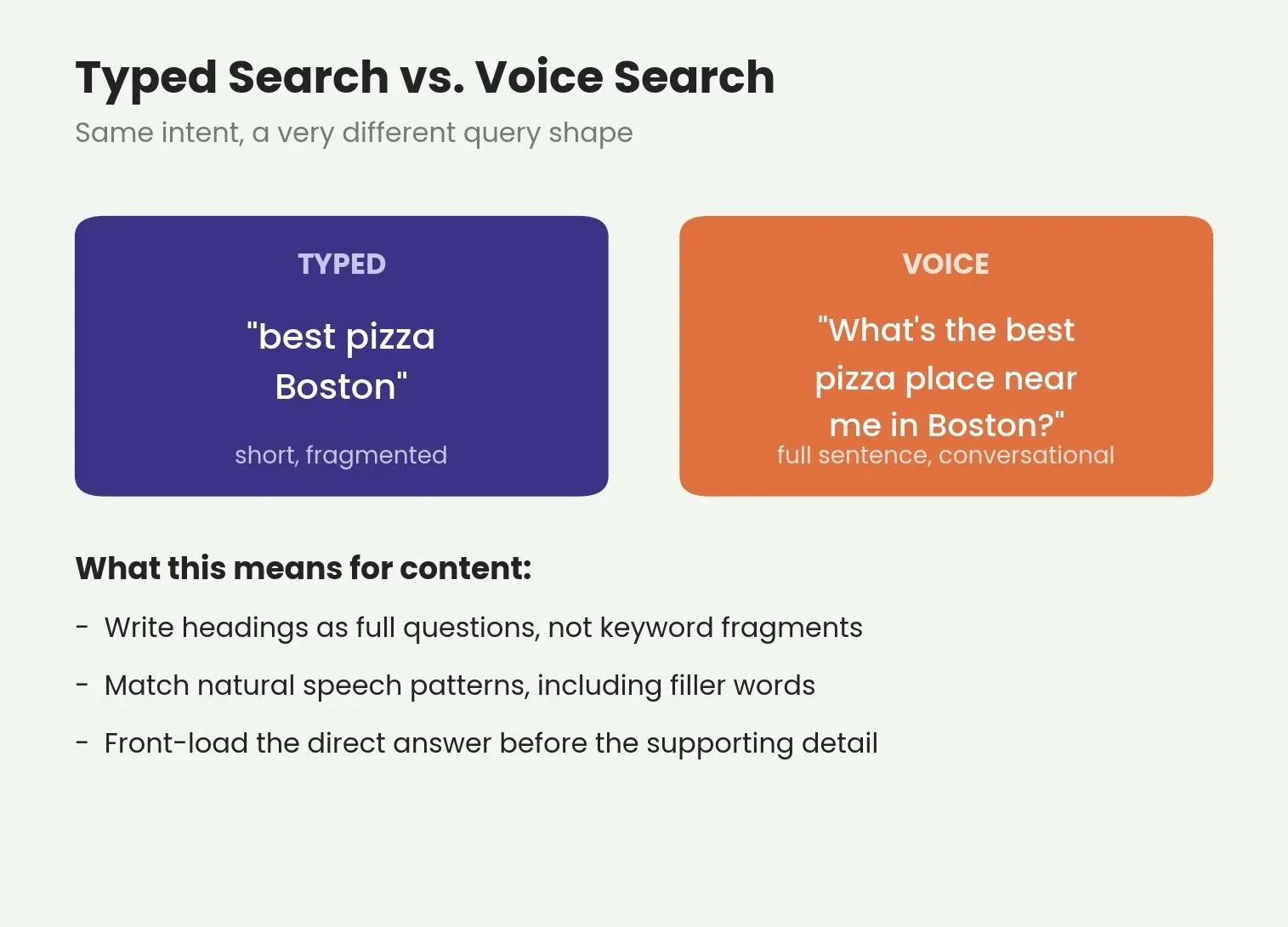
This shift changes what "ranking" means. Backlinko's analysis of 10,000 voice searches found that 40.7% of voice answers come from featured snippets, which means winning position zero for a target query often matters more than your average organic position across all your keywords. Voice and answer-engine optimization overlap almost entirely in practice: the structural work that gets a page read aloud by Google Assistant is largely the same work that gets it cited by an AI-generated answer.
Local businesses have the most to gain. Over half of consumers use voice search to find local businesses, whether that's "coffee shop near me" or "best Italian restaurant in London," and Google typically leans on your Google Business Profile and Google Maps data to answer those queries accurately, alongside your website's own content.
The Ranking Factors That Matter Most
A handful of factors decide whether your content gets picked as the spoken answer.
Conversational, question-based content. Pages written in natural language, organized around real questions people ask out loud, consistently outperform pages built around short-tail keywords.
Featured snippet ownership. Since voice assistants read from position zero far more often than any other position, snippet optimization is not optional for a serious voice search strategy.
Structured data. Schema markup gives search engines an explicit map of what your content answers, which reduces the guesswork involved in selecting your page as the source for a spoken result.
Site speed and mobile performance. Most voice searches originate on mobile devices, so a slow or poorly optimized mobile experience quietly disqualifies otherwise-strong content.
Local signals. For any query with local intent, consistent business name, address, and phone (NAP) details across platforms, alongside a healthy review profile, factor heavily into which business gets recommended.
How to Optimize for Voice Search, Step by Step
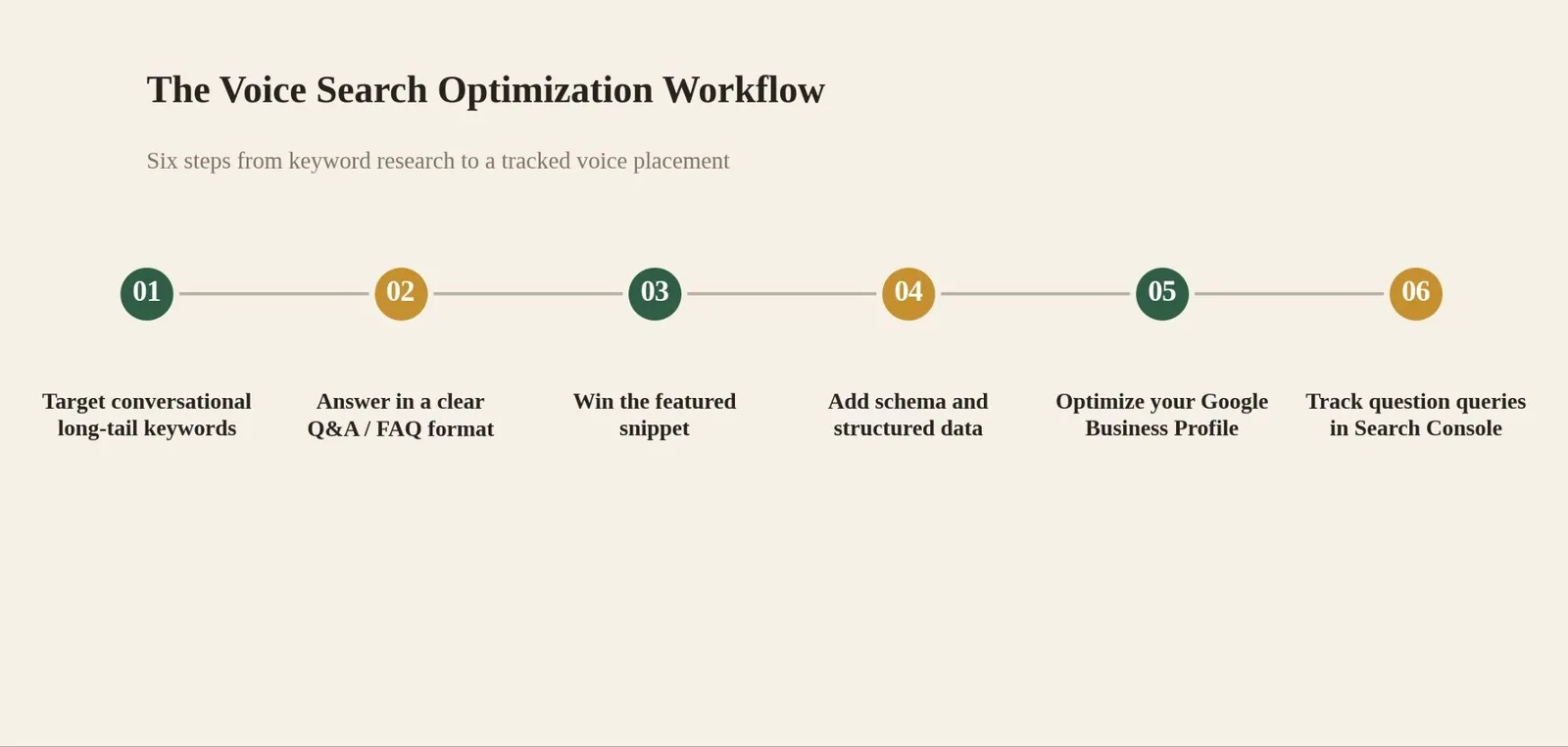
Step 1: Target Conversational, Long Tail Keywords
Start from real questions, not fragments. Instead of optimizing around "voice search SEO," build content around the full question a person would actually ask: "How do I optimize my website for voice search?" Long tail keywords carry less competition and match spoken queries far more closely than short-tail terms.
Step 2: Answer in a Clear Q&A Format
Structure your content so each section opens with a heading that mirrors a real question, followed immediately by a direct, self-contained answer. FAQ-style sections built this way are exactly what both featured snippets and voice assistants are built to extract.
Step 3: Win the Featured Snippet
Since the snippet is the answer voice assistants actually read, treat snippet acquisition as its own project: identify which of your target queries currently show a featured snippet, then rework your content specifically to match the format Google is already favoring for that query, whether that's a paragraph, a list, or a table.
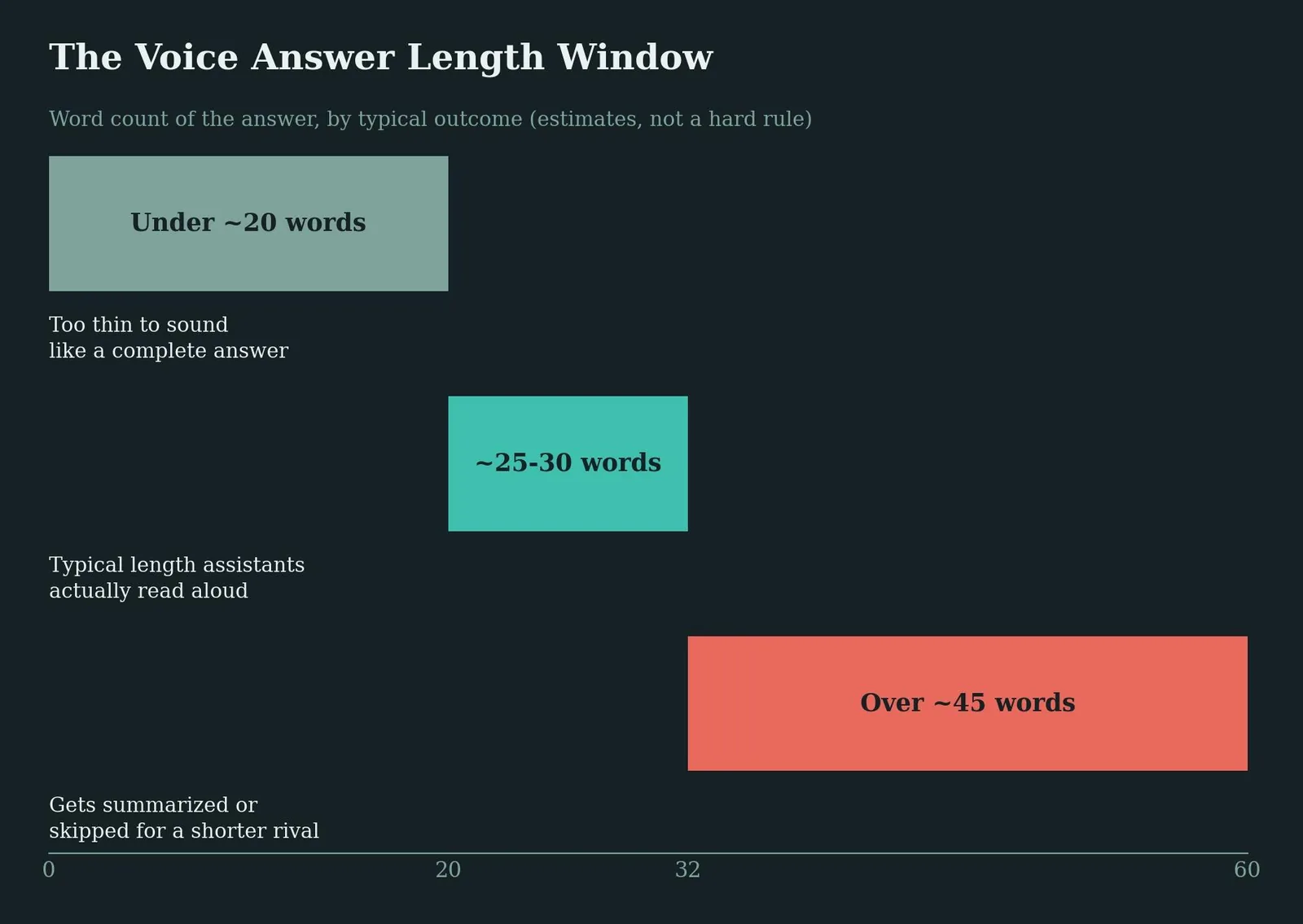
Backlinko's original study found the average voice search answer runs about 29 words, a benchmark that's held up as the reference point across the industry for years since.
Step 4: Add Structured Data
Implement FAQPage and HowTo schema markup wherever your content answers discrete questions or walks through a process. Structured data doesn't guarantee a voice placement on its own, but it removes ambiguity for the systems deciding which content answers which question.
Step 5: Optimize Your Google Business Profile
For any business with local intent in its search queries, keep your Google Business Profile complete and current: accurate hours, categories, photos, and a steady flow of reviews. Google Maps and Google Business Profile data are often what voice assistants lean on most heavily for "near me" style questions, ahead of your website content itself.
Step 6: Track Question Queries in Search Console
There's no dedicated "voice search" filter in Google Search Console or Google Analytics, so track question-shaped queries (who, what, where, when, why, how) as a proxy instead. Rising impressions on question queries, paired with featured snippet ownership, is the closest thing to a direct voice-visibility signal available today.
Voice Assistants Compared
Google Assistant, Siri, and Alexa don't pull from identical sources, which means a strategy built only around Google's ecosystem leaves gaps on the other two. Alexa has historically leaned on Bing as a primary web source, though Amazon has been integrating its own AI capabilities since 2024. Siri draws on Apple Maps and Yelp for local businesses and Wikipedia for general information, while Google Assistant relies most heavily on featured snippets and the Knowledge Graph.
Table 1: Voice Assistants Compared
| Assistant | Primary data sources | Best optimization focus |
|---|---|---|
| Google Assistant | Featured snippets, Knowledge Graph, Google Business Profile | Standard SEO best practices, snippet ownership |
| Siri | Apple Maps, Yelp, Wikipedia, structured web content | Local listings accuracy, Speakable schema |
| Alexa | Historically Bing, increasingly Amazon's own AI and multiple sources | Bing visibility, Alexa Skills, structured product data |
Voice Search Tools and Tactics Compared
Table 2: Voice Search Optimization Tactics Compared
| Tactic | What it targets | Cost | Where to start |
|---|---|---|---|
| Conversational keyword research | Long tail keywords and question phrases | Free-Paid | Google Search Console query report |
| Featured snippet optimization | Position zero for target queries | Free | Manual SERP review + on-page rewrite |
| FAQPage / HowTo schema | Structured data for Q&A and process content | Free | Google's Structured Data Markup Helper |
| Google Business Profile optimization | Local, "near me" voice queries | Free | Google Business Profile dashboard |
Common Mistakes That Keep Content Out of Voice Results
Short-tail keywords targeted instead of the full conversational phrase a person would actually speak.
A technically correct answer that runs too long or too hedged to work as a single spoken response.
Featured snippets ignored entirely while the focus stays fixed on overall ranking position.
A Google Business Profile left incomplete or outdated, which quietly disqualifies a local business from "near me" voice queries regardless of how strong its website content is.
Voice treated as a one-time project instead of an ongoing part of seo strategy, even as new discovery channels emerge. Voice assistants aren't the only place search behavior is fragmenting away from a single search box; separate 2026 research on platforms like TikTok shows a meaningful, if fluctuating, share of consumers now also use it for certain kinds of search, even though Google still leads by a wide margin overall.
Voice search tool
Is this page voice-search ready?
Answer four quick questions about a page you want assistants to read from. We'll score how ready it is.
Answer the questions above
Your readiness score will appear here once all four are answered.
Frequently Asked Questions
Is Voice Search Optimization Different From Regular SEO?
It's built on the same foundation but with a narrower target. Regular SEO competes for a ranked list of ten results. Voice search optimization competes to be the single answer read aloud, which puts much more weight on featured snippets, structured data, and question-matched content.
Do I Need to Rank Number One to Be Read Aloud by a Voice Assistant?
Not necessarily, but you typically need the featured snippet for that query, since that's the primary source voice assistants read from. A page can rank respectably overall and still lose the spoken answer to whichever page currently holds the snippet.
How Long Should a Voice Search Answer Be?
Aim for a tight, direct answer; Backlinko's original study of 10,000 voice searches puts the average around 29 words. Much shorter reads as incomplete, and much longer tends to get summarized or passed over for a more concise competing answer.
Does Google Business Profile Actually Affect Voice Search Results?
Yes, especially for local intent queries. Voice assistants lean heavily on Google Business Profile and Google Maps data to answer "near me" and location-based questions, often ahead of a business's own website content.
How Do I Measure Voice Search Performance if There's No Dedicated Report for It?
Use question-shaped queries in Google Search Console as a proxy, combined with your featured snippet ownership for those same queries. There's no native voice-search dimension in Google Analytics or Search Console, so this indirect approach is currently the most practical option.
The Bottom Line on Optimizing for Voice Search
Voice search rewards a different kind of content discipline than traditional SEO. Write full conversational questions rather than keyword fragments, aim for one direct answer rather than a page covering every angle, and use structured data to remove any ambiguity about what you're answering. None of it works without the technical basics: mobile speed, a clean site, and, for local businesses, a genuinely complete Google Business Profile.
Pick one query where you already show up in the results, check whether you hold the featured snippet for it, and rebuild that section around a single 25-to-30 word answer if you don't. That one change will tell you more about where your voice search gaps actually are than a full audit will.
Ready to Win More Voice Search Visibility?
Structuring content for voice search takes a different discipline than writing for typed search alone: conversational headings, snippet-focused answers, and structured data applied consistently across every page. Web Tonic's growth marketing team builds that structure into on-site SEO and content work from the start, so voice visibility isn't an afterthought bolted onto content that was never built for it.
More from Web Tonic: growth marketing services, data & analytics.
Sources: circlesstudio.com · backlinko.com · digitalapplied.com · seomator.com · teknoppy.com · improvado.io · ailabsaudit.com · searchenginejournal.com