Table of contents
Ask a smart speaker for the nearest coffee shop and it won't hand you ten blue links. It picks one answer, reads it out loud, and moves on. That's voice search in a sentence: no scrolling, no second page, one winner per question.
That shift changes what "ranking well" even means for your website. Voice search optimization is the practice of shaping your content so search engines and voice assistants can find it, trust it, and read it back as the answer. This guide covers how voice queries differ from typed ones, which platforms actually matter, and the concrete steps that help a page get chosen as the spoken answer.
Key Takeaways
- Voice search optimization means structuring content to be selected and read aloud as a single answer, not just to rank on a results page.
- About 20.5 percent of people worldwide now use voice search, and roughly 35 percent of US adults own a smart speaker.
- 76 percent of voice searches carry local intent ("near me," "closest," "open now"), which makes an optimized Google Business Profile one of the highest-leverage assets a business has.
- Google Assistant and Siri each hold about 36 percent of US voice assistant usage, with Amazon Alexa at roughly 25 percent, so most optimization work should target Google's own index rather than any single hardware platform.
- Voice queries are typically short, conversational questions, but the pages that win them tend to be long, comprehensive, and clearly structured, not short and thin.
- Featured snippets and clean structured data are the two levers with the most direct influence over whether your content gets read aloud as the answer — though FAQ schema itself no longer produces a visible Google result.
What Is Voice Search Optimization?
Voice search optimization is the process of adapting a website's content, structure, and technical setup so it can be found, understood, and selected as the spoken answer to a voice query. It shares a foundation with traditional SEO — keywords, backlinks, page speed — but adds a layer built around how people actually talk versus how they type. Some teams simply call this practice voice SEO; the two terms describe the same work.
The scale of that audience is no longer niche. DemandSage's research puts global voice search usage at around 20.5 percent of people, with the installed base of voice assistants worldwide now estimated in the billions of active devices.
The core difference comes down to phrasing. A typed search might be "best coffee shop London." A voice query for the same need is more likely to be "what's the best coffee shop near me right now," using natural language and full sentences rather than fragments. Spoken questions also tend to run longer and more specific than typed ones — exactly the territory long-tail keywords cover. Same intent, completely different shape, and that difference drives almost every recommendation in this guide.
Why Voice Search Optimization Matters
Why Voice Search Optimization Matters
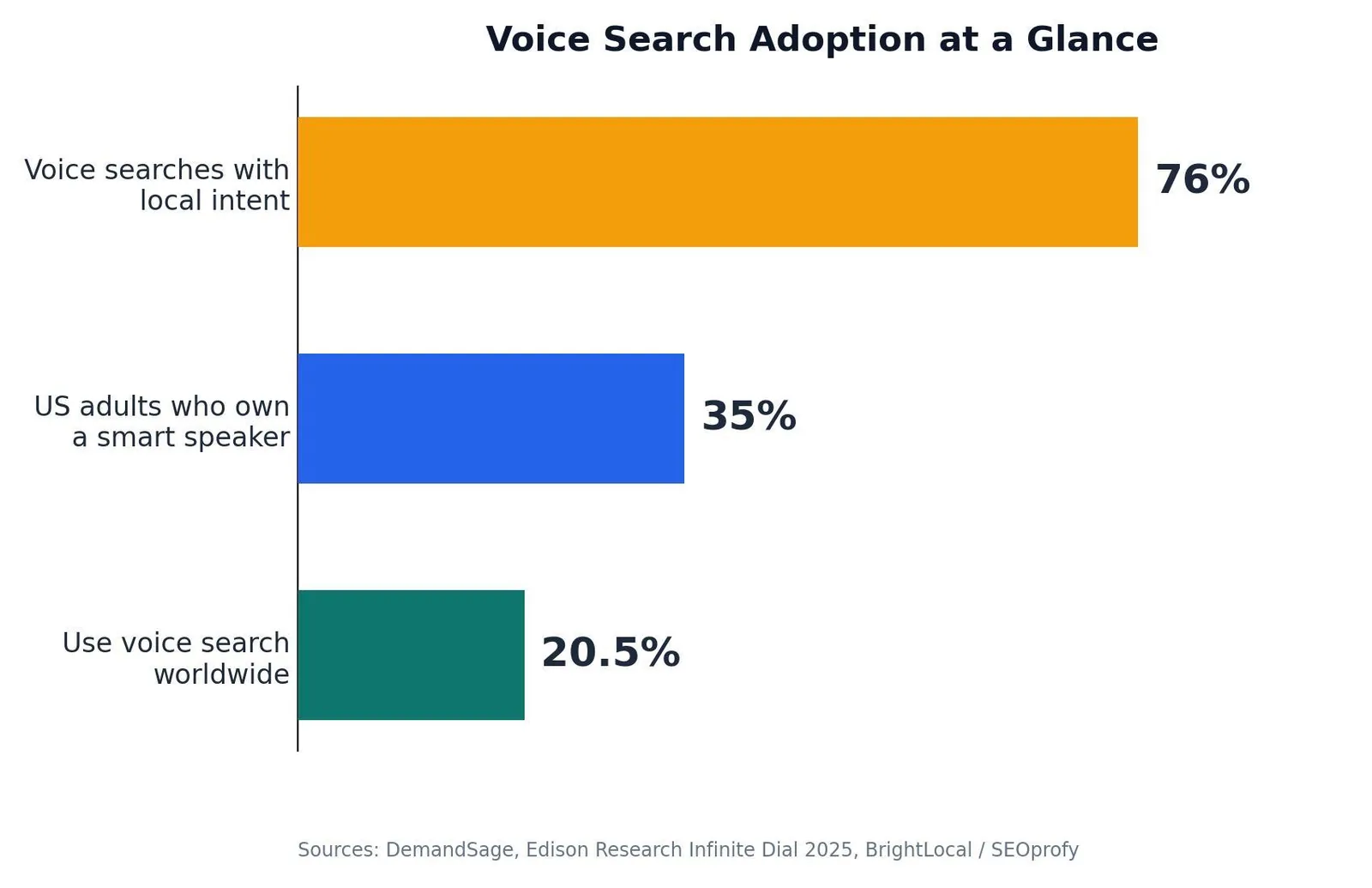
Three numbers explain why this deserves a dedicated strategy rather than an afterthought inside a general SEO plan. Voice adoption sits at roughly 20.5 percent globally. US smart speaker ownership holds around 35 percent, according to Edison Research's Infinite Dial 2025 data. And local intent dominates the query mix: 76 percent of smart speaker owners use voice for local, "near me" searches every week, per BrightLocal's voice search research.
Put together, that means voice search isn't a separate audience to chase. It's the same audience asking the same questions in a format that rewards a different kind of answer.
Voice Search vs. Text Search: Key Differences
| h3 id="h.1bpwsq4q5006-2" style="padding-top:14pt;margin:0;color:#434343;padding-left:0;font-size:14pt;padding-bottom:4pt;line-height:1.15;page-break-after:avoid;font-family:"Arial";orphans:2;widows:2;text-align:center;padding-right:0">Factor/h3> | h3 id="h.1bpwsq4q5006-3" style="padding-top:14pt;margin:0;color:#434343;padding-left:0;font-size:14pt;padding-bottom:4pt;line-height:1.15;page-break-after:avoid;font-family:"Arial";orphans:2;widows:2;text-align:center;padding-right:0">Text search/h3> | h3 id="h.1bpwsq4q5006-4" style="padding-top:14pt;margin:0;color:#434343;padding-left:0;font-size:14pt;padding-bottom:4pt;line-height:1.15;page-break-after:avoid;font-family:"Arial";orphans:2;widows:2;text-align:center;padding-right:0">Voice search/h3> |
|---|---|---|
| h3 id="h.1bpwsq4q5006-5" style="padding-top:14pt;margin:0;color:#434343;padding-left:0;font-size:14pt;padding-bottom:4pt;line-height:1.15;page-break-after:avoid;font-family:"Arial";orphans:2;widows:2;text-align:left;padding-right:0">Query length/h3> | h3 id="h.1bpwsq4q5006-6" style="padding-top:14pt;margin:0;color:#434343;padding-left:0;font-size:14pt;padding-bottom:4pt;line-height:1.15;page-break-after:avoid;font-family:"Arial";orphans:2;widows:2;text-align:left;padding-right:0">Short, keyword-style ("coffee shop London")/h3> | h3 id="h.1bpwsq4q5006-7" style="padding-top:14pt;margin:0;color:#434343;padding-left:0;font-size:14pt;padding-bottom:4pt;line-height:1.15;page-break-after:avoid;font-family:"Arial";orphans:2;widows:2;text-align:left;padding-right:0">Longer, full sentence ("what's the best coffee shop near me")/h3> |
| h3 id="h.1bpwsq4q5006-8" style="padding-top:14pt;margin:0;color:#434343;padding-left:0;font-size:14pt;padding-bottom:4pt;line-height:1.15;page-break-after:avoid;font-family:"Arial";orphans:2;widows:2;text-align:left;padding-right:0">Phrasing/h3> | h3 id="h.1bpwsq4q5006-9" style="padding-top:14pt;margin:0;color:#434343;padding-left:0;font-size:14pt;padding-bottom:4pt;line-height:1.15;page-break-after:avoid;font-family:"Arial";orphans:2;widows:2;text-align:left;padding-right:0">Fragmented, keyword-focused/h3> | h3 id="h.1bpwsq4q5006-10" style="padding-top:14pt;margin:0;color:#434343;padding-left:0;font-size:14pt;padding-bottom:4pt;line-height:1.15;page-break-after:avoid;font-family:"Arial";orphans:2;widows:2;text-align:left;padding-right:0">Conversational, question-based ("who," "what," "where," "how")/h3> |
| h3 id="h.1bpwsq4q5006-11" style="padding-top:14pt;margin:0;color:#434343;padding-left:0;font-size:14pt;padding-bottom:4pt;line-height:1.15;page-break-after:avoid;font-family:"Arial";orphans:2;widows:2;text-align:left;padding-right:0">Typical intent/h3> | h3 id="h.1bpwsq4q5006-12" style="padding-top:14pt;margin:0;color:#434343;padding-left:0;font-size:14pt;padding-bottom:4pt;line-height:1.15;page-break-after:avoid;font-family:"Arial";orphans:2;widows:2;text-align:left;padding-right:0">Mixed, browsing common/h3> | h3 id="h.1bpwsq4q5006-13" style="padding-top:14pt;margin:0;color:#434343;padding-left:0;font-size:14pt;padding-bottom:4pt;line-height:1.15;page-break-after:avoid;font-family:"Arial";orphans:2;widows:2;text-align:left;padding-right:0">Immediate, often local or urgent/h3> |
| h3 id="h.1bpwsq4q5006-14" style="padding-top:14pt;margin:0;color:#434343;padding-left:0;font-size:14pt;padding-bottom:4pt;line-height:1.15;page-break-after:avoid;font-family:"Arial";orphans:2;widows:2;text-align:left;padding-right:0">Answer format needed/h3> | h3 id="h.1bpwsq4q5006-15" style="padding-top:14pt;margin:0;color:#434343;padding-left:0;font-size:14pt;padding-bottom:4pt;line-height:1.15;page-break-after:avoid;font-family:"Arial";orphans:2;widows:2;text-align:left;padding-right:0">A results page to scan/h3> | h3 id="h.1bpwsq4q5006-16" style="padding-top:14pt;margin:0;color:#434343;padding-left:0;font-size:14pt;padding-bottom:4pt;line-height:1.15;page-break-after:avoid;font-family:"Arial";orphans:2;widows:2;text-align:left;padding-right:0">One direct, spoken answer/h3> |
| h3 id="h.1bpwsq4q5006-17" style="padding-top:14pt;margin:0;color:#434343;padding-left:0;font-size:14pt;padding-bottom:4pt;line-height:1.15;page-break-after:avoid;font-family:"Arial";orphans:2;widows:2;text-align:left;padding-right:0">Best content structure/h3> | h3 id="h.1bpwsq4q5006-18" style="padding-top:14pt;margin:0;color:#434343;padding-left:0;font-size:14pt;padding-bottom:4pt;line-height:1.15;page-break-after:avoid;font-family:"Arial";orphans:2;widows:2;text-align:left;padding-right:0">Traditional headers and paragraphs/h3> | h3 id="h.1bpwsq4q5006-19" style="padding-top:14pt;margin:0;color:#434343;padding-left:0;font-size:14pt;padding-bottom:4pt;line-height:1.15;page-break-after:avoid;font-family:"Arial";orphans:2;widows:2;text-align:left;padding-right:0">Question-based headers with a direct answer up top/h3> |
| h3 id="h.1bpwsq4q5006-20" style="padding-top:14pt;margin:0;color:#434343;padding-left:0;font-size:14pt;padding-bottom:4pt;line-height:1.15;page-break-after:avoid;font-family:"Arial";orphans:2;widows:2;text-align:left;padding-right:0">Ranking goal/h3> | h3 id="h.1bpwsq4q5006-21" style="padding-top:14pt;margin:0;color:#434343;padding-left:0;font-size:14pt;padding-bottom:4pt;line-height:1.15;page-break-after:avoid;font-family:"Arial";orphans:2;widows:2;text-align:left;padding-right:0">Top 10 positions/h3> | h3 id="h.ac4ruldt5evp" style="padding-top:14pt;margin:0;color:#434343;padding-left:0;font-size:14pt;padding-bottom:4pt;line-height:1.15;page-break-after:avoid;font-family:"Arial";orphans:2;widows:2;text-align:left;padding-right:0">Featured snippet or position zero/h3> |
Which Voice Assistant Are You Optimizing For?
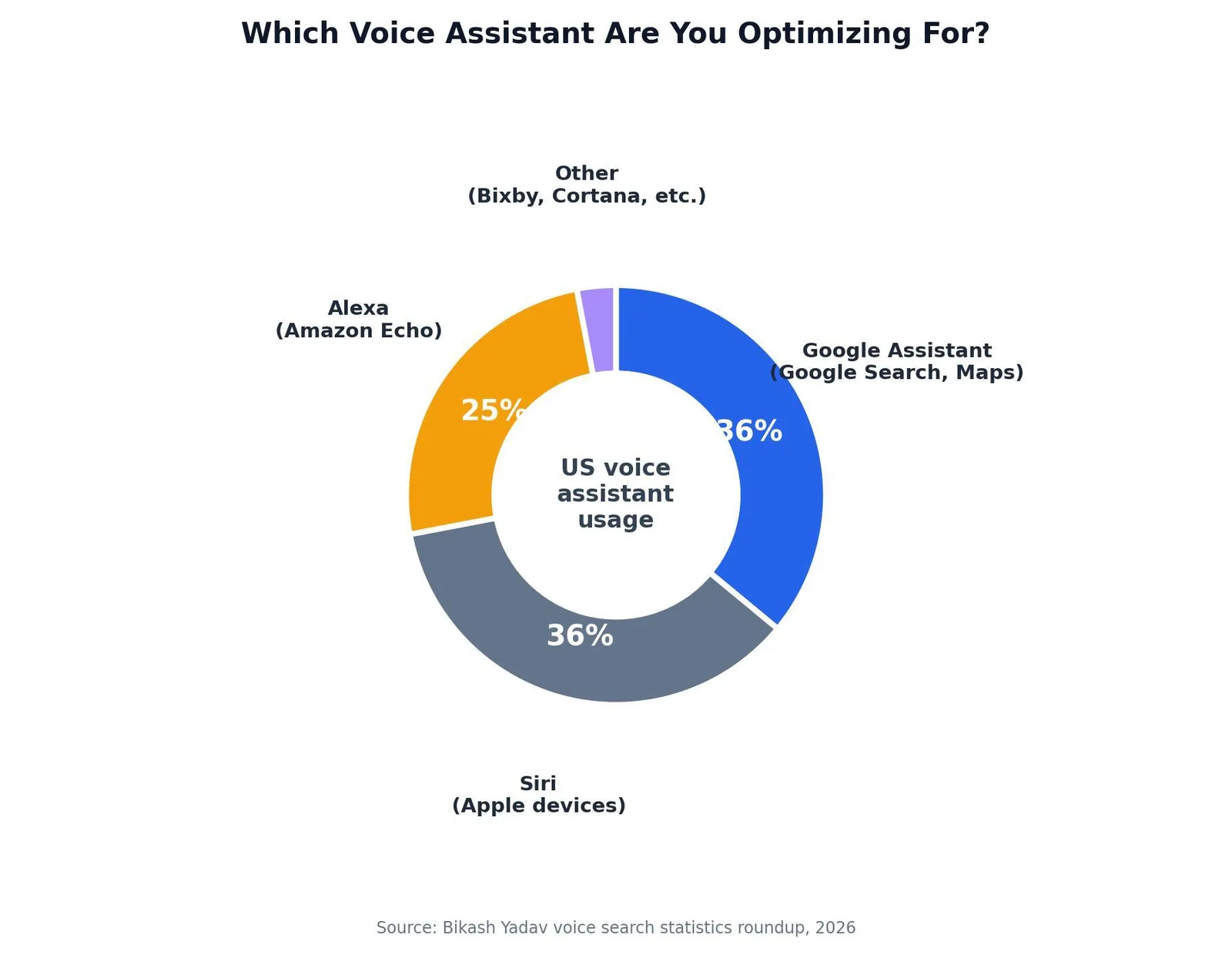
Google Assistant and Siri are essentially tied at the top of the global voice assistant market, each holding about 36 percent share, according to DemandSage's data, with Amazon Alexa trailing in third place at roughly 25 percent. That split matters less than it seems. Google Assistant and Google's own voice results pull directly from the same index that traditional SEO already targets, so most of the optimization work here reinforces work you'd want to do anyway, including gains in standard SERP features like featured snippets.
Siri SEO works differently. Siri leans on Apple Maps and Yelp data for local answers rather than Google's index, which is another reason a complete, accurate Google Business Profile alone isn't the whole picture for Apple device users. Alexa, built by Amazon, was designed primarily as a smart home and shopping assistant rather than a general search tool, so it tends to matter most for e-commerce and voice commerce use cases rather than informational content.
The Voice Search Answer Funnel
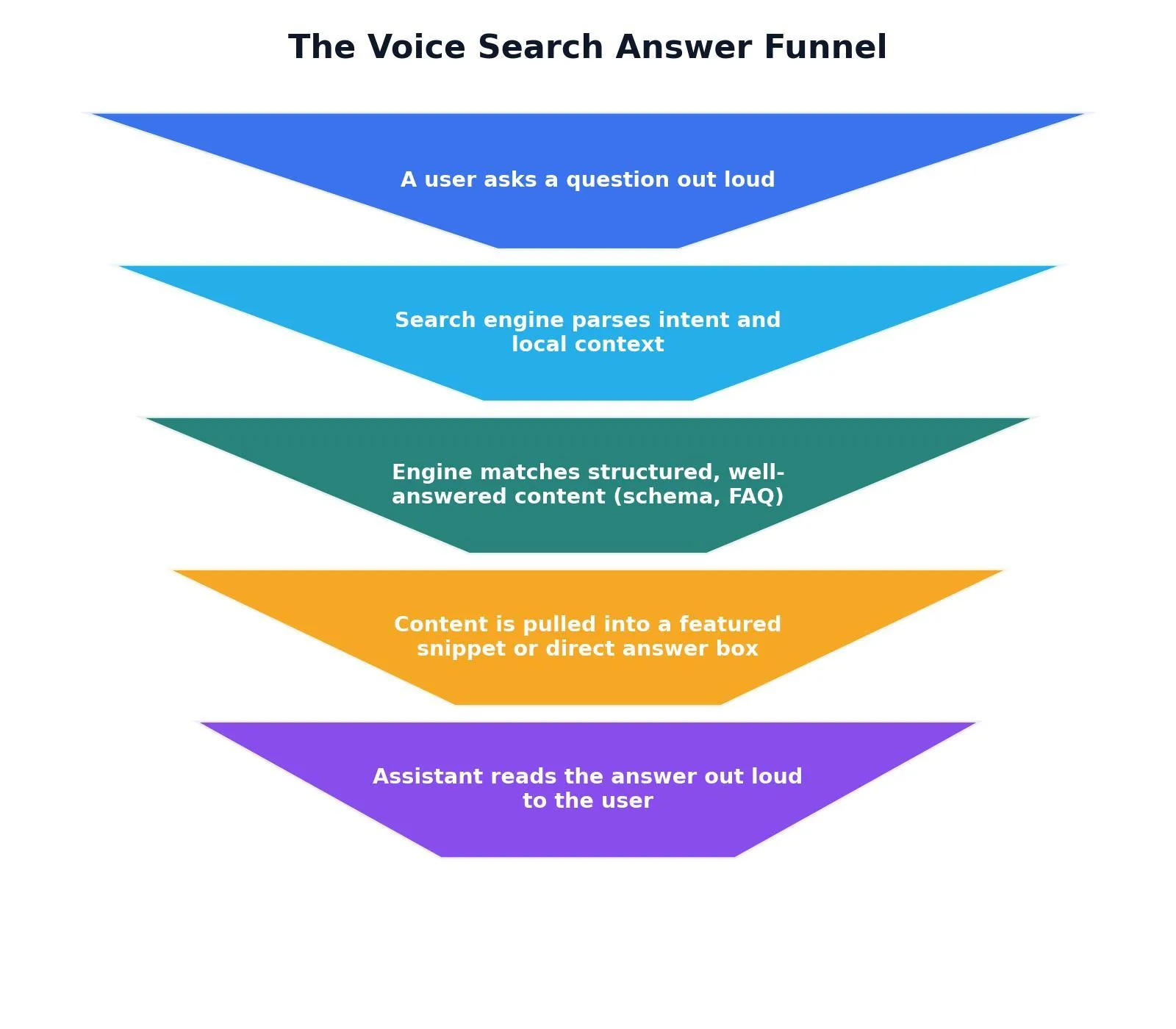
Every spoken answer follows the same path. A user asks a question out loud, the search engine parses the intent and any local context behind it, then matches that intent against content that's structured and clearly answered. The winning content gets pulled into a featured snippet or direct answer box, and the assistant reads that answer back word for word. Miss any one of those steps and the content never gets read aloud, no matter how good it is.
Get every step right, and your content stops competing for a spot on a page. It becomes the one answer spoken back to the user.
How to Optimize for Voice Search
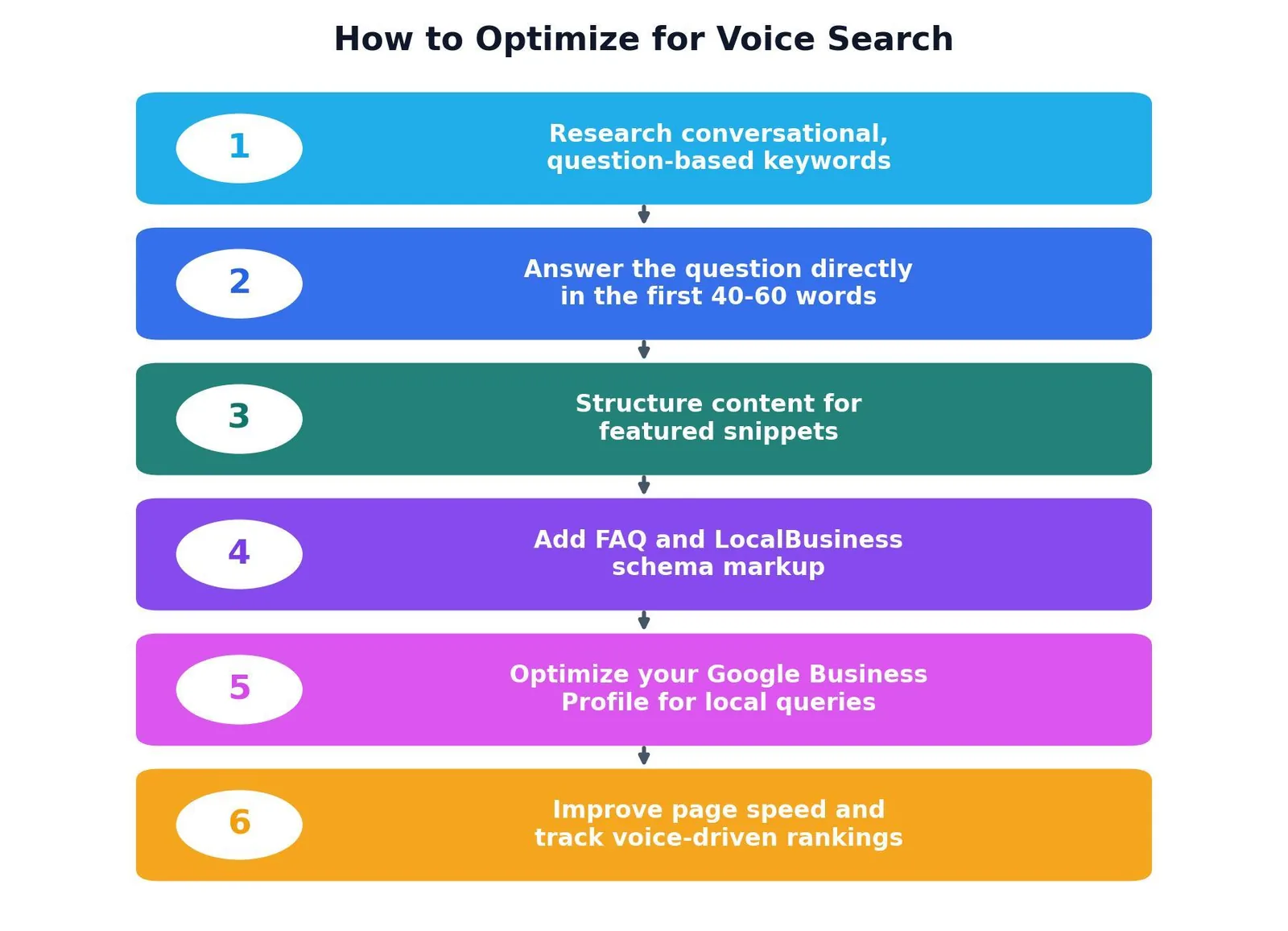
Step 1: Research conversational, long-tail keywords
Traditional keyword research targets short phrases. Voice research should target full questions built on long-tail keywords: "how," "what," "where," and "can I" style phrasing that matches how someone would actually ask the question out loud, not how they'd type it. That specificity is exactly what helps search engines match the right page to the right question.
Step 2: Answer the question directly in the first 40-60 words
Voice assistants read a short answer, not a full article. Put the direct answer to the target question immediately after the relevant heading, then use the rest of the section to add depth for readers who want more.
Step 3: Structure content for featured snippets
Featured snippets are where a large share of voice answers come from. Clear headers, concise definitions, and short, well-formatted lists all increase the odds that Google's algorithm selects your content as the snippet worth reading aloud.
Step 4: Add LocalBusiness and Organization schema markup
Structured data still gives search engines and AI systems a machine-readable signal about what a page answers and who it belongs to — but the payoff looks different than it did a year ago. Google retired the FAQ rich result entirely, according to Google's own Search Central changelog, so FAQ schema no longer produces the expandable dropdown that used to appear directly in search results. FAQPage markup is still valid schema.org vocabulary, and it can still help organize question-and-answer content for readers, but it's no longer the visibility lever it once was. LocalBusiness and Organization schema haven't been touched by this change, and Search Engine Land's reporting on schema and AI search notes that Google has confirmed structured data still helps AI Overviews understand and select content. For voice, that means LocalBusiness schema remains one of the more reliable ways to reinforce the same address, hours, and category information an assistant pulls from a Google Business Profile.
Step 5: Optimize your Google Business Profile for local queries
With 76 percent of voice searches carrying local intent, a complete, accurate, regularly updated Google Business Profile (correct address, phone number, hours, categories, and an accurate pin on Google Maps) often has more impact on voice visibility than any single piece of written content. A London business with a complete profile and a consistent name, address, and phone number across the web can win a "near me" query even in a crowded market.
Step 6: Improve page speed and track voice-driven rankings
Slow pages get skipped over in the milliseconds it takes an assistant to pick an answer. Pair speed improvements with regular tracking in Google Search Console to see whether your featured snippet and question-based rankings are actually moving.
Voice search tool
Is this page ready for voice search?
Check off what this page already does. Your score updates as you go.
0 of 5
Check off items above to see how voice-ready this page is.
Common Voice Search Optimization Mistakes to Avoid
The most common gap is writing for typed keywords instead of spoken questions — often invisible until you actually test how a page reads out loud.
An incomplete or outdated Google Business Profile undercuts local voice visibility even when the rest of a site is well optimized, given how much of voice search leans on local intent.
Skipping structured data entirely leaves search engines and AI systems to infer what a page is about instead of being told directly. That gap matters less for FAQ markup now that Google has retired the FAQ rich result, but it still puts a site at a disadvantage for LocalBusiness schema and for the kind of structured entity information Google's AI Overviews increasingly rely on.
Treating voice optimization as a one-time project is the last common mistake, and it misses how often assistants — and the structured-data features they depend on — get updated.
The Bottom Line on Voice Search Optimization
Voice search doesn't reward more content; it rewards clearer content. A page that answers one question directly, backs that answer with solid structure and schema, and keeps its Google Business Profile accurate has a real shot at being the one answer an assistant reads out loud. Everything else is still just competing for space on a page nobody using voice search will ever see.
Start with your highest-traffic page. Add a direct answer in the first sentences, add LocalBusiness or Organization schema if it's missing, and check that your Google Business Profile is complete. From there, this guide's six-step process scales to the rest of the site.
Frequently Asked Questions
What's the difference between SEO and voice search optimization?
Traditional SEO targets ranking well on a results page a person scans. Voice search optimization targets being selected as the single spoken answer, which means prioritizing direct answers, question-based structure, and structured data on top of standard SEO fundamentals.
Does voice search optimization require a different keyword strategy?
Yes, in phrasing more than substance. The underlying intent is usually the same as a typed search, but voice keyword research should center on full, natural questions rather than short keyword fragments.
How important is local SEO for voice search?
Very. With roughly 76 percent of voice searches carrying local intent, an optimized Google Business Profile is one of the highest-impact assets a business can maintain for voice visibility.
Do I need schema markup for voice search to work?
Not for the reason it's often pitched. Google retired the FAQ rich result in May 2026, so FAQ schema no longer creates the expandable dropdown that used to appear in Google's results. LocalBusiness and Organization schema still matter, though: they give search engines and AI Overviews a direct, structured signal about who a business is and where it's located, which increases the odds that voice assistants surface accurate information.
Ready to Be the Answer Voice Search Reads Out Loud?
Getting your content structured for featured snippets, your schema markup in place, and your Google Business Profile fully optimized is a lot to coordinate without a dedicated process. Web Tonic's growth marketing team handles the technical SEO, local optimization, and AI visibility work covered in this playbook as part of a full-funnel approach that also connects it to paid acquisition and attribution, so voice search isn't competing for attention against the rest of your marketing.
More from Web Tonic: growth marketing services, data & analytics.
Sources: demandsage.com · edisonresearch.com · brightlocal.com · developers.google.com · searchengineland.com