Table of contents
Publishing one blog post per keyword eventually produces a site full of near-duplicate pages competing against each other for the same search intent. Keyword clustering fixes that by grouping related search terms into a single topic before a single word gets written, so one well-built page can rank for dozens of variations instead of a dozen thin pages fighting for the same spot. Building well-formed keyword clusters is also one of the more direct ways to establish topical authority, since search engine optimization increasingly rewards sites that cover a subject completely rather than scattering high quality content across dozens of thin, overlapping pages. Whether you're organizing keywords for a blog, a SaaS site, or an Amazon storefront, the underlying logic behind this keyword clustering process is the same.
This guide covers how to cluster keywords using both major methods, when to do it manually versus with a keyword clustering tool, and the mistakes that cause clean-looking clusters to still underperform against top search competitors.
Key Takeaways
- Keyword clustering groups related search terms into a single topic so one page can target several variations instead of competing pages splitting the same search intent.
- There are two main clustering methods: SERP-based clustering groups keywords that share ranking URLs, and NLP-based clustering groups keywords by linguistic similarity, even when their search results don't overlap.
- A common SERP overlap threshold is around 30% shared URLs in the top 10 results, though the exact figure varies by tool and is usually adjustable.
- SERP-based clustering mirrors actual Google ranking behavior and is generally more reliable for search intent matching, while NLP-based clustering is faster and better suited to early-stage topic brainstorming.
- For lists under roughly 300 keywords, a structured prompt to an AI tool like Claude or ChatGPT can produce a usable first-pass cluster in under a minute, though it should still be checked against real search results.
- Keywords that look similar in text can trigger completely different search results and need separate clusters, which is exactly the kind of mismatch a pure NLP approach can miss.
What keyword clustering actually is
Keyword clustering is the process of grouping keywords that share the same underlying search intent so they can be targeted by a single piece of content instead of several competing pages. The output of a clustering process is a set of topic groups, each one representing a page worth building, rather than a flat, unorganized keyword list.
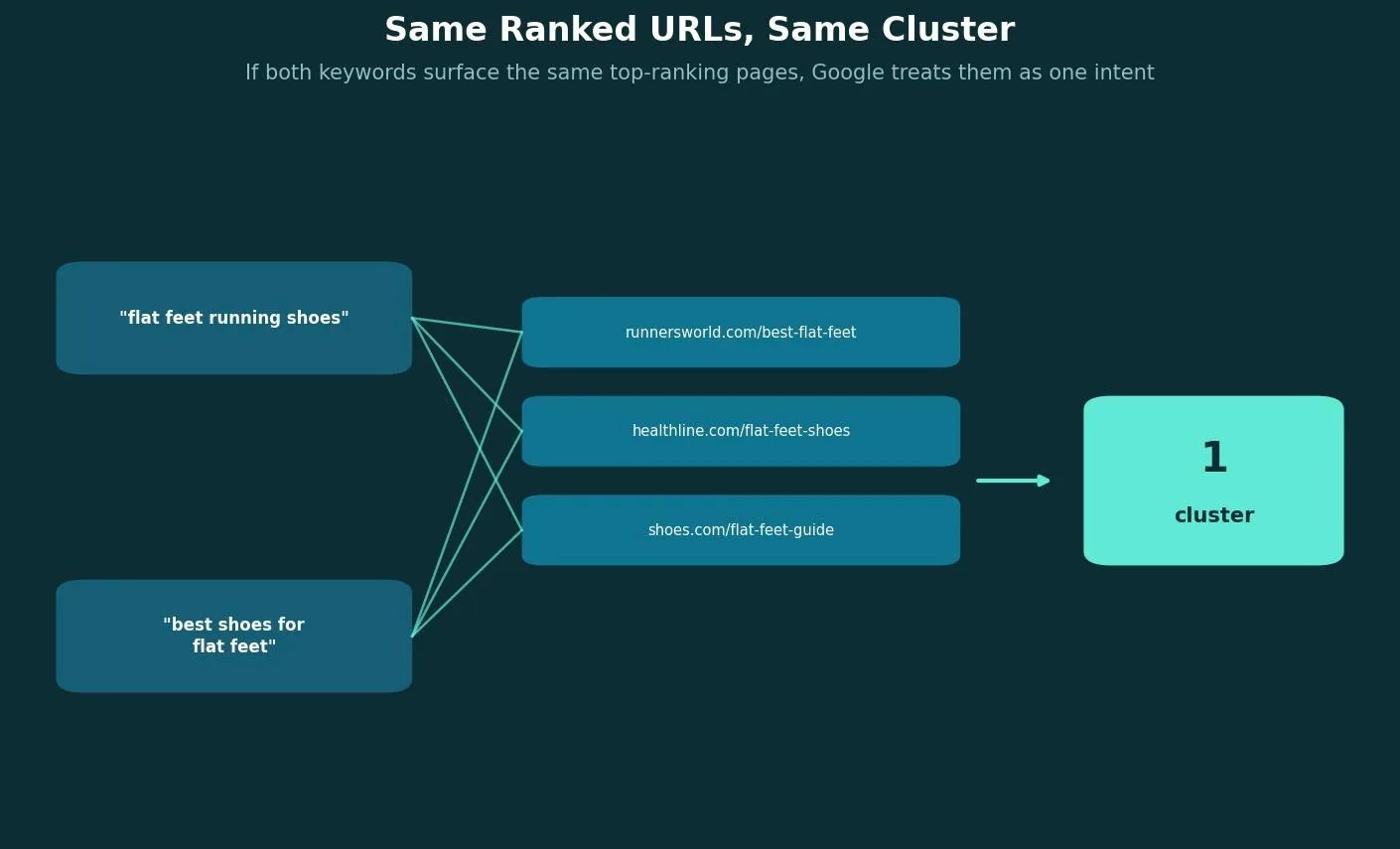
There are two fundamentally different ways to do this. SERP-based clustering checks which URLs actually rank for each keyword and groups keywords that share enough of those ranking pages, since search engines showing the same results for two different queries is the clearest signal that Google treats them as one intent. NLP-based clustering instead compares the keywords themselves using natural language processing, grouping terms that are semantically related even if their search results haven't converged. A commonly cited example of why this distinction matters: "apple care" and "apple care number" look almost identical as text, but one is about a warranty program and the other is a support contact search, and they return different search results entirely.
SERP-based versus NLP-based clustering

SERP-based clustering has the advantage of mirroring exactly what a search engine already believes about keyword relationships, since it works directly from the ranked results rather than inferring intent from wording. It tends to be the more reliable method for search intent matching and works especially well in established niches with plenty of existing content and clear ranking patterns. Its weak point shows up in newer or thinner niches, where search results haven't stabilized enough for URL overlap to mean much yet.
NLP-based clustering approaches the same problem from the opposite direction, comparing the language of the keywords themselves rather than what currently ranks for them. This makes it useful for brainstorming, expanding a topic into related questions, and building out FAQ sections, since it can surface conceptually related terms before the search results catch up. The tradeoff is that a pure NLP approach can merge keywords that read as similar but actually serve different search intent, producing clusters that look tidy on paper but don't hold up against real search behavior.
Clustering method by approach
| Method | How it works | Best for | Watch out for |
|---|---|---|---|
| SERP-based | Groups keywords sharing ranking URLs | Production content, established niches | Thin or new SERPs with no stable pattern |
| NLP-based | Groups keywords by linguistic similarity | Brainstorming, FAQ expansion, ideation | Merging keywords with different actual intent |
| Hybrid | Uses NLP to expand, SERP data to validate | Most production workflows at scale | Extra setup time versus a single-method tool |
The manual clustering process, step by step
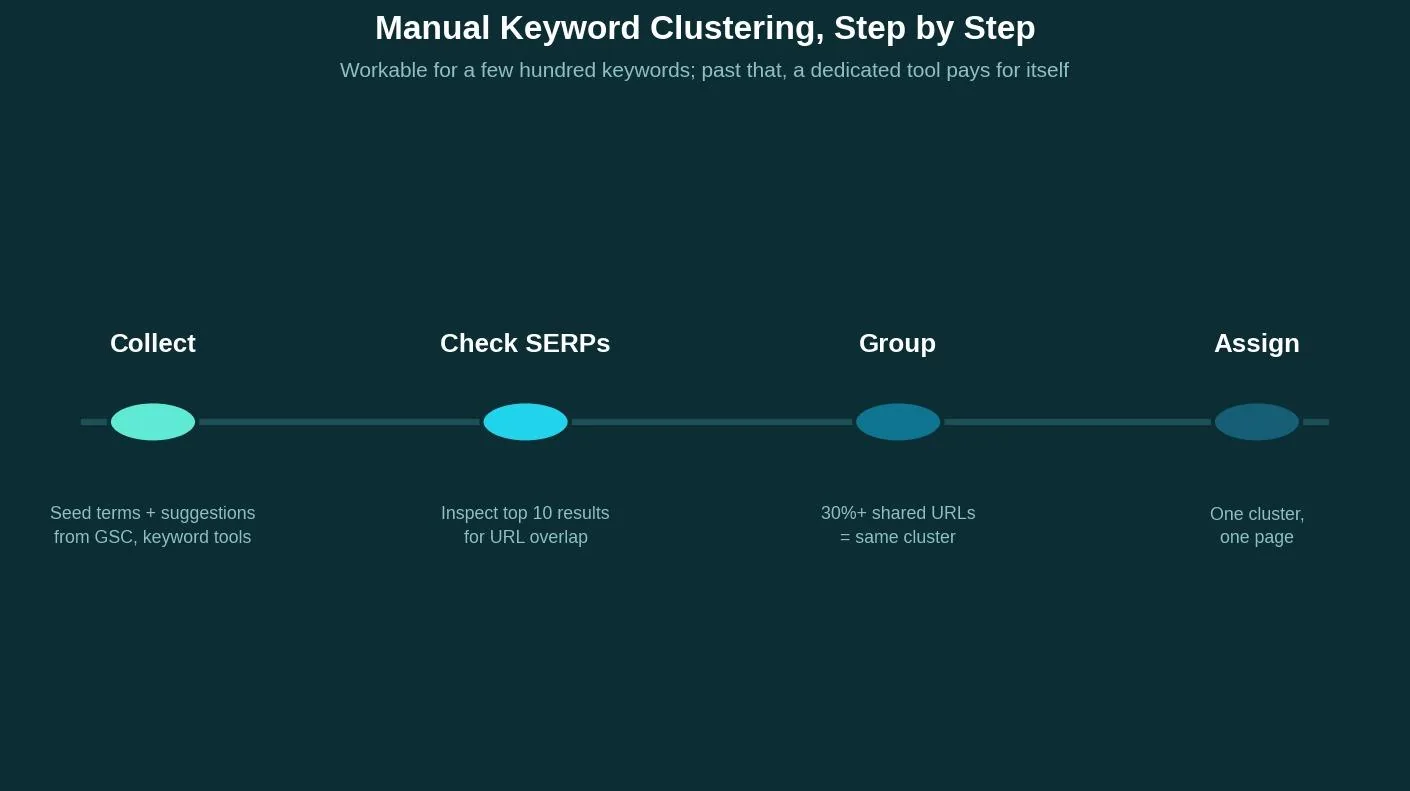
For a smaller keyword list, clustering by hand in a spreadsheet is entirely workable. Start by collecting seed terms and their suggested variations from a keyword tool or Google Search Console. Next, check the actual search results for each keyword, looking specifically at which URLs appear in the top 10. Group keywords together once they share a meaningful share of those ranking URLs, commonly somewhere around 30 percent overlap, though there's no universally fixed threshold. Once the groups are set, assign each cluster to a single planned page rather than letting overlapping clusters compete against each other. This process works well for a few hundred keywords; past that, the manual review time stops being worth it compared to a dedicated clustering tool.
Try it: which clustering method fits your list?
Answer two quick questions about your keyword list to get a starting recommendation.
Content strategy tool
Which clustering method fits your list?
Answer two questions about your keyword list.
Recommendation
Using AI tools to speed up clustering
For smaller lists, a structured prompt to an AI tool such as Claude or ChatGPT can produce a workable first-pass cluster in well under a minute. That's useful for quick topic ideation before committing to a full research pass. The prompt needs to be specific: ask the model to group a provided keyword list into topical sets based on shared search intent, and to flag any keywords it's uncertain about rather than forcing every term into a cluster. This kind of AI-based clustering is fast and flexible, but it works from language similarity rather than actual search engine results, so it inherits the same blind spot as any other NLP-based approach. Treat its output as a draft to validate against real SERPs, not a finished cluster ready for content briefs.
Common keyword clustering mistakes
Relying entirely on SERP-based clustering in a brand-new or thin niche produces unreliable groups, since the search results this method depends on haven't settled into a stable pattern yet.
Trusting NLP-based clusters without checking them against actual search results risks merging keywords with genuinely different intent into the same page, the exact failure the apple care example illustrates.
Treating keyword clustering as a one-time exercise, rather than revisiting clusters as search results shift and new keywords emerge, lets cannibalization risks build up quietly over time.
Skipping the step of assigning each cluster to a specific page turns a clean clustering exercise into just another list, with no actual content plan attached to it.
Tools for clustering keywords at scale
Manual spreadsheet work handles small lists well but doesn't scale past a few hundred keywords before the review time becomes the bottleneck. Dedicated SERP-based clustering tools pull live search results for every keyword in a list and group them by URL overlap automatically, with most offering an adjustable sensitivity setting to control how strict that overlap needs to be; a solid keyword clustering tool will also export the finished keyword groups as a CSV so they drop straight into a content calendar. Free options exist for occasional projects, though most cap out well before the volume a busy content team needs. Several SEO suites now build a cluster tool directly into their existing keyword research workflow, so a keyword list can be clustered without exporting to a separate platform. Search volume data carries over naturally in tools that handle discovery and clustering in the same interface. For very large keyword lists, tens of thousands of terms, dedicated clustering platforms built specifically for that scale process the list faster than general-purpose SEO suites not built for that kind of volume. Whichever tool helps most with your specific workflow, the goal stays the same: a keyword strategy organized around real topics and consistent keyword grouping, not a flat list of unrelated terms.
Frequently asked questions
What is the difference between SERP-based and NLP-based keyword clustering?
SERP-based clustering groups keywords that share the same ranking URLs in search results, directly reflecting how a search engine already treats those keywords. NLP-based clustering groups keywords by linguistic and semantic similarity using natural language processing. That can identify related terms even before search results converge, but it risks merging keywords with different actual intent.
What percentage of URL overlap counts as a cluster?
There's no single fixed threshold; many tools default to around 30 percent shared URLs in the top 10 results, though this is typically adjustable, and some platforms use different fixed percentages.
Can I cluster keywords manually without a tool?
Yes, for smaller lists. Check the top 10 search results for each keyword, group keywords that share enough ranking URLs, and assign each resulting group to one planned page. This becomes impractical for large keyword lists where review time outweighs the benefit.
Is AI-based keyword clustering accurate enough to use directly?
It's useful for a fast first pass, especially on smaller lists, but AI and NLP-based clustering groups by language similarity rather than actual search results, so its output should be checked against real SERPs before being finalized into content briefs.
How many keywords should be in one cluster?
There's no fixed number; a cluster should include exactly the keyword variations that share the same search intent and belong on a single page. That can range from a handful of terms to dozens depending on the topic.
Building clusters that hold up against real search behavior
Keyword clustering works when it reflects how search engines actually treat a set of queries, not just how similar those queries look as text. SERP-based clustering and NLP-based clustering solve different parts of the same problem, and the strongest workflows use both: NLP for broadening a topic and generating ideas, SERP data for confirming which of those ideas actually belong on the same page. None of the mechanics here are complicated. What separates a set of clusters that produces real rankings from one that just looks organized is checking the clustering decisions against actual search results before committing content to them.
Ready to turn a messy keyword list into a content plan?
Clustering keywords properly, choosing the right method for each list, and mapping clusters to an actual publishing plan is exactly the kind of foundational work that determines whether new content compounds or competes with itself. Web Tonic's growth marketing team folds keyword clustering into a broader content strategy that also covers technical SEO and paid acquisition, so topic planning becomes a system rather than a one-off spreadsheet exercise.
More from Web Tonic: growth marketing services, data & analytics.
Sources: rankyak.com · keywordly.ai · topicalmap.ai · keywordinsights.ai · aeoinsider.com · keyclusters.com · getairefs.com