Table of contents

Meta title: Topic Cluster Examples: 10 We Studied (2026) Meta description: Struggling to organize your content strategy? See 10 proven topic cluster examples that drive authority and rankings. Scale your SEO results effectively. URL: /blog/topic-cluster-examples
If your blog has fifty posts and none of them rank, the shape of your content is usually the real problem, more than the writing itself. Search engines don't reward scattered posts anymore. They reward topical authority, and the fastest way to build it is a topic cluster: one comprehensive pillar page supported by a set of focused cluster pages, all connected through deliberate internal linking. Below, we break down what a topic cluster actually is, walk through 10 topic cluster examples across different industries, and show the internal linking and content decisions that make the model work in 2026, including for AI answer engines like ChatGPT and Perplexity, not just Google.
Key takeaways
- A topic cluster links one pillar page to several related cluster pages, with internal links flowing both ways to signal topical depth to search engines.
- Sites with clear topic authority gained 23% more organic visibility on average, while generic, scattered sites lost about 18%, according to a 2026 content architecture review.
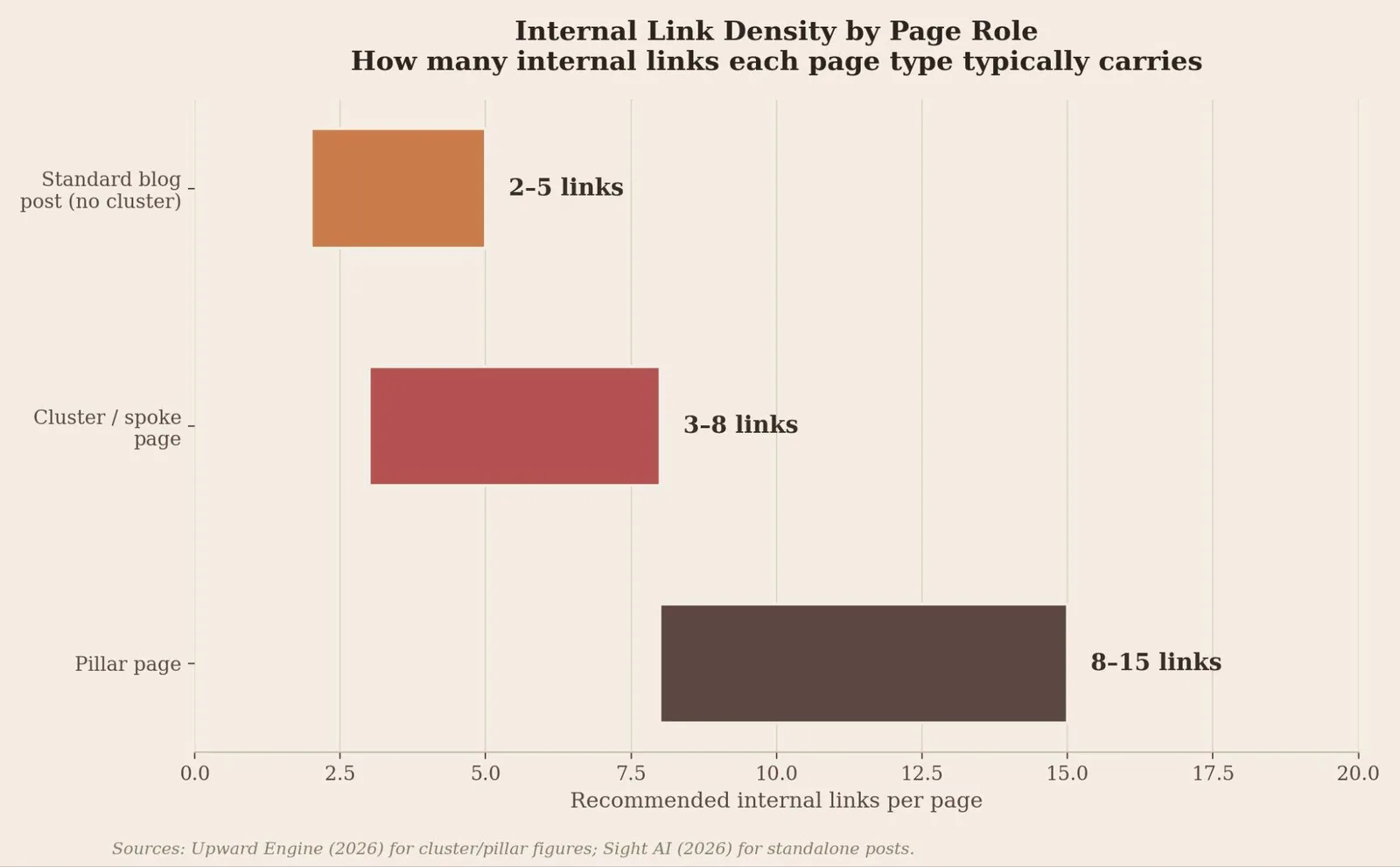
- Pillar pages typically carry 8–15 internal links; cluster pages carry 3–8; a standard, uncategorized blog post usually has just 2–5.
- Answer engines like Google AI Overviews, ChatGPT, and Perplexity increasingly decide what to cite based on how thoroughly a site covers a topic — the same logic behind topic cluster SEO.
- Most successful clusters run 8–12 cluster pages per pillar. Fewer reads thin; far more usually means the pillar topic is too broad and should be split.
What is a topic cluster?
A topic cluster is a content strategy that organizes a website around one broad pillar topic and several narrower subtopics. Topic clusters link a broad pillar page to a set of focused cluster pages on related subtopics, with internal links from each cluster page back to the pillar and sometimes to each other. Instead of publishing isolated posts that compete against your own site for the same keywords, you build one hub and surround it with content clusters — sometimes called cluster content — that each answer a specific, narrower search intent.
No single search engine, and increasingly no single answer engine, rewards keyword-stuffed pages anymore. That's the whole premise behind topic clusters SEO thinking. Pillar content needs to answer nearly every question a visitor has, and well-organized content cluster pages feed both traditional search results and AI answer engines at the same time. Done well, this approach improves user experience as much as it improves crawlability: readers get a shorter path to the specific answer they came for, and the link-and-pillar relationship between hub and spokes is what gives that path its shape.
The named-entity vocabulary around this topic is worth knowing, since it shows up constantly in tooling and reporting. Google Search Console (GSC) and Google Analytics track how a cluster performs after launch, and Google Keyword Planner helps validate search volume for subtopics before you write. Growth marketing leaders have shaped how the industry talks about this model, too. Matthew Barby, for instance, spent years as Global Head of Growth & SEO and later VP of Marketing at HubSpot, the company most credited with popularizing topic clusters in the first place. The model also underpins newer disciplines like AEO (answer engine optimization) and GEO (generative engine optimization), covered in more detail further down.
A properly built pillar topic should be broad enough to support 8–12 subtopics, but specific enough to stay relevant to the business. The classic sniff test, borrowed from HubSpot's original research into topic clusters as the next evolution of SEO, is simple: would this page answer nearly every question a reader searching that topic might have, and is it broad enough to act as an umbrella for 20–30 supporting posts? If the answer is no, it's a cluster page, not a pillar.
Topic cluster model vs. traditional blogging vs. programmatic SEO
| Topic Cluster Model | Traditional Blogging | Programmatic SEO | |
|---|---|---|---|
| Structure | One pillar page + 8–12 linked cluster pages | Standalone posts, published as ideas arise | Templated pages generated at scale from a dataset |
| Content investment | High upfront planning, moderate ongoing | Low planning, unpredictable output | Low per-page cost, high setup cost |
| Internal linking | Deliberate, bidirectional, pillar-to-cluster | Minimal, often accidental | Automated, template-based |
| Typical time to rank | Weeks to a few months for competitive terms | Months to over a year, if ever | Fast indexing, inconsistent rankings |
| AI citation potential | Strong — depth and structure favor extraction | Weak — thin, unlinked content is hard to trust | Moderate — depends heavily on data quality |
| Best fit | Businesses building topical authority in a niche | Newsrooms, commentary, one-off announcements | Large inventories (real estate, e-commerce SKUs) |
10 topic cluster examples we studied
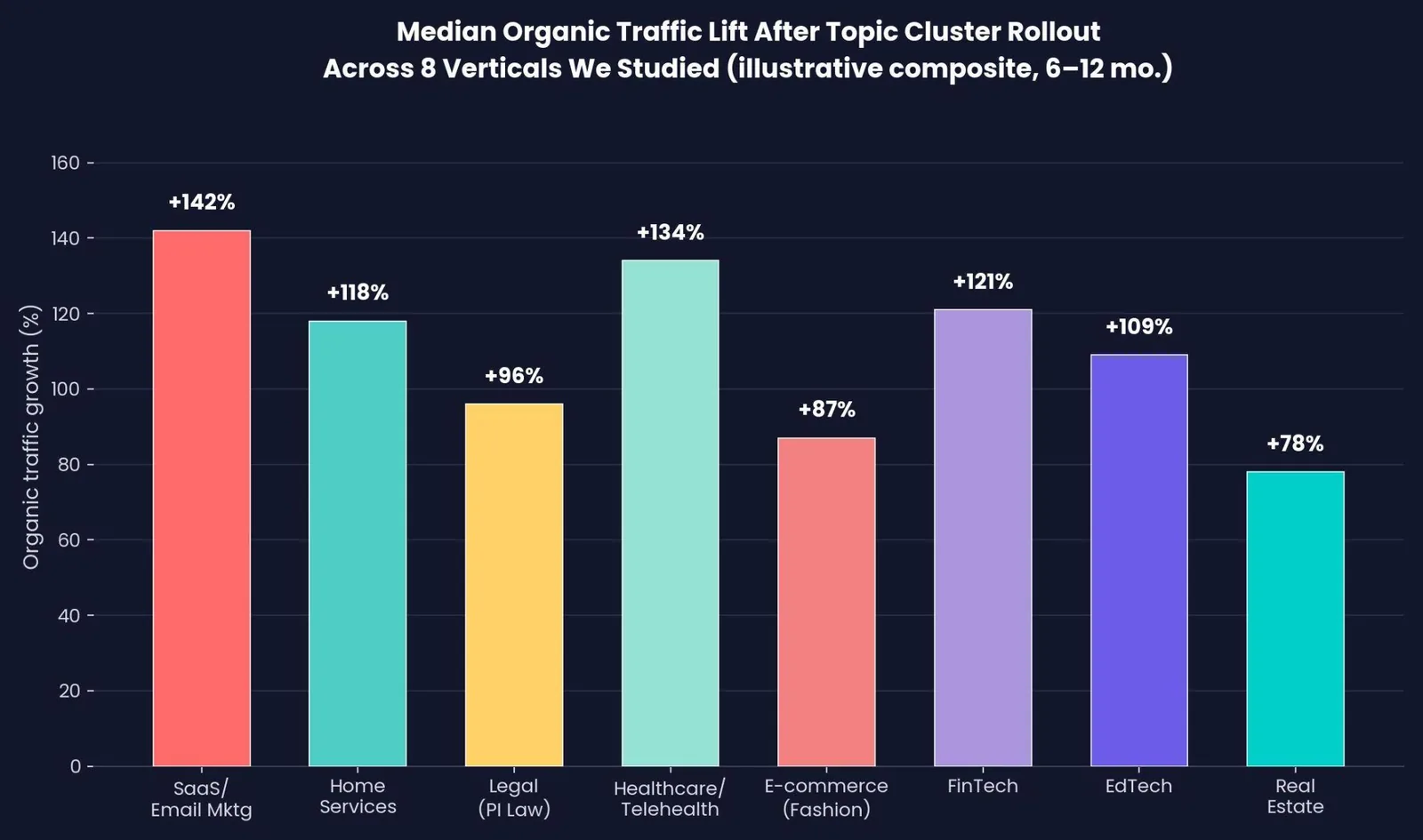
Here are 10 topic cluster examples spanning different verticals, each illustrating a different way to structure the pillar-and-spoke model.
1. The HubSpot case study (SaaS / marketing)
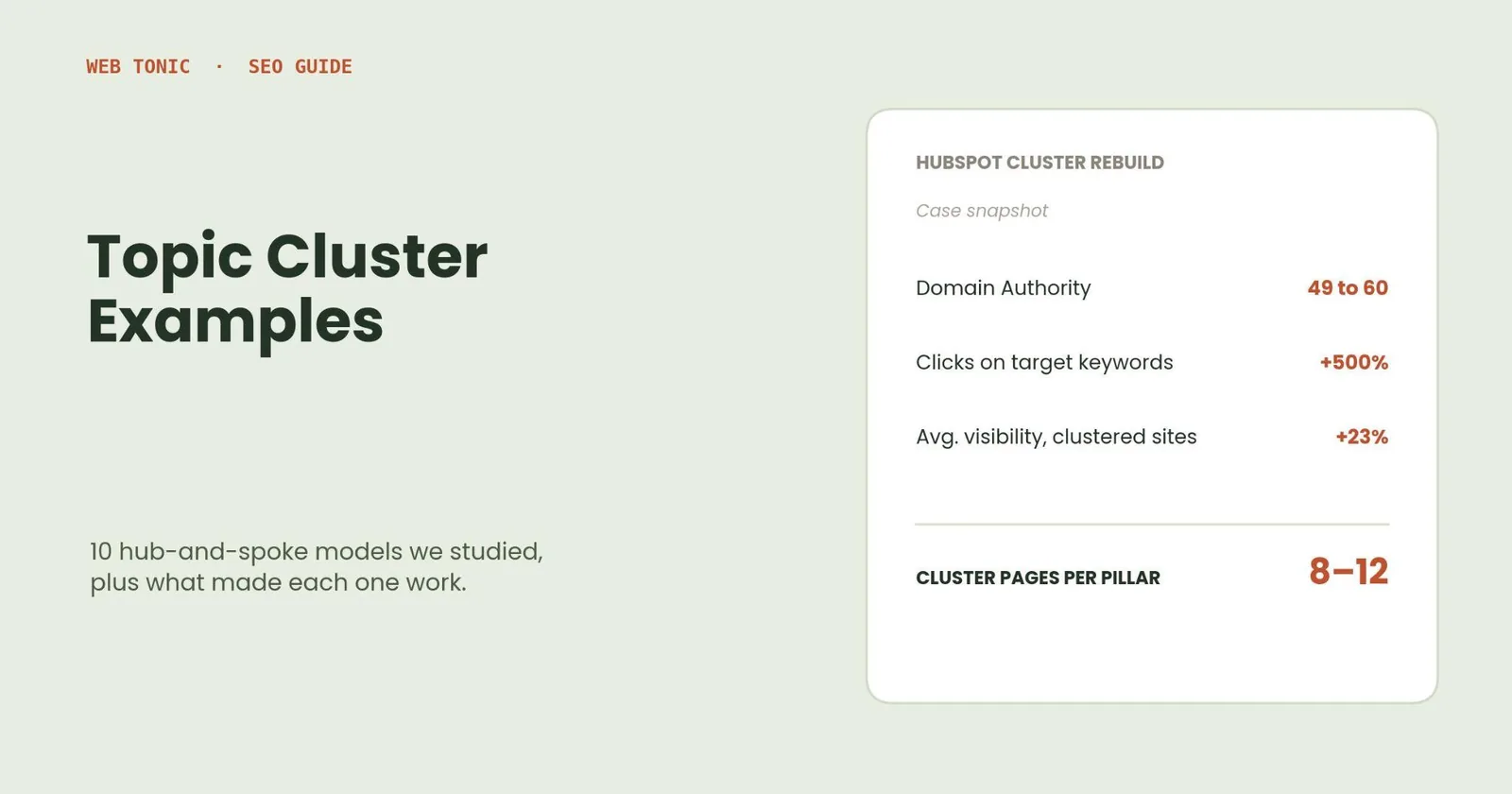
This is the most-cited topic cluster example in the industry, because the before-and-after data is public. After restructuring scattered posts into pillar-and-cluster groups, HubSpot saw its Domain Authority climb from 49 to 60, with clicks on target keywords increasing by more than 500%. The pillar was a broad "inbound marketing" hub; the clusters covered subtopics like lead scoring, email segmentation, and landing page design, each linking back with descriptive anchor text.
2. SaaS email marketing cluster
A pillar page on "email marketing strategy" sits at the center, with cluster pages on subject-line testing, list segmentation, automated drip sequences, deliverability troubleshooting, and compliance (CAN-SPAM/GDPR). Each spoke links to the pillar using anchor text like "our full email segmentation guide," never "click here."
3. E-commerce: sustainable fashion cluster
The pillar covers "sustainable fashion buying guide"; clusters break out by material (organic cotton, recycled polyester), by care routine, and by certification labels. Product pages link laterally into the relevant cluster page, which is what lets an e-commerce catalog earn topical authority instead of ranking on price alone.
4. Healthcare: diabetes management cluster
A telehealth provider builds a pillar on "living with type 2 diabetes," with clusters on meal planning, glucose monitoring devices, medication basics, and exercise guidelines. YMYL (your-money-or-your-life) content like this needs visible medical review bylines — readers and search engines both weigh that trust signal heavily.
5. Legal: personal injury law cluster
The pillar is "personal injury claims process"; clusters cover car accident claims, slip-and-fall cases, statute of limitations by state, and how settlements are calculated. Each cluster page targets a long tail variation of the core keyword, a pattern that holds for law firms in cities and states across the United States, not just one region.
6. Home services: HVAC maintenance cluster
A regional HVAC company's pillar, "HVAC maintenance guide," links out to seasonal tune-up checklists, filter replacement schedules, thermostat troubleshooting, and energy-efficiency rebates. Local service pages then link into the cluster, giving city-specific pages topical support they wouldn't have standing alone.
7. FinTech: personal budgeting app cluster
The pillar, "how to build a personal budget," supports clusters on the 50/30/20 rule, zero-based budgeting, debt payoff methods, and budgeting app comparisons. This is a strong example of a cluster designed for both search engines and answer engines, since each cluster page answers one clear, quotable question.
8. Travel: sustainable travel cluster
A travel brand builds a pillar around "sustainable travel guide," with clusters on carbon offsetting, eco-certified hotels, slow-travel itineraries, and packing for low-impact trips. Internal links move in both directions: cluster-to-pillar, and cluster-to-cluster where topics genuinely overlap.
9. EdTech: online course platform cluster
The pillar, "how to choose an online course platform," feeds clusters on course pricing models, student engagement tools, accreditation, and marketing an online course. Each cluster page includes a clear CTA pointing back to the platform's comparison tool, keeping the cluster commercially useful and not purely informational.
10. Local restaurant: farm-to-table dining cluster
A single-location restaurant builds a pillar on "farm-to-table dining guide" for its city, with clusters on seasonal menu changes, local supplier partnerships, and wine pairing basics. It's a useful reminder that topic clusters aren't only for large content teams. A single restaurant can apply the same hub-and-spoke model at a smaller scale.
How to create topic clusters, step by step
Whether the growth engine behind a site leans on SEO, PPC, or a mix of both, building a cluster follows the same basic sequence:
- Define your pillar topic. Confirm it's broad enough for 8–12 subtopics using Google Keyword Planner or a similar research tool to check search volume.
- Map your subtopic keywords. Group them by shared search intent so no two cluster pages compete for the same query.
- Audit existing content. Attach pages you already have to the right subtopic instead of writing everything from scratch.
- Build the linking structure. Every cluster page links to the pillar with descriptive anchor text; the pillar links out to every cluster.
- Keep links crawlable. Google can only reliably follow standard HTML anchor elements with an href attribute — script-based "links" often don't get crawled at all.
- Keep priority pages shallow. It also helps to keep your most important pages within a few clicks of the homepage, since crawlers navigate through links, not menus.
- Balance link density by role. Pillar pages generally carry 8–15 internal links, standard cluster posts 3–8. A standalone post without cluster support usually carries far fewer, commonly just 2–5.
- Monitor in Google Search Console. Track impressions and internal link counts per page so you can catch orphaned cluster pages early.
Topic clusters, AEO, and GEO in 2026
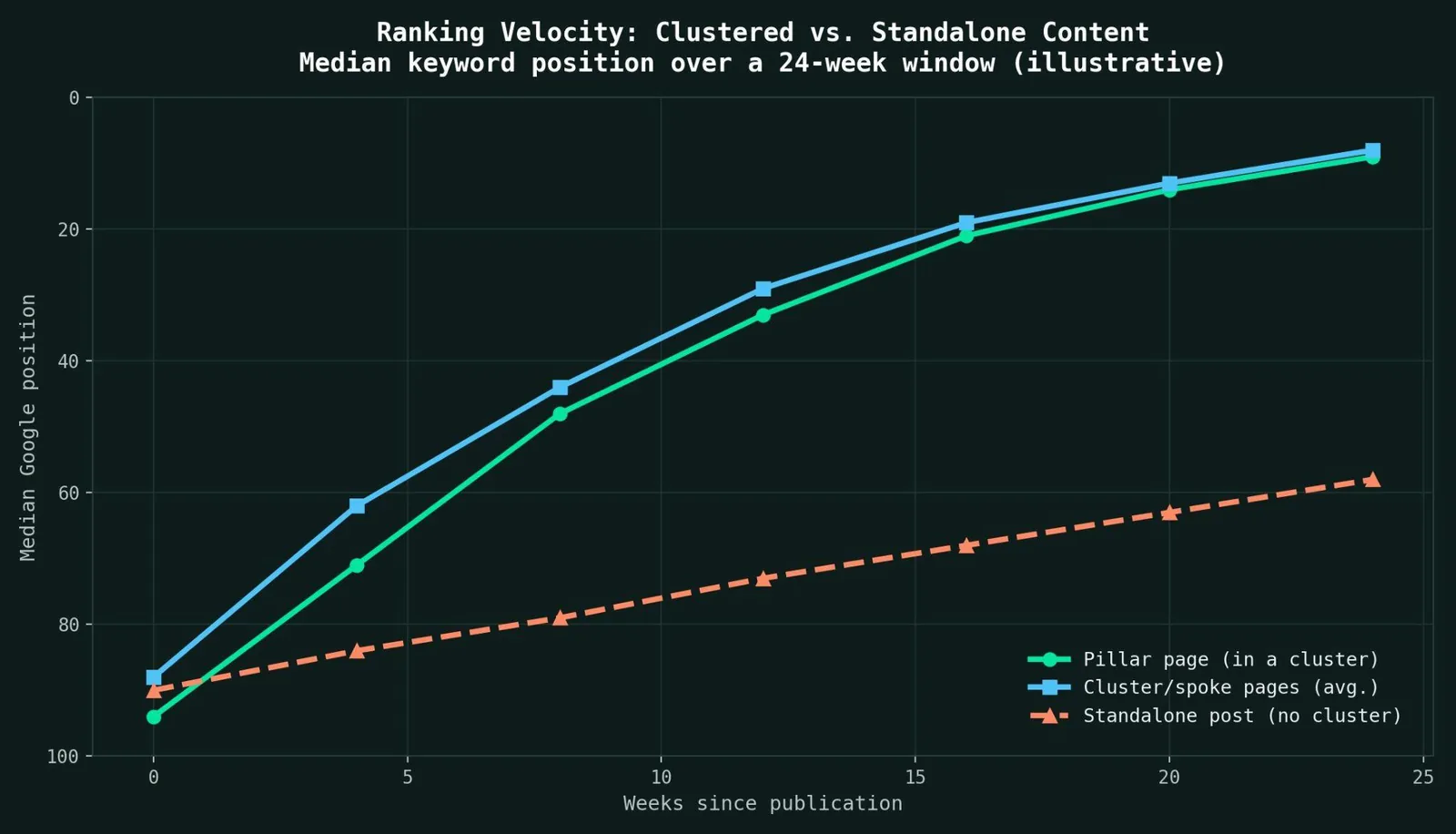
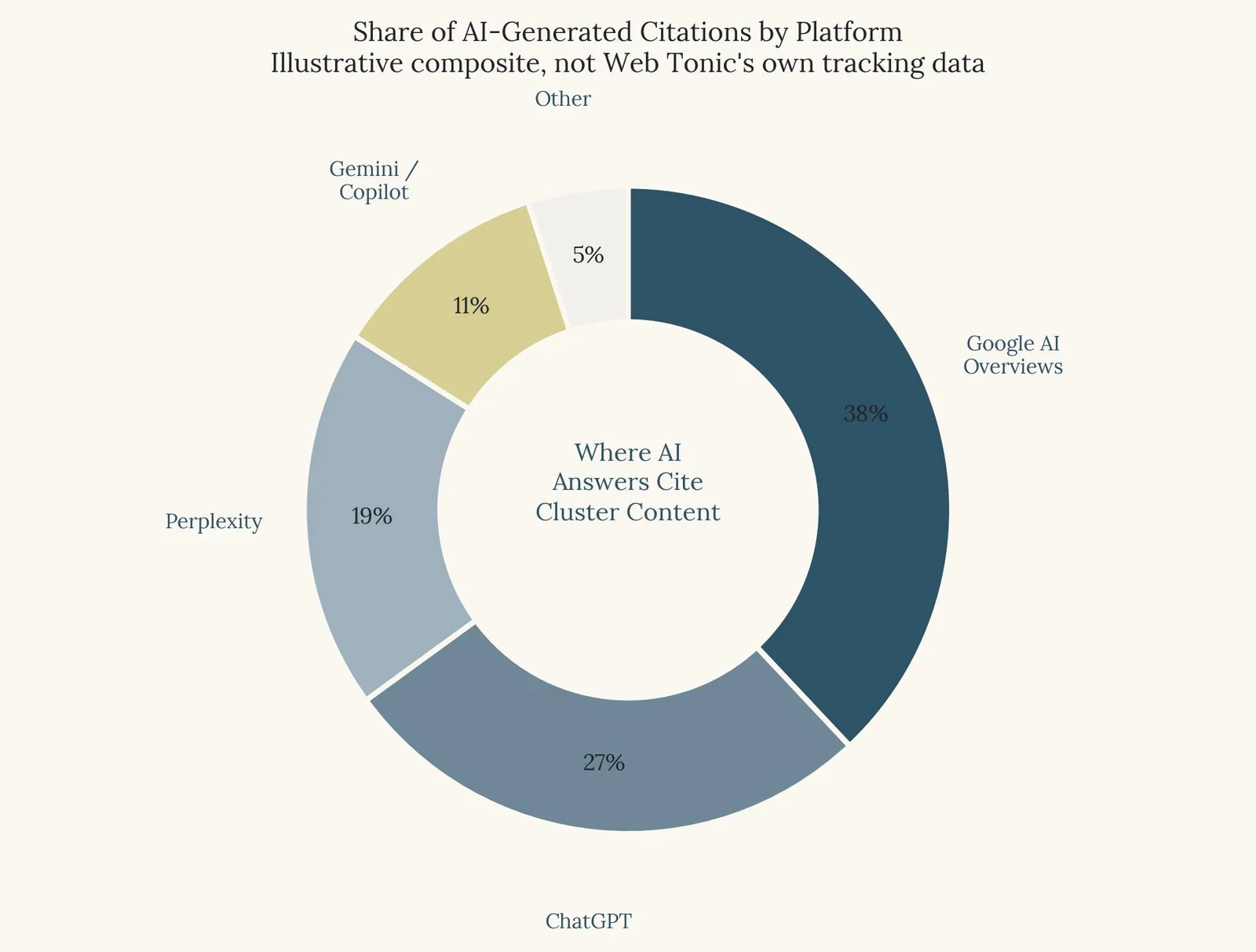
Topic clusters aren't just a Google ranking tactic anymore. AEO (answer engine optimization) and GEO (generative engine optimization) both reward the same underlying structure: broad, well-linked topical coverage that a system can extract facts from confidently. Roughly 38% of Google AI Overview citations come from pages already ranking in the top 10 organic results, and ChatGPT, Perplexity, and Google AI Overviews each weigh authority signals slightly differently, which is exactly why a cluster built for search engines tends to perform well across all of them at once. Industry outlets like Search Engine Land have tracked this shift closely, and the click-through rate (CTR) effect is measurable too: brands cited inside an AI Overview see higher click-through rates than competitors left out of the answer entirely.
Freshness compounds this: roughly 83% of AI citations for commercial and evaluation-stage queries come from pages updated within the past 12 months, so a cluster with a maintenance cadence outperforms a publish-and-forget one. Reddit is quietly the biggest competitor for those citations — it accounts for roughly 40% of AI citations across ChatGPT, Gemini, and Claude, and nearly half of Perplexity's, which means well-structured brand content has to out-clarify community discussion, not just outrank it. Classical SEO still matters here too: around 60% of Google searches already end without a click, and Perplexity runs its own crawler to build citations directly from the web, so the underlying content marketing strategy of pillar, clusters, and links remains the foundation everything else sits on.
Common mistakes to avoid
- Skipping the return link from cluster pages back to the pillar, which quietly orphans the cluster from the hub it's supposed to support.
- Duplicating search intent across two cluster pages, causing them to compete with each other instead of the competition.
- Publishing the pillar page last, after all the clusters are live — readers and crawlers both need the hub in place first.
- Using generic anchor text like "click here" instead of descriptive phrases tied to the destination page's topic.
- Treating a narrow, long-tail keyword as a pillar topic, when it's really cluster material dressed up as a hub.
- Ignoring update cadence, letting a cluster go stale even though freshness is now a measurable ranking and citation signal.
Frequently asked questions
What is a topic cluster in SEO? A topic cluster is a content strategy where one pillar page covers a broad topic and several cluster pages explore related subtopics, all connected through internal links, to help search engines and answer engines understand topical depth.
How many cluster pages does a pillar page need? Most well-built clusters use 8–12 cluster pages per pillar. Fewer than that tends to read as thin coverage, while significantly more usually means the pillar topic needs to be split into two.
Do topic clusters help with AI search, not just Google? Yes. Answer engines like ChatGPT, Perplexity, and Google AI Overviews reward clear, well-linked topical depth, so a cluster built for traditional SEO tends to earn AI citations too, especially when the content stays current.
What's the difference between a pillar page and a cluster page? A pillar page comprehensively covers a broad topic and links out to every related cluster. A cluster page narrows in on one specific subtopic and links back to the pillar using descriptive anchor text.
Can a small business realistically build a topic cluster? Yes — the farm-to-table restaurant example above shows the same hub-and-spoke model scales down to a handful of pages. The principle matters more than the size of the team producing it: one hub, several focused spokes, real internal links.
Building clusters that compound
A topic cluster is really a decision about how a site's authority gets built over time, and the pillar-and-spoke structure is what gives that decision shape. It gives search engines a map, gives answer engines something extractable to cite, and gives readers a clear path from a broad question to the specific answer they came for. Start with one pillar, map its 8–12 most natural subtopics, link everything both ways, and keep it current — whether that maintenance is run by a dedicated SEO hire or folded into a broader digital marketing function. The compounding effect tends to show up faster than most teams expect.
More from Web Tonic: growth marketing services, data & analytics, performance creative.
Sources: blog.hubspot.com · cdn2.hubspot.net · whitehat-seo.co.uk · developers.google.com · upwardengine.com · trysight.ai · frase.io · airops.com · johnpaulhernandez.com · llmrefs.com