Table of contents
Cold calling converts fewer dials but recovers faster once someone answers; cold email reaches far more people but at a lower per-message rate. Two 2026 benchmark studies - one built on 200,000-plus tracked calls, the other on billions of tracked emails - let both channels be compared on the same terms instead of on anecdote.
Key Takeaways
- The industry cold call success rate is 2.7% in 2026, up from 2.3%.
- Cognism's own team converts cold calls at 11.3%, four times that average.
- It takes 1.55 calls on average to reach a prospect who will answer.
- The average cold email reply rate is 3.43% across billions of tracked sends.
- Top-quartile cold email campaigns reach 5.5% reply rates.
- The elite top 10% of senders exceed 10% reply rates.
- 58% of all cold email replies come from the first message in a sequence.
- The remaining 42% come from follow-up messages, not the opener.
- Average cold call connect rates run 5.4%, per 300 million tracked calls.
- Top-quartile connect rates reach 13.3% on the same dataset.
- Average meeting-set rates after connecting are 4.6%.
- Top-quartile meeting-set rates reach 16.7%, more than 3x the average.
- 82% of buyers say they accept meetings from cold callers who reach out.
- 42% of sellers rate social outreach as very effective, ahead of email and calls.
- Email is rated very effective by 26% of sellers, phone by 23%.
- Wednesday sees the highest cold email reply rates of any weekday.
Two channels, two very different funnels
A cold call and a cold email are not measuring the same moment. A call's "hit rate" usually means a booked meeting or an agreed next step out of every dial attempted. A cold email's headline number is a reply out of every message delivered - a much earlier and lower-friction action. Putting both on one chart requires reading each on its own definition, then comparing the funnels that sit behind them.
Cognism's State of Cold Calling in 2026 report, built in partnership with WHAM on more than 200,000 tracked calls, and Instantly.ai's Cold Email Benchmark Report 2026, drawn from billions of interactions across 700,000-plus businesses, are the two most current, most heavily sampled reads on each channel.
The headline numbers, side by side
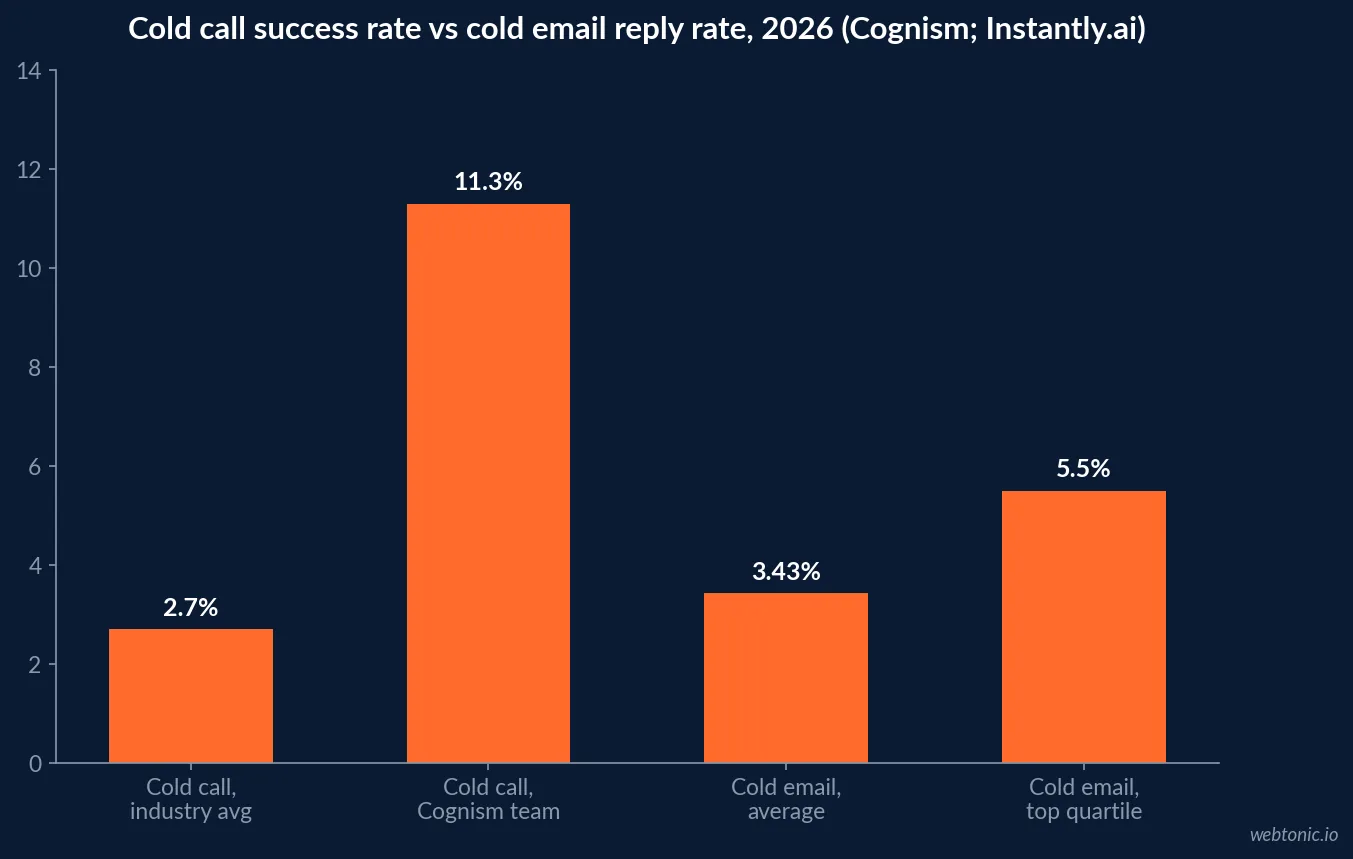
The industry average cold call success rate climbed to 2.7% in 2026 from 2.3% the year before, per Cognism. Cognism's own sales team, applying verified contact data and disciplined targeting, converts at 11.3% - a jump from the 6.7% it reported the previous year. On email, Instantly.ai's average reply rate sits at 3.43%, with top-quartile campaigns at 5.5% and the top 10% of senders clearing 10%.
Read literally, a well-run email program's average outperforms a typical cold call program's average. But the two averages are not interchangeable: a call success rate already implies a meeting or next step, while an email reply can be a "not interested" as easily as a "yes."
| Metric | Industry average, 2026 | Top performer, 2026 | Source |
|---|---|---|---|
| Cold call success rate (meeting/next step) | 2.7% | 11.3% (Cognism team) | Cognism |
| Cold email reply rate (all replies) | 3.43% | 10%+ (elite tier) | Instantly.ai |
| Cold call connect rate (answered) | 5.4% | 13.3% | Gong (300M+ calls) |
| Cold call set rate (connect → meeting) | 4.6% | 16.7% | Gong (300M+ calls) |
| Cold email first-touch share of replies | 58% | n/a | Instantly.ai |
What happens after someone actually answers or opens
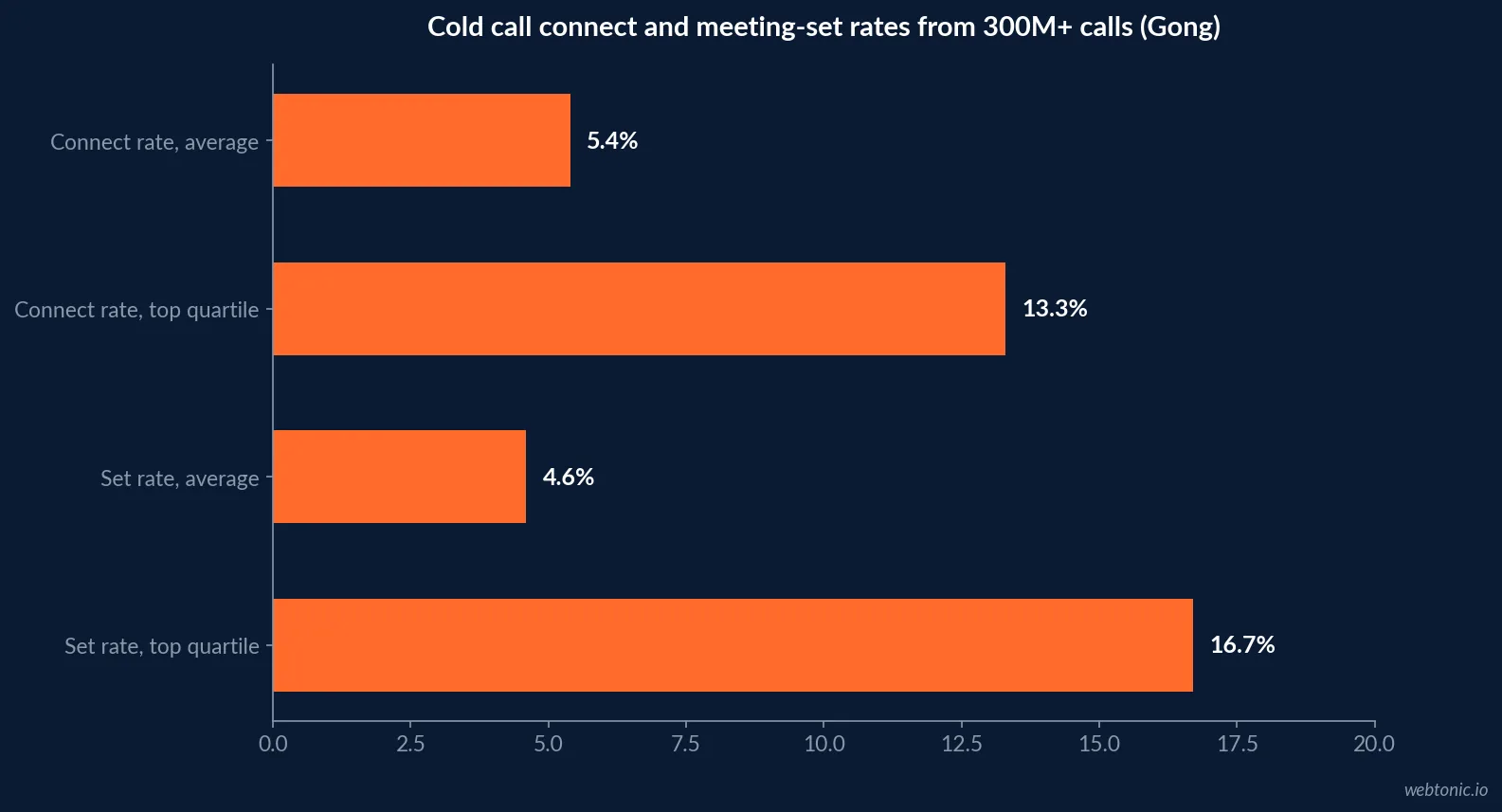
Gong's analysis of 300 million cold calls breaks the funnel into two steps that matter more than the headline rate: connecting at all, then converting that conversation into a meeting. The average rep connects on 5.4% of dials and turns 4.6% of connected conversations into a meeting. The top quartile connects on 13.3% of dials and sets meetings on 16.7% of conversations - a compounding gap that means a top rep needs roughly 45 dials per meeting against several hundred for an average rep.
Email shows a similar compounding pattern at the message level. Instantly.ai found that 58% of all replies land on the first message in a sequence, with the remaining 42% coming from follow-ups - meaning a sequence stopped after one email forfeits close to half its eventual response volume.
Why the gap between average and top performer is widening
Both channels show the same shape: the average is flat to slightly improving, but the gap to the top performer is large and growing. On calls, Cognism attributes its own jump from 6.7% to 11.3% to calling the right accounts at the right time and prioritizing conversation quality over volume. On email, Instantly.ai attributes elite-tier performance to micro-segmentation, sub-80-word emails, a single clear call to action, and weekly A/B testing rather than higher send volume.
The practical read is the same for both channels: more dials and more sends no longer close the gap on their own. Targeting precision and message relevance do.
| Lever | Cold call equivalent | Cold email equivalent |
|---|---|---|
| Targeting precision | Verified contact data, intent signals | Micro-segmented lead lists |
| Message discipline | Problem-first opening, shorter calls | Sub-80-word first-touch emails |
| Persistence structure | 1.55 calls average to first answer | 58/42 split between first touch and follow-ups |
| Testing cadence | Weekly review of objections and timing | Weekly A/B tests on subject and copy |
| Best day/time signal | Regional variation by market | Tuesday-Wednesday, Wednesday peak |
Is cold calling actually dead? The buyer-side answer
Not according to buyers. RAIN Group's Center for Sales Research, surveying 488 B2B buyers and 489 sellers, has repeatedly found that 82% of buyers say they have accepted a meeting with a seller who reached out through a cold call - a figure that has held steady across multiple survey years. The channel is not being rejected outright; buyers are simply filtering harder for relevance before they say yes.
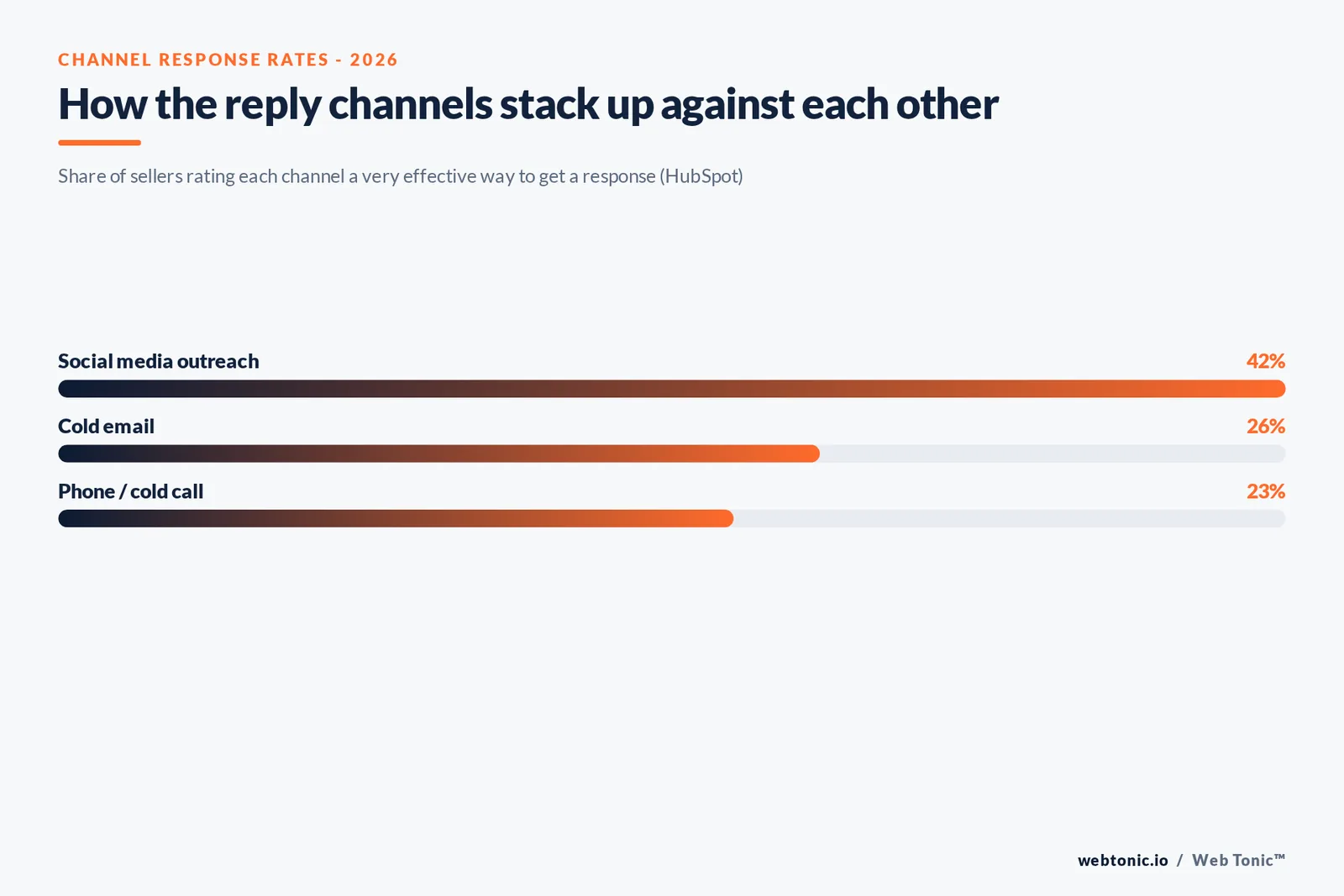
That filtering shows up in how sellers themselves rate channel effectiveness. HubSpot's sales research found 42% of professionals rate social media outreach very effective at driving a response, ahead of email at 26% and phone calls at 23% - a reminder that the two channels compared here rarely operate alone in a real outbound motion.
| Channel | Sellers rating it 'very effective' | Source |
|---|---|---|
| Social media outreach | 42% | HubSpot sales research |
| In-person meetings | 44% | HubSpot sales research |
| Cold email | 26% | HubSpot sales research |
| Cold call / phone | 23% | HubSpot sales research |
| Video calls | 35% | HubSpot sales research |
Why the per-dial number understates the real odds
A single-dial connect rate hides how quickly the odds improve with persistence. Belkins' cold calling benchmark data found that while a single dial to a B2B prospect connects roughly 9.9% of the time, dialing the same prospect across multiple attempts lifts the per-prospect connect rate to nearly 24.5% - almost two and a half times higher. That gap is the practical argument for a multi-touch cadence rather than judging a list as "dead" after one unanswered call.
30 Minutes to President's Club's breakdown of the same Gong dataset puts the arithmetic in dials-per-meeting terms: an average rep needs roughly 402 dials to book one meeting, while a top rep needs about 45 - multiplying connect rate by set rate (13.3% times 16.7%) rather than treating either number in isolation.
| Persistence metric | Single attempt | Multiple attempts | Source |
|---|---|---|---|
| Per-dial connect rate | 9.9% | n/a | Belkins cold calling benchmarks |
| Per-prospect connect rate (multi-attempt) | n/a | 24.5% | Belkins cold calling benchmarks |
| Dials per meeting, average rep | n/a | ~402 dials | 30MPC, from Gong's 300M-call dataset |
| Dials per meeting, top-quartile rep | n/a | ~45 dials | 30MPC, from Gong's 300M-call dataset |
What the timing data adds to the picture
Both datasets also break performance down by day and time, and the patterns are specific enough to plan around. Instantly.ai's benchmark report found Tuesday-Wednesday produce the peak cold email reply rates, with Wednesday the single strongest day, and that the best-performing campaigns keep first-touch emails under 80 words while running weekly A/B tests on subject lines and opening copy. Cognism's cold calling data similarly finds identifiable best days and times to call that vary by region, with call duration and objection patterns shifting as the year has progressed through 2026.
Neither study found that simply calling or emailing more often, without regard to timing, closes the gap between an average and a top-quartile performer. The lever in both datasets is precision - who gets contacted, when, and with what message - not raw volume.
| Timing signal | Cold call finding | Cold email finding |
|---|---|---|
| Best days | Varies by region (Cognism) | Tuesday-Wednesday (Instantly.ai) |
| Peak single day | n/a, market-dependent | Wednesday |
| Message length | Shorter, problem-first calls trend up | Under 80 words on first touch |
| Testing cadence recommended | Review objections weekly | A/B test weekly |
| Volume vs. precision | Precision favored over dial volume | Precision favored over send volume |
How the two channels perform together, not just apart
Neither report argues for picking one channel exclusively. Sopro's State of Prospecting research, cited alongside HubSpot's sales data, found that while email remains the most preferred outreach method for the third consecutive year among buyers, buyers increasingly expect a mix of channels rather than a single touchpoint before they engage. That lines up with RAIN Group's buyer research showing cold calls still earn meetings when done well, and with HubSpot's finding that social outreach, not email or phone alone, is now rated most effective by sellers themselves.
The practical implication for anyone building an outbound motion in 2026 is to treat call and email hit-rate benchmarks as complementary diagnostics on the same pipeline, not as a scoreboard for choosing a single channel and dropping the other.
How to use these numbers to benchmark your own team
Split your own reporting into the same funnel stages these studies use: connect rate, then set/reply rate, rather than one blended "hit rate." A call program stuck at a 2-3% success rate is behaving like the industry average and has room to move toward the double digits Cognism's own team demonstrates with better targeting. An email program below a 2% reply rate is under-performing even the conservative average and likely needs shorter copy and tighter segmentation before it needs more volume.
If outbound sits inside a broader growth plan, our growth marketing practice builds the multi-channel sequencing HubSpot's data points toward, our team can review a call or email sample against these benchmarks directly, and our guide to whether paid social is worth it is a useful next read when outbound alone is not hitting pipeline targets.
Frequently Asked Questions
What is a good cold calling success rate in 2026?
Cognism's State of Cold Calling in 2026 report, built on 200,000-plus tracked calls in partnership with WHAM, puts the industry average success rate - a booked meeting or agreed next step - at 2.7%, up from 2.3% the year before. Cognism's own sales team, using verified contact data and stricter targeting, converts at 11.3%, more than four times the average.
What is a good cold email reply rate?
Instantly.ai's Cold Email Benchmark Report 2026, drawn from billions of tracked interactions across 700,000-plus businesses, puts the average reply rate at 3.43%. Campaigns in the top quartile clear 5.5%, and the top 10% of senders - the elite tier - exceed 10%, roughly two to four times the average.
Does it take more attempts to reach someone by phone or by email?
By phone, most answers come fast: Cognism's 2026 data shows the average prospect who will pick up does so within 1.55 calls. By email, persistence pays differently - Instantly.ai found the first email in a sequence captures 58% of all replies, with the remaining 42% coming from follow-ups, so abandoning a sequence after one email leaves nearly half the replies on the table.
Is cold calling actually dead in 2026?
No. RAIN Group's Center for Sales Research, surveying 488 B2B buyers and 489 sellers, has consistently found that 82% of buyers say they have accepted a meeting with a seller who reached out by cold call, a figure that has held for several years running. What has changed is precision: Gong's analysis of 300 million calls shows a wide gap between average reps (a 4.6% meeting-set rate) and top-quartile reps (16.7%), so skill and targeting now matter more than volume.
Which channel gets rated most effective by sellers themselves?
Social media outreach, according to HubSpot's sales research: 42% of sales professionals rate it very effective at getting a response, ahead of email at 26% and cold calls at 23%. That does not mean phone and email are obsolete - it means multi-channel sequencing, not any single channel, is what current sellers report working best.
Sources
Cognism (with WHAM) - The State of Cold Calling in 2026
Instantly.ai - Cold Email Benchmark Report 2026
Gong - The Hidden Power of Cold Calling: Insights From 300M Calls
RAIN Group Center for Sales Research - Sales Prospecting Research
HubSpot - Modern Sales Orgs Are Leaning Into Marketing Behaviors
Sopro - The State of Prospecting 2025
Belkins - Cold Calling Benchmarks
30 Minutes to President's Club - How to Master Cold Calls: Data From 300M+ Calls