Table of contents

The median email open rate across 3.6 million 2025 campaigns was 43.46%, but that number now includes millions of opens nobody actually made. Apple's Mail Privacy Protection pre-fetches every tracking pixel the instant a message lands, and Apple's client family accounts for 62.26% of all tracked opens as of July 2026. Open rate still tells you something - it just is not the same something it told you in 2019.
Key Takeaways
- MailerLite's 2025 median open rate is 43.46%, up from 42.35% in 2024.
- Mailchimp's published all-user benchmark is 35.63% open, 2.62% click.
- Brevo's standard open rate averages 20.73%, rising to 33.87% once Apple MPP opens are counted.
- Apple's client family now drives 62.26% of tracked opens, per Litmus, July 2026.
- Gmail holds 27.03% of tracked opens, a distant second to Apple.
- Outlook sits at just 5.83% of tracked opens.
- Unsubscribe rate doubled year over year to 0.22% after Gmail's one-click unsubscribe rollout.
- Email drives an average ROI of USD 36 for every dollar spent, per Litmus.
- Single opt-in lists show an 80% higher ROI than double opt-in lists.
- Nonprofit open rates lead most datasets, at 40.04% (Mailchimp) to 52.38% (MailerLite-adjacent reads).
- Ecommerce open rates trail most industries, at 29.81% to 32.67% across vendors.
- Government and public administration tops Brevo's industry table at 46.60% including MPP.
- Top-10% Brevo senders reach a 44.02% standard open rate, more than double the average.
- Gmail deliverability lands 87.2% in the inbox, per Validity's 2025 benchmark.
- Subject lines over 71 characters scored a 40.71% open rate in one large dataset.
- Tuesday is the strongest day for opens at 31.27% in Omnisend's 26-billion-email dataset.
Benchmarks at a glance, three vendors, three numbers
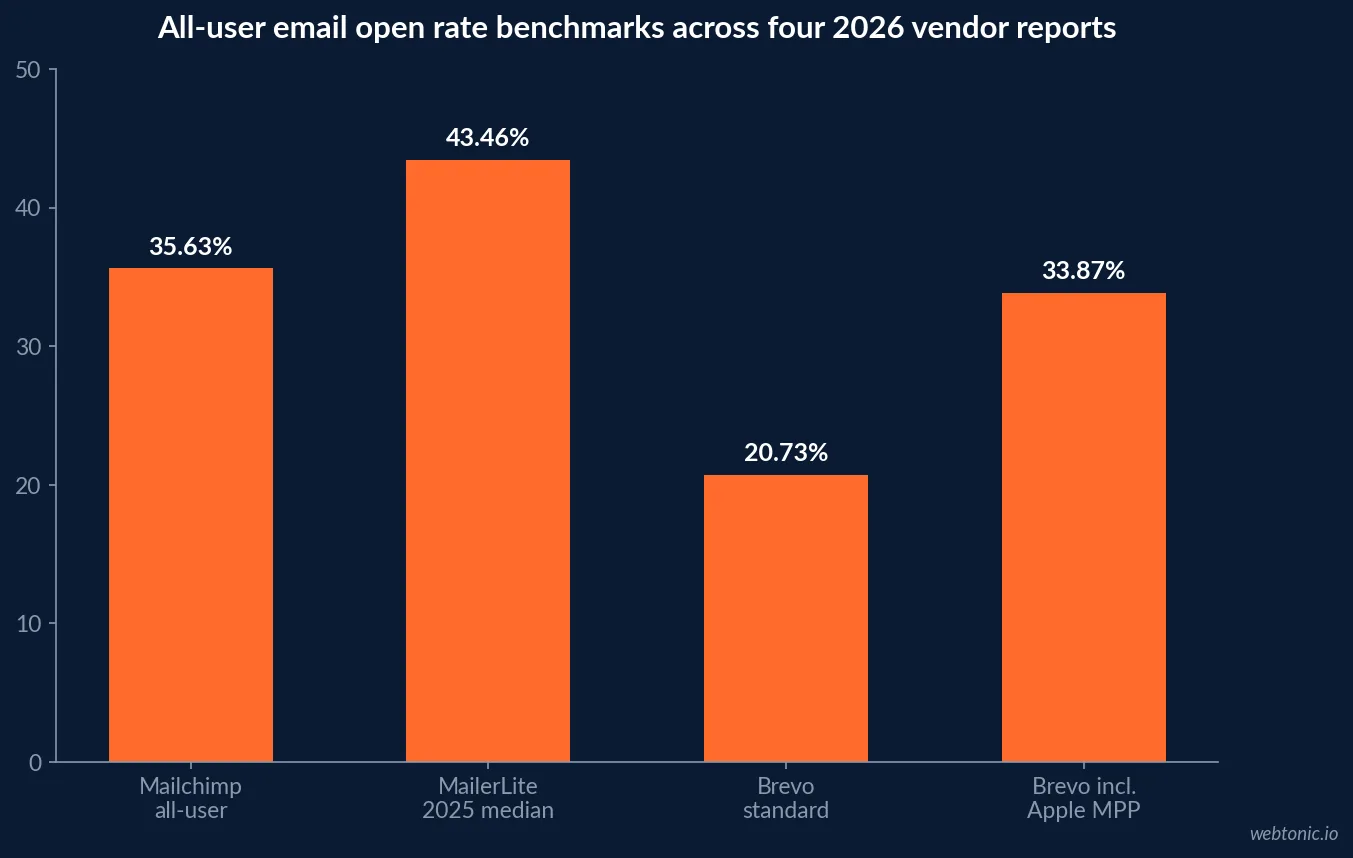
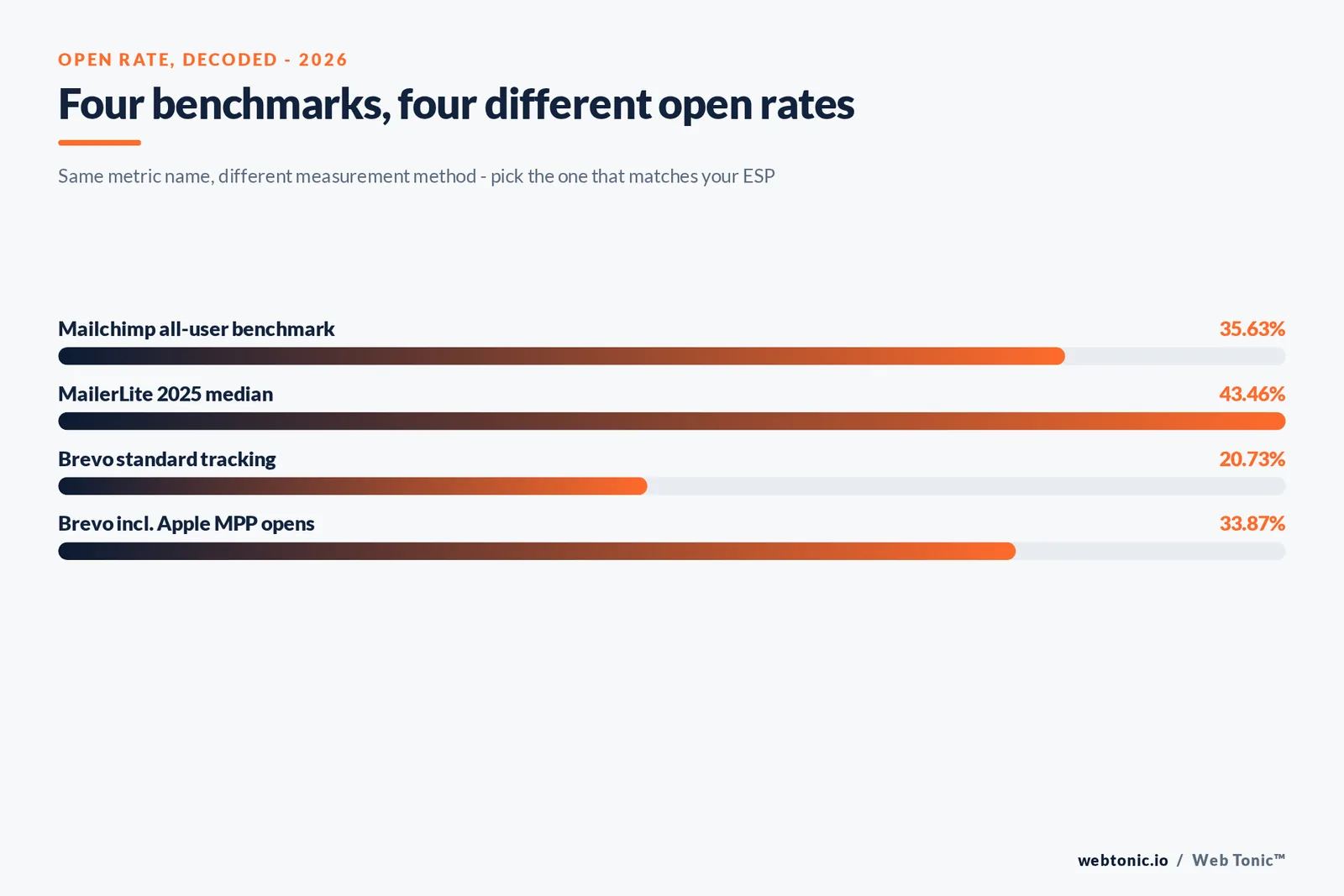
Start here before quoting a single "average open rate" to a client or a boss: three of the largest published 2026 datasets do not agree, because each measures a different thing. Mailchimp reports 35.63% open and 2.62% click for all users. MailerLite's 2025 dataset of 3.6 million campaigns puts the median at 43.46% open. Brevo's 2026 benchmark splits the number in two: 20.73% standard and 33.87% including Apple Mail Privacy Protection opens.
| Vendor (2026 report) | All-user open rate | Click / CTR | Unsubscribe rate | Sample size |
|---|---|---|---|---|
| Mailchimp | 35.63% | 2.62% click | 0.22% | Hundreds of millions of sends |
| MailerLite (2025 data) | 43.46% | 2.09% click, 6.81% CTOR | 0.22% | 3.6M campaigns, 181,000 accounts |
| Brevo (standard) | 20.73% | 2.27% CTR | 0.46% | Active senders across 2025 |
| Brevo (incl. Apple MPP) | 33.87% | 2.27% CTR | 0.46% | Same dataset, MPP opens included |
Why Apple Mail Privacy Protection broke the metric
Apple's Mail Privacy Protection, live since iOS 15, routes remote content - including the tracking pixel - through Apple's own proxy servers the moment a message arrives, whether or not a human ever opens it. That registers as an "open" for every delivered message to an opted-in Apple Mail user, turning a behavioral metric into a delivery metric for a large share of any list.
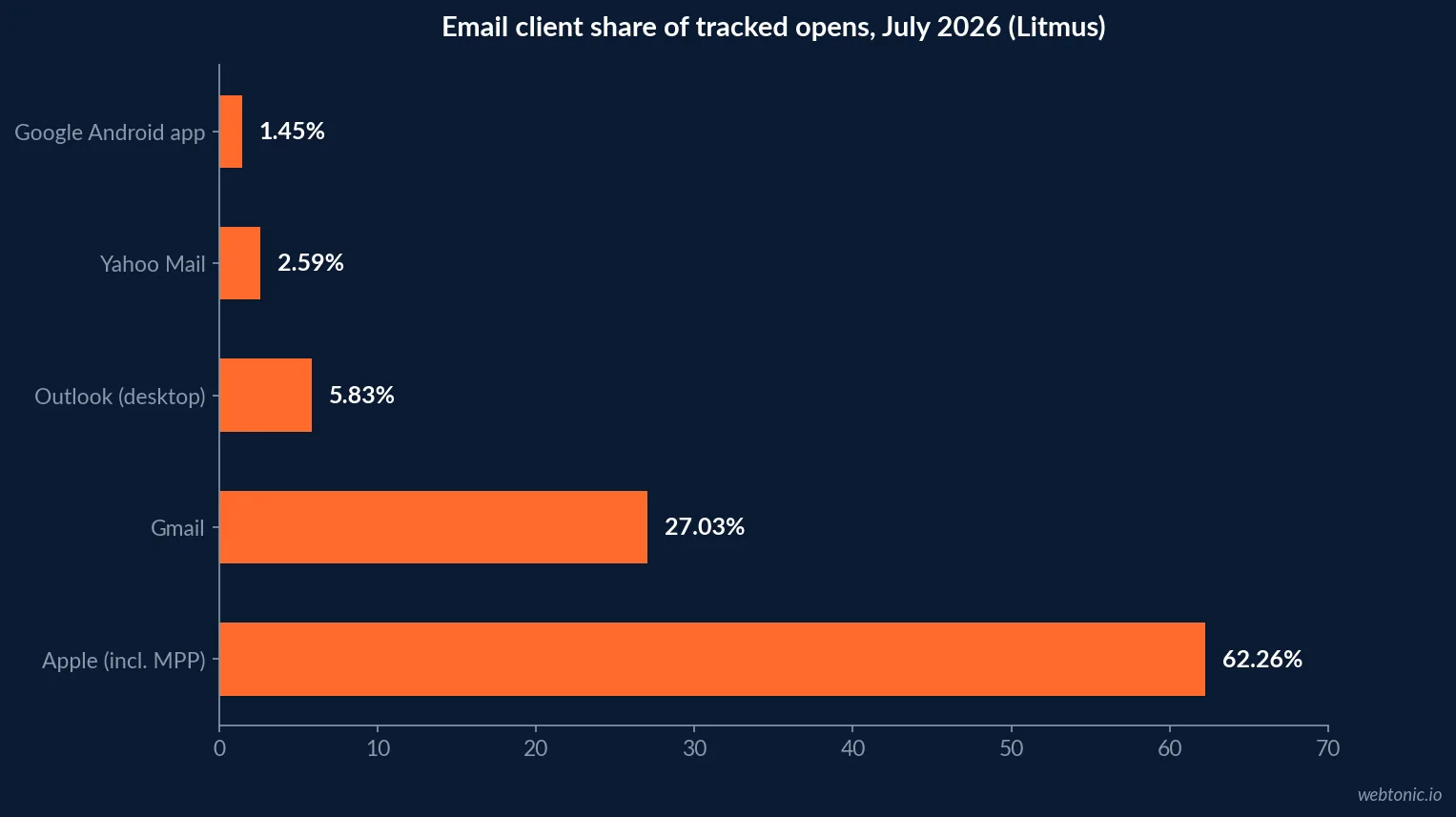
Litmus's July 2026 client share report, built from more than one billion tracked opens, puts Apple's client family (Apple Mail, iPhone, iPad and MPP) at 62.26% of the total, with Gmail at 27.03%, Outlook at 5.83% and Yahoo Mail at 2.59%. Apple and Gmail alone account for close to 90% of tracked opens, which means most senders' headline open rate is really an Apple-and-Gmail-weighted average with a small correction for everyone else.
| Email client (Litmus, Jul 2026) | Share of tracked opens | What it means for your number |
|---|---|---|
| Apple (Mail, iPhone, iPad, MPP) | 62.26% | Majority of your "opens" may be pixel pre-fetches |
| Gmail | 27.03% | Image-caching also opens before a human necessarily sees it |
| Outlook (desktop) | 5.83% | Closest to a behavioral signal among major clients |
| Yahoo Mail | 2.59% | Also uses image caching, similar caveat to Gmail |
| Google Android app | 1.45% | Genuine device-level open, no caching layer |
Open rate by industry: who actually gets read
Even with the MPP distortion baked in, the relative ranking between industries has stayed fairly stable across vendors. Mission-driven and permission-heavy lists open more; commercial, high-volume lists open less. Mailchimp's table puts Non-Profits at 40.04% against Ecommerce at 29.81%. MailerLite's 2025 data shows a similar gap: consulting at 45.96% against ecommerce at 32.67%.
| Industry | Mailchimp open rate | Mailchimp click rate | MailerLite open rate (2025) |
|---|---|---|---|
| Non-profit / cause-driven | 40.04% | 3.27% | consulting analog: 45.96% |
| Education & Training | 35.64% | 3.02% | authors analog: 43.14% |
| Business & Finance | 31.35% | 2.78% | n/a |
| Health & Fitness | n/a | n/a | 47.81% |
| Ecommerce | 29.81% | 1.74% | 32.67% |
| All users / all industries | 35.63% | 2.62% | 43.46% |
A fourth and fifth data point: ActiveCampaign and HubSpot
Two more named, dated datasets round out the picture and land closer to MailerLite than to Mailchimp. ActiveCampaign's own 2026 benchmark, calculated from real customer campaigns sent between January 1 and December 10, 2025 rather than a self-reported survey, puts its average open rate at 39.26%, with e-commerce and retail customers trailing at 35.66% and software customers close behind at 36.20%. HubSpot's 2026 Marketing Statistics roundup separately reports that 22% of marketers name email one of their top ROI-driving channels, placing it fifth behind website/blog/SEO at 27% - useful context for why open rate still gets debated even as some budget shifts toward organic content.
Unsubscribe rate is the metric that just doubled
While open rate crept up, MailerLite reports the median unsubscribe rate more than doubled year over year, from 0.08% to 0.22%, and attributes it directly to Gmail's change that surfaces an unsubscribe link next to every promotional email without requiring the recipient to open it. Brevo's 2026 figures show a similar split: 0.46% average unsubscribe rate against 0.05% for its top-10% senders, and it flags anything above 0.5% as a warning signal.
Read those two moves together. A rising open rate and a rising unsubscribe rate in the same period is not necessarily good news - it can mean more of your list is disengaging in one click before ever opening the message, while the MPP layer keeps the open number looking healthy.
| Unsubscribe benchmark (2026) | Figure | Source | Read on it |
|---|---|---|---|
| Median unsubscribe, 2025 | 0.22% | MailerLite | Over double the 0.08% recorded in 2024 |
| Average unsubscribe, Brevo dataset | 0.46% | Brevo | Warning threshold starts at 0.5% |
| Top-10% sender unsubscribe rate | 0.05% | Brevo | The gap between average and top decile is wide |
| Lowest-unsubscribe industries | 0.20%-0.30% | Brevo | Government and nonprofit audiences self-select |
Deliverability: the gate before the open even happens
None of the open-rate figures above matter if the message never reaches the inbox. Brevo's 2026 report, citing Validity's Email Deliverability Benchmark, shows meaningful gaps between mailbox providers: Gmail places 87.2% of tested mail in the inbox against 6.8% in spam, while Microsoft places only 75.6% in the inbox with 14.6% landing in spam - roughly double Gmail's spam rate.
| Mailbox provider (Validity 2025) | Inbox placement | Spam placement | Missing |
|---|---|---|---|
| Gmail | 87.2% | 6.8% | 6.0% |
| Yahoo! | 86.0% | 4.8% | 9.2% |
| Apple | 76.3% | 14.3% | 9.4% |
| Microsoft | 75.6% | 14.6% | 9.8% |
What still reliably changes an open rate
Two variables move the number even inside the MPP era: subject line and send time. A large-scale subject line dataset found the 9-13 word range performing best at 40.20% open, essentially tied with subject lines over 71 characters at 40.71%. Return Path's earlier analysis of read rates by character count found the opposite pattern peaking in the 41-50 character band, which is the honest reason to treat any single "ideal length" rule with suspicion and test it against your own list.
Send time is more consistent across datasets. Omnisend's analysis of roughly 26 billion emails found Tuesday leading the week for opens at 31.27% and clicks, while Friday leads for conversions at a 0.081% conversion rate despite carrying the week's highest send volume at 4.51 billion emails. The spread between the best and worst day for opens is only about 1.6 percentage points, so day of week is a minor lever next to list health and subject relevance.
| Send-time finding (Omnisend, 26B emails) | Figure | What it is best for |
|---|---|---|
| Tuesday open rate | 31.27% | Highest open and click day of the week |
| Friday conversion rate | 0.081% | Best day for revenue-focused sends |
| Saturday click-to-sent rate | 0.68% (lowest) | Weakest day for fast engagement |
| Spread between best/worst day, opens | ~1.6 points | Day matters less than list quality |
What email ROI looks like once you stop chasing opens
Litmus's email ROI guide reports email driving an average USD 36 return for every dollar spent, ahead of every other channel it benchmarks. The same guide contains a genuinely counter-intuitive finding: single opt-in programs show an 80% higher return than double opt-in programs, because the extra confirmation step filters out real, if lower-intent, subscribers along with the bad ones - useful context before defaulting every new signup form to double opt-in for its own sake.
If your program is optimizing the open number rather than the return it produces, that is worth revisiting before the next subject-line test. Our growth marketing team builds email programs around the revenue metric first and treats open rate as one diagnostic input among several, alongside data and analytics work that reconciles ESP-reported opens against actual site and purchase behavior.
How to read your own number against these benchmarks
Pick the vendor whose measurement approach matches your own tooling - if your ESP reports a combined Apple-inclusive figure, benchmark against Brevo's 33.87% line, not Mailchimp's all-user 35.63%, which uses a different underlying methodology. Track click-to-open rate and unsubscribe rate alongside open rate every send, not just at quarter-end, so a rising unsubscribe trend does not hide behind a flattering open number for three months. And treat any industry table as a directional comparison, not a target: a nonprofit and an ecommerce brand are not selling the same thing to the same audience, and their open rates should not converge.
Want a second opinion on what your own list is actually doing? Talk to us, or see how our take on paid channels compares in our Facebook Ads ROI analysis and our roundup of the best email marketing agencies for a structural comparison of who runs programs like this for a living.
Frequently Asked Questions
What is a good email open rate in 2026?
It depends which vendor's dataset you compare against, because the methodologies are not the same. Mailchimp's published all-user benchmark is 35.63%. MailerLite's 2025 dataset, covering 3.6 million campaigns, puts the median at 43.46%. Brevo's 2026 benchmark, which separates confirmed opens from Apple Mail Privacy Protection opens, reports a standard open rate of 20.73% and an MPP-inclusive rate of 33.87%. Compare your number against the vendor whose tracking method matches your own list, not against a single headline figure.
Why do open rate benchmarks disagree so much between vendors?
Three reasons. First, list quality: some datasets keep unengaged contacts, others prune them, and pruning alone can move the reported rate several points. Second, whether Apple Mail Privacy Protection opens are counted as real opens or filtered out - Brevo shows this changes the all-industry average from 20.73% to 33.87% by itself. Third, sample composition: an all-user average blends transactional, welcome and promotional sends, which behave very differently.
Does Apple Mail Privacy Protection make open rate useless?
Not useless, but it makes the raw number a worse proxy for attention than it used to be. Litmus reports that Apple's client family, MPP included, now accounts for 62.26% of tracked email opens as of July 2026, and Apple pre-fetches a tracking pixel the moment a message lands regardless of whether a human reads it. That inflates the numerator for roughly six in ten subscribers. Click rate and click-to-open rate, which need an actual tap, are less distorted and are worth tracking alongside open rate rather than instead of it.
Does subject line length still change open rates?
The published studies do not agree on a single optimal length, which is itself informative. One dataset puts the 9-13 word range at a 40.20% open rate with subject lines over 71 characters slightly ahead at 40.71%. Return Path's older subject-line dataset found the opposite pattern, with the 41-50 character band reading best. The safer takeaway is that length matters less than relevance to that specific segment, and any single-vendor length rule should be tested against your own list before you rewrite a template around it.
What replaces open rate as the primary email KPI?
Most of the vendors publishing 2026 benchmarks now lead with click-to-open rate or an engagement-based metric instead of raw opens, because both require an action beyond a pixel loading. Litmus reports email driving an average ROI of USD 36 for every dollar spent, which is the number that actually justifies the channel to a budget holder - open rate is a diagnostic along the way, not the outcome itself.
Sources
Mailchimp - Email Marketing Benchmarks and Metrics
MailerLite - Email marketing benchmarks by industry and region for 2026
Brevo - Email Marketing Benchmarks: Region & Industry Data (2026)
Litmus - Email Client Market Share, July 2026
Litmus - Email Marketing ROI Guide
Omnisend - The Best Time to Send an Email (2026 Research)
Statista - Global e-mail client market share 2026
ActiveCampaign - 2026 Email Marketing Benchmarks: Open & Click Rates by Industry
HubSpot - 2026 Marketing Statistics, Trends & Data