Table of contents
Growth advisory is priced on the seniority of the judgement you are renting, not on hours delivered. In 2026 that means roughly $150 to $500 an hour, $4,000 to $20,000 a month on a retainer, or a fixed fee for a scoped diagnostic — and the spread inside those bands is where buyers overpay.
Key Takeaways
- Senior growth and marketing advisory commonly bills $150 to $500 an hour, averaging near $325, with embedded retainers between $4,000 and $20,000 a month.
- The 2026 Global Consulting Fees Survey puts the global median consulting fee at $190 an hour and the North American median at $290, on a reported range from $12 to $4,000.
- Retainers cluster tighter than the headline range suggests: advisory retainers with limited deliverables sit at $3,000 to $8,000 a month, and one 2026 analysis put the median retainer near $8,500.
- Pricing models moved. 55% of consultants now charge primarily by project, hourly billing fell from 36% to 30% in two years, and retainer or fractional work rose from 0.5% to 11%.
- The number that decides value is not the fee. It is the size of the decision the fee is attached to — a $45,000 engagement against a $6 million allocation is a rounding error; the same fee against a $200,000 budget is not.
What "growth advisory" is being priced
Growth advisory sits between two things that are easy to price and one that is not. Execution capacity is priced on volume of work. A full-time leader is priced on salary. Advisory is priced on the quality of a small number of decisions: which channels to stop, which segment to attack, what the next dollar of spend is supposed to buy, and how you will know.
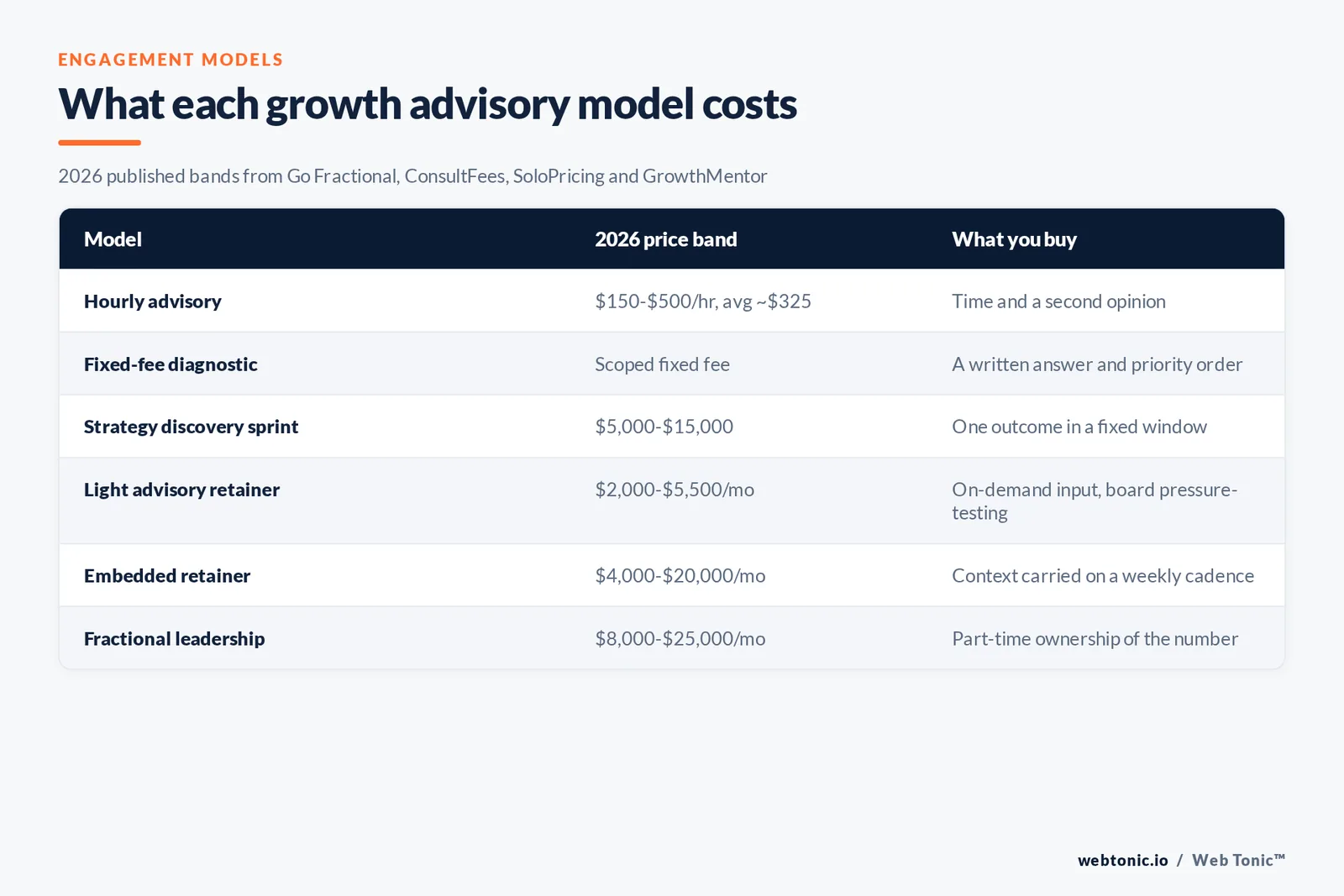
Taylor Sicard's 2026 cost breakdown, drawing on Go Fractional's rate data, splits the market into four models: hourly at $150 to $500 with an average near $325, fixed-fee audits and projects, time-boxed sprints, and embedded retainers at $4,000 to $20,000 a month. Its read of the bands is the useful part: a quote near the floor usually buys a specialist on a narrow task, and a quote near the ceiling usually buys someone who has personally run the decision you are facing.
GrowthMentor's 2026 guide prices the same market by discipline rather than by model — paid acquisition work at $2,000 to $8,000 a month on top of media spend, deeper cross-functional growth work at $5,000 to $15,000, and strategy-led retainers at $3,000 to $10,000 where a growing share of the fee buys thinking your team then executes. It puts the practical monthly minimum for a real retainer at $3,000 to $6,000.
| Engagement model | 2026 price band | What you are actually buying | Best fit |
|---|---|---|---|
| Hourly advisory | $150–$500/hr, average near $325 | Time and a second opinion | Genuinely ad-hoc questions |
| Fixed-fee diagnostic or audit | Scoped fixed fee | A defined deliverable and a written answer | A first paid trial before any retainer |
| Discovery or strategy sprint | $5,000–$15,000 for strategy discovery | One outcome inside a fixed window | Getting a single decision made properly |
| Light advisory retainer | $2,000–$5,500/month | On-demand input and board pressure-testing | A team that executes and needs a referee |
| Embedded retainer | $4,000–$20,000/month | Context carried week to week, on a cadence | Where most real advisory relationships live |
| Fractional leadership | $8,000–$25,000/month at 2–3 days a week | Accountability for the number, part-time | A leadership seat that is not yet a full role |
The market rate, from the surveys rather than the sales pages
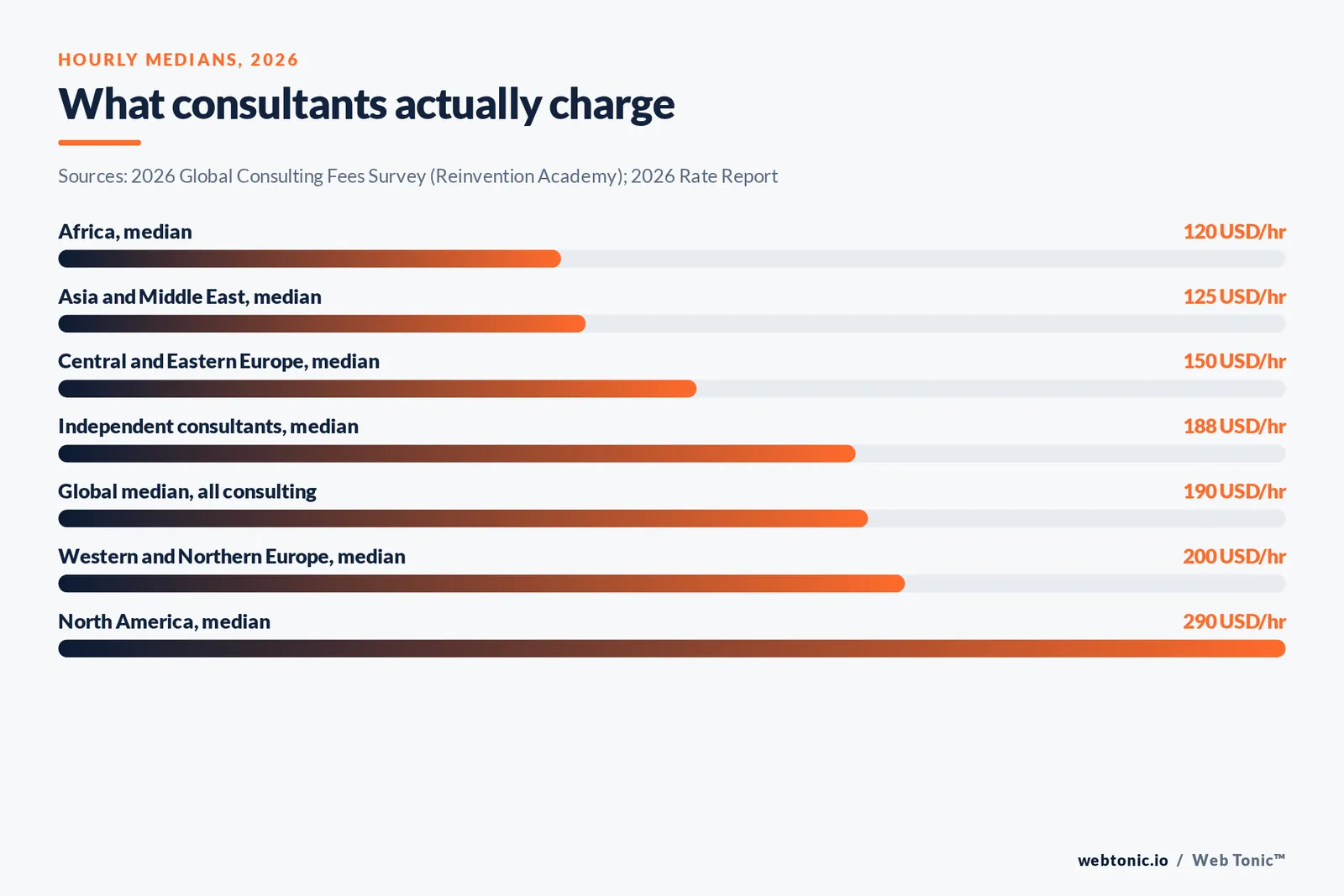
Rate pages are self-reported, so the survey data is worth more. The Reinvention Academy's 2026 Global Consulting Fees Survey reports a median fee of $190 an hour, with North America highest at $290, Western and Northern Europe at $200, Central and Eastern Europe at $150, Asia and the Middle East at $125 and Africa at $120. The tails are extreme — $12 to $4,000 globally, and $125 to $2,500 inside North America alone — which is why a single quote tells you almost nothing without a comparison set.
Independent-consultant data lands in the same place. The 2026 Rate Report puts the median equivalent hourly rate at $188 and the mean at $207, with the middle half of the market between $150 and $250. The four-figure hourly rate people worry about is rare: in Consulting Success's study of independent consultants, only about 4% charge $500 to $1,000 an hour and 0.5% charge more than that.
Fee inflation is real but modest in aggregate. The same global survey found 54% of consultants raised fees in the previous 24 months, with 43.2% of those raising by 11–20% and 18.2% by 21–30%. The structural change is bigger than the price change: 55% now bill primarily by project, hourly billing slid from 36% to 30%, and retainer or fractional arrangements went from 0.5% to 11% in two years. If you are being quoted a project fee rather than an hourly rate, that is the market working normally.
Retainers: where the real spread sits
Monthly retainers are quoted across an enormous band, and the band hides four different products. Schmidt Consulting Group's retainer guide separates them by provider size: boutique consultants at $2,000 to $8,000 a month, mid-size firms at $5,000 to $15,000, and the overall market spanning $2,000 to $25,000. SoloPricing's 2026 benchmarks attach hours to those numbers: marketing and business strategy consultants at $3,000 to $8,000 a month for 10 to 20 hours, and fractional C-suite work at $8,000 to $25,000 a month for two to three days a week.
Zanfia's 2026 retainer analysis adds the distribution: the median retainer landed near $8,500 in early 2026, the $5,000 to $15,000 tier holds the largest share of active engagements, and specialised verticals such as AI strategy or M&A advisory command 50–100% premiums. ConsultFees' strategy benchmarks break the retainer itself into tiers — board-level advisory at $2,000 to $5,500, ongoing strategic input at $3,000 to $8,500, and fractional strategy leadership at $5,500 to $15,000 a month, with strategy discovery engagements at $5,000 to $15,000.
Read those four sources together and the honest picture is narrower than the headline range: most credible growth advisory retainers for a mid-market company clear somewhere between $4,000 and $15,000 a month, and anything quoted far outside that needs a scope explanation, not a discount conversation. Our own growth advisory engagements start from a scoped diagnostic for exactly that reason — you should be able to test the thinking on a fixed deliverable before anyone signs a monthly commitment.
What actually moves your quote
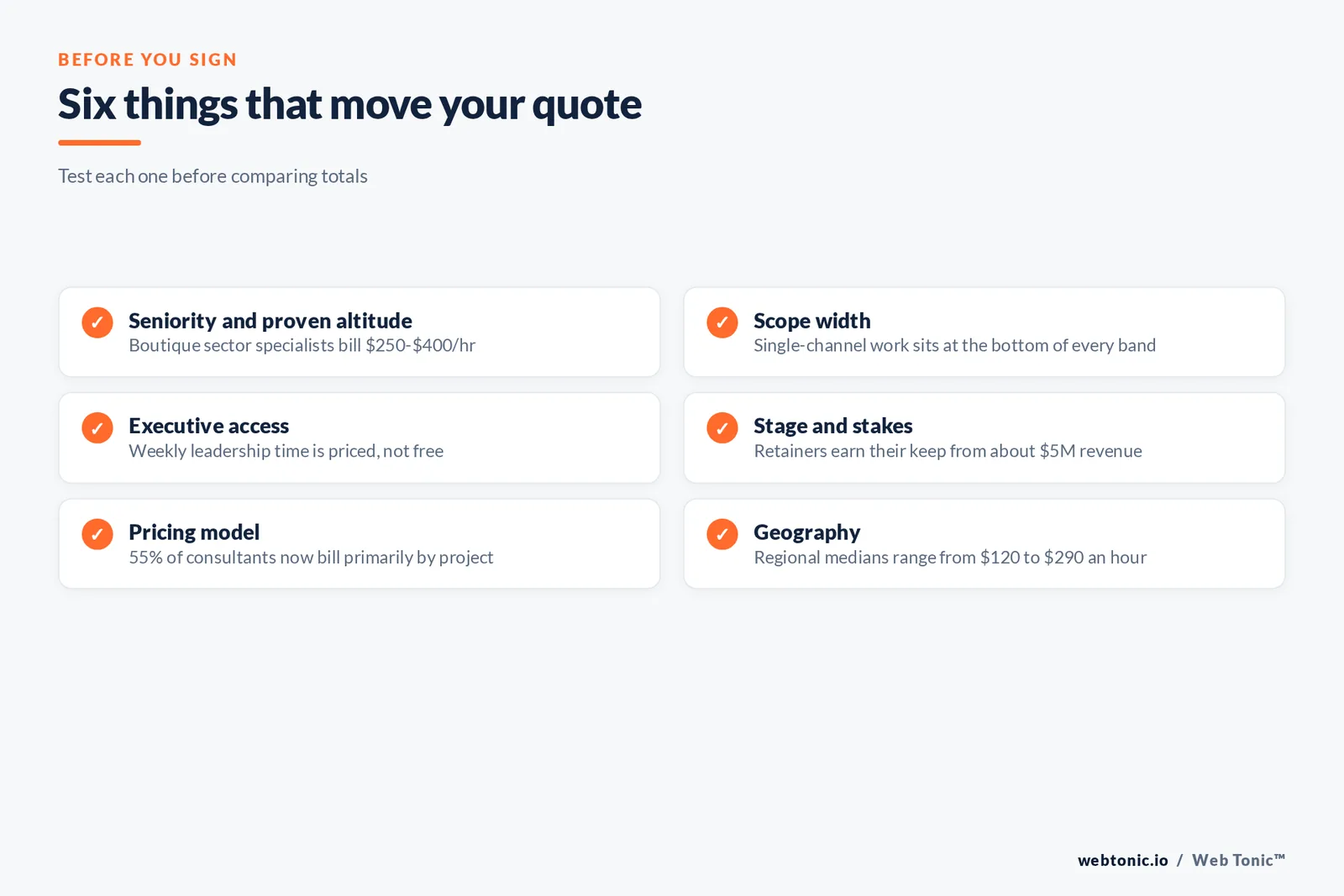
Six variables explain most of the difference between two quotes for what looks like the same work.
1. Seniority and proven altitude. ConsultingDemand's 2026 fee data puts boutique strategy consultants with deep sector experience at $250 to $400 an hour, competitive with second-tier firm rates that run at roughly 60–70% of Big Three pricing. Someone who has run your decision at your revenue scale prices higher than someone who has read about it, and usually costs less in total because the engagement is shorter.
2. Scope width. A single-channel question and a full go-to-market rebuild are not the same purchase. Discipline-level work sits at the bottom of the ranges; cross-functional growth work — pricing, positioning, channel mix, measurement and team design at once — sits at the top.
3. Access. ConsultFees explicitly prices executive access as a fee driver. A retainer that includes weekly leadership sessions and standing availability costs more than one with a monthly review, because the constraint being sold is calendar, not deliverables.
4. Stage and stakes. Taylor Sicard's read is that below roughly $5 million in revenue a full retainer is usually the wrong purchase, that the $5M to $20M band is where retainers start earning their keep at the lower end, and that above $20M the fee rises because the stakes rise, not because the hours do.
5. Pricing model. The same work priced hourly, as a project, or on a retainer produces three different totals and three different incentives. Hourly rewards time spent. Projects reward closure. Retainers reward continuity — and only pay off if there is a real cadence of decisions to make.
6. Geography. The regional medians above vary by more than 2x. That matters less for judgement-led remote work than it used to, but it still explains a large share of quote variance.
Cost against the alternatives
Advisory is almost never compared correctly. The two comparisons that matter are the loaded cost of a senior hire and the cost of an agency retainer, and they answer different questions.
| Option | Typical 2026 cost | What it buys | The catch |
|---|---|---|---|
| Fixed-fee diagnostic | Scoped fixed fee, weeks not months | A written answer and a priority order | Someone still has to execute it |
| Advisory retainer | $4,000–$20,000 a month | Senior judgement on a cadence | Not execution capacity |
| Fractional growth leader | $8,000–$25,000 a month, 2–3 days a week | Ownership of the growth number, part-time | Priorities compete with other clients |
| Full-time senior leader | Roughly $657,000 a year fully loaded, per Go Fractional 2026 | Permanent ownership and institutional memory | 3–5 months to hire, slow to reverse |
| Agency retainer | Priced on volume of work | Execution capacity and account management | You are buying hands, so the thinking must come from somewhere |
Go Fractional's 2026 analysis, as reported by Taylor Sicard, puts the fully loaded cost of a full-time senior marketing leader near $657,000 a year against roughly $144,000 for a comparable fractional advisor — a saving of about 78%. The saving is not the point. The point is reversibility: a retainer ends on notice, a hire ends with severance and a stalled quarter. Web Tonic's model is deliberately built the other way round from an agency retainer — the diagnostic and the measurement layer come first, and execution is scoped against what the numbers say, which is why our data intelligence work usually runs before any spend recommendation.
How to judge whether the fee is worth it
ConsultFees makes the strongest argument on this point: the fee should be judged against the financial consequence of the decision, not against a competitor's estimate. Its worked example puts a $55,000 growth strategy engagement against a decision carrying $5 to $9 million of financial stake — a 0.6% to 1.1% cost of clarity — and a $45,000 fee against a $6 million capital allocation as trivially justifiable. Run the same arithmetic on your own numbers before you compare quotes.
Then pressure-test the return the way a buyer of fractional leadership would. Fractional Pulse's ROI framework expects a senior part-time engagement to lift marketing-sourced pipeline by 30–60% and improve CAC by 15–30% within six months, with typical 90-day outcomes of 15–25% more MQLs and 10–20% better conversion rates. It benchmarks a $12,000-a-month engagement as needing $432,000 to $720,000 in attributable revenue or savings over a year to clear a 3–5x bar. Those are advocacy numbers from a fractional marketplace, not audited results, so treat them as the shape of a target rather than a promise — but do write your own version down before the engagement starts.
MarkCMO's consultant tiering is a useful sanity check on the other side: mid-tier consultants at $150–$300 an hour with 5–10 years of experience, senior at $300–$500 with ex-VP or CMO depth, and tier-one at $500–$1,500. If the rate says tier-one and the reference calls say mid-tier, the price is wrong regardless of the market range.
Three ways buyers waste the budget
Buying a retainer before a diagnostic. A monthly commitment made before anyone has read your data locks you into a scope built on assumptions. A fixed-fee diagnostic first costs less and makes the retainer scope specific.
Buying hours when the problem is a decision. Hourly is the weakest of the four models for growth work, because it prices the input you do not care about. If the deliverable is a decision, buy a deliverable.
Buying seniority you cannot use. A $15,000-a-month advisor at $3 million of revenue is usually a mismatch — as Taylor Sicard puts it, the fair question is what they intend to do with all those hours. Advisory pays when there is a real cadence of consequential decisions and a team able to act on them. If nobody can execute, buy execution first. Our service overview maps which of those two problems you actually have, and the blog works through the same decisions in more depth.

Frequently Asked Questions
How much does growth consulting cost per month in 2026?
Most credible retainers land between $4,000 and $20,000 a month, with the median near $8,500 and the largest share of engagements in the $5,000 to $15,000 tier. Light advisory retainers with limited deliverables start around $2,000 to $3,000, and fractional leadership at two to three days a week runs $8,000 to $25,000.
Is hourly or project pricing better for growth advisory?
Project or fixed-fee pricing is now the market default — 55% of consultants bill that way, against 30% primarily hourly. For a scoped question, a fixed fee aligns incentives around closure. Hourly makes sense only for genuinely ad-hoc input where you cannot define the deliverable in advance.
What is a fair hourly rate for a senior growth consultant?
The independent-consultant median sits at $188 to $190 an hour globally and $290 in North America, with the middle half of the market between $150 and $250. Senior growth and marketing specialists commonly bill $300 to $500. Rates above that are a small minority of the market and should be backed by results at your scale.
How do I know whether the engagement paid off?
Write the target down before you start, in the client's own numbers: pipeline sourced, CAC or payback period, and one operational milestone such as a working measurement layer. Six months is a fair horizon for CAC and pipeline movement; 90 days is fair for leading indicators like MQL volume and conversion rate.
Why do two quotes for the same brief differ by 3x?
Because they are usually not the same brief. Seniority, scope width, executive access, stage, pricing model and geography each move a quote materially — regional medians alone vary from $120 to $290 an hour. Ask each provider to state the deliverable, the decision it informs and the hours behind it, then compare those three things rather than the totals.
Where to go next
Price the decision before you price the provider. If the decision in front of you is worth six or seven figures, the fee range above is noise; if it is not, buy a smaller engagement. When you are ready to scope one, the contact page is the fastest route to a fixed-fee read on which of these models fits.
Sources: Taylor Sicard, What a Growth Consultant Costs in 2026 (Go Fractional 2026 rate data) · GrowthMentor, Growth Consultants: Types, Costs & When to Hire One · Reinvention Academy, 2026 Global Consulting Fees Survey via Chief Reinvention Officer · The 2026 Rate Report · Consulting Success, Consulting Hourly Rate study · Schmidt Consulting Group, Consulting Retainer Cost · SoloPricing, Retainer Pricing for Consultants 2026 · Zanfia, Consulting Retainer Pricing 2026 · ConsultFees, Strategy Consultant Fees 2026 · ConsultingDemand, Consulting Fees & Rates by Industry 2026 · Fractional Pulse, Fractional CMO ROI · MarkCMO, Marketing Consultant. All figures accessed September 2026.