



Table of contents

Quick answer: A marketing audit checklist needs three things: read access to every account in the money path, a fixed export window so numbers are comparable, and four output artefacts — a findings register, a tracking map, a spend reconciliation and a 90-day plan.
Last verified: 2026-09-08
Tooling is an access problem, not a software problem
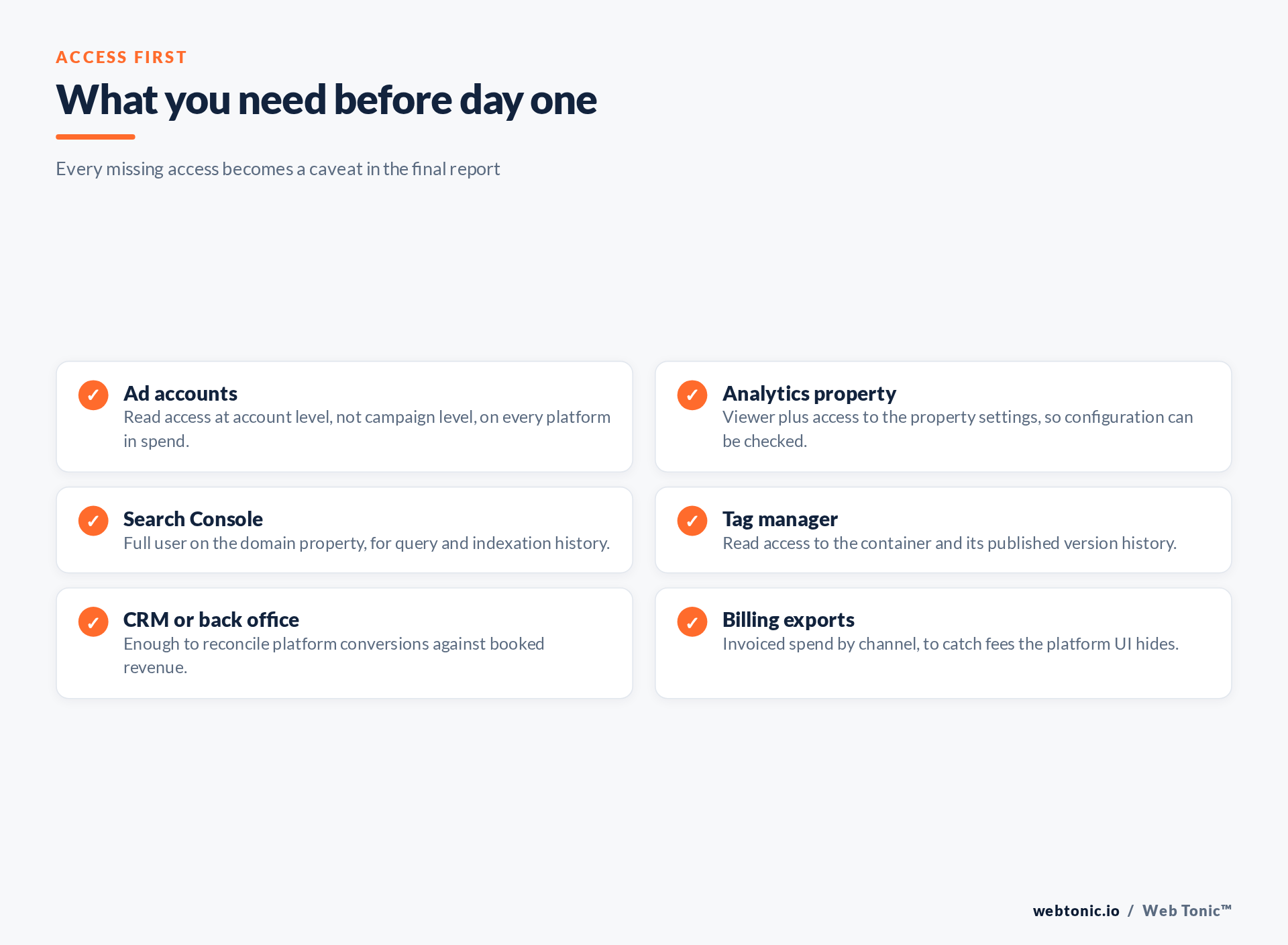
Most growth audit delays are not analytical. They are somebody waiting nine days for account access. Send the access request list before anything else, at the level you actually need: account-level read on ad platforms, viewer plus settings visibility on the analytics property, full user on the domain property in Search Console, and read on the tag container including its version history.
Two access details cause most rework. First, campaign-level ad access hides account settings and conversion actions, which is where half the findings live. Second, a URL-prefix property in Search Console shows a fraction of the domain — insist on the domain property, per Google's property setup documentation. Anything refused becomes a written caveat, not a guess.
Fix the export window before you export anything
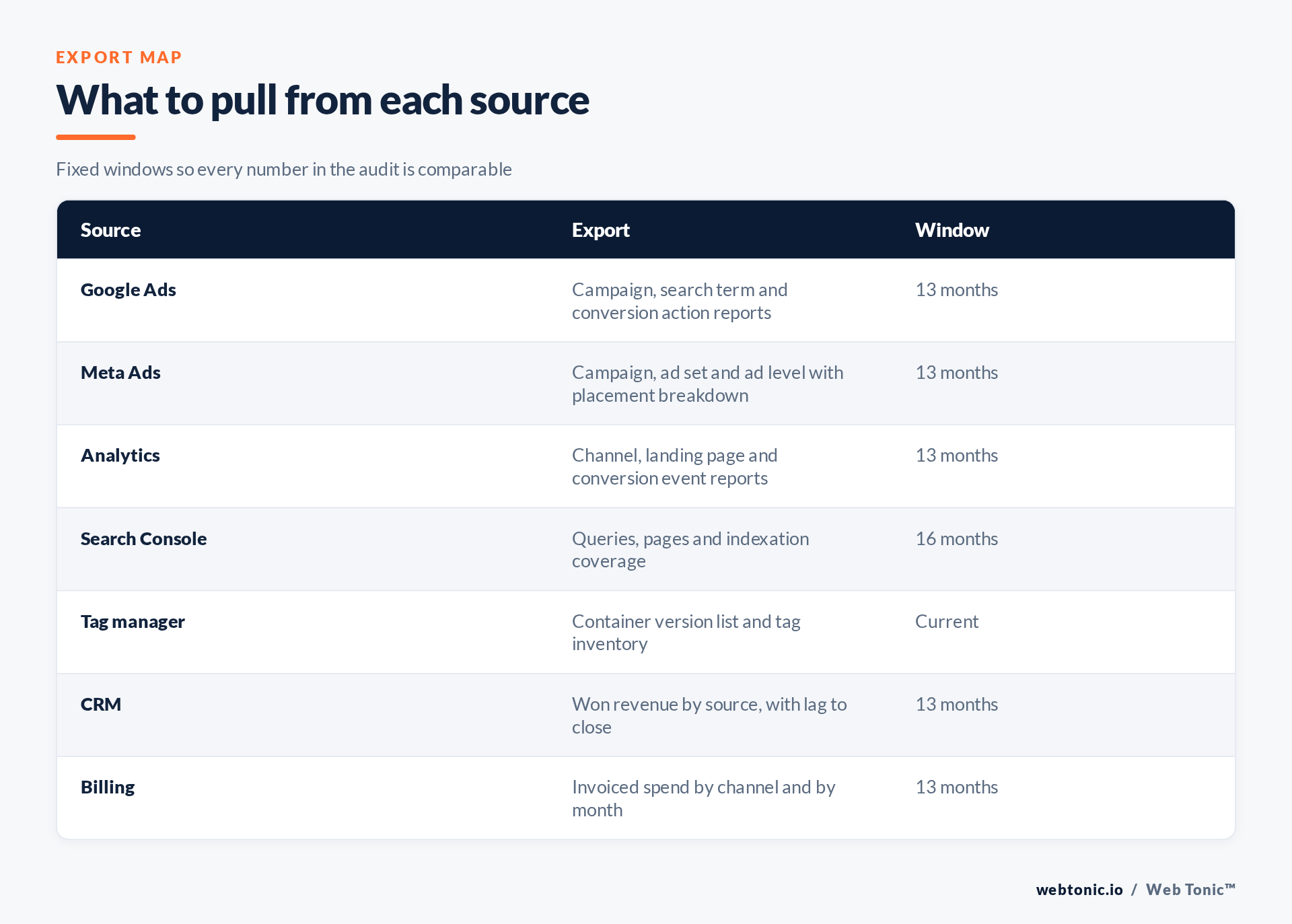
Pick one window and use it everywhere. Thirteen months on ad platforms, analytics and CRM gives a clean year-over-year comparison; Search Console holds 16 months of performance data, so pull all of it and trim later. Mixed windows are the single most common reason two tabs of the same audit disagree.
Record the attribution settings alongside every export. A conversion count means nothing without the conversion window and attribution model that produced it, and platforms change their defaults. Note the timezone and currency too — an account reporting in a different timezone from the CRM will produce a permanent, unexplained daily offset.
The four artefacts the audit must produce
Templates matter less than the fact that these four exist. A findings register: one row per finding, with severity, evidence link, money at stake and owner. A tracking map: every conversion action, where it fires, whether it is deduplicated, and whether it reaches the CRM. A spend reconciliation: invoiced spend against platform-reported spend by month. A 90-day plan: sequenced, with dates and metrics.
Keep the register in one place and severity-rank it, because that ranking is what survives into the board paper. If you also maintain a scorecard, define the key performance indicators once and reuse the definitions verbatim in every later review.
The tracking checks worth automating
A digital marketing audit lives or dies on measurement quality, so run the same short list every time: duplicate conversion events, conversions with no deduplication key, goals counting page views instead of actions, consent configuration, and offline conversion import for anything that closes off-site. Google's event documentation and its consent mode reference are the citations to use for the mechanics; your judgment goes on top.
Where personal data is in scope, note the lawful basis and retention settings while you are already in the property — GDPR obligations are cheaper to check during an audit than during a review. Our conversion tracking and server-side tracking pages describe the remediation patterns we use when these checks fail.
| Artefact | Format | Done when |
|---|---|---|
| Access log | One table | Every account granted or refused in writing |
| Findings register | Sheet, one row per finding | Severity, evidence and owner on every row |
| Tracking map | Sheet plus diagram | Every conversion traced end to end |
| Spend reconciliation | Sheet by month | Invoiced and platform spend within a stated tolerance |
| 90-day plan | One table | Dates, owners and one metric per line |
| Caveat list | Bullets in the report | Every missing access or data gap named |
What an audit costs, in market terms
Buyers usually want a range before they scope. Published third-party guides put standalone marketing and SEO audit engagements broadly in the low four figures to the mid five figures depending on scope, account count and whether remediation is included; consultancy day rates vary by market by a factor of several. Those are market observations, not a quote — the honest answer is that an audit's cost tracks the number of accounts and the depth of the tracking work, and we quote after a short scoping call.
What does not vary is the sequencing: access, exports, findings, plan. Skipping straight to recommendations without the reconciliation step produces advice that cannot be defended when someone checks the numbers.
What goes wrong
The failure mode: the audit is built on platform screenshots instead of exports. Nothing is reproducible, nobody can re-run a number three weeks later, and the first challenged figure ends the conversation. Export raw, keep the files, and cite the file in the register.
Second failure mode: no spend reconciliation. Platform-reported spend and invoiced spend routinely differ, and if you never compare them you cannot say what the business actually paid per acquisition.
Third: an unwritten access log. Six weeks later nobody remembers which system was refused, and the audit's gaps look like sloppiness rather than a constraint someone chose. More process notes sit in the help library, and the delivery side is covered under data intelligence.
Related reading
- Fractional CMO Tooling and Template Checklist
- Growth Advisory Tooling and Template Checklist
- Marketing Strategy Consulting: Tooling and Template Checklist
- Marketing Strategy Consulting services at Web Tonic
Frequently Asked Questions
What tools do I actually need for a marketing audit?
Read access to the ad accounts, analytics property, Search Console domain property, tag container, CRM and billing exports. A spreadsheet is enough for the analysis itself; access is the real dependency.
How far back should the audit data go?
Thirteen months on ad platforms, analytics and CRM for a clean year-over-year read, and the full 16 months available in Search Console. Use one window everywhere.
Which templates does a growth audit need?
Four: an access log, a severity-ranked findings register, a tracking map and a spend reconciliation, plus the 90-day plan they feed.
How long does a marketing audit take?
Most of the elapsed time is access and exports, not analysis. With access on day one, a focused audit of a handful of accounts is typically a one to two week exercise.
Sources: Google support documentation on tag manager versions, Search Console properties, performance data retention, conversion windows, Analytics events; Google consent mode; GDPR; Key performance indicator (Wikipedia). Verified 2026-09-08.


