Table of contents
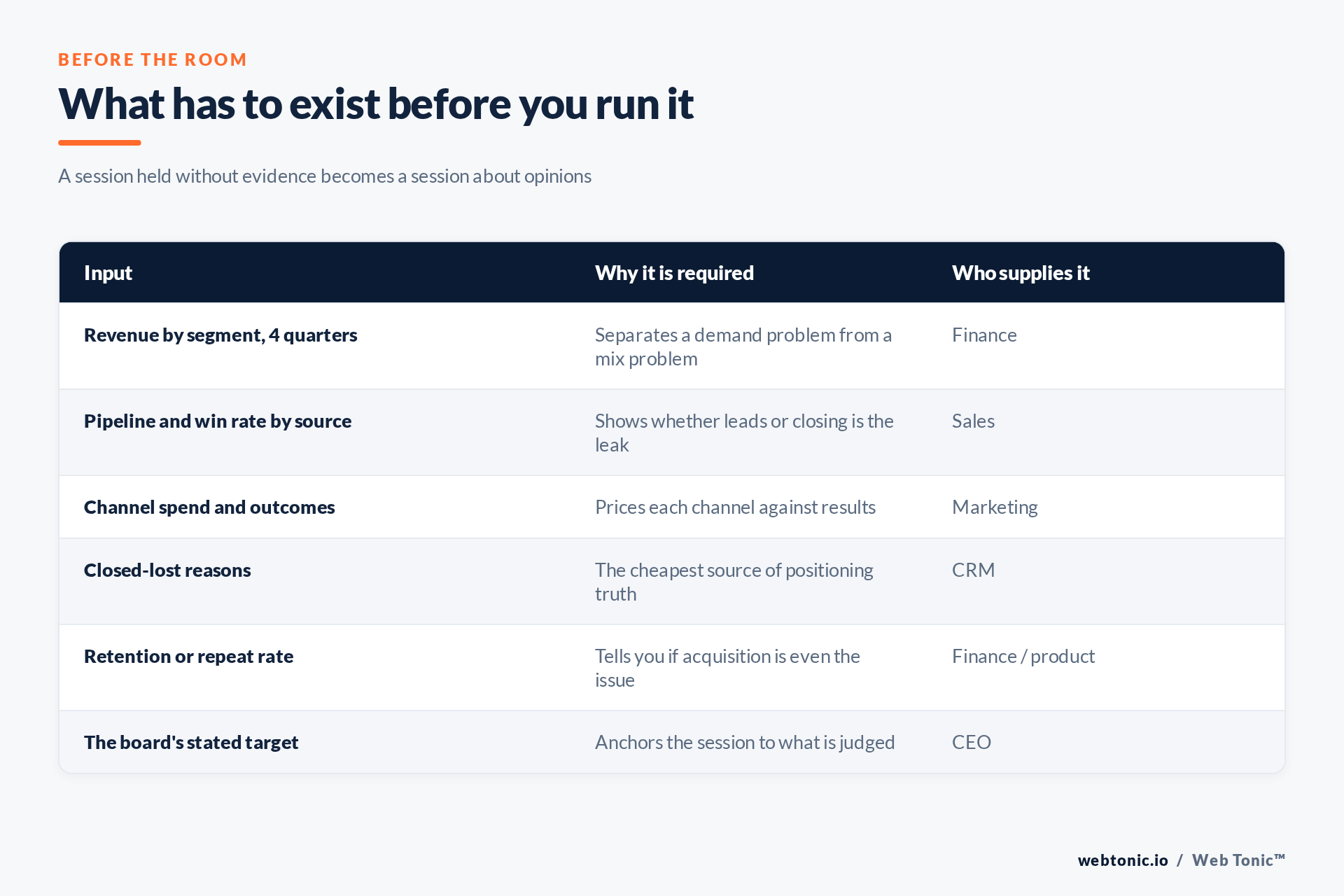
Quick answer: Run the first growth strategy session in three hours and four blocks: an evidence read-out with no opinions, an open argument about the real constraint, three decisions with owners and dates, and a stated signal that would prove the call wrong.
Last verified: 2026-09-04
What this session is for
The first session of a growth advisory engagement has exactly one job: settle what the constraint is, with the people who can act on it in the room. It is not a kickoff, not a capability presentation, and not a workshop that ends on sticky notes nobody transcribes.
That framing changes the preparation. If the goal is agreement on a diagnosis, the consultant's job before the session is evidence, and the room's job during it is to attack that evidence. Sessions that skip the attack phase produce polite consensus around whatever the growth strategy consultant proposed, which is the least useful possible outcome.
Before the room: the inputs
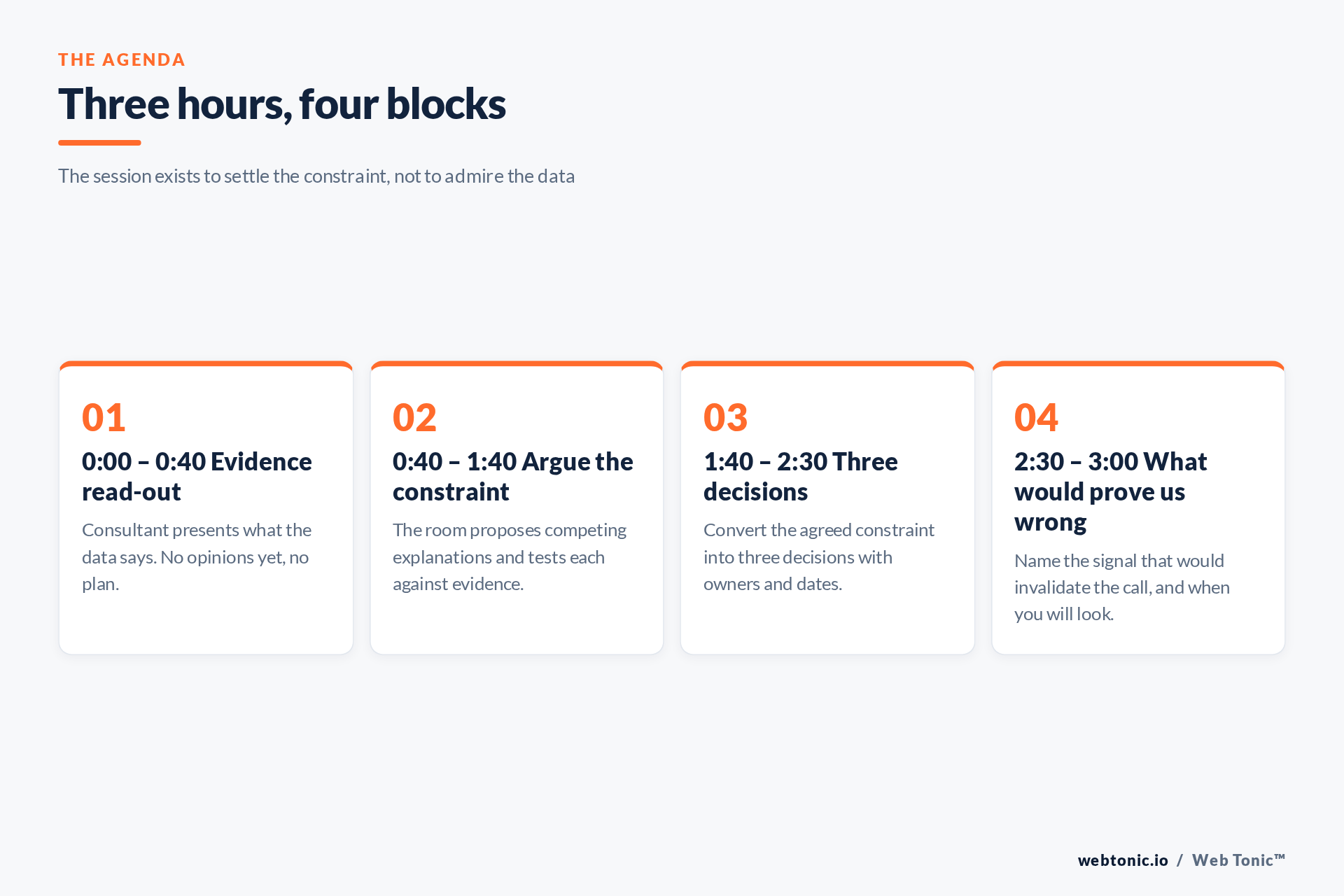
Six inputs, gathered in advance, in writing. Revenue by segment across four quarters. Pipeline and win rate by source. Channel spend against outcomes. Closed-lost reasons from the CRM. Retention or repeat rate. And the target the board actually holds the company to.
Refuse to run the session without them. A strategy session held on memory becomes a session about opinions, and the loudest opinion in a founder-led company wins by default. Where the data genuinely does not exist, that absence is the first finding and the session's output becomes a measurement plan — which is a legitimate result, just a different one.
Block one — evidence, no interpretation
Forty minutes. Present what the numbers say, flatly, with no recommendations attached. Trends, splits, and anything that contradicts what the company believes about itself. Hold your own hypothesis back deliberately: naming it early anchors the room and you lose the independent thinking you came for. Anchoring is a well-documented effect in decision research, and a strategy room is an unusually easy place to trigger it.
Flag data you do not trust, explicitly, and say why. A room that later discovers a shaky number treats every other number as shaky too.
Block two — argue the constraint
An hour, and it should be uncomfortable. Ask each participant to state, in a sentence, what they believe is limiting growth. Write every version on the board including the contradictory ones. Then test each against the evidence from block one: what would we expect to see if this were true, and do we see it?
Most rooms produce three or four candidate constraints — demand, conversion, retention, execution capacity. The test is discriminating, not democratic. If pipeline volume has grown while closed revenue has not, a demand explanation is already in trouble, whoever proposed it. This is essentially hypothesis testing applied to your own business, and the value comes from being willing to reject the comfortable answer.
End the block by writing the agreed constraint in one sentence and reading it aloud. If nobody objects to the sentence, you have your engagement's spine — which is also what a scope should then be built on.
Block three — three decisions
Fifty minutes, and a hard limit of three. Each decision gets an owner, a date, and one line of reasoning. Three is not a rhetorical number: rooms that leave with nine actions complete two, and the ones they complete are the easy ones.
Decisions, not tasks. "Stop running the mid-funnel retargeting campaign and move the budget to lifecycle email" is a decision. "Explore lifecycle email" is a task disguised as one. Where a decision needs data the company does not yet have, the decision is to build the measurement — and it still gets an owner and a date. Our analytics and conversion tracking notes cover what that usually involves.
Block four — what would prove us wrong
Thirty minutes, and the block most often cut for time. Name the signal that would tell you the agreed constraint was the wrong call, and the date you will look at it. Writing this down before anyone is invested makes the later correction cheap, and it is the single clearest marker of an honest advisory relationship.
It also protects the engagement politically. When a plan is revised in month three, the difference between "the consultant was wrong" and "we said in June this is what we would check" is the whole relationship.
| Role | Why they are in the room | If they cannot attend |
|---|---|---|
| CEO or founder | Owns the target and can release budget | Postpone the session |
| Sales lead | Holds closed-lost reality | Pre-interview and present their view |
| Marketing owner | Knows what has already been tried | Written channel history required |
| Finance | Supplies and defends the numbers | Numbers signed off in advance |
| Everyone else | Usually not needed | Send the write-up instead |
After the room
Circulate a one-page write-up within 24 hours: the agreed constraint, the three decisions with owners and dates, the disproof signal, and anything unresolved. One page, not a deck. The write-up is the artefact the revenue growth plan is built from, and it is what the next session opens with.
Then hold the review when you said you would, even if things are going well. Skipping a scheduled review because performance is good is how a wrong diagnosis survives a good quarter.
What goes wrong
The failure mode: the session becomes a presentation. The consultant arrives with a plan, presents for two hours, the room nods, and the constraint is never argued. Everyone leaves satisfied and nothing was tested. If you find yourself talking for more than half the session, it has already gone wrong.
The second failure mode is the missing decision-maker. Without the person who controls budget, the room produces recommendations rather than decisions, and recommendations decay. Postponing a session for two weeks to get the founder in it costs less than running it without them.
The third is leaving with a long list. Nine actions with no owners is the classic strategy-day output, and it is why strategy days have the reputation they do. Three decisions, three owners, three dates — and the honesty to say that everything else was interesting but not chosen. Where the room wants execution support on those three, scope it separately alongside growth marketing delivery rather than folding it into the advisory hours, and keep the reading in the help library as the shared reference.
Related reading
- EOS / Scorecard & KPI Advisory — How to Run the First Strategy Session
- AI Marketing Advisory / AI Readiness — How to Run the First Strategy Session
- Investor-Ready Growth Plan: How to Run the First Strategy Session
- Marketing Strategy Consulting services at Web Tonic
Frequently Asked Questions
How long should the first strategy session be?
About three hours. Shorter sessions cut the argument block, which is the part that produces the diagnosis; full-day sessions lose the room's attention and drift into workshopping.
Who must attend?
The person who owns the target and can release budget, plus sales, marketing and finance representation. If the decision-maker cannot attend, postpone rather than proceed.
Should the consultant share their hypothesis first?
No. Present evidence first and hold the hypothesis until the room has proposed its own explanations, or you will anchor the discussion to your view and lose the test.
What is the output of the session?
A one-page write-up within 24 hours: the agreed constraint in one sentence, three decisions with owners and dates, and the signal that would prove the call wrong.
Sources: Anchoring effect, Customer development, Sales process (Wikipedia); MIT Sloan Management Review; Harvard Business Review. Verified 2026-09-04.