Table of contents

Quick answer: Run the first marketing KPI scorecard session as a cull: read the current dashboard aloud, delete every line that informs no decision, pick leading numbers that predict revenue, then assign an owner, target and floor to each.
Last verified: 2026-09-11
Open by reading the current dashboard aloud
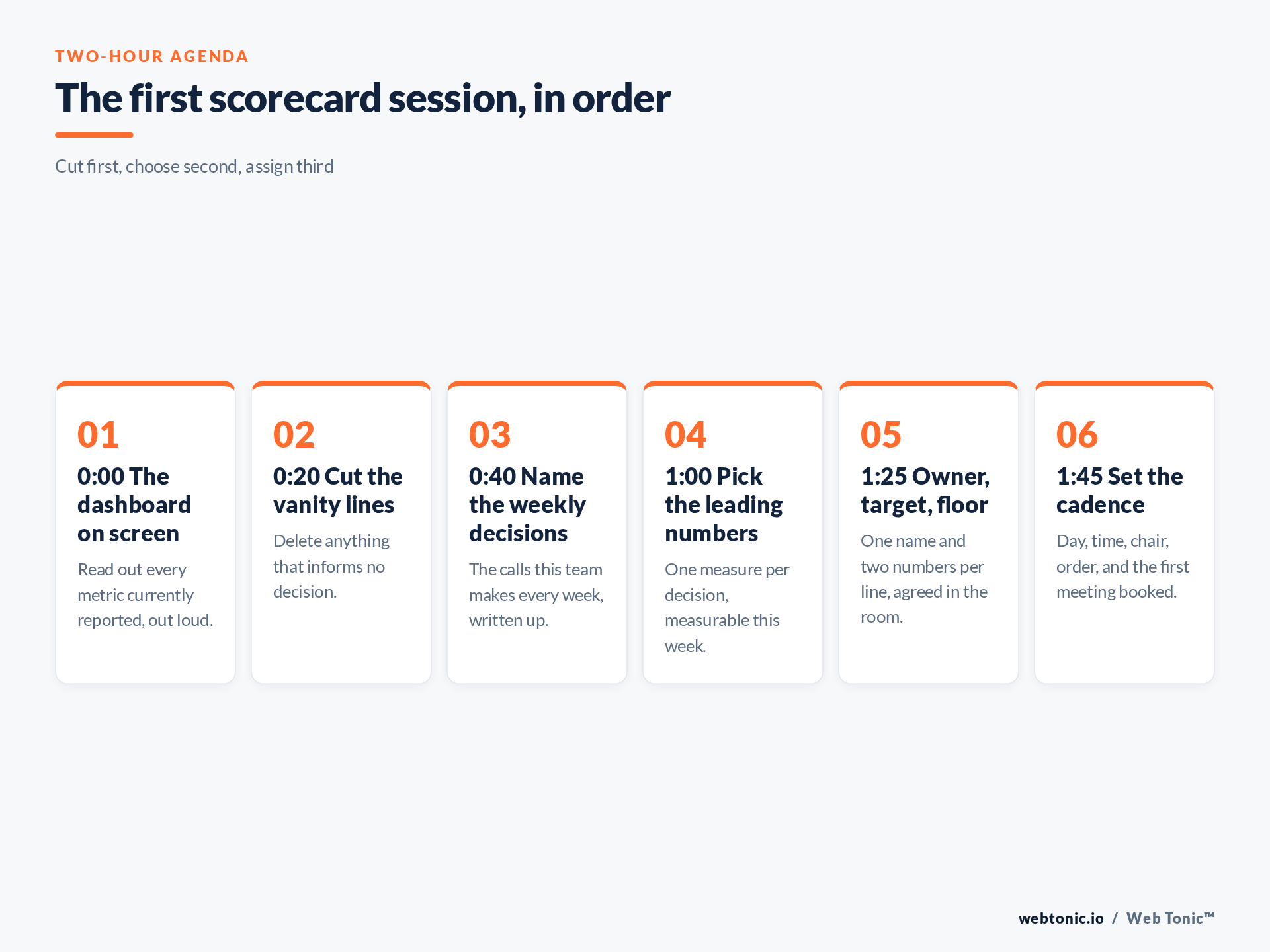
Put whatever the team reports today on screen and read every metric out, one by one, asking a single question each time: which decision did this number change in the last ninety days? The silence does the work. Nobody defends impressions out loud when the question is phrased that way, and the room reaches its own conclusion faster than any framework slide would produce.
Keep a running cut list on the board. A KPI advisory session that adds lines without removing any has failed before it starts — a KPI earns its place by triggering behaviour, and most reported marketing metrics simply never do.
Name the weekly decisions before choosing numbers
Ask the team to list the decisions they actually make every week: shift budget, pause or scale a campaign, change an offer, chase a pipeline gap, escalate a sales-capacity problem. Write them on the board. This list, not the tool export, defines the sheet — a balanced-scorecard layout only works when every line answers a recurring question.
Then pick one leading measure per decision. Leading means it moves before the money does: qualified conversations booked, opportunities created, cost per qualified lead by channel, non-brand sessions on money pages, test or publish throughput. Lagging totals stay on the monthly financial review, where they belong.
Prove each number is measurable in the room
Do not accept a candidate line on trust. Pull it live while everyone watches: the ad platform for cost and volume within its own conversion windows and attribution settings, GA4 events for on-site behaviour, the CRM for pipeline. If a number takes twenty minutes and a spreadsheet to produce, it will not survive a busy week.
Note every failure as a measurement gap rather than a reason to lower the bar. Missing conversions route to conversion tracking, definition and reporting structure to analytics, and genuinely lossy collection to server-side tracking. Where consent and privacy obligations such as GDPR cause the gap, say so plainly instead of letting the team assume the tracking is broken.

Assign an owner, a target and a floor, live
Every surviving line leaves the room with one named person beside it — not a department — plus the number expected in a normal week and the floor that forces a conversation. Do this in the session, out loud, because ownership agreed by email is ownership nobody remembers agreeing to.
Separate targets from ambitions. Stretch outcomes belong in an OKR set or the marketing plan; the scorecard target is the steady operating number that says execution is on track. If a line has no credible target yet, mark it "baseline for four weeks" and set the target from real data rather than from hope.
| Session block | Output | Owner afterwards |
|---|---|---|
| Dashboard read-out | Cut list of metrics nobody acts on | Consultant |
| Decision list | The weekly calls the sheet must serve | Marketing lead |
| Line selection | One leading measure per decision | Consultant |
| Live pull test | Measurable lines confirmed, gaps logged | Analyst |
| Owner, target, floor | One name and two numbers per line | Named line owners |
| Cadence | Day, time, chair, agenda order, first meeting booked | Internal chair |
Close on the cadence, not on the sheet
The last fifteen minutes decide whether any of this survives. Fix the day and time, name the chair, agree the order the lines are read in, and book the first meeting before people stand up. Same lines, same order, every week: the discipline is what produces behaviour change, and the sheet is only its container.
Agree two rules while everyone is present. First, a definition never changes silently — if it changes, the prior period is restated on the new definition. Second, whoever pulls the numbers must have durable access, with a named administrator per system and MFA on admin accounts per CISA guidance and NIST SP 800-63. Access that expires with one person's laptop is the most common reason a scorecard stops being updated.
What goes wrong
The failure mode: the session becomes a metrics wish list. Thirty candidate lines, none tested against a live system, and the sheet arrives a fortnight later half-empty. Pull numbers in the room or expect the sheet to be aspirational.
Second failure mode: nothing gets cut. Adding a scorecard on top of the existing dashboard leaves the team with two truths and no focus, and the older report usually wins because people already trust it.
Third: the person who builds the reports is not invited. They know which numbers are manually patched every month, and choosing lines without them guarantees at least one line that cannot be produced. Related process notes sit in the help library; delivery sits under data intelligence, and constraint sequencing follows theory of constraints.
Related reading
- AI Marketing Advisory / AI Readiness — How to Run the First Strategy Session
- Marketing Team Structure & Hiring Advisory — How to Run the First Strategy Session
- How to Run the First Growth Strategy Session
- Marketing Strategy Consulting services at Web Tonic
Frequently Asked Questions
Who should be in the first scorecard session?
The marketing lead, the sales lead, whoever builds the reports, and someone with live admin access so candidate lines can be pulled on screen.
How long should the session be?
Two hours. Longer sessions drift into strategy; shorter ones end before owners and targets are agreed, which is the part that matters.
What if the team refuses to cut a favourite metric?
Keep it, but demand the decision it triggers and a floor. A metric with a stated consequence stops being a vanity line; one without a consequence proves the point.
Should the scorecard be built during the session?
No. Leave with agreed lines, owners, targets and floors, then build within a week so the first weekly meeting runs on the real sheet.
Sources: Google Ads conversion windows, GA4 events (Google); GDPR; CISA MFA; NIST SP 800-63-3; KPI, Balanced scorecard, OKR, Marketing plan, Theory of constraints (Wikipedia). Verified 2026-09-11.