



Table of contents
Quick answer: Run the first session of an investor-ready growth plan as a half-day working meeting that reconciles the core numbers, names the growth engine, lists the weak claims, and ends with a draft five-sentence board story plus owners for every evidence gap.
Last verified: 2026-10-01
What the first session is for
An investor-ready growth plan has to survive due diligence, so the first strategy session is not a brainstorm. Its job is to produce the board story: a short narrative the founder can tell a board or an investor, in which every sentence points at a number the team can defend. The rest of the engagement fills in the evidence behind that story.
The session works best with three to five people: the founder, the board marketing advisor or fractional executive leading the work, the finance lead, and whoever owns acquisition. Larger groups turn reconciliation into debate, and the people who own the source data need to be in the room to answer questions on the spot rather than by email a week later. This page assumes the engagement has already been scoped; if not, start with how to scope an investor-ready growth plan.
Before the session: the pre-read
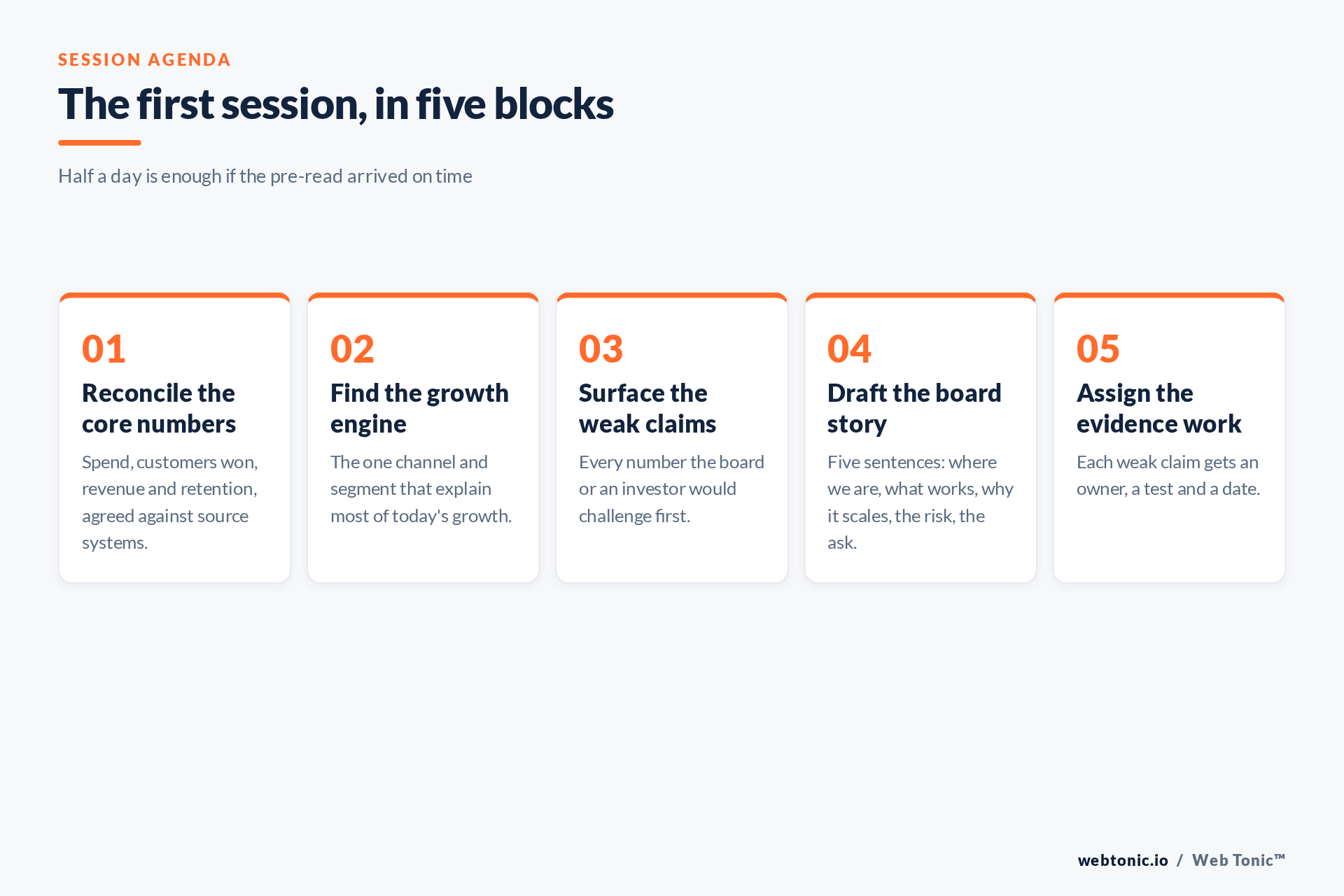
Send raw exports, not slides, at least two working days ahead. The advisor should arrive having already tried to reconcile spend to customers won, so the session starts with the discrepancies rather than discovering them. If the conversion data comes from an analytics tool, note which events are counted, using definitions such as Google's recommended GA4 events and the conversion window each ad platform uses. Strip personal data from customer exports before sharing them; GDPR applies to internal data rooms too.
The agenda, step by step
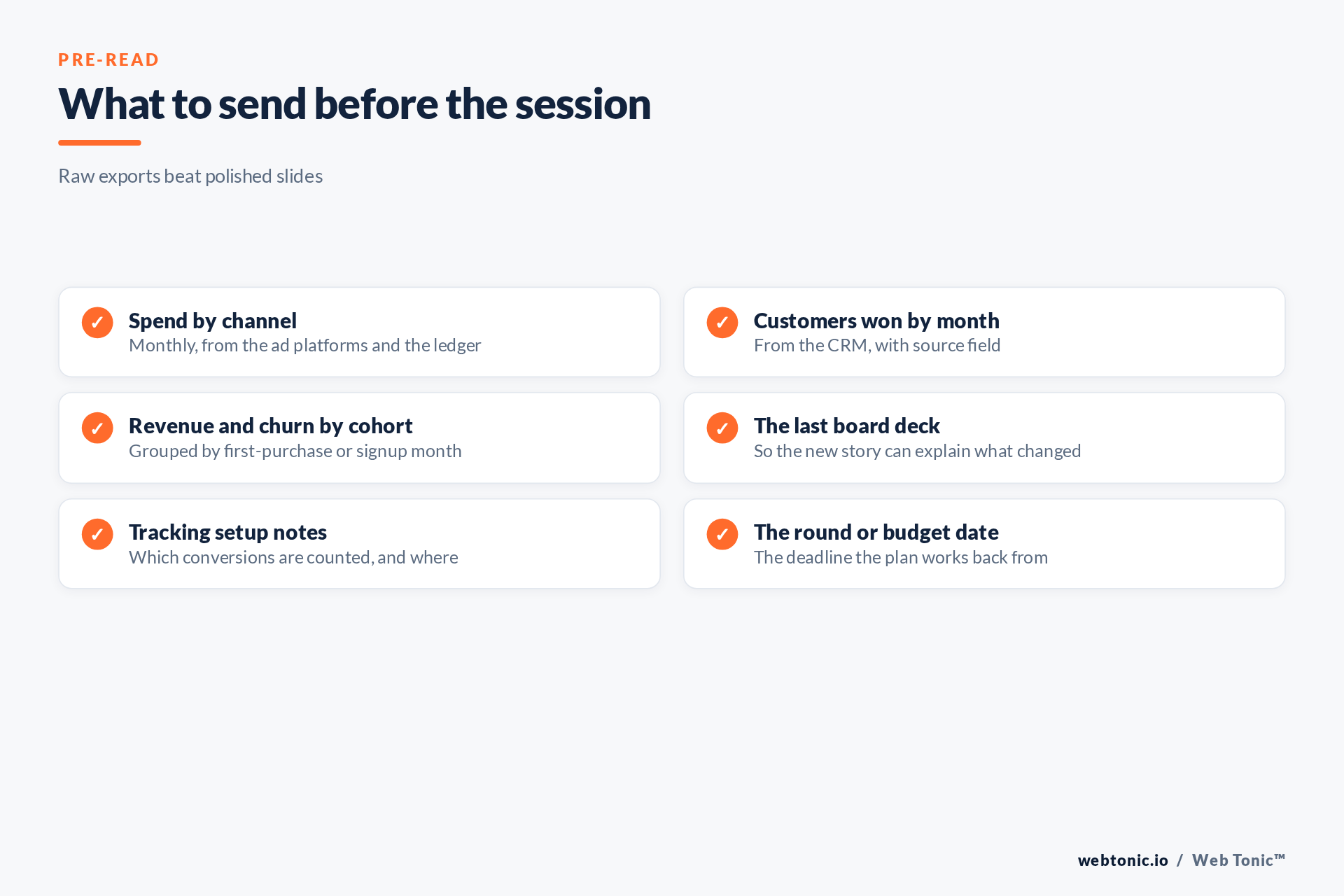
- Reconcile the core numbers (about an hour). Agree one figure each for spend, customers won, revenue and retention, and write down how customer acquisition cost and lifetime value are calculated. Where the CRM and the ad platforms disagree, record the gap rather than picking the flattering number.
- Find the growth engine. Identify the channel and customer segment that explain most of current growth. Investors back an engine they can understand; a plan that spreads credit evenly across eight channels usually means nobody knows which one works.
- Surface the weak claims. Go through the plan section by section and ask which number a sceptical reader would challenge first. Typical candidates: market size, acquisition cost at higher spend, and retention of recent cohorts.
- Draft the board story. Write five sentences on a whiteboard: where the business is, what is working, why it can scale, the main risk, and what the money or budget is for. Each sentence must cite a number from step 1 or be marked as an assumption.
- Assign the evidence work. Every weak claim becomes a line in the assumptions register with an owner, a test and a date. That list is the work plan for the rest of the engagement.
| Board story sentence | Weak version | Diligence-ready version |
|---|---|---|
| Where we are | "Strong traction" | Revenue and customer count, reconciled to the ledger |
| What works | "Multi-channel growth" | One named channel and segment, with its acquisition cost |
| Why it scales | Top-down market size | Bottom-up market and a tested spend increase |
| The main risk | Omitted | Named, with the test that will retire it |
| The ask | "Fuel growth" | Where the money goes and what it should produce |
Why the output is a story, not a deck
A business plan deck can hide a weak number on slide 30. Five sentences cannot. Writing the story first forces the team to decide what it actually believes, and it gives the advisor a fixed structure to build diligence-ready marketing evidence behind. The deck comes later and follows the story, not the other way round. If the story leans on venture investors rather than an existing board, the "why it scales" sentence usually needs the most work.
What goes wrong
The failure mode: the session skips reconciliation and goes straight to strategy. The team spends the afternoon on channel ideas built on acquisition-cost figures that do not match the ledger, and the gap surfaces in diligence instead. Reconcile first, even if it takes the whole morning.
The second failure is leaving without owners. A list of weak claims with no names or dates is just a list of worries. If the evidence gap is measurement, our analytics and conversion tracking work usually closes it; if it is an untested channel, a small measured test through growth marketing beats a projection. More help pages are on the Web Tonic blog.
Frequently Asked Questions
How long should the first strategy session be?
Half a day is usually enough when the pre-read arrives on time. Without a pre-read, reconciliation alone can take the whole session.
Should investors or board members attend?
Not the first session. It is a working meeting to find the weak claims; the board sees the story once the evidence work has started.
What if the numbers cannot be reconciled in the room?
Record the gap, mark the affected sentence as an assumption, and give someone a date to fix it. Do not pick the higher number to keep the story clean.
Who owns the board story after the session?
The founder owns and tells it; the advisor maintains the draft and the assumptions register behind it.
Sources: Due diligence, Board of directors, Customer acquisition cost, Customer lifetime value, Business plan (Wikipedia); GA4 recommended events, Google Ads conversion windows; GDPR.eu. Verified 2026-10-01.


