



Table of contents

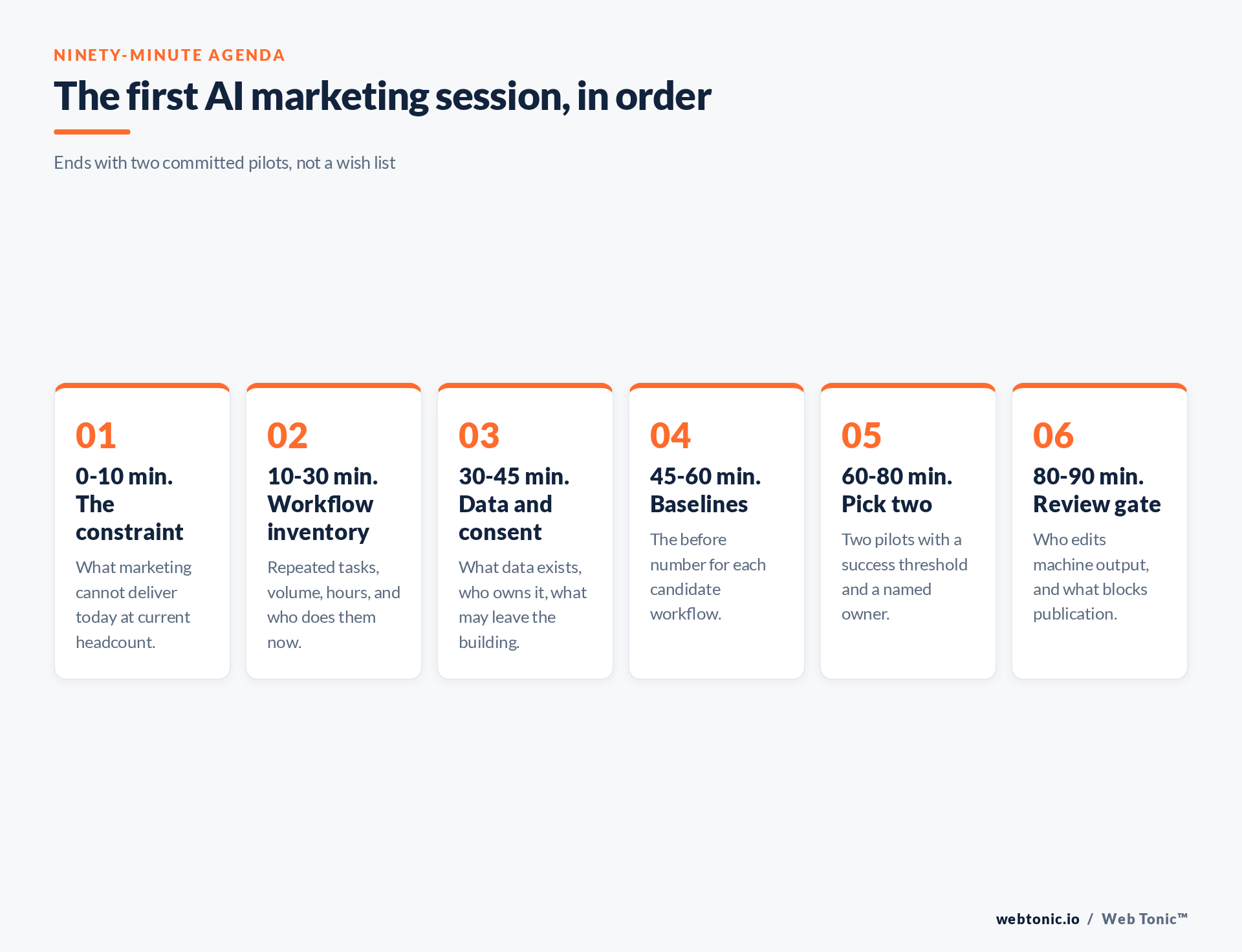
Quick answer: Run the first AI marketing session in ninety minutes: name the constraint, inventory repeated workflows, check data and consent, capture baselines, then commit to exactly two pilots with owners, thresholds and a named human review gate.
Last verified: 2026-09-12
Open on the constraint, not on the technology
The first question is not what AI could do. It is what marketing currently cannot deliver at its present headcount — briefs waiting three days, one creative variant per campaign instead of six, reporting that eats a week a month. An AI marketing consultant who starts anywhere else will produce a capability tour instead of a plan.
Write the constraint on the board in one sentence and keep it visible. Every candidate use case is then judged against it, which is what stops the session drifting into a discussion about which large language model is best this quarter.
Get the right six people in the room
You need the person accountable for marketing outcomes, the person who actually does the repetitive work, whoever administers the data systems, and someone who can say no on legal or brand grounds. Six people maximum. Sessions with fifteen attendees produce enthusiasm and no owner.
The operator is the most important seat and the one most often missing. They know which parts of a task are genuinely repeatable and which look repeatable from a slide. Generative AI earns its keep on first drafts of structured, high-volume work — only the operator can tell you which of your work is that.
Check data and consent before choosing anything
Spend fifteen minutes on where customer data lives, who administers each system, and what your consent language permits. Sending personal data to a third-party model is a processing decision with obligations under regimes such as GDPR, and the answer changes which pilots are even legal.
Then agree one written rule about prohibited inputs. The NIST AI Risk Management Framework gives a workable shape — govern, map, measure, manage — and where the EU AI Act framework applies, note which uses are out of scope now rather than discovering it mid-pilot.
Capture the baseline in the session
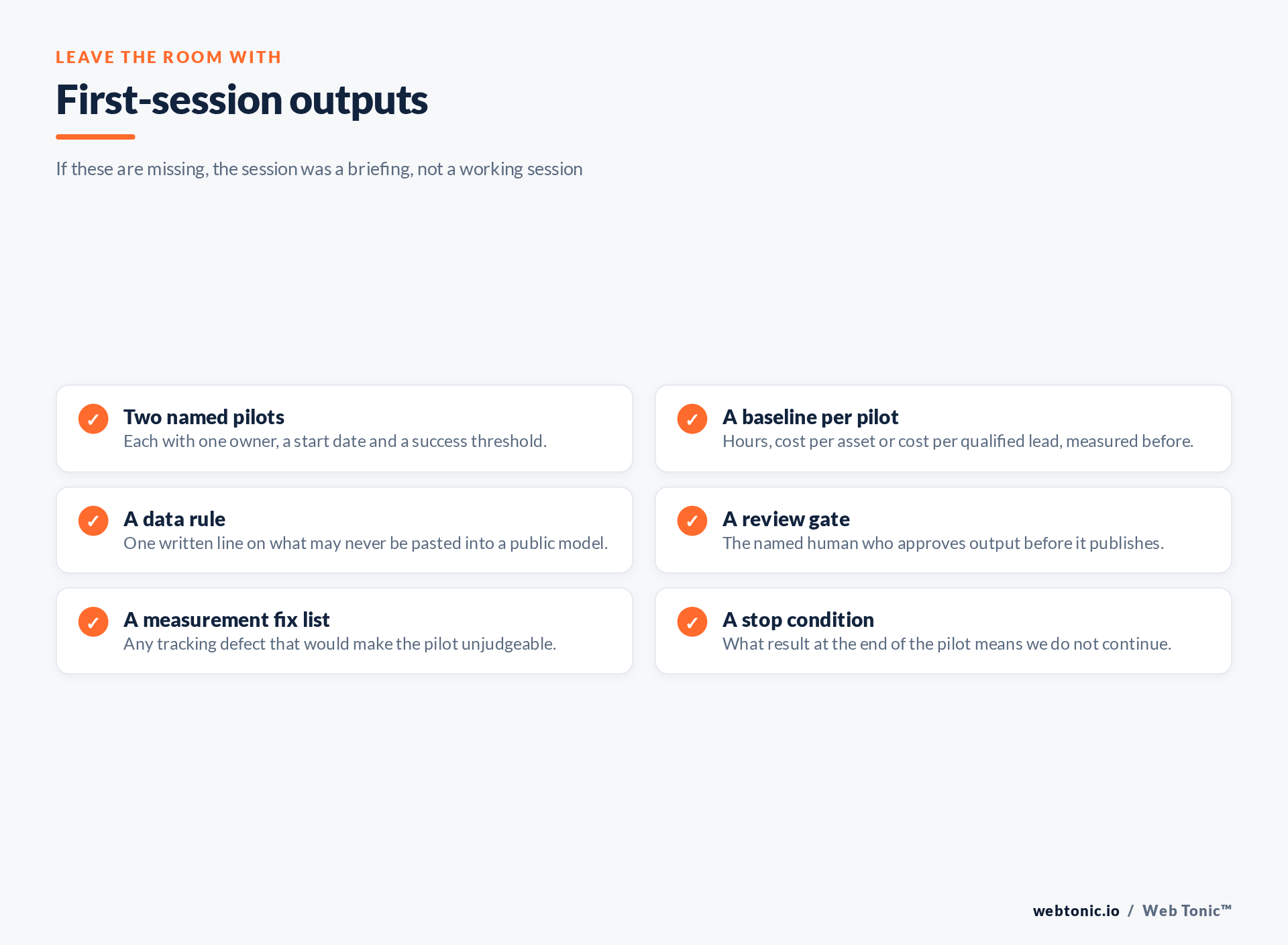
For each candidate workflow, write the before number on the board: hours per week, cost per asset, or cost per qualified lead. If nobody knows, that is the first finding, and the pilot cannot be judged until it is fixed. Missing event configuration and misread platform attribution windows are the usual culprits, and they belong to conversion tracking and analytics work.
Baselines also settle arguments later. A pilot that halves brief turnaround is a win even if it does not move revenue in six weeks, but only if someone recorded the turnaround before.
| Agenda block | Output it must produce | Failure signal |
|---|---|---|
| Constraint | One sentence on what marketing cannot deliver today | The session opens with a tool demo |
| Workflow inventory | Repeated tasks with volume, hours and current owner | Only managers describe the work |
| Data and consent | Systems, administrators, and one prohibited-input rule | Nobody in the room can answer where data sits |
| Baselines | A before number per candidate workflow | Estimates offered with no source |
| Pilot selection | Exactly two pilots with owner, date and threshold | Seven ideas survive to the end |
| Review gate | Named editor and what blocks publication | Output would publish unreviewed |
Commit to two pilots and a stop condition
Two is the number. One tells you nothing about whether the approach generalises; five guarantees none get proper attention. Each pilot needs a single owner, a start date, a success threshold, and a stop condition stated out loud — the result at which you do not continue. Fold both into the running plan the way you would any other initiative in a marketing plan.
Close with the review gate. Name the human who approves machine-generated output and the criteria they apply, because Google's own guidance on helpful, people-first content is unambiguous that scale without quality is a losing trade. Any marketing automation that skips this step is manufacturing cleanup work.
What goes wrong
The failure mode: the session becomes a demo. Ninety minutes of impressive outputs, zero baselines, no owner, and a follow-up meeting to "explore further". The tell is that no name and no date left the room.
Second failure mode: the operator was not invited. Pilots designed without the person who does the work pick tasks that are only superficially repeatable, and the pilot dies quietly when the exceptions appear in week two.
Third: no stop condition. Without one, a pilot that underperforms gets extended rather than concluded, and the budget drifts for a quarter. Session notes and templates live in the help library; delivery sits under growth marketing.
Related reading
- Marketing Team Structure & Hiring Advisory — How to Run the First Strategy Session
- EOS / Scorecard & KPI Advisory — How to Run the First Strategy Session
- How to Run the First Growth Strategy Session
- Marketing Strategy Consulting services at Web Tonic
Frequently Asked Questions
How long should the first session be?
Ninety minutes, once, with pre-read material sent in advance. A full-day workshop before any pilot has run tends to produce ambition rather than evidence.
Who must be in the room?
The marketing owner, the operator who does the repetitive work, whoever administers the data systems, and someone able to refuse on legal or brand grounds.
How many pilots should we start?
Two. One cannot show whether the approach generalises, and more than two means none receives the attention needed to judge it.
What if measurement is not trustworthy yet?
Fix the tracking defect first and say so plainly. Running a pilot on numbers nobody believes produces a decision nobody will defend.
Sources: NIST AI RMF; European Commission, AI Act framework; GDPR; GA4 events, Google Ads conversion windows, Google helpful content guidance; Large language model, Generative AI, Marketing plan (Wikipedia). Verified 2026-09-12.


