Table of contents

Google publishes its own search engine optimization guidance, and most of what SEO agencies sell as secret method is already written down in it. This SEO guide turns that documentation into an execution order any website owner can work through.
Key Takeaways
- Google handled 91.31% of worldwide search in July 2026, against 4.47% for Bing and 1.24% for Yahoo, so one search engine's documented rules cover almost the whole SEO opportunity (Statcounter).
- Ranking work splits into 3 documented stages — crawling, indexing and serving — and a page that fails stage one cannot be fixed by better copy.
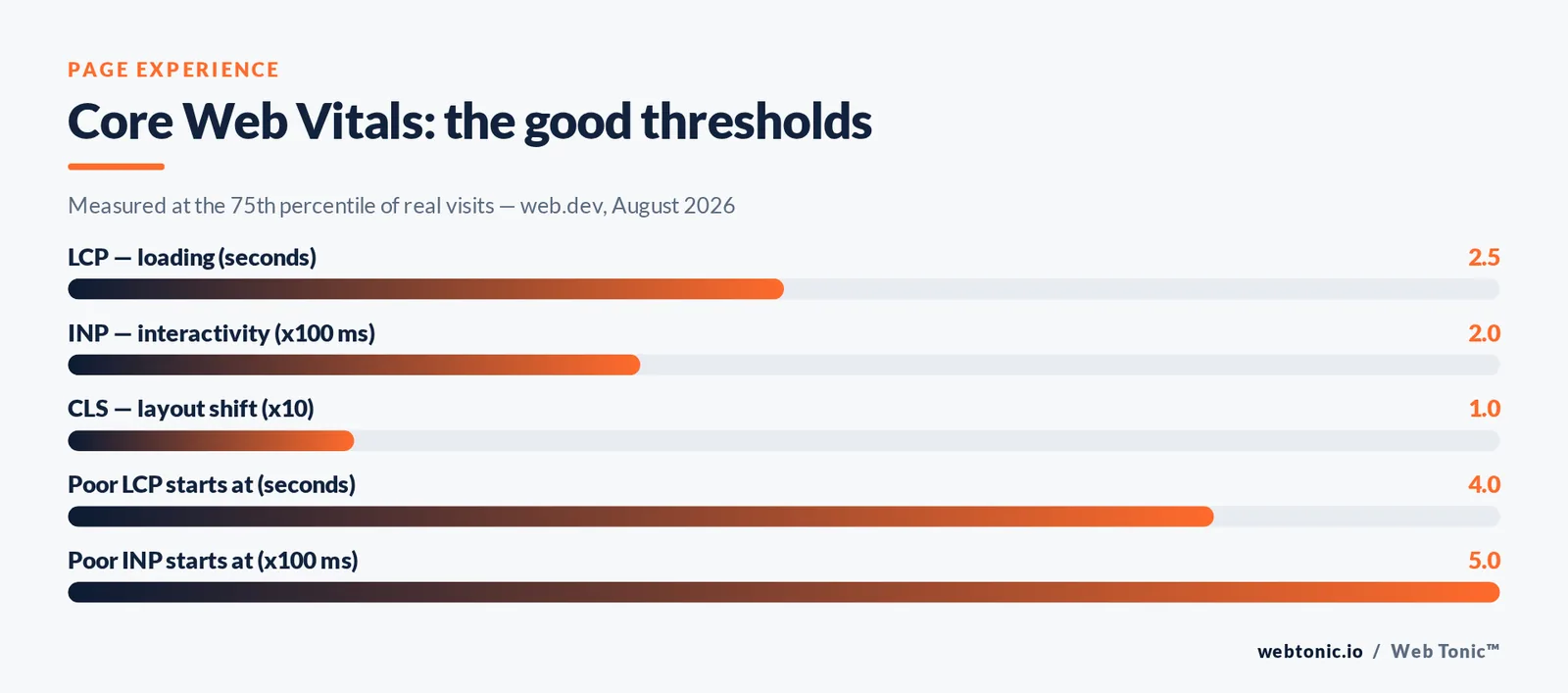
- The page-experience thresholds are fixed numbers: 2.5s Largest Contentful Paint, 200ms Interaction to Next Paint, 0.1 Cumulative Layout Shift, measured at the 75th percentile of real visits (web.dev).
- Google's own starter documentation says most sites need no technical intervention to be indexed — the SEO wins sit in search intent coverage, title tags and internal links.
- Budget 4 to 6 months before organic traffic curves bend on a new site, and track it in Search Console rather than a rank tracker.
Web Tonic runs this SEO checklist on every organic engagement, and the order matters more than the individual tactics, because search engines will not reward a website users cannot read. If you want the vocabulary first, start with our SEO basics primer; if you already have a site indexed, work top to bottom from here.
Stage 1–3: how the crawler actually reaches a ranking
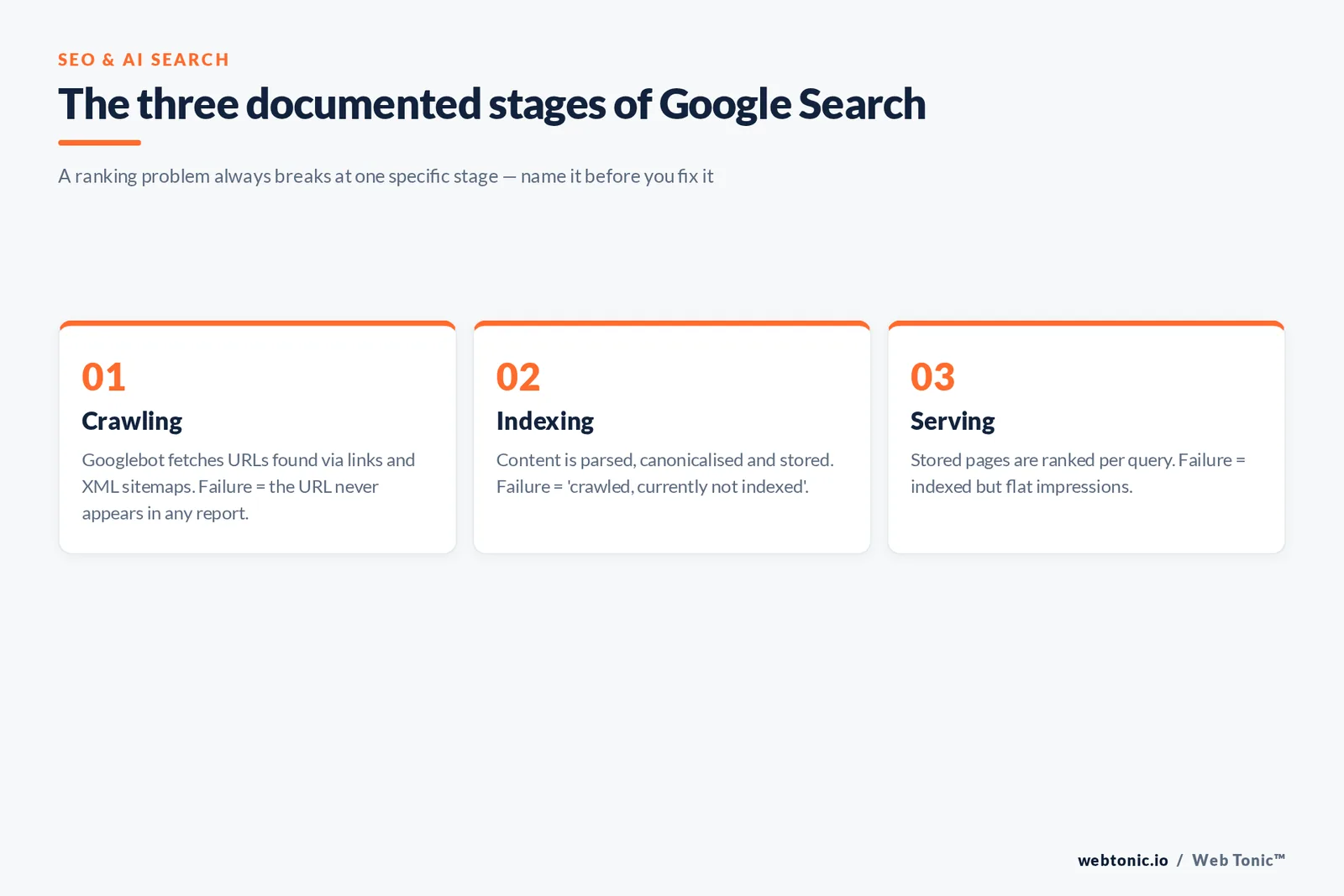
Google documents three stages in Search. Diagnosing a ranking problem starts with naming which stage broke, because search engines treat each stage separately and the fixes share nothing.
| Stage | What happens | Failure symptom | Where to check | Typical fix |
|---|---|---|---|---|
| 1. Crawling | Googlebot fetches URLs it discovers from links and sitemaps | URL never appears in reports at all | Crawl stats, robots tester | Unblock in robots.txt, submit an XML sitemap |
| 2. Indexing | Content is parsed, canonicalised and stored | "Crawled – currently not indexed" or a wrong canonical | Page indexing report | Consolidate duplicates, raise page usefulness |
| 3. Serving | Stored pages are ranked and shown per query | Indexed but flat impressions | Performance report by query | Better intent match, stronger internal links |
Two documents govern eligibility: the Search Essentials (technical requirements plus policies) and the spam policies. Everything else is best practices advice; those two documents are the SEO rulebook, and breaking the second one is the only way to lose visibility overnight.
The 8 checks that decide whether a URL is even eligible
Run these on your website before touching content quality. Each check is binary and takes minutes.
| Check | Pass condition | How long | Risk if failed |
|---|---|---|---|
| Check 1 — Fetchable | Returns HTTP 200 to the crawler, not 403 or 5xx | 5 min | Total invisibility |
| Check 2 — Not blocked | No matching Disallow rule and no noindex tag | 5 min | Total invisibility |
| Check 3 — Discoverable | Linked from at least 1 crawlable internal link | 15 min | Slow or no discovery |
| Check 4 — Canonical clear | 1 preferred URL per piece of content | 30 min | Signals split across variants |
| Check 5 — Rendered content | Main copy present without user interaction | 20 min | Empty index entry |
| Check 6 — HTTPS | Valid certificate, no mixed content | Varies | Trust and ranking drag |
| Check 7 — Mobile parity | Same copy and links on the small screen | 30 min | Hidden content ignored |
| Check 8 — Policy clean | No cloaking, scraped or doorway pages | 1 hr audit | Manual action |
Rendering deserves its own note: the JavaScript documentation confirms client-rendered pages are processed, but anything that needs a click or a logged-in state is not. If your framework hides body copy behind hydration, that copy does not exist for ranking purposes. Our web development team treats this as a build requirement rather than a later fix.
On-page: the 6 elements Google documents an opinion about
Google is unusually specific about a handful of on-page SEO elements and silent about the rest. Work the documented ones and ignore keyword density folklore, which no search engine documentation supports.
| Element | Documented behaviour | Practical target | Common error |
|---|---|---|---|
| Title link | Generated mainly from the title tag, sometimes rewritten from on-page text | Unique per URL, primary phrase in the first 40 characters | Same boilerplate on 100+ URLs |
| Meta description | Used as a snippet source, not a ranking factor | 120–158 characters, benefit-led | Leaving it empty on money pages |
| Headings | Signal document structure to parsers | 1 H1, descriptive H2s per sub-intent | Styling text as a heading with no hierarchy |
| Alt text | Primary way images are understood and surfaced | 25+ descriptive characters, no stuffing | Filename-as-alt |
| Internal links | Drive discovery and pass context via anchor text | 3–8 descriptive in-body links per page | "Click here" anchors |
| Structured data | Enables specific result appearances only | Only types you genuinely qualify for | Marking up content users cannot see |
The title link guidance and the snippet controls both make the same point: you influence these, you do not own them. Rewritten titles almost always trace back to duplication or a mismatch with the visible H1. Our on-page walkthrough covers the element-by-element edits.
Content: what "helpful" means in the guidance, in measurable terms
The helpful-content documentation is a list of self-assessment questions, not a formula. Converted into editorial rules it produces four tests a draft either passes or fails.
| Test | The question behind it | Measurable version | Fail example |
|---|---|---|---|
| Test 1 — First-hand value | Does this add anything beyond the top results? | At least 2 data points or examples no competitor page carries | Reworded summary of page one |
| Test 2 — Task completion | Can the reader act without another search? | Every sub-question in the SERP answered on the page | Definition with no next step |
| Test 3 — Evidence | Would an expert trust the claims? | 5–10 primary sources cited inline | Round numbers with no attribution |
| Test 4 — Purpose | Was this made for people or for the crawler? | Under 1 commercial interruption per screen | Keyword variants stacked as headings |
Publishing volume without differentiation is the expensive failure mode here, because low quality pages dilute the topic authority of the whole website. Ahrefs' foundational overview and Yoast's copywriting guide both land on the same conclusion from the practitioner side: fewer, deeper pages beat thin coverage of every variant. Our content writing process builds that gate into the brief.
Page experience: the 3 thresholds and what actually moves them
Core Web Vitals are documented as a small, real tiebreaker with hard numbers attached, and they describe what real users experience on your website. Field data from real visits is what counts, which is why lab scores and reality diverge.
| Metric | Good | Needs work | Poor | Biggest lever |
|---|---|---|---|---|
| LCP (loading) | ≤ 2.5s | 2.5–4.0s | > 4.0s | Hero image weight and server response |
| INP (interactivity) | ≤ 200ms | 200–500ms | > 500ms | Third-party scripts and tag managers |
| CLS (stability) | ≤ 0.1 | 0.1–0.25 | > 0.25 | Reserved dimensions on media and embeds |
Judge yourself at the 75th percentile of real sessions, available through the Chrome UX Report. On most business sites the fastest win is deleting marketing tags nobody reads, which typically cuts INP more than any code refactor. Where speed genuinely blocks revenue, treat it as a measurement and infrastructure project, not a plugin purchase.
Structured data and the appearances it unlocks
Structured data does not raise rankings; it helps search engines understand a page and changes how the result looks. Only a defined set of types is supported, listed in the search gallery.
| Type | Who should use it | Realistic gain | Effort |
|---|---|---|---|
| Article | Any blog or news publisher | Cleaner attribution and dates | Low |
| FAQPage | Pages with genuine on-page Q&As | Occasional expanded display | Low |
| Product | Ecommerce with price and stock | Price, availability, review stars | Medium |
| LocalBusiness | Anyone with a served area or address | Entity clarity alongside a profile listing | Low |
| HowTo / Recipe | Step-based instructional content | Step surfacing where still supported | Medium |
| VideoObject | Pages whose main asset is video | Video result eligibility | Medium |
Two rules keep this safe. Mark up only what a visitor can see, and expect eligibility rather than entitlement — a valid Article implementation can still be shown as a plain blue link.

Measurement: a 5-step Search Console routine
One free tool answers nearly every SEO question, and Google Search Console is where the data comes from the search engine itself. Search Console reports impressions, average position, coverage state and manual actions — a rank tracker reports none of those.
| Step | Report | Cadence | Decision it drives |
|---|---|---|---|
| Step 1 | Page indexing | Weekly | Fix or deliberately drop excluded URLs |
| Step 2 | Performance by query | Weekly | Positions 5–20 get the next content edit |
| Step 3 | Performance by page | Monthly | Consolidate cannibalising URLs |
| Step 4 | Core Web Vitals | Monthly | Prioritise the worst URL group |
| Step 5 | Manual actions and security | Monthly | Escalate immediately if non-empty |
When traffic falls, Google's own drop-debugging guide separates technical loss, reporting artefacts, seasonality and algorithmic movement — in that order. Announcements land on the Search Central blog, so date every drop against it before rewriting anything.
Local and off-site: the 2 signals outside your own HTML
Two signals sit outside your website yet decide a large share of local SEO and competitive visibility: your Google Business Profile and the backlinks other sites give you.
| Signal | What to do | Frequency | Realistic timeline |
|---|---|---|---|
| Business profile | Verify, pick precise categories, add hours, services and photos | Refresh monthly | Map visibility moves in 2–8 weeks |
| Editorial links | Earn citations through data, tools or original research | Continuous | Compounding over 6+ months |
Category choice is the highest-leverage field in a business profile and the one most often left generic. On links, the spam policies rule out paid placements and exchanges; the practical alternative is publishing something worth citing, which is why our growth marketing engagements pair content with distribution rather than link buying.
Keyword research: turning topics into a mapped keyword list
Keyword research is the bridge between what your business sells and what users type. The goal is not a big keyword list; it is one relevant page per search intent, with long tail keywords grouped under the topic they belong to.
| Keyword type | Search intent | Volume pattern | Page that should rank | Realistic difficulty |
|---|---|---|---|---|
| Head term | Mixed or unclear | High, seasonal | Service or category page | Hardest — 12+ months |
| Commercial modifier | Ready to buy or hire | Medium | Service page with proof | Moderate — 4–8 months |
| Local keywords | Nearby provider wanted | Medium, map-heavy | Location page plus business profile | Fast — 2–8 weeks |
| Long tail keywords | Specific question | Low each, large in aggregate | Article or FAQ section | Easiest — 1–3 months |
| Branded keywords | You, specifically | Grows with demand | Homepage | Already yours to lose |
| Comparison keywords | Shortlisting options | Low, high value | Honest comparison page | Moderate |
Two rules keep a keyword list useful. Group keywords by topic so one strong page absorbs the whole cluster, and read the results page before writing, because search engines have already shown you which format users reward. Our keyword research guide covers the grouping mechanics in detail.
Backlinks, topical authority and the technical SEO audit
Links remain a documented ranking signal, and the quality of the linking website matters far more than the count. Authority is earned by being the most useful page on a topic, then cited for it.
| Signal | What builds it | What damages it | How to audit | Cadence |
|---|---|---|---|---|
| Backlink quality | Editorial links from relevant, trusted websites | Paid links, exchanges, directories at scale | Referring-domain report, spot-check relevance | Quarterly |
| Topical authority | Complete coverage of one topic, internally linked | Scattered posts across unrelated topics | Map keywords to URLs, find gaps | Quarterly |
| Internal linking | Descriptive anchor text between related pages | Orphan pages and "click here" anchors | Crawl for pages with 0 inbound internal links | Monthly |
| Technical SEO health | Clean status codes, fast templates, valid sitemaps | Redirect chains, duplicate URL parameters | A site audit crawl (Semrush, Screaming Frog or similar) | Monthly |
| Content quality | Original data, expert review, real examples | Thin pages kept alive for keywords | Impressions-per-page review in Search Console | Quarterly |
One habit separates websites that keep growing: every quarter, prune or merge the pages that earn nothing. Search engines reward a website whose good pages are easy to find, and pruning is faster than writing more.
How SEO priorities change by website type
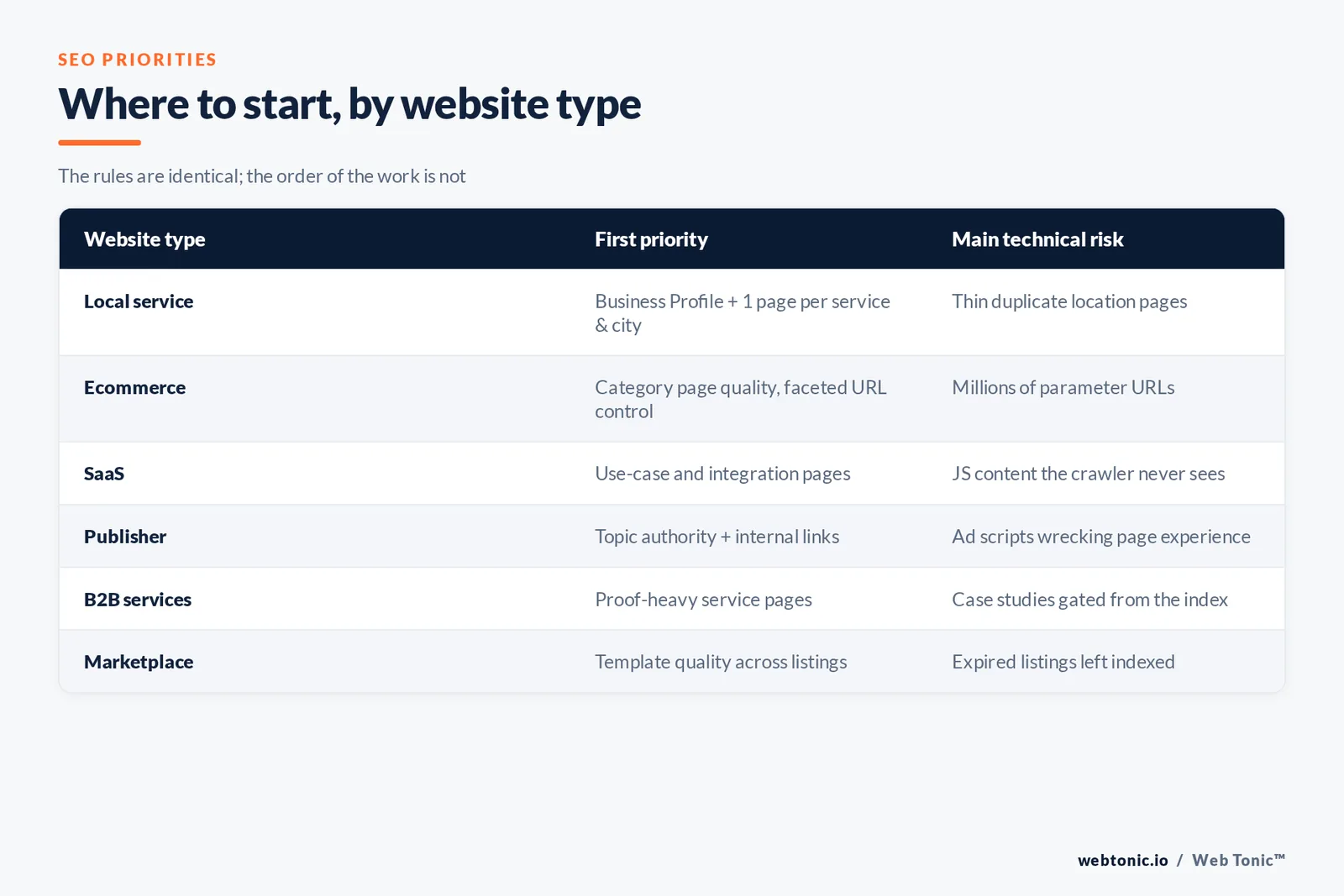
The same search engine rules apply everywhere, but the order of the SEO work does not. Pick the row that matches your website and start there — don't copy an ecommerce playbook onto a local service business.
| Website type | First SEO priority | Content that earns links | Keyword focus | Main technical risk |
|---|---|---|---|---|
| Local service business | Google Business Profile plus 1 page per service and city | Local guides, price transparency | Local keywords with intent to hire | Thin duplicate location pages |
| Ecommerce | Category page quality and faceted URL control | Buying guides, original product data | Product and comparison keywords | Millions of crawlable parameter URLs |
| SaaS | Use-case and integration pages | Benchmarks, free tools, research | Problem and alternative keywords | JavaScript-rendered content the crawler never sees |
| Publisher | Topic authority and internal links between related articles | Reporting and data journalism | Long tail keywords at volume | Ad scripts wrecking page experience |
| B2B services | Proof-heavy service pages, then supporting content | Original surveys, teardowns | Commercial keywords, low volume, high value | Case studies gated away from the index |
| Marketplace | Template quality across thousands of listings | Category-level trend data | Head plus long tail keyword pairs | Expired listings left indexed |
Whatever the type, the same test applies to every new page: would a user who searched this keyword find the answer here without going back to Google? If not, the page is not ready to publish.
The 5 tools that cover 95% of the work
SEO tooling gets oversold. Five categories cover almost everything, and only one of them is non-negotiable.
| Tool category | What it answers | Free option | Necessity |
|---|---|---|---|
| Search Console | Which keywords a page ranks for, and whether Google indexed it | Yes — Google Search Console | Mandatory |
| Site audit crawler | Broken links, redirect chains, missing title tags and alt text | Partly — 500 URL crawl limits are common | High |
| Keyword research tool | Search volume, difficulty, related long tail keywords | Limited | High |
| Backlink index | Who links to you and to competing websites | Limited | Medium |
| Analytics | What organic users do after the click | Yes — Google Analytics | Mandatory |
Don't buy a suite before you have read your own Search Console data for a month. Most sites find their next 10 content decisions in the queries they already rank for in positions 5 to 20.
6 traps that waste organic budget
| Trap | What it looks like | Why it fails | Do this instead |
|---|---|---|---|
| Trap 1 — Variant pages | One URL per near-identical phrase | Splits signals, reads as doorway content | One strong page per intent |
| Trap 2 — Tool-score chasing | Optimising to a 100/100 plugin score | No third-party score is a ranking input | Optimise to query coverage |
| Trap 3 — Rank-only reporting | Position screenshots, no clicks | Results are personalised and volatile | Report clicks, impressions and pipeline |
| Trap 4 — Bulk publishing | 50+ generated posts a month | Scaled-content policy exposure | Fewer pages with original inputs |
| Trap 5 — Ignoring intent shape | A blog post aimed at a transactional query | Wrong page format never ranks | Match the format already ranking |
| Trap 6 — Set-and-forget | No edits after publication | Freshness and coverage decay | Quarterly refresh of top 20 URLs |
A 90-day sequence that follows the documentation
| Phase | Days | Focus | Deliverable | Success signal |
|---|---|---|---|---|
| Phase 1 — Eligibility | 1–30 | The 8 checks, sitemap, canonical map | Clean indexing report | Valid URLs rising, excluded falling |
| Phase 2 — Intent coverage | 31–60 | Rewrite the top 10 commercial URLs, fix titles | Query-to-URL map | Impressions up on mapped queries |
| Phase 3 — Depth and links | 61–90 | Supporting articles, internal linking, one citable asset | Published cluster | Average position improving in the 5–20 band |
Three months of SEO work is enough to prove direction, not to finish. Competitive commercial phrases typically need 4 to 6 months of consistent publishing before the click curve turns, and longer where established sites already own the query set. Practitioner checklists from Semrush and Search Engine Journal are useful cross-checks, but sequence beats checklist length every time.
FAQ
Is there an official Google guide to ranking?
Yes — the starter documentation plus Search Essentials in Search Central. They cover requirements, spam policies and best practices, and explicitly state that most sites need no special technical work to appear in results.
How many pages should a new site publish before expecting traffic?
Depth matters more than count. A tight cluster of 8–15 genuinely differentiated URLs around one commercial theme outperforms 100 thin pages, and it carries no scaled-content risk.
Do Core Web Vitals really affect rankings?
They are a documented but small factor, and they act as a tiebreaker between comparable pages. Treat the 2.5s, 200ms and 0.1 thresholds as a conversion project that also helps visibility.
Does keyword density matter?
No. Google documents nothing about a target percentage, and repetition past natural usage risks the spam policies. Cover the sub-questions instead.
How do I know whether a drop is an algorithm update or my own mistake?
Check indexing and manual actions first, confirm the drop exists in Search Console rather than only in analytics, then compare the date against Search Central announcements. Self-inflicted losses are far more common than algorithmic ones.
Sources: Google Search Central (How Search Works, Search Essentials, spam policies, helpful content, JavaScript basics, title links, snippets, structured data gallery, Article markup, traffic-drop debugging, Search Central blog) · Google Search Console · Google Business Profile Help · web.dev Core Web Vitals · Chrome UX Report · Statcounter Global Stats (July 2026) · Ahrefs · Semrush · Search Engine Journal · Yoast. Figures verified August 2026.