Table of contents

No vendor publishes a Meta Ads benchmark built specifically for funeral homes, so the honest starting point is what NFDA's own consumer research and Meta's ad-standards policy actually say, not a borrowed CPL from an unrelated vertical.
Key Takeaways
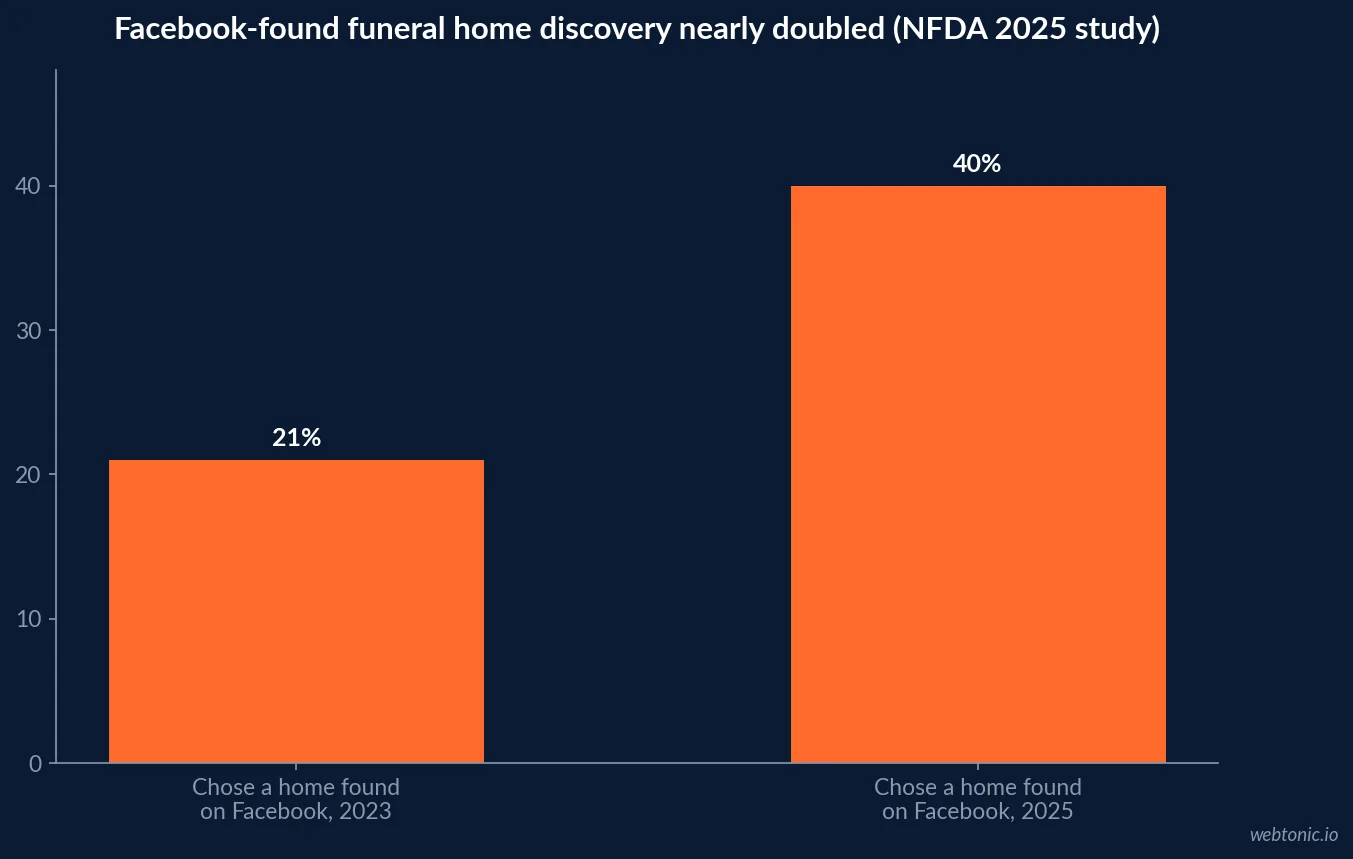
- 40% of consumers have used a funeral home they found on Facebook, per NFDA.
- That is nearly double the 21% NFDA reported in 2023.
- 78.7% of funeral directors themselves turn to Facebook for industry information.
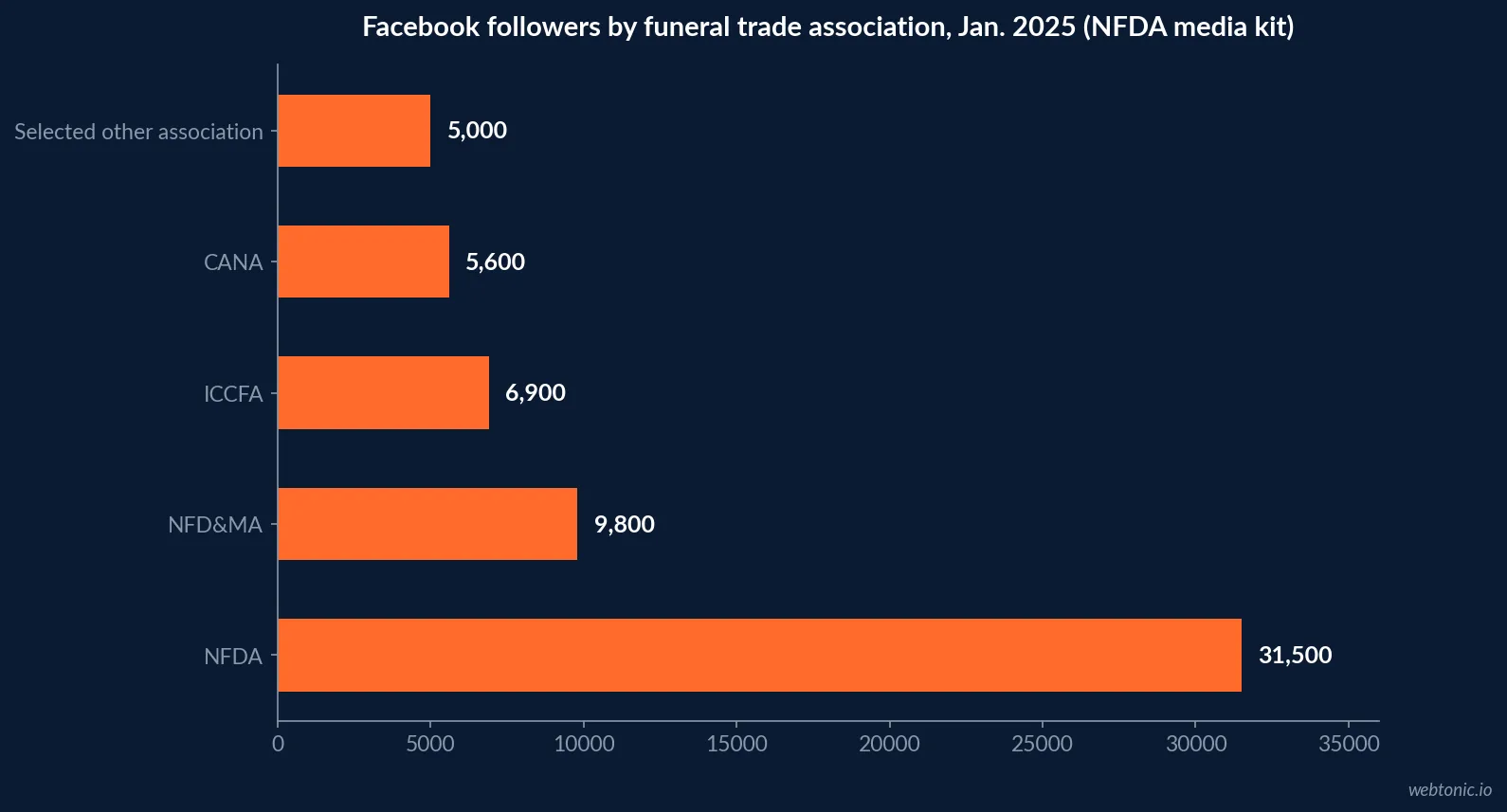
- NFDA's own Facebook page carries 31,500 followers, more than any peer association.
- 74% of US adults 50 to 64 use Facebook, per Pew Research.
- 57% of US adults 65 and older use Facebook, the platform's strongest older-adult reach.
- 44.4% would not feel confident planning a funeral without a director, up 7.1 points since 2024.
- 82.4% of consumers favor a firm that posts its price list online, per NFDA's 2026 study.
- Personal Services conversion rates rose 26.69% year over year in WordStream's 2026 data.
- Personal Services cost per click rose about 23.41% in the same report.
- Meta bars ads that assume bereavement or health status under its personal-attributes policy.
- Nearly 30% of families now complete arrangements entirely online, per NFDA.
- 64% would arrange livestreaming for distant relatives, a Meta-native distribution moment.
- 61.4% are interested in exploring green or natural burial options, a fresh creative angle.
- NFDA's own site draws 47,000 monthly visits researching the profession, not families.
- The average Google Ads conversion rate across all industries is 8.18% in 2026, for scale.
Why this page does not lead with a cost-per-lead number
Ask a Meta rep or an agency for a "funeral home Meta Ads benchmark" and what comes back is almost always a Personal Services or Home Services number borrowed from a report that never surveyed a funeral home. WordStream's 2026 Search Advertising Benchmarks report, built from 13,474 US search campaigns running April 2025 to March 2026, groups death care under Personal Services alongside dry cleaners and pet groomers - useful for a rough compass, not a promise.
What the industry does have is NFDA's own, repeated survey of the people who actually buy: the families choosing a provider. That is the primary source this page builds from.
What NFDA's own consumer research shows
The 2025 NFDA Consumer Awareness and Preferences Study, based on 1,126 Americans aged 40 and older surveyed in spring 2025, found that 40% of consumers have used the services of a funeral home they found on Facebook - nearly double the 21% reported in 2023. The same study found nearly 30% of families now complete all funeral arrangements online, while 44.4% said they would not feel confident planning a funeral without a director's help, up 7.1 points since 2024.
Those two facts are not a contradiction. Families are researching and discovering providers digitally, then still converting through a human conversation - which is exactly the shape a Meta campaign should be built for: awareness and trust on the platform, conversion off it.
| NFDA finding (2025-2026 studies) | Figure | What it means for Meta strategy |
|---|---|---|
| Chose a home found on Facebook | 40%, up from 21% (2023) | Facebook is now a real at-need discovery channel |
| Complete arrangements fully online | Nearly 30% | Landing pages need to close, not just inform |
| Not confident planning without a director | 44.4% (+7.1 pts YoY) | Creative should promote guidance, not self-serve only |
| Prefer a firm with its price list online | 82.4% | Ads should route to a page carrying the GPL |
| Would arrange livestreaming for distant family | 64% | Livestream links are a native Meta share moment |
| Interested in green/natural burial options | 61.4% | An underused, differentiated ad angle |
Who is actually the audience
Pew Research's 2025 social media fact sheet puts Facebook usage at 74% of US adults aged 50 to 64 and 57% of adults 65 and older - both far above TikTok's 12% reach in that oldest bracket. That matches NFDA's own survey population: Americans 40 and older. The buyer on Meta is rarely the deceased's own generation; it is a spouse, adult child or sibling in that 50-plus band making a decision inside days, not weeks.
NFDA's own 2026 supplier media kit reports that 78.7% of funeral directors themselves turn to Facebook for industry information, ahead of every other platform including LinkedIn, and that its own association page carries 31,500 followers versus 9,800 for NFD&MA, 6,900 for ICCFA and 5,600 for CANA. The profession is already living on the platform it is advertising through.
| Age band (Pew, 2025) | Facebook usage | Relevance to funeral Meta Ads |
|---|---|---|
| 50-64 | 74% | Primary decision-maker generation for a parent's funeral |
| 65+ | 57% | Pre-need planners and surviving spouses |
| 30-49 | ~62-67% (Pew range) | Adult children arranging on behalf of a parent |
| 18-29 | 62-65% (Pew range) | Smallest share of at-need decisions, largest pre-need awareness reach |
Meta's sensitive-event targeting limits
Meta's Privacy Violations and Personal Attributes policy bars ads that assume or imply a person's personal circumstances - health status, financial situation or family status among them - even when the assumption is accurate. Funeral advertisers cannot target people believed to be actively grieving, and detailed-targeting options referencing sensitive causes were already narrowed in Meta's 2022 detailed-targeting update. Housing, employment and credit ads carry a separate mandatory Special Ad Category flag under Meta's Special Ad Categories documentation; a standard funeral-services campaign does not fall in that flagged set, but it still answers to the broader personal-attributes rule.
In practice that means building audiences on age, location and stated interest (estate planning, veterans' benefits, pre-need insurance), never on an inferred loss event, and writing creative that offers guidance rather than assuming a specific circumstance.
| Meta policy area | What it restricts for funeral advertisers | Practical fix |
|---|---|---|
| Personal attributes / privacy violations | Assuming grief, health status or family loss | Target on demographics + stated interests, not inferred events |
| Detailed-targeting sensitive causes (2022 update) | Narrower cause/affinity targeting options | Lean on broad + Advantage+ audience expansion instead |
| Special Ad Categories (housing/employment/credit) | Does not apply to standard funeral campaigns | No special flag required, but review creative against the general standard |
| Ad creative and claims | No implied urgency exploiting a specific loss | Lead with guidance, price transparency and community trust |
Where the price-list preference changes the funnel
NFDA's 2026 Consumer Awareness & Preferences data, summarized in its "What Today's Families Really Want" recap, found 82.4% of consumers more likely to engage a firm that posts its General Price List online, and the underlying Funeral Rule requirements for that list are codified at 16 CFR 453.2 and explained in the FTC's own Complying with the Funeral Rule guidance. A Meta ad that clicks through to a page without a visible price list is fighting the single strongest documented preference in the 2026 study before the family has even spoken to a director.
This is the same reason our performance creative practice treats the landing page as part of the ad, not a separate project: the click and the price-list disclosure are one decision for the family, even if they are two line items on an invoice.
What a cross-industry cost proxy actually tells you
Absent a funeral-specific figure, WordStream's Personal Services grouping is the least-wrong stand-in available. The category posted a cost-per-click increase of roughly 23.41% and a conversion-rate increase of 26.69% year over year in the 2026 report - both among the larger swings of any tracked vertical, suggesting rising competition met by improving landing-page and creative quality across the group, not a single answer for funeral homes alone. Google Ads' own 2026 cross-industry average conversion rate sits at 8.18%, useful only as a floor for comparison.
Anyone quoting a specific "funeral home Meta CPL" without naming a source and a sample is quoting a guess. Build a campaign's own baseline in the first 30 days and measure against that, not against a borrowed number.
| Cross-industry proxy (2026, labeled) | Figure | Source | Caveat |
|---|---|---|---|
| Personal Services CPC, YoY change | +23.41% | WordStream 2026 benchmarks | Not funeral-specific; grouped vertical |
| Personal Services CVR, YoY change | +26.69% | WordStream 2026 benchmarks | Same grouped-vertical caveat |
| All-industry average Google Ads CVR | 8.18% | WordStream 2026 benchmarks | Search, not Meta; directional floor only |
| All-industry average Google Ads CTR | 6.64% | WordStream 2026 benchmarks | Search, not Meta; directional floor only |
Creative angles the data actually supports
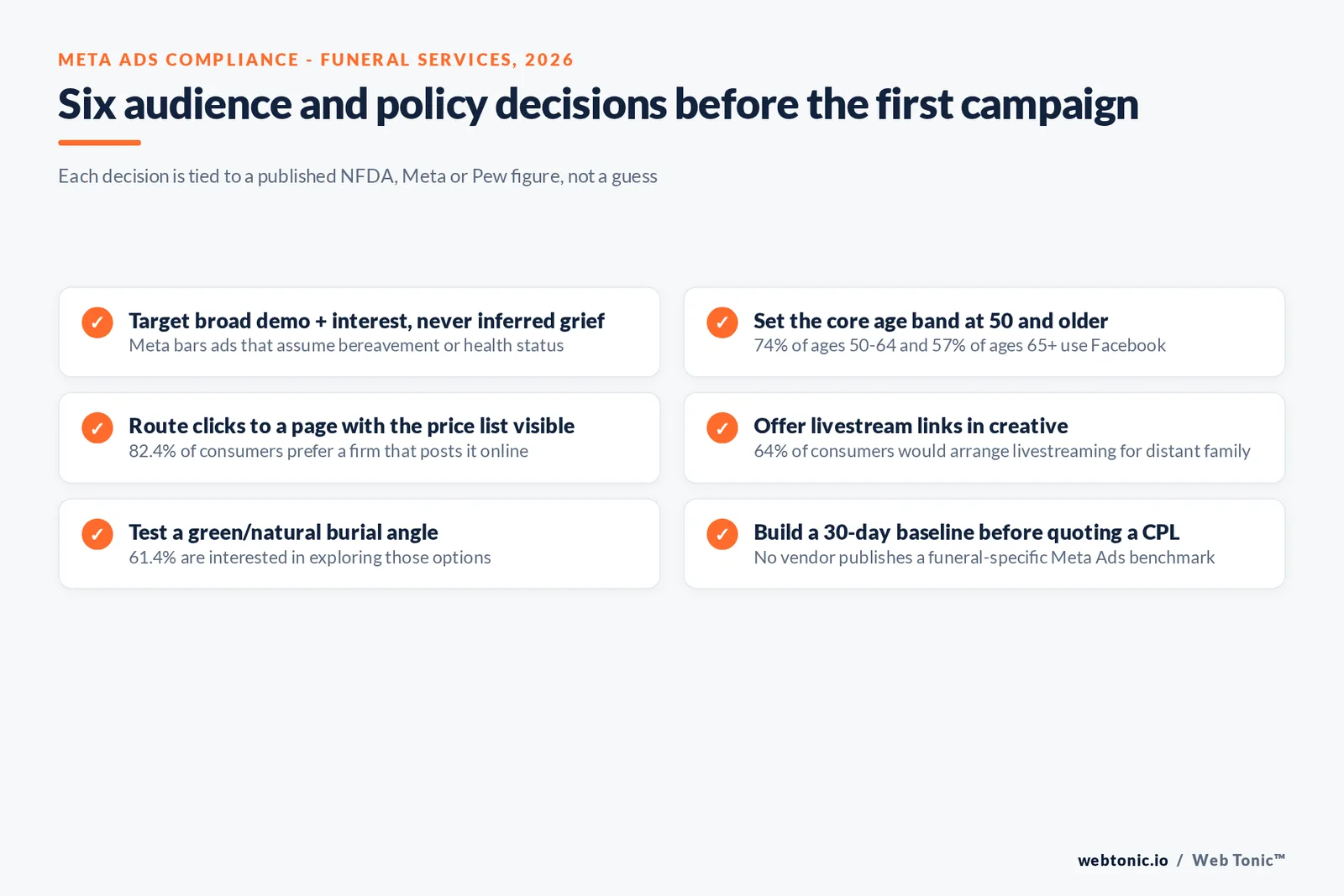
Four angles trace directly back to a sourced figure rather than a guess: price-list transparency (82.4% preference), livestream access for distant family (64% interested), green/natural burial options (61.4% interested), and guided rather than self-serve planning (44.4% not confident planning alone). None of these require assuming a specific loss event to target - they are stated preferences a broad, older-skewing audience already holds.
Our Meta Ads team builds funeral and other sensitive-category campaigns around exactly this pattern: audience breadth, creative specificity, and a landing page that answers the one preference the data says matters most. Our broader view on when paid social earns its budget is in our Facebook Ads ROI analysis, useful context before committing a monthly spend to a sensitive-category campaign.
Frequently Asked Questions
Can a funeral home target grieving people directly on Meta?
No, and it should not try to. Meta's ad standards on privacy violations and personal attributes bar advertisers from assuming or implying a person's personal circumstances, including bereavement, health status or family situation. Funeral advertisers build audiences from broad demographics, geography and stated interests such as estate planning or pre-need services, not from an inferred loss event. Creative that says "we know you just lost someone" is the kind of assumption the policy exists to stop.
What does NFDA's own research say a Facebook presence is worth?
NFDA's 2025 Consumer Awareness and Preferences Study, based on 1,126 Americans aged 40 and older, found that 40% of consumers have used the services of a funeral home they found on Facebook, nearly double the 21% reported in 2023. That is a discovery metric, not a paid-media ROAS, but it is the closest thing the industry has to a documented link between Facebook presence and at-need selection.
Is there a published funeral-specific Meta Ads CPL or CTR benchmark?
No. WordStream's 2026 Search Advertising Benchmarks report (13,474 US search campaigns, April 2025 to March 2026) does not break out funeral homes; the closest labeled category is Personal Services, which saw one of the largest year-over-year conversion-rate gains of any vertical, up 26.69%. Treat that as a directional, cross-industry proxy, not a funeral-specific number, until a vendor publishes one.
Which age group should the media plan target?
Pew Research's 2025 fact sheet puts Facebook usage at 74% of US adults aged 50 to 64 and 57% of adults 65 and older, both well above the 63% median for TikTok among 18-to-29-year-olds. The funeral decision-maker is usually a spouse, adult child or sibling in that 50-plus band, which is also NFDA's own survey population of Americans 40 and older.
Does the FTC Funeral Rule affect what a Meta ad can say?
Indirectly. The Funeral Rule (16 CFR Part 453) governs the General Price List disclosed in person or by phone, not the ad creative itself, but NFDA's 2026 study found 82.4% of consumers are more likely to engage a firm that posts its General Price List online. An ad that drives to a landing page without a visible price list is leaving that preference on the table, even where the Rule itself does not require the ad to carry prices.
Sources
NFDA - 2025 Consumer Awareness and Preferences Study release
NFDA - What Today's Families Really Want (2026 study recap)
NFDA - 2026 Supplier Media Kit (Facebook usage and follower data)
Pew Research Center - Social Media Fact Sheet
Meta Transparency Center - Privacy Violations and Personal Attributes policy
Meta for Developers - Special Ad Categories documentation
eCFR - 16 CFR 453.2, Funeral Rule price disclosures
Federal Trade Commission - Complying with the Funeral Rule
WordStream - 2026 Search Advertising Benchmarks by Industry