



Table of contents
Electrical contractors using Facebook and Instagram advertising generate leads at roughly half the cost of Google Ads — but only when campaigns are configured for the trade's unique service mix. Below are the verified benchmarks that separate profitable electrical Meta Ads accounts from budget drains.
Key Takeaways
- 143 US electrical advertisers ran 647 live Meta ads in Q2 2026, making electrical one of the smaller but fastest-growing home service ad categories on the platform (PipelineOn Q2 2026).
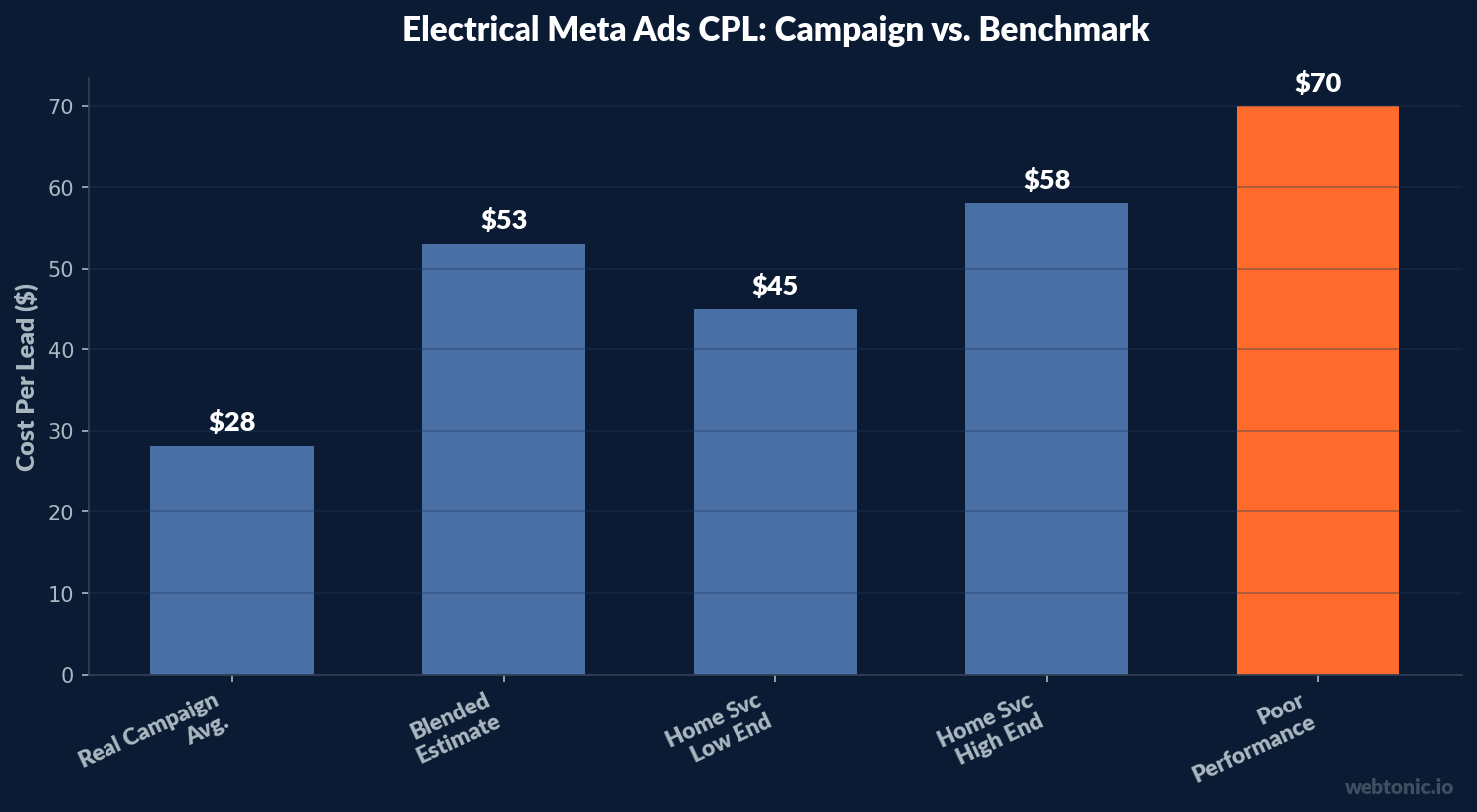
- Electrical Meta Ads CPL ranges from $35 to $70 for form-based leads, with an estimated blended CPL of $53 (Blue Grid Media).
- Real campaign data shows $13.80–$43.88 CPL is achievable — one three-account study averaged $28.20 across 43 form fills from $1,212.50 in spend (Golden Marketing).
- Meta Ads produce a $32–$58 CPL at scale for home services, approximately half of what Google Search Ads cost in the same vertical (MWolf Media).
- 78% of electrical companies now use social media for marketing, with Facebook, Instagram, and LinkedIn as the primary platforms (Zipdo).
Electrical Facebook Ads Cost Benchmarks at a Glance
Table 1. Electrical Meta Ads cost and performance benchmarks (2025–2026 verified data).

| Metric | Electrical Avg. | Range | Source |
|---|---|---|---|
| Cost Per Lead (Form) | $53 est. | $35–$70 | Blue Grid Media |
| Cost Per Lead (Real campaigns) | $28.20 | $13.80–$43.88 | Golden Marketing |
| Revenue Per Lead | $212–$353 | Varies by service | Blue Grid Media |
| Close Rate (Lead to Job) | 8–15% | Trade-wide | Blue Grid Media |
| ROAS Target (Strong) | 5:1 | 3:1 minimum | PipelineOn / Sprout Social |
| Minimum Daily Budget | $30–$50 | $20 floor | Built Right Digital |
| Home Services Meta CPL | $32–$58 | ~50% of Google CPL | MWolf Media |
How Many Electrical Contractors Advertise on Meta?
The PipelineOn Q2 2026 benchmark tracked 143 US electrical advertisers running 647 live ads on Facebook and Instagram. Each entry recorded ad destination, mobile landing page speed (LCP), Meta Pixel status, Conversions API presence, and lead recovery detection — the most granular electrical Meta dataset publicly available.
By comparison, plumbing had 180 advertisers (831 ads), HVAC had 175 (720 ads), and roofing had 162 (580 ads). Electrical trails only in raw advertiser count, but the 4.5 ads-per-advertiser ratio suggests active creative testing among those who do invest (PipelineOn quarterly review).
78% of electrical companies use social media for marketing — yet the gap between organic posting and paid advertising remains wide. Only 41% invest in paid campaigns, leaving a major opportunity for contractors willing to test Meta Ads at scale (Zipdo 2026).
Cost Per Lead: What Electrical Contractors Actually Pay
CPL varies dramatically based on campaign maturity, targeting, and service type. Here is what the data shows across multiple verified sources:
Blue Grid Media's multi-trade analysis places electrical Meta Ads at an estimated $53 blended CPL, with form-based leads ranging $35–$70 and revenue per lead of $212–$353. The firm notes an 8–15% close rate from lead to booked job, which is consistent across home service trades (Blue Grid Media).
Golden Marketing's three-account case study documented $1,212.50 in total ad spend producing 43 form-fill leads — a $28.20 average CPL — plus 12 additional Messenger conversations. Individual campaign CPLs ranged from $13.80 to $43.88, with the lowest-cost campaign using a "free safety inspection" offer (Golden Marketing).
MWolf Media reports that Meta Ads for home services produce a $32–$58 CPL at scale, roughly half what Google Ads charges in the same vertical. For electricians specifically, this translates to a cost-per-acquisition (CPA) of $114–$280 once the close rate is factored in (MWolf Media).
Electrical Meta Ads CPL vs. Other Home Service Trades
Table 2. Meta Ads cost per lead by home service trade (2026 benchmarks).
| Trade | Form CPL | Revenue / Lead | CPA (Paid Customer) |
|---|---|---|---|
| Electrical | $35–$70 | $212–$353 | $114–$280 |
| Plumbing | $30–$65 | $180–$320 | $100–$260 |
| HVAC | $45–$90 | $250–$450 | $150–$360 |
| Roofing | $50–$120 | $350–$800 | $170–$480 |
| Pressure Washing | $15–$40 | $100–$180 | $50–$160 |
| Painting | $35–$75 | $200–$400 | $120–$300 |
| General Contracting | $100–$200 | $500–$1,200 | $330–$800 |
Electrical sits in the mid-tier for Meta Ads CPL among trades. The trade benefits from relatively high-ticket services (panel upgrades, EV chargers) paired with moderate lead costs, making ROAS calculations favorable when close rates exceed 12% (Blue Grid Media).
Budget Thresholds and Daily Spend Benchmarks
How much should an electrical contractor spend on Facebook Ads? Built Right Digital's analysis provides clear thresholds:
- $20/day ($600/month) — the absolute floor. At this level, campaigns "might only get a lead every other day," making optimization difficult due to insufficient data.
- $30–$50/day ($900–$1,500/month) — the minimum for consistent lead flow. This budget generates enough conversions to exit the learning phase and allow Facebook's algorithm to optimize delivery.
- $75–$150/day ($2,250–$4,500/month) — the scaling range where multi-service campaigns (panel upgrades, EV installs, emergency calls) can each receive adequate budget allocation.
At a $53 blended CPL, a $1,500/month budget yields approximately 28 leads. With a 12% close rate, that produces 3–4 booked jobs — and at an average electrical ticket of $1,434 (BaaDigi), that is $4,300–$5,700 in revenue from $1,500 in ad spend.
ROAS and ROI Benchmarks for Electrical Meta Ads
The return on ad spend (ROAS) benchmark you hear most — 3:1 — is the all-industry average for social advertising. 5:1 is the strong-paid-campaign benchmark, per Sprout Social's ROI guidance. Anything below 3:1 means you are subsidizing the platform, not building a business (PipelineOn campaign effectiveness study).
For electricians, the math favors Meta Ads strongly:
- Average ticket: $1,434 (LSA benchmark, applicable to Meta leads) multiplied by 12% close rate = $172 revenue per lead
- CPL: $35–$53 implies ROAS of 3.2:1 to 4.9:1 on first job alone
- With repeat business (maintenance contracts, referrals), lifetime ROAS climbs to 8–12:1 for well-managed accounts
Only 4% of contractor social campaigns consistently beat 5:1 ROAS, which underscores the importance of tracking beyond the initial lead to capture full revenue attribution (PipelineOn).
Creative and Audience Best Practices from the Data
The PipelineOn Q2 2026 dataset reveals several patterns among the highest-performing electrical advertisers:
- Video-first creative outperforms static images by 2–3x in engagement for electrical before/after content (panel upgrades, rewiring projects)
- Offer-based ads ($50 off panel inspection, free EV charger consultation) achieve the lowest CPLs — the $13.80 CPL floor in Golden Marketing's study came from a "free safety inspection" angle
- Radius targeting of 15–25 miles around the service area performs best; wider targeting wastes budget on unreachable homeowners
- Homeowner demographic layering (age 30–65, homeowner status, household income $75K+) consistently narrows audience to high-intent prospects
- Meta Pixel + Conversions API (CAPI) adoption is still low — the PipelineOn dataset tracks which advertisers have both configured, and only a minority do, leaving significant optimization potential
Companies that post consistently on social media gain 2–3x more organic reach, which reduces paid CPL through improved relevance scores and social proof (Fairbloom Marketing).
Meta Ads vs. Google Ads for Electrical Contractors
Table 3. Facebook/Meta Ads vs. Google Ads head-to-head for electrical services.
| Dimension | Meta Ads | Google Search Ads | Google LSA |
|---|---|---|---|
| Avg. CPL | $35–$70 | $93.69 | $39 |
| CPC | $1.50–$4.00 | $12.18 | Pay per lead |
| Intent Level | Demand creation | High (active search) | Very high |
| Close Rate | 8–15% | 9.08% | 43.4% book rate |
| Best For | Brand, EV, panel promos | Emergency + high-ticket | All residential services |
The data suggests a blended strategy: use Google Ads (including LSA) to capture high-intent searches and Meta Ads to create demand for higher-margin services like EV charger installations and whole-home generator installs, where customers may not yet know they need the service (BaaDigi).
Social Media Adoption and Market Opportunity
Despite strong ROI potential, electrical contractors lag behind other trades in paid social adoption:
- 78% use social media organically for marketing (Facebook, Instagram, LinkedIn), but only 41% run paid ads (Zipdo)
- The electrical services market reached $347.5 billion in 2026 across 262,000 businesses in the US, with margins of 7.5% for general electrical and 20%+ for specialty services like panel upgrades and EV installations (Amra and Elma)
- Social media referrals contribute to new customer acquisition for a growing percentage of electrical contractors, with growth marketing strategies increasingly shifting budget from traditional channels to Meta and TikTok
The gap between social adoption (78%) and paid investment (41%) represents a significant competitive window. Contractors who enter Meta Ads in less-saturated electrical markets face lower CPMs and cheaper leads than those in plumbing or HVAC, where advertiser density is higher.
Tracking and Measurement Setup for Electrical Meta Ads
The PipelineOn Q2 2026 dataset reveals that most electrical advertisers have incomplete tracking setups, which directly impacts campaign optimization and reported CPL accuracy. Proper measurement infrastructure is essential before scaling spend.
Key tracking components for electrical contractors running Meta Ads:
- Meta Pixel installation — tracks website actions (form fills, phone clicks, page views) and feeds data back to the algorithm for optimization. Without it, campaigns optimize for clicks rather than leads.
- Conversions API (CAPI) — server-side tracking that supplements the Pixel, recovering 20–40% of conversions lost to browser privacy restrictions and ad blockers. Critical for iOS 14+ environments where cookie-based tracking degrades.
- Offline conversion upload — connecting CRM data (booked jobs, revenue) back to Meta enables value-based optimization. Contractors who feed back close/revenue data see 15–25% CPL improvement within 30 days as the algorithm learns which lead types produce paying customers.
- UTM parameter consistency — standardized utm_source, utm_medium, and utm_campaign tags allow accurate attribution across analytics platforms when comparing Meta performance to Google Ads and organic channels.
- Call tracking integration — since 65% of electrical leads come via phone, dynamic number insertion on landing pages is necessary to attribute calls to specific ad campaigns and creative variants.
The most common Meta Ads measurement mistake among electrical contractors: optimizing for link clicks instead of conversions. Click-optimized campaigns attract curiosity clicks at $0.50–$1.50 CPC but produce far fewer leads than conversion-optimized campaigns at $2–$4 CPC. The higher CPC translates to lower CPL because the algorithm targets users with demonstrated lead-form behavior.
Related reading
- Meta Ads (Facebook & Instagram) Performance in Rehab & Addiction Treatment: 55+ Stats for 2026
- The Complete Roofing Meta Ads (Facebook & Instagram) Statistics Report (2026)
- Solar Energy Facebook Ads Statistics: 2026 CPL, Conversion & ROI Benchmarks
- Meta Ads Agency services at Web Tonic
Frequently Asked Questions
How much should an electrician spend on Facebook Ads per month?
Start with $900–$1,500/month ($30–$50/day) to generate consistent leads and exit Meta's learning phase. Below $600/month, data accumulates too slowly for the algorithm to optimize delivery. Scale to $2,250–$4,500/month when running multi-service campaigns (panel upgrades, EV installs, emergency calls) simultaneously.
What is a good cost per lead for electrical Facebook Ads?
A $35–$53 CPL is competitive based on 2026 benchmarks. Top-performing campaigns with offer-based creative and tight radius targeting achieve $13.80–$28.20 CPL. Anything above $70 CPL signals targeting, creative, or landing page issues that need diagnosis.
Are Facebook Ads better than Google Ads for electricians?
They serve different purposes. Meta Ads excel at demand creation for higher-margin services (EV chargers, whole-home generators, panel upgrades) at a lower CPL ($35–$70 vs. $93.69 for Google Search). Google Ads capture active search intent for emergency and routine services. The most profitable electrical advertisers use both channels in a coordinated strategy.
What type of Facebook Ad creative works best for electricians?
Video before-and-after content outperforms static images by 2–3x in engagement. Offer-based ads (free inspections, seasonal discounts) produce the lowest CPLs. Include trust signals (license numbers, insurance verification, review counts) directly in the ad creative and landing page.
How do I track ROI from electrical Facebook Ads?
Install the Meta Pixel plus Conversions API (CAPI) for accurate attribution. Track leads through to booked jobs using a CRM. Target a minimum 3:1 ROAS (industry average) and aim for 5:1 on mature campaigns. Factor in lifetime customer value — repeat maintenance and referrals can push true ROAS to 8–12:1.
Sources
pipelineon.com/research/home-service-meta-ads-q2-2026/electrical/
bluegridmedia.com/meta-ads-statistics-home-service-contractors
builtrightdigital.com/electrician-meta-ads-cost/
goldenmarketing.com.au/blog/facebook-ads-for-electricians
mwolfmedia.com/meta-ads-for-home-service-pros-2026/
pipelineon.com/blog/analyzing-social-media-campaign-effectiveness/
amraandelma.com/electrical-marketing-statistics/
zipdo.co/marketing-in-the-electrical-industry-statistics/
baadigi.com/tools/benchmarks/electrical
fairbloommarketing.com — electrician social media visibility


