Table of contents
Automotive-Repair posts the lowest Facebook click-through rate of any category WordStream tracks - 0.80% - while a Cox Automotive/Polk case study logged a 162% jump in site content views from the same platform. Meta ads for dealerships and powersports rooftops are not one story; they are at least three, and this page keeps them separate.
Key Takeaways
- Automotive-Repair has the lowest Facebook CTR tracked, at 0.80%.
- The all-industry Facebook traffic CTR average is 1.71% (2025 report).
- Sports and Recreation, a powersports proxy, clicks at 2.60%.
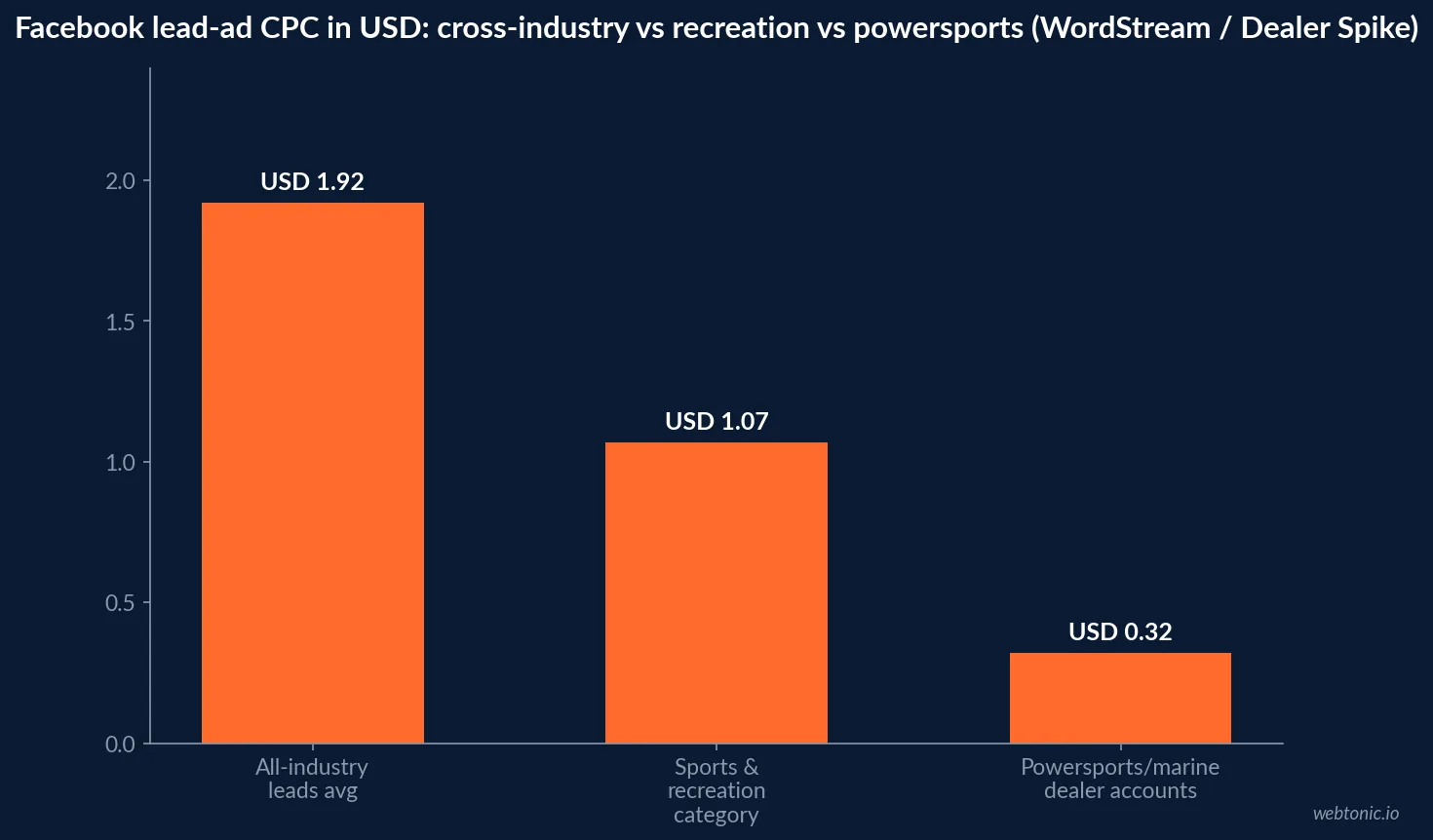
- The all-industry Facebook leads-campaign CPC averages USD 1.92.
- Sports and Recreation leads CPC runs USD 1.07, nearly half the average.
- Powersports/marine dealer accounts average USD 0.32 CPC per Dealer Spike's own book.
- The all-industry average cost per lead is USD 27.66 in 2025.
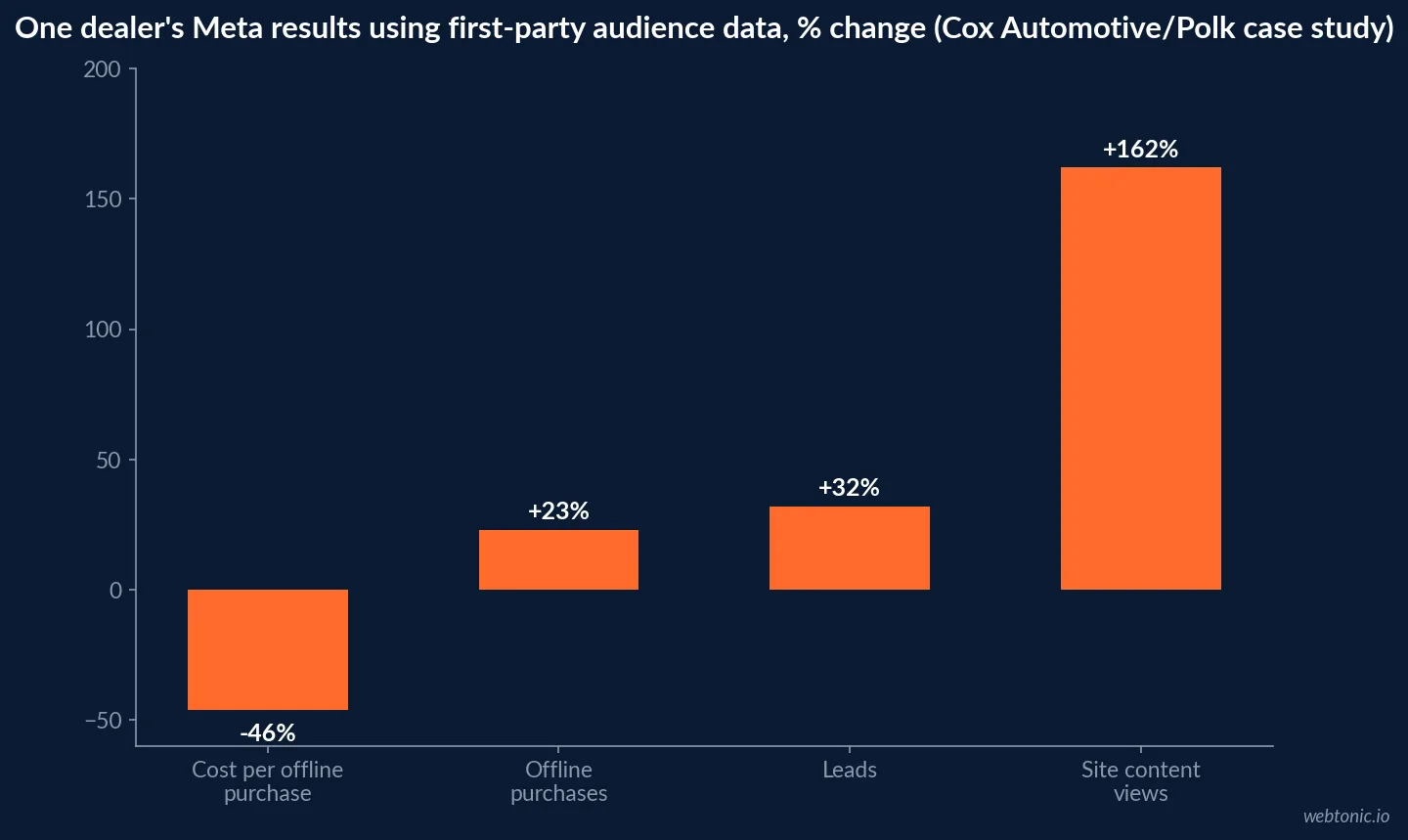
- A first-party audience case study logged +162% site content views.
- The same case study logged +32% leads and +23% offline purchases.
- Cost per offline purchase fell 46% in that same 12-month comparison.
- CDP-driven dealers sold more than 2x the vehicles while spending 1.5x more.
- Those dealers saw a 20% boost in ad efficiency on Meta.
- 85% of the total sales lift landed after the campaign ended.
- Facebook CPL rose 20% year over year across WordStream's 2025 dataset.
- The powersports industry carries a USD 50.9 billion US economic footprint (MIC).
The category everyone assumes is expensive is not the expensive one
The WordStream Facebook Ads Benchmarks report, built from roughly 1,180 campaigns running April 2024 through June 2025, found Automotive-Repair, Services and Parts posting the lowest click-through rate of any industry it tracks in traffic campaigns, at 0.80% - below Physicians and Surgeons (0.83%) and Finance and Insurance (0.98%). The all-industry average sits at 1.71%, so a service-bay campaign clicking at 0.80% is not underperforming a target - it is performing exactly to category type.
Coverage of WordStream's subsequent 2026 release confirms the direction held: traffic CTR climbed to 1.93% across roughly 1,800 campaigns while lead costs stayed close to flat, meaning clicks got easier to earn everywhere except in categories, like automotive service, where the audience genuinely is not always in-market.
| Facebook category (2025 report) | Traffic CTR | Leads CPC | Notes |
|---|---|---|---|
| Automotive - Repair, Services & Parts | 0.80% | Not separately broken out | Lowest CTR of any tracked category |
| Sports & Recreation (powersports proxy) | 2.60% | USD 1.07 | Highest CTR alongside Shopping/Collectibles |
| Finance & Insurance | 0.98% | Not separately broken out | Second-lowest CTR tracked |
| All-industry average | 1.71% | USD 1.92 | Base rate for comparison |
What a powersports dealer's own account says
No association publishes a Meta-specific benchmark broken out for powersports or marine dealers, so the WordStream categories above are a cross-industry proxy. The one industry-specific data point available comes from Dealer Spike, an agency running paid accounts for powersports, marine and outdoor power equipment dealers, which reports its own book averaging a Facebook CPC near USD 0.32 and a conversion rate near 0.58% through November 2025 - a fraction of the USD 1.92 all-industry leads CPC, though this is one vendor's own client set, not an independent census of the powersports category.
The Motorcycle Industry Council puts the wider powersports economy at USD 50.9 billion with 11 million motorcycles in use in the US, context for why that audience segment is worth a dedicated Meta strategy rather than an automotive template applied to a different product.
What first-party data changes on Meta
A Cox Automotive/Polk case study of Cochran Chevrolet Buick GMC of Youngstown compared a 12-month window using Polk Audiences segments against the same window a year earlier and logged a 162% increase in site content views, a 32% increase in leads, a 23% increase in offline purchases and a 46% reduction in cost per offline purchase. Those are single-dealer results, published by the vendor whose product produced them, and should be read as a best-case illustration rather than a typical outcome.
PureCars' AutoMiner study reaches a similar conclusion from a different angle: dealers combining a customer data platform with Meta advertising sold more than twice as many vehicles while spending 1.5 times more, achieved a 20% boost in Meta ad efficiency using Meta's own Robyn marketing-mix-modeling tool, and - the detail worth budgeting around - found that 85% of the total sales increase happened after the tracked campaign had already ended.
| Study | Publisher | Headline result | Measurement window |
|---|---|---|---|
| Polk Audiences on Meta | Cox Automotive / Polk | +162% site content views, -46% cost per offline purchase | 12 months vs. prior 12 months |
| AutoMiner CDP + Meta ads | PureCars | 2x+ vehicles sold, 20% higher ROAS | Campaign period + post-campaign tail |
| Facebook traffic benchmarks | WordStream | Automotive-Repair CTR 0.80%, lowest tracked | April 2024 - June 2025 |
| Powersports/marine account averages | Dealer Spike | USD 0.32 CPC, 0.58% conversion | Through November 2025 |
Reading a case study without overbuying the number
A single-dealer case study and an aggregated 1,180-campaign benchmark are answering two different questions. The benchmark tells you what to expect from the category on average; the case study tells you what is possible when first-party data and platform-native measurement tools like Robyn are layered on top of that category baseline. Neither substitutes for the other, and a rooftop quoting the case study's 162% figure as its own expected outcome is setting up its own campaign to look like a failure by comparison.
The safer planning approach: budget against the category benchmark (0.80% CTR and category-level CPC for a service campaign, the Sports and Recreation proxy or a powersports vendor's own data for a recreation rooftop), then treat first-party audience integration and post-campaign attribution as the upside case that justifies testing a CDP rather than the baseline the budget assumes.
Measurement gaps that inflate or deflate the real number
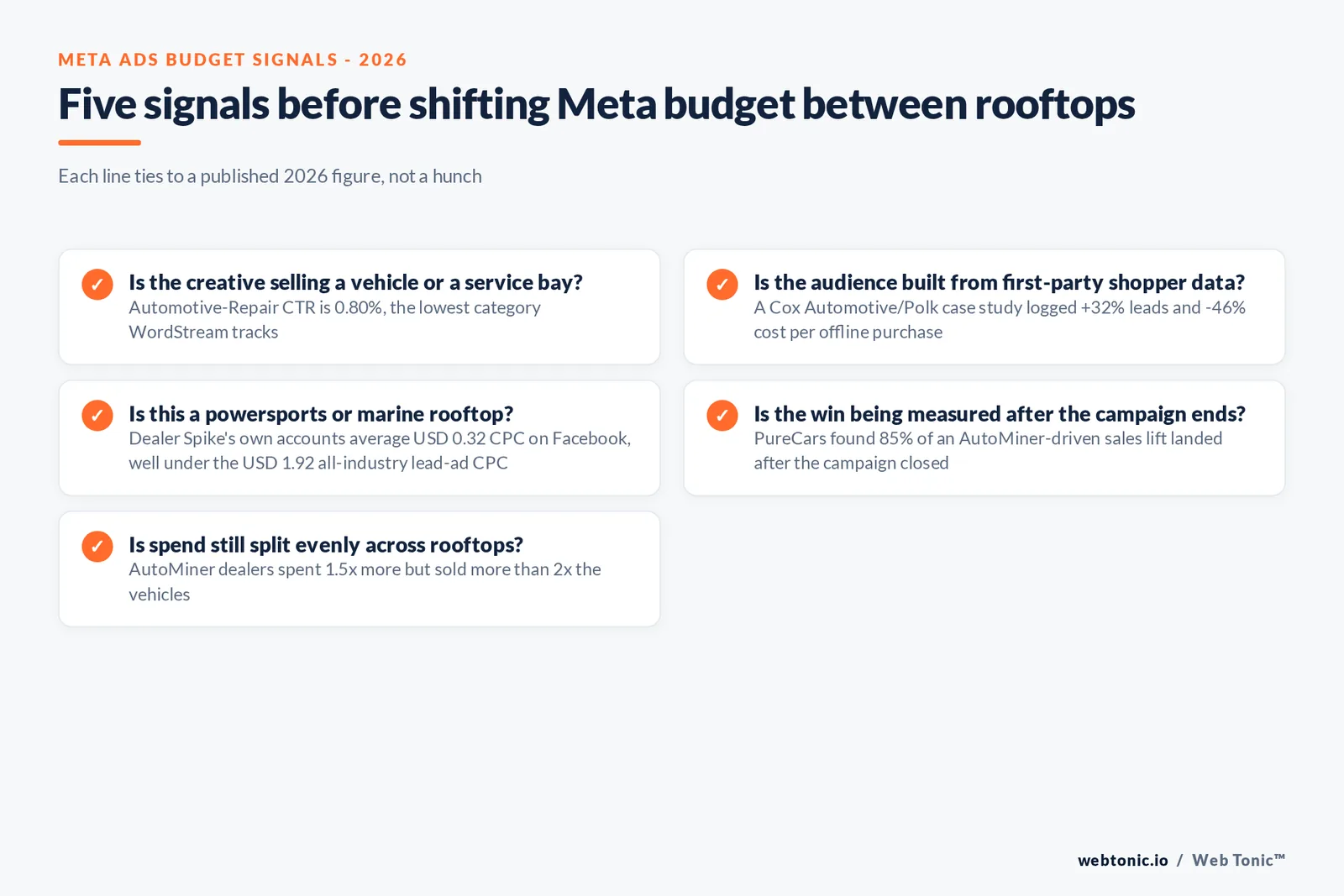
The PureCars finding that 85% of a Meta-driven sales lift landed after the campaign window closed is the single most consequential data point on this page for anyone reporting ROAS off Meta's native dashboard alone. A dealer measuring only in-platform, last-click conversions during the flight dates is very likely looking at a fraction of the actual result, which explains why case studies built on offline sales data and marketing-mix modeling report numbers that look implausible next to a Facebook Ads Manager screenshot.
WordStream's own 2025 data adds a budgeting wrinkle on top of that: the average cost per lead rose 20% year over year across its full dataset even as click costs held closer to flat, meaning a flat CPL target set in 2025 is already stale heading into 2026 planning.
| Planning input for 2026 | Figure | Source | Budget implication |
|---|---|---|---|
| Automotive-Repair traffic CTR | 0.80% | WordStream 2025 | Do not benchmark service ads against inventory ads |
| All-industry leads CPC | USD 1.92 | WordStream 2025 | Floor for planning a new dealer group account |
| All-industry cost per lead, YoY change | +20% | WordStream 2025 | Refresh CPL targets before locking 2026 budgets |
| Sales lift landing post-campaign | 85% | PureCars | Extend attribution windows before judging ROAS |
OEM co-op money is now earmarked for Meta specifically
Powersports OEMs are no longer leaving the channel mix up to the dealer. BMW Motorrad's 2026 co-op guidelines require dealers to spend a minimum of 15% of co-op funds on paid social media and 20% on paid search or Performance Max, with the remaining 65% flexible. Coverage of the 2026 co-op season reports that BRP became the first major powersports OEM to reimburse the cost of video content production itself, up to USD 250 per video, with that same footage able to generate further co-op claims for an influencer fee and a paid social media promotion.
That is a direct instruction from manufacturers to dealers: Meta and other paid social budgets are being protected, and in some programs mandated, at the OEM level - which changes the conversation from "should the rooftop test Meta ads" to "which of the co-op-funded dollars are being left unclaimed."
| OEM co-op signal (2026) | Requirement or benefit | Source | Effect on Meta budget |
|---|---|---|---|
| BMW Motorrad minimum paid social spend | 15% of co-op funds | BMW Motorrad 2026 guidelines | Floor budget guaranteed regardless of rooftop preference |
| BMW Motorrad minimum paid search spend | 20% of co-op funds | BMW Motorrad 2026 guidelines | Complements, does not replace, the Meta floor |
| BRP video content reimbursement | Up to USD 250 per video | Motorcycle & Powersports News | Lowers the cost of Meta-ready creative |
| Social promotion claims on that footage | Additional co-op eligible | Motorcycle & Powersports News | Stacks Meta spend on top of already-funded content |
Building the 2026 Meta plan by rooftop
The evidence points to three separate Meta strategies inside one dealer group: an inventory-led strategy for new and used vehicle sales that can lean on the category's relatively stronger cross-shopping behavior, a tightly targeted service-bay strategy that accepts a lower CTR as the category norm rather than a campaign failure, and - where the group carries a powersports or marine rooftop - a distinct budget built from that segment's own account data rather than an automotive benchmark relabeled. Our growth marketing practice builds that three-way split account by account, and our guide on what Facebook ads cost across industries is a useful starting benchmark before setting rooftop-level targets, alongside our list of Facebook ads agencies if a group needs a specialist per rooftop.
Frequently Asked Questions
Is Facebook advertising cheaper for car dealerships or powersports dealers?
On the data available, powersports and marine dealers appear to buy clicks far cheaper. Dealer Spike, an agency running Facebook accounts for powersports, marine and outdoor power equipment dealers, reports its own book averaging USD 0.32 per click through November 2025 - well under WordStream's USD 1.92 all-industry average cost per click for Facebook leads campaigns. That gap is a comparison across a vendor's own client set against a cross-industry benchmark, not two controlled samples of the same size, so read it as directional rather than exact.
Why does Automotive-Repair have the lowest Facebook click-through rate of any category?
WordStream's 2025 Facebook Ads Benchmarks report, built from roughly 1,180 campaigns, found Automotive-Repair, Services and Parts had the lowest traffic-campaign CTR of every tracked category at 0.80%, down from a year earlier. The report's own explanation is that service-bay ads cannot rely on the same visual pull as a vehicle listing or a recreation ad, since only part of the audience is actively in-market for a repair at any given moment.
What does first-party audience data actually change in a Meta campaign?
A Cox Automotive/Polk case study of Cochran Chevrolet Buick GMC found that adding Polk Audiences segments to Meta campaigns produced a 162% increase in site content views, a 32% increase in leads, a 23% increase in offline purchases and a 46% reduction in cost per offline purchase over a 12-month comparison window. Separately, PureCars reported dealers combining a customer data platform with Meta advertising sold more than twice as many vehicles while spending 1.5 times more, with 85% of the total sales lift landing after the campaign had already ended.
Should a dealer group budget the same amount per rooftop for Meta ads?
Not if the rooftop is selling inventory versus booking service, and not if it is powersports versus automotive. Automotive-Repair's 0.80% CTR is the lowest WordStream tracks in Facebook traffic campaigns, while Sports and Recreation - the closest available proxy for a powersports audience - sits at 2.60%, more than three times higher. Budget and creative should follow that gap, not a flat per-rooftop number.
Is Meta ad performance measured correctly if it only counts online conversions?
PureCars' AutoMiner study is a direct warning against that shortcut: 85% of the sales increase attributed to CDP-driven Meta advertising happened after the tracked campaign window closed, meaning a last-click or in-platform-only view of ROAS would have missed most of the actual result. Dealers relying solely on Meta's native reporting are very likely undercounting their own campaigns.
Sources
WordStream - Facebook Ads Benchmarks 2025
PPC Land - Coverage of WordStream's 2026 Facebook Ads Benchmarks
Cox Automotive / Polk - Cochran Chevrolet Buick GMC Meta case study
PureCars - Dealers double vehicle sales using the AutoMiner CDP with Meta ads
Dealer Spike - High CPCs, low lead counts: what dealers need to know
Motorcycle Industry Council - Powersports industry statistics
BMW Motorrad - 2026 Advertising Guidelines and Co-op Marketing Program
Motorcycle & Powersports News - A breakdown of OEM co-op changes in 2026