Table of contents
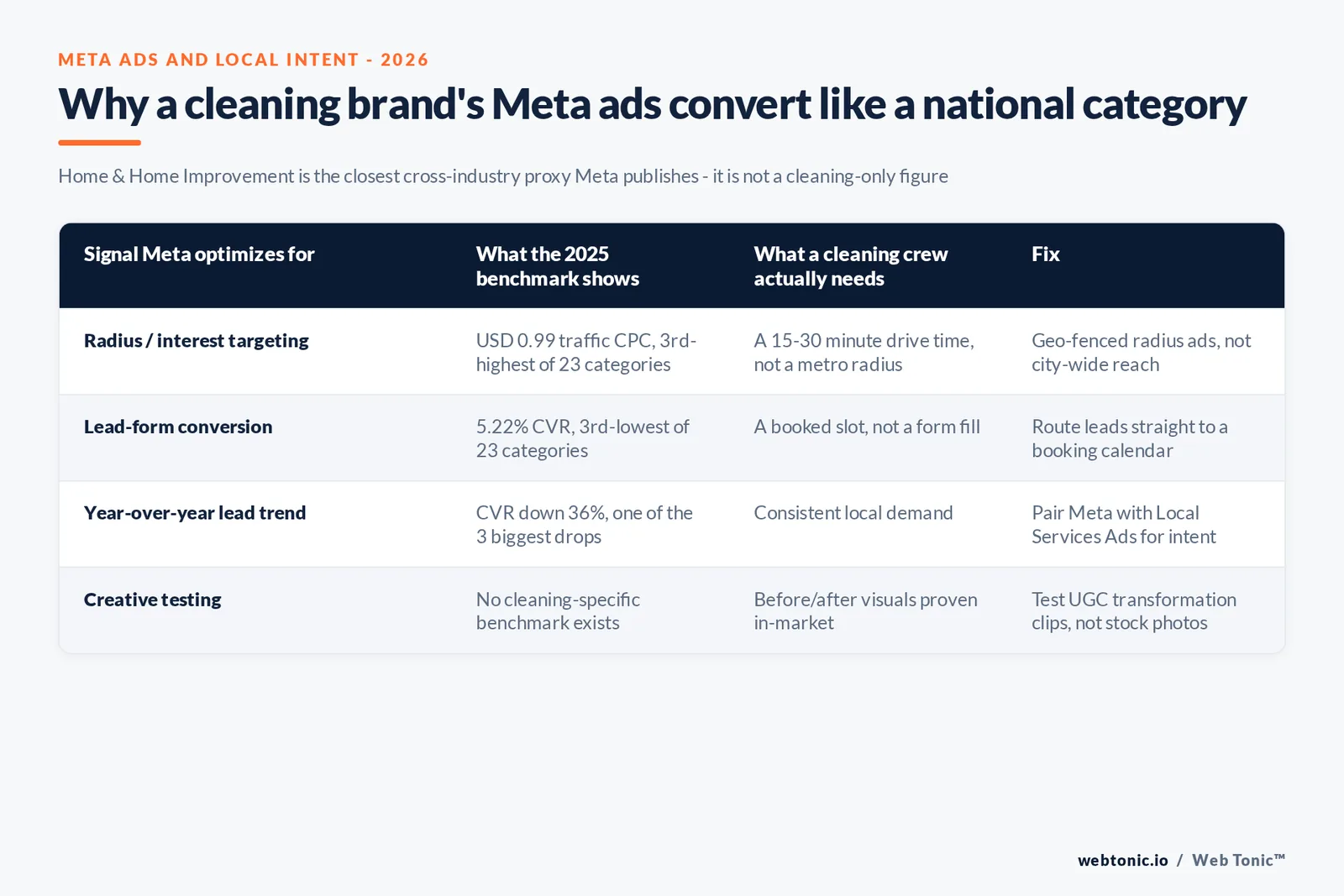
Meta has never published a cleaning-services benchmark, so every figure attributed to the category on this page is really "Home & Home Improvement" - WordStream's catch-all bucket for cleaning, lawn care, handyman and pest control businesses. That cross-industry data still tells a clear story: the category pays near-top-three prices for clicks and converts leads at one of the worst rates Meta tracks, a pattern consistent with ads built for reach instead of the tight local radius a cleaning crew actually serves.
Key Takeaways
- Home & Home Improvement pays USD 0.99 per click on Facebook traffic campaigns, the 3rd-highest of 23 categories.
- The all-industry average traffic CPC is USD 0.70, 29% cheaper.
- Home & Home Improvement converts leads at 5.22%, the 3rd-lowest of 23 categories.
- The all-industry average lead conversion rate is 7.72%.
- That conversion rate fell 36% year over year, one of the 3 steepest drops WordStream measured.
- Restaurants and Food convert leads at 18.25% - visually obvious, immediate-need categories outperform.
- The average Facebook lead ad now costs USD 27.66 per lead across all categories, up from USD 22.87.
- "Near me" searches grew more than 130% year over year per Google's own research.
- Mobile makes up 88% of all "near me" searches, growing 146% year over year on mobile alone.
- "Open now near me" queries grew over 400% year over year globally.
- The US janitorial and cleaning services market is worth USD 112.4 billion in 2026, growing 2.7% a year (IBISWorld).
- The industry has roughly 1.23 million janitorial businesses competing for that spend, per ISSA.
- Google's Local Services Ads require a business-license background check for house cleaning specifically, a signal Meta ads do not carry.
- The FTC's fake-review rule has been enforceable since October 21, 2024, covering testimonial creative on any platform.
Why "cleaning services Meta Ads statistics" doesn't exist as a dataset
WordStream's benchmark reports and Meta's own advertiser tools group businesses into broad verticals, and cleaning services sit inside "Home & Home Improvement" alongside lawn care, handyman work, pest control and general contracting. That is the honest starting point: there is no isolated Meta Ads benchmark for house cleaning or commercial janitorial specifically, so this page treats the Home & Home Improvement figures as a labeled proxy, not a cleaning-specific result.
What that proxy shows is still useful, because the pattern - high cost, low conversion, getting worse - is not something a single anomalous business would produce. It shows up at the category level across 1,180 campaigns WordStream analyzed for its 2025 Facebook Ads Benchmarks report.
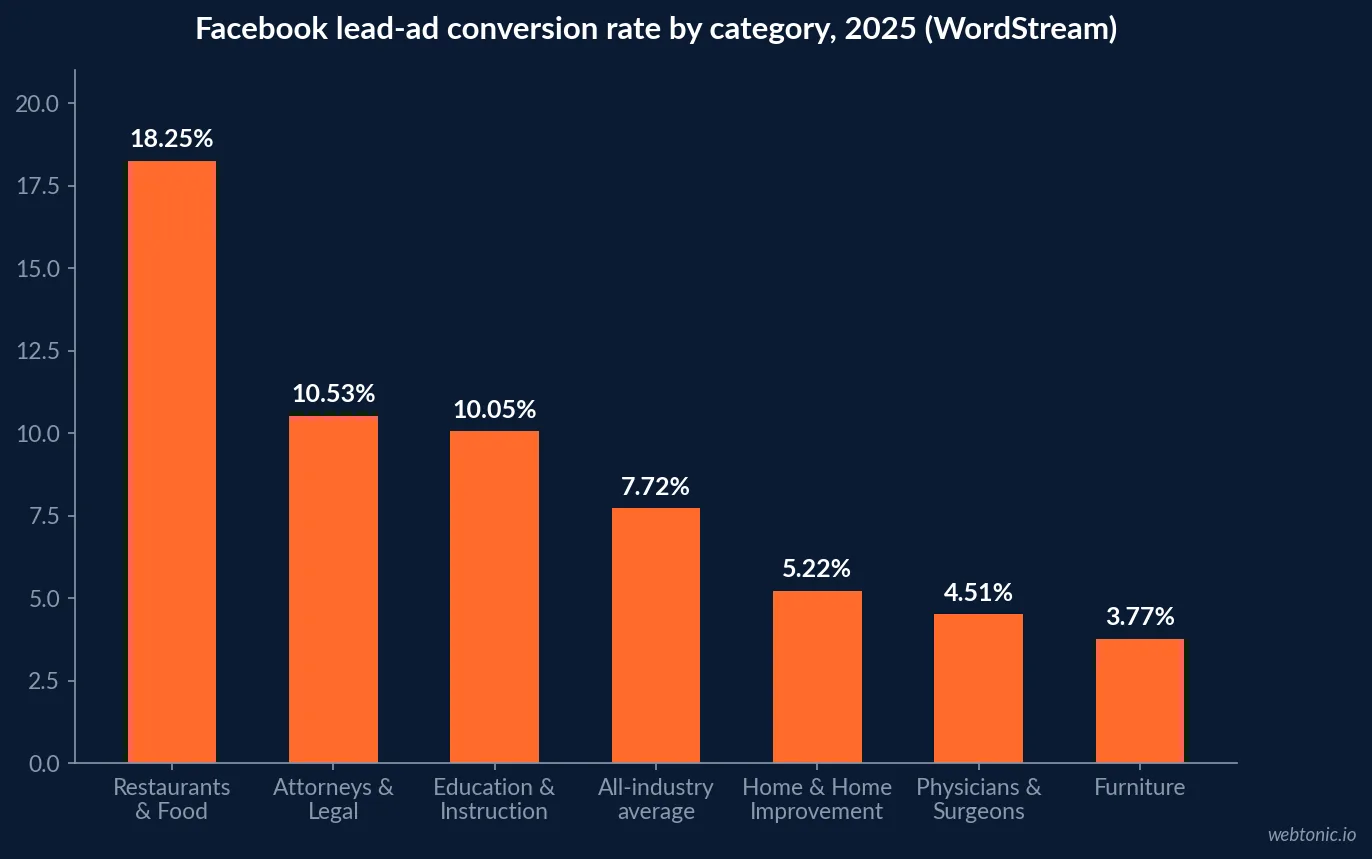
| Facebook leads metric (2025) | Home & Home Improvement | All-industry average | Gap |
|---|---|---|---|
| Conversion rate | 5.22% | 7.72% | -2.50 points |
| Conversion rate, year over year | Down 36% | Down from 8.67% to 7.72% | One of 3 biggest declines |
| Cost per lead | Not broken out separately | USD 27.66 | Up from USD 22.87 (+21%) |
| Highest-converting category | Restaurants & Food, 18.25% | - | 13.03-point gap to Home & HI |
The click is getting more expensive, not less
On the traffic side of the funnel, Home & Home Improvement pays USD 0.99 per click, the third-highest cost per click of the 23 categories WordStream tracks, behind only Finance and Insurance (USD 1.22) and Personal Services (USD 1.00). The all-industry average traffic CPC is USD 0.70. A cleaning brand buying clicks at the category rate is paying roughly 41% more than the average advertiser for the same click.
Paying more for the click and converting fewer of them into leads is the combination that should worry a media buyer, not either number alone.
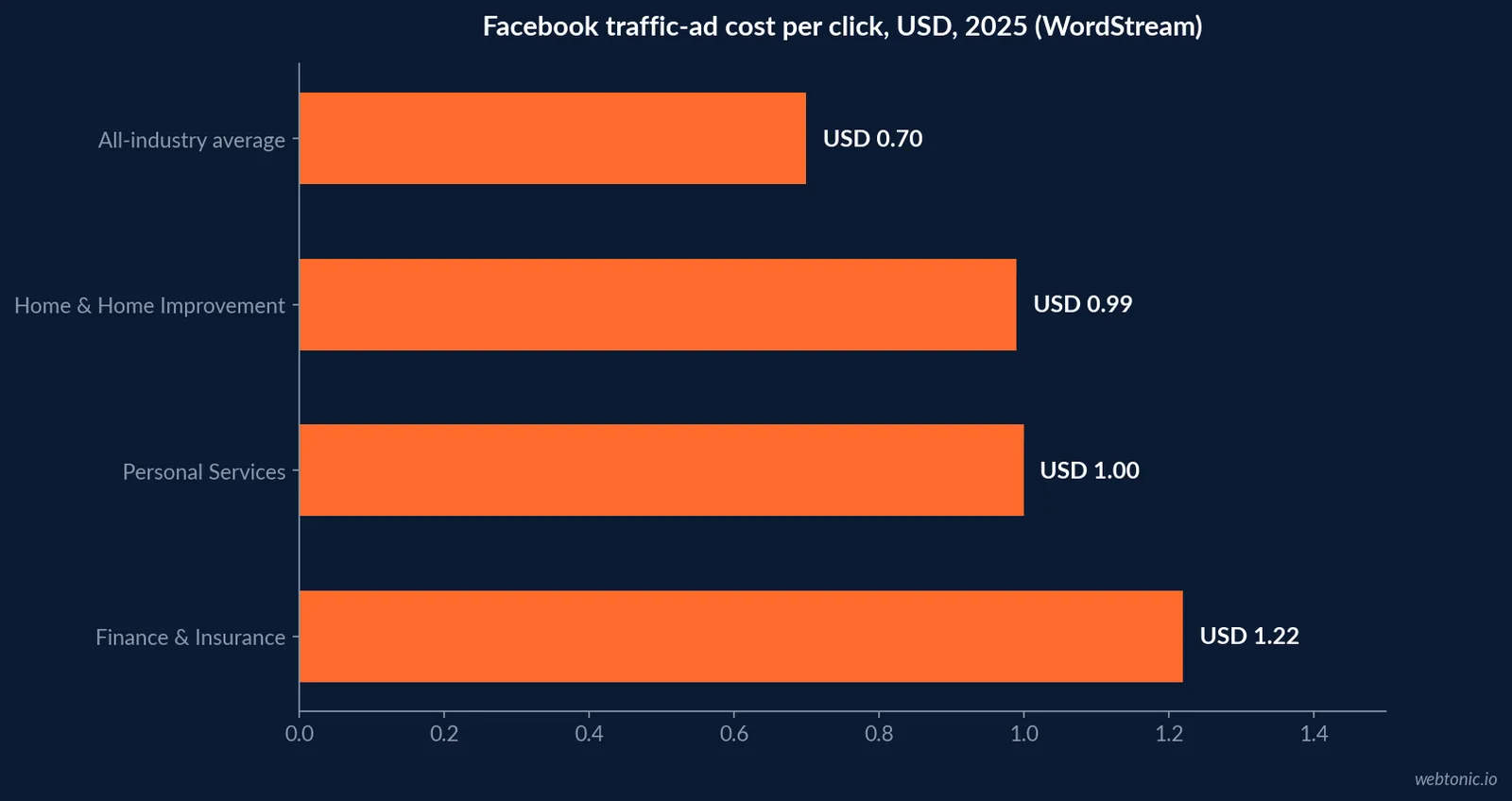
| Facebook traffic metric (2025) | Value | Rank of 23 categories |
|---|---|---|
| All-industry average CPC | USD 0.70 | - |
| Home & Home Improvement CPC | USD 0.99 | 3rd-highest |
| Finance & Insurance CPC (highest) | USD 1.22 | 1st |
| Shopping, Collectibles & Gifts CPC (lowest) | USD 0.34 | 23rd |
| All-industry average CTR | 1.71% | - |
What "local intent" means and why Meta rarely captures it
The claim in this page's title is about intent, not spend. Google's own research found "near me" searches growing more than 130% year over year, with mobile making up 88% of all "near me" searches and those mobile queries growing even faster, at 146% year over year. A separate Think with Google report puts "open now near me" search growth at over 400% year over year globally.
Those are Google Search behaviors, not Meta behaviors, and that gap is the point. A homeowner who types "cleaning service near me" is announcing an address-level intent that a search engine can match to a map pin. A person scrolling Facebook or Instagram is not issuing a query at all - Meta has to infer intent from interests and demographics, then apply a radius around an address the advertiser sets. If that radius is a whole metro area instead of a 15-to-30-minute drive time, the platform is doing exactly what it was told, and the conversion-rate data above is the result.
| Local intent signal | Figure | Source | What it means for Meta ads |
|---|---|---|---|
| "Near me" search growth | >130% YoY | Think with Google | Growing share of demand starts as a location query, not a feed scroll |
| Mobile share of "near me" searches | 88% | Think with Google | The intent moment happens on a phone, in or near the home |
| "Open now near me" query growth | >400% YoY | Think with Google | Urgency-driven searches reward instant local answers, not brand awareness ads |
| Home & Home Improvement lead CVR | 5.22% | WordStream 2025 | Broad-radius Meta ads convert this intent poorly relative to other categories |
The market a Meta budget is actually competing in
The category's fragmentation compounds the targeting problem. ISSA's 2026 state-of-the-industry reporting puts the janitorial market at roughly USD 112 billion, growing about 2.7% a year, with the number of competing firms growing faster, around 4.2% a year, and roughly 1.23 million janitorial businesses already in the market. IBISWorld's 2026 industry report confirms the same USD 112.4 billion figure and the 2.7% five-year CAGR.
More competitors chasing the same demand, running the same broad-radius playbook, is a second honest explanation for a declining conversion rate that the WordStream data alone cannot separate from the targeting issue - both forces likely push the same direction at once.
| Market fact (2026) | Figure | Source |
|---|---|---|
| US janitorial services market size | USD 112.4 billion | IBISWorld |
| Five-year revenue CAGR | 2.7% | IBISWorld / ISSA |
| Number of janitorial businesses | Roughly 1.23 million | ISSA |
| Growth rate of competing firms | About 4.2% a year | ISSA |
The compliance layer Meta creative can't skip
A cleaning company's most persuasive Meta creative is usually a before-and-after photo paired with a customer quote, and that is exactly the creative type the FTC's 2024 rule on consumer reviews and testimonials covers. The final rule, effective since October 21, 2024, bans fabricated reviews and testimonials, undisclosed insider reviews, and company-run sites that pose as independent review platforms. Every testimonial quoted in an ad has to trace to a real, attributable customer.
That is not a reason to avoid social proof in Meta creative - it is a reason to source it correctly, the same way verified reviews already have to work for Google Business Profile and Local Services Ads.
What Local Services Ads capture that Meta doesn't
Google's Local Services Ads screening requirements for house cleaning specifically require a state-level business license and a state-level owner license as part of the "Google Guaranteed" verification. The broader screening and verification process layers on identity and criminal-history background checks for the business owner and field-worker roster.
Meta Ads carries no equivalent verification layer. A cleaning brand cannot make a Meta ad behave like a Local Services Ads listing, but it can borrow the logic: put the license, insurance and real reviews on the landing page the ad clicks to, and let Meta do what it does well - reach - while Local Services Ads or a Google Business Profile carries the trust signal.
| What Google verifies for house cleaning LSA | Requirement |
|---|---|
| Business license | State-level, required |
| Owner license | State-level, required |
| Identity/criminal history check | Business owner and field-worker roster (US/CA) |
| Business litigation history | Civil judgments and liens, federal and state courts |
What to change before the next Meta budget renewal
Three changes follow directly from the data above: shrink the radius to a real drive time instead of a metro-wide interest audience, route every lead straight into a booking calendar instead of a generic contact form, and rebuild creative around real before-and-after job footage with FTC-compliant, attributable testimonials. None of that requires new budget - it requires spending the existing budget against the category's actual weak point, which the conversion-rate data isolates clearly even without a cleaning-specific benchmark.
If Meta is one piece of a broader lead-generation stack, our growth marketing practice builds the local-radius and booking-funnel structure this data points to, our breakdown of whether Facebook ads are worth it walks through the ROI math category by category, and our Meta Ads management page covers how we structure radius and creative testing for local service brands specifically.
Frequently Asked Questions
Does Meta publish a cleaning-services-specific ad benchmark?
No. WordStream's 2025 Facebook Ads Benchmarks report groups every home-service business - cleaning, lawn care, handyman, pest control - into one "Home & Home Improvement" category across 1,180 campaigns. Every figure attributed to "cleaning" on this page is really that broader category, clearly labeled as such, because no narrower published dataset exists.
Why does the title say most cleaning brands miss local intent?
Because the closest available proxy shows a category that pays a near-top-three cost per click (USD 0.99) for traffic, then converts leads at 5.22%, the third-lowest of 23 categories, with the conversion rate falling 36% year over year - one of the three steepest declines WordStream tracked. That pattern - expensive clicks, weak conversion, and a rate that is getting worse - is consistent with ads run at a metro or interest-based radius instead of the tight drive-time radius a cleaning crew actually services, though WordStream's data cannot isolate targeting as the specific cause.
Should a cleaning business run Meta Ads at all?
The category data does not say don't advertise; it says don't advertise the way a national brand would. Google's own research shows "near me" search volume growing more than 130% year over year and "open now near me" queries up over 400%, both overwhelmingly mobile - a locational intent signal Meta's interest and radius targeting was not built to isolate the way a Google Local Services Ad listing, tied to a verified service address, can.
What should replace a broad Meta radius campaign?
A geo-fenced radius matched to the actual service area, a lead form that routes straight into a booking calendar instead of a generic contact form, and creative built from real before/after job footage rather than stock photography. None of that is Meta-specific policy; it follows directly from why the Home & Home Improvement category underperforms categories like Restaurants and Food (18.25% CVR) that sell an immediate, visually obvious outcome.
Does the FTC's fake-review rule affect Meta ad creative for cleaning businesses?
Yes, indirectly. The FTC's 2024 rule (effective since October 21, 2024) bans buying or fabricating consumer reviews and testimonials and bans undisclosed insider reviews. A Meta ad or landing page that quotes a testimonial has to be a real, attributable customer - a compliance detail cleaning brands running review-driven creative cannot treat as optional.
Sources
WordStream - Facebook Ads Benchmarks 2025
WordStream - 2026 Google Ads Benchmarks
Think with Google - Mobile-centric search strategy (near-me search data)
Think with Google - Store visits and local search trends
ISSA - The state of the cleaning and facility solutions industry, 2026
IBISWorld - Janitorial Services industry report, 2026
Google Local Services Help - Business screening and verification requirements
Google Local Services Help - Screening and verification process
Federal Trade Commission - Trade Regulation Rule on Consumer Reviews and Testimonials
Federal Register - Final rule text, consumer reviews and testimonials