



Table of contents

A fractional head of growth is a senior operator who owns your acquisition and conversion system part-time, usually one to two days a week. The title matters less than the authority: if the role only advises, you have bought a consultant, not a head of growth.
Key Takeaways
- A fractional head of growth (also sold as a fractional CGO) takes accountability for pipeline and the experiment system, not just for a plan. Scope tracks hours: at 5–8 hours a week you get direction, at 15–20 you get ownership.
- Published 2026 ranges put fractional growth leadership at roughly $5,000–$15,000 a month for 10–20 hours a week, with ARR-banded guides quoting $8,000–$12,000 at $1M–$5M ARR and $12,000–$20,000 above that.
- The comparison is not against a freelancer, it is against a full-time hire. Chief growth officer base pay in the US sits around a $282,457 average with a $232,453–$336,659 interquartile range.
- Supply has exploded — fractional executive supply roughly tripled in 24 months and monthly fractional job postings rose about five-fold from early 2024 to Q1 2026 — so vetting matters more than availability.
- The clearest need signal is a measurement and prioritisation problem, not a capacity problem: marketing-sourced pipeline stuck below 30%, or fewer than 2 valid experiments a month.
- Do not buy the role to avoid a decision. A mis-hired senior leader can cost up to 213% of salary, and retained search alone runs 25–35% of it.

What the role actually owns
A head of growth sits across the revenue funnel rather than inside the marketing department. In practice that means four things: the acquisition mix and its economics, the conversion path from first touch to closed revenue, the experiment pipeline that improves both, and the reporting that lets a board see which of those is working.
The fractional version compresses this into a fixed weekly commitment. Market guidance on the role describes typical engagements at 10–20 hours a week of senior growth expertise, which is enough to own strategy, channel decisions and a testing cadence, and not enough to also produce the work. That distinction is where most disappointing engagements start.
Authority is the second variable, and it is the one buyers under-specify. Fractional pricing research for 2026 notes that head-of-growth scope is narrower than a fractional CMO's — closer to funnel and channel economics than to brand and market narrative — and prices slightly below it for that reason. If you want positioning and category work as well, you are describing a fractional CMO engagement instead.
| Weekly commitment | What the role can genuinely own | What stays with you |
|---|---|---|
| 5–8 hours | Priorities, channel decisions, reporting definitions | All execution, agency management, hiring |
| 8–12 hours | The above plus experiment design and vendor briefs | Production, analytics build, day-to-day optimisation |
| 12–20 hours | Full funnel ownership, forecast, team and agency oversight | Creative and engineering capacity |
| 20+ hours | Effectively an interim in-house leader | Little — at this level compare against a permanent hire |
Head of growth, CGO, CMO: the distinction that matters
Titles in this space are close to interchangeable in job adverts and not interchangeable in practice. The useful test is reporting lines. A growth role owns levers across marketing, product-led acquisition and retention; a marketing role owns demand creation and brand. When only marketing reports into the role, a "chief growth officer" title is a renamed marketing job, and the growth mandate quietly disappears.
Seniority expectations differ too. Role and compensation guidance for a full-time head of growth in 2026 describes base pay of $180,000–$280,000 with total cash between $220,000 and $350,000, and Series B tech as the modal band. Verified SaaS salary data is lower for smaller companies — a $140,000 median base and a $100,000–$200,000 typical range across 69 reported salaries — which tells you the same title covers two very different jobs.
At the executive end, chief growth officer benchmarks by company size put base pay at $300,000–$400,000 for companies between $100M and $500M in revenue, rising further with scale. Buying a fraction of that seniority is the actual argument for the fractional model — not saving money on a mid-level marketer.
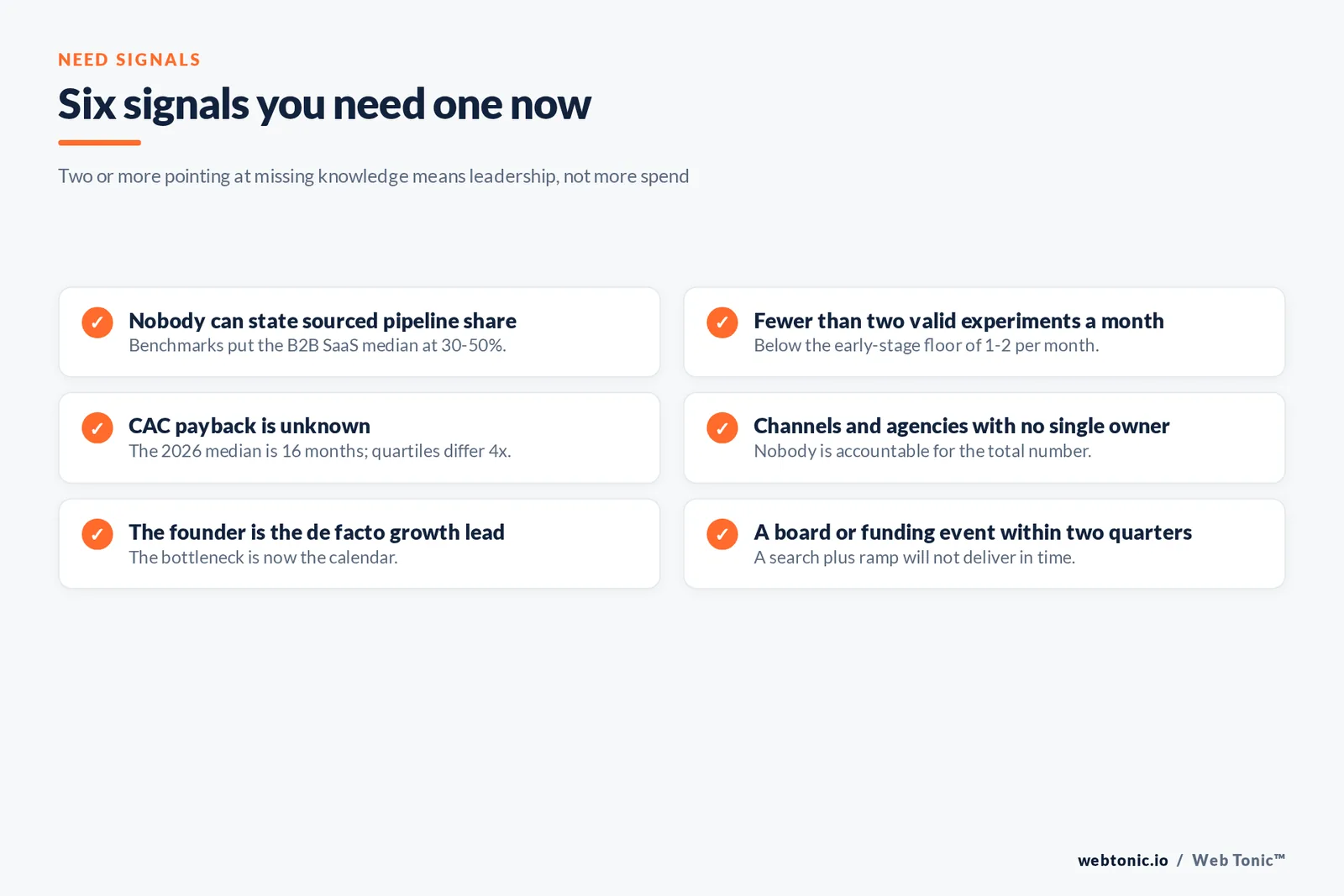
The six signals that you need one now
The honest need test is whether your constraint is knowledge or capacity. Fractional leadership solves the first and makes the second worse, because a leader with no execution capacity underneath them generates decisions nobody can act on.
Signal one: nobody can state what share of pipeline marketing sources. B2B benchmark data puts marketing-sourced pipeline at about 31% on average for B2B SaaS, with influenced pipeline near 68%; 2026 benchmark analysis places the SaaS median at 30–50% sourced and treats anything below 30% as a warning. If you cannot produce your own figure, you are not ready to hire anyone full-time into the problem.
Signal two: testing has stalled. Experimentation velocity benchmarks describe early-stage teams at 1–2 valid experiments a month, structured teams at 3–5, and high-performing operations at 6–10 across channels. Sitting below the floor for two quarters is a systems problem a senior operator can fix quickly.
Signal three: unit economics are unclear. 2026 payback benchmarks built on full-year 2025 actuals from 342 companies show a 16-month median CAC payback, with the top quartile at 6 months or less and the bottom at 24 or more. Not knowing which quartile you are in is the most expensive form of ignorance in growth.
Signal four is organisational: you have channels, agencies and tools but no single person accountable for the number they add up to. Signal five is a founder who has become the de facto head of growth and is now the bottleneck. Signal six is a funding or board event in the next two quarters that requires a defensible growth plan you do not currently have.
Business model shapes the answer too. In a recurring-revenue SaaS business the growth remit usually spans acquisition, activation and retention, so a CGO-style operator with product experience is the right fit; in a services or multi-brand consumer business, paid acquisition and conversion are often where the whole functional gap sits, and a narrower growth lead does better. Founders scaling several brands from one team should be explicit about which businesses the retainer covers, because splitting 12 monthly hours across three P&Ls buys direction for none of them.
When a fractional hire is the wrong answer
Three situations argue against it. First, if the plan already exists, is agreed, and simply is not shipping, buy hands and project management — not more leadership. Second, if the role would need 30 or more hours a week to be useful, the fractional structure stops being an advantage and you should run a permanent search. Third, if there is no internal owner to hold the work between sessions, the engagement will produce documents rather than outcomes.
There is also a market-quality caveat. 2026 research on fractional executive talent reports that supply has roughly tripled in 24 months, partly through operators relabelling themselves, and marketplace data shows monthly postings up about five-fold from early 2024 with 149% year-on-year growth in Q1 2026. Demand that strong pulls in people whose only fractional experience is the last six months.
Finally, price the downside. Senior mis-hire benchmarks cite costs of up to 213% of salary, executive process cost of roughly $28,000 per hire, and retained search fees of 25–35% of salary. A three-month fractional engagement with a written scope is a materially cheaper way to learn what the role should actually be.
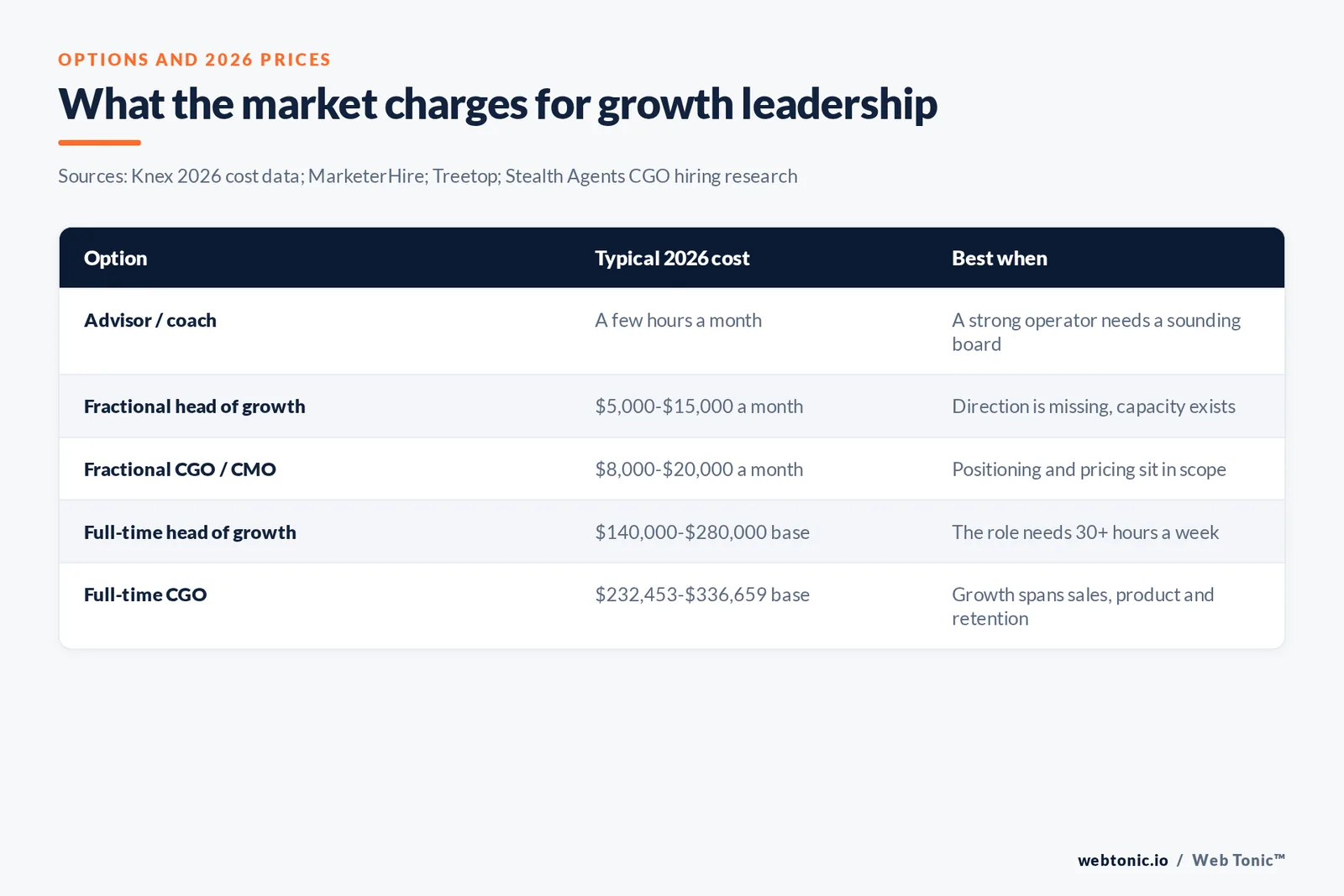
What the market charges
Rates cluster more tightly than you would expect. 2026 pricing data puts fractional heads of growth at $4,000–$12,000 a month, with systematic experimentation and acquisition strategy work landing in the $5,000–$9,000 band and active channel management trending higher. Role-level guidance sets a wider band of $5,000–$15,000 a month, or $60,000–$180,000 a year for 10–20 hours a week.
ARR-banded guides are more useful than averages: $8,000–$12,000 monthly at $1M–$5M ARR and $12,000–$20,000 at $5M–$20M, against a full-time VP of Growth costed at $300,000–$450,000 all-in. Market sizing for fractional executive services puts the global segment above $5.7bn growing at 14% annually, which is why pricing has become this legible.
Treat any quote outside these bands as a question rather than a red flag. Below them, check how many hours are really included; above them, check whether execution capacity, analytics build or agency management is bundled in. Our own commercial terms are quoted per engagement — tell us the scope and we will price it against the outcome, not a rate card.
| Option | Typical 2026 cost | Best when |
|---|---|---|
| Advisor / coach | A few hours a month of strategy, no ownership | You have a strong operator who needs a sounding board |
| Fractional head of growth | $5,000–$15,000 a month, 10–20 hours a week | Direction and accountability are missing, capacity exists |
| Fractional CGO / CMO | $8,000–$20,000 a month at wider scope | Positioning, pricing and brand sit in scope too |
| Full-time head of growth | $140,000–$280,000 base, plus variable and equity | The role needs 30+ hours a week for 12+ months |
| Full-time CGO | $232,453–$336,659 base at the interquartile range | Growth spans sales, product and retention at scale |
How to structure the engagement
Write the scope as decisions, not deliverables. The engagement should name the two or three decisions the leader is accountable for in the first quarter — which segments, which channels, what the qualified-lead definition is — plus the reporting they will maintain and the cadence at which you review it. Vague scopes are why fractional growth leadership gets judged on effort instead of outcomes.
Then set an evidence bar. Ask for one prior engagement at your stage and model, the actual before-and-after numbers, and what they would do differently. Ask who covers continuity if they take on another client mid-engagement. And insist on a named internal owner for implementation — the strongest predictor of whether anything ships is whether someone inside the business owns it.
Measurement should be agreed before the start. Leading indicators (experiment velocity, pipeline coverage, data trust) belong in the first quarter; sourced pipeline and payback belong in the second and third. Judging a growth leader on closed revenue at day 90 measures your sales cycle, not their work — a mistake we cover in more depth across the growth marketing and data intelligence practices, and in the rest of the blog.

Related reading
- Fractional CMO for SaaS: what it is and when you actually need one
- Fractional CMO: what it is and when you actually need one
- Growth Advisory / Growth Consulting: what it is and when you actually need one
- Marketing Strategy Consulting services at Web Tonic
Frequently Asked Questions
Is a fractional head of growth the same as a fractional CMO?
No. A head of growth is scoped around funnel economics, acquisition channels and experimentation; a CMO's remit adds positioning, brand and market narrative. Pricing follows scope, with head-of-growth engagements typically sitting slightly below fractional CMO rates for the same weekly hours.
How many hours a week is normal?
Published engagement data clusters at 10–20 hours a week, or one to two days. Below 8 hours you are buying direction only; above 30 hours the economics of the fractional model break down and a permanent hire is usually the better comparison.
How long should the first engagement run?
Three to six months. That is long enough to diagnose, decide and show leading indicators moving, and short enough that you are not locked in if the fit is wrong. Growth outcomes such as sourced pipeline and CAC payback need two to three quarters, so a 12-month judgement window belongs in the contract even if the initial term is shorter.
What should the role be measured on in the first quarter?
Decisions made and documented, experiment velocity against a stated baseline, data trust, and pipeline coverage. Revenue attribution comes later; benchmark data shows a median CAC payback of about 16 months, so day-90 revenue is a poor test of a growth leader's work.
Can a fractional head of growth manage our agencies?
Yes, and it is often the highest-value part of the engagement — provided it is written into scope and the hours reflect it. Agency oversight, briefing and performance review realistically need 12 hours a week or more once you have two or more partners.
Sources
MarketerHire (fractional head of growth rates; head of growth job description and compensation), Treetop Growth Strategy (2026 fractional executive pricing guide; state of fractional executive talent 2026), Knex (fractional head of growth cost 2026), JRG Partners (chief growth officer salary guide 2026), Founderpath (SaaS head of growth salary benchmarks), Fractional Jobs (Fractional Work Report), Vendux (fractional executive market data 2026), The Starr Conspiracy (B2B marketing benchmarks 2025–2026), Prooflytics (marketing-sourced pipeline benchmarks 2026), Aleph (CAC payback benchmarks 2026), Exactius (experimentation velocity benchmarks), Talentfoot (senior leadership mis-hire benchmark 2026). Accessed September 2026.


