



Table of contents
Quick answer: Run the first session with a fractional head of growth as three hours of arithmetic: build the pipeline math from the revenue target backwards, check each stage against what the systems report, name the one binding constraint, and leave with three owned decisions.
Last verified: 2026-09-08
Start with arithmetic, not a workshop
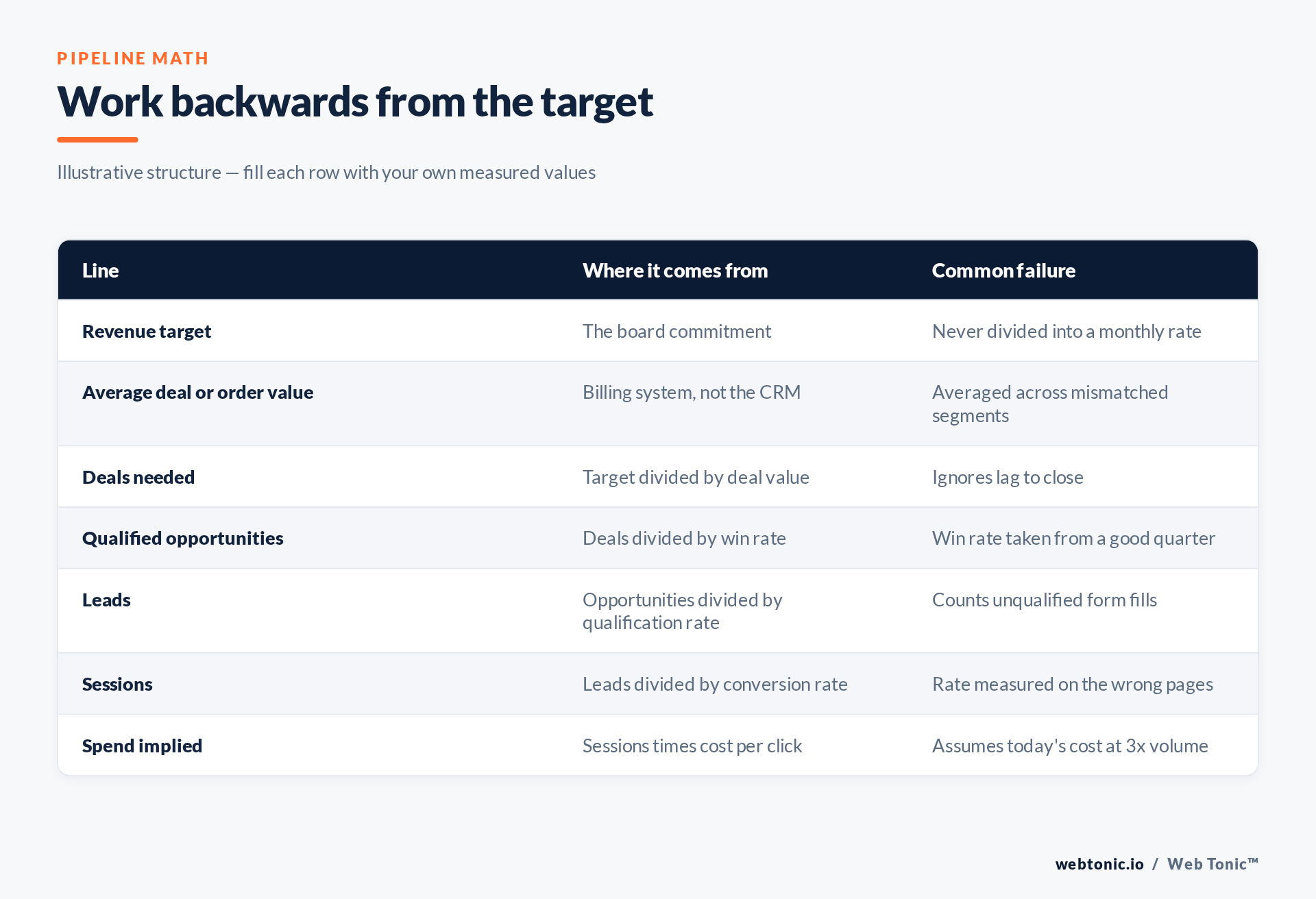
The temptation in a first session is a channel brainstorm. Resist it. Build the funnel backwards on a whiteboard while everyone watches: revenue target, average deal value, deals needed, win rate, qualified opportunities, leads, sessions, implied spend. Half the time the plan collapses at this stage because the implied volume is several times anything the business has ever produced — and that is the most valuable thing the session can find.
Take deal value from the billing system rather than the CRM, and state the segment. Pull win and qualification rates from a full trailing year, not a strong quarter. This is ordinary sales process arithmetic, and its only difficulty is honesty about the inputs.

Check every stage against the systems
Each line of the math has to be traceable to something measured. Sessions and conversion rate from analytics, with the event definitions checked rather than assumed — Google's event documentation is the reference for what a "conversion" actually counts. Paid cost per click and conversion counts from the ad platforms, with the conversion window and attribution model noted next to the number.
Expect one stage to be unmeasurable. Offline closes with no import, a form with no event, a phone channel nobody tracks. Write it on the board as a gap rather than filling it with an estimate; a fractional CGO whose first act is to name the measurement gap is doing the job. Remediation patterns live in conversion tracking.
Find the binding constraint and prove it
Growth is capped by one stage at a time. The session's job is to identify which, and to show the evidence: traffic that converts but is too small, conversion that fails on volume that already exists, qualification that discards most of what marketing sends, or sales capacity that cannot work the pipeline it already has. This is the theory of constraints applied to a funnel, and it prevents the most common waste — optimising a stage that is not the limit.
State the constraint in one sentence with a number attached. "We convert 2.1% of 40,000 monthly sessions and need 3.4% at the same volume to hit the target" is a constraint. "Our website underperforms" is a mood. Where positioning is the real limiter rather than mechanics, say that too — positioning problems do not respond to bid changes.
Leave with three decisions and something killed
Ideas are cheap in a first session; decisions are the deliverable. Three, each with an owner, a date, a cost and the metric it moves. And because capacity is finite, agree what stops to fund them — a channel, a report nobody reads, a test queue that has not produced a winner in two quarters. A session that only adds work has not changed anything.
Frame the three as objectives and key results if the company already works that way, but keep the decision list separate and shorter than the OKR document. Growth leadership is visible in what gets stopped, not in the length of the roadmap.
| Output | Form | Owner |
|---|---|---|
| Pipeline math | One sheet, one column per stage | Fractional lead |
| Measurement gap list | Bullets, each with a fix | Analytics or engineering |
| Constraint statement | One sentence with a number | Fractional lead |
| Three decisions | Owner, date, cost, metric | Founder or CEO |
| Stop list | What is being killed to fund them | Founder or CEO |
| Cadence | Weekly written, monthly review | Fractional lead |
Get the room right
Whoever can say yes to a budget move must be present. Add the person closest to the numbers and the person closest to customers — a session without either produces plausible arithmetic detached from what buyers actually say. Keep it to five people; beyond that it becomes a presentation.
Send the data request a week ahead: trailing twelve months of spend, leads, opportunities and closed revenue by source, plus analytics access. Sessions that begin by hunting for exports lose their first hour and never recover it. If customer research exists, circulate it too; it is usually the fastest route to a positioning read.
What goes wrong
The failure mode: the session becomes a channel wish list. Fourteen tactics, no arithmetic, no constraint, nothing stopped. Everyone leaves energised, nothing changes, and by month two the engagement is judged on activity rather than the metric. Build the math first and let it rule out most of the list.
Second failure mode: accepting numbers nobody can source. If a win rate cannot be traced to a system, mark it as an assumption on the board and carry the uncertainty forward rather than burying it.
Third: no decision maker in the room. The three decisions become three proposals awaiting approval, and the following month opens with the same session. More process notes in the help library; the delivery side sits under growth marketing.
Related reading
- Fractional CMO for SaaS: How to Run the First Strategy Session
- Investor-Ready Growth Plan: How to Run the First Strategy Session
- Fractional CMO: How to Run the First Strategy Session
- Marketing Strategy Consulting services at Web Tonic
Frequently Asked Questions
How long should the first strategy session be?
About three hours, in one block: pipeline math, reality check against the systems, constraint, options, decisions and cadence. Longer sessions drift into brainstorming.
What data should be ready beforehand?
Trailing twelve months of spend, leads, opportunities and closed revenue by source, plus analytics and ad account access. Deal values should come from billing, not the CRM.
Who needs to attend?
Whoever can approve a budget move, the person closest to the numbers, and the person closest to customers. Five people maximum.
What should the session produce?
A pipeline math sheet, a measurement gap list, a one-sentence constraint with a number, three owned decisions, a stop list and an agreed reporting cadence.
Sources: Theory of constraints, Sales process, Positioning, OKR, Voice of the customer (Wikipedia); Google Analytics events, Google Ads conversion windows; MIT Sloan Management Review. Verified 2026-09-08.


